
Why Async Remote Dev Listings Are the Antidote to Zoom Fatigue
Async remote dev listings are job postings for software engineering roles where work happens on your own schedule – no mandatory standups, no back-to-back video calls, no real-time availability required.
Here’s what to look for at a glance:
| What to Look For | What It Means in Practice |
|---|---|
| “Fully async” label | No required meetings, results-focused output |
| “No micromanagement” | You own features end-to-end |
| Written check-ins | Daily updates via text, not video |
| Timezone flexibility | Work any hours, not just 9-5 |
| AI-first workflow | Cursor, Claude Code, or Copilot expected |
The demand for this kind of work is real. All-remote engineering teams increasingly publish roles with explicit async expectations across engineering, product, finance, and operations. Early-stage SaaS founders are hiring developers with clear written-update workflows, timezone flexibility, and ownership-based delivery. Even AI code evaluation and model feedback projects now offer flexible contract engineering work, often at premium hourly rates, with limited or no fixed schedule requirements.
The catch? These roles are scattered across dozens of job sources, buried under listings that claim to be remote but still expect you on Zoom at 9 AM sharp.
I’m Dominic Zijlstra, co-founder of Adaptify.ai and a former data scientist and DevOps engineer – someone who has navigated async remote dev listings across distributed teams firsthand. In the sections below, I’ll break down exactly where to find these roles, what stacks they demand, and how to stand out when you apply.
Async remote dev listings basics:
- Remote Software Engineer Jobs Reddit
- Remote Software Engineer Jobs Work From Home
- Curated Coding Job Daily
Defining Async Remote Work vs Traditional Remote Positions
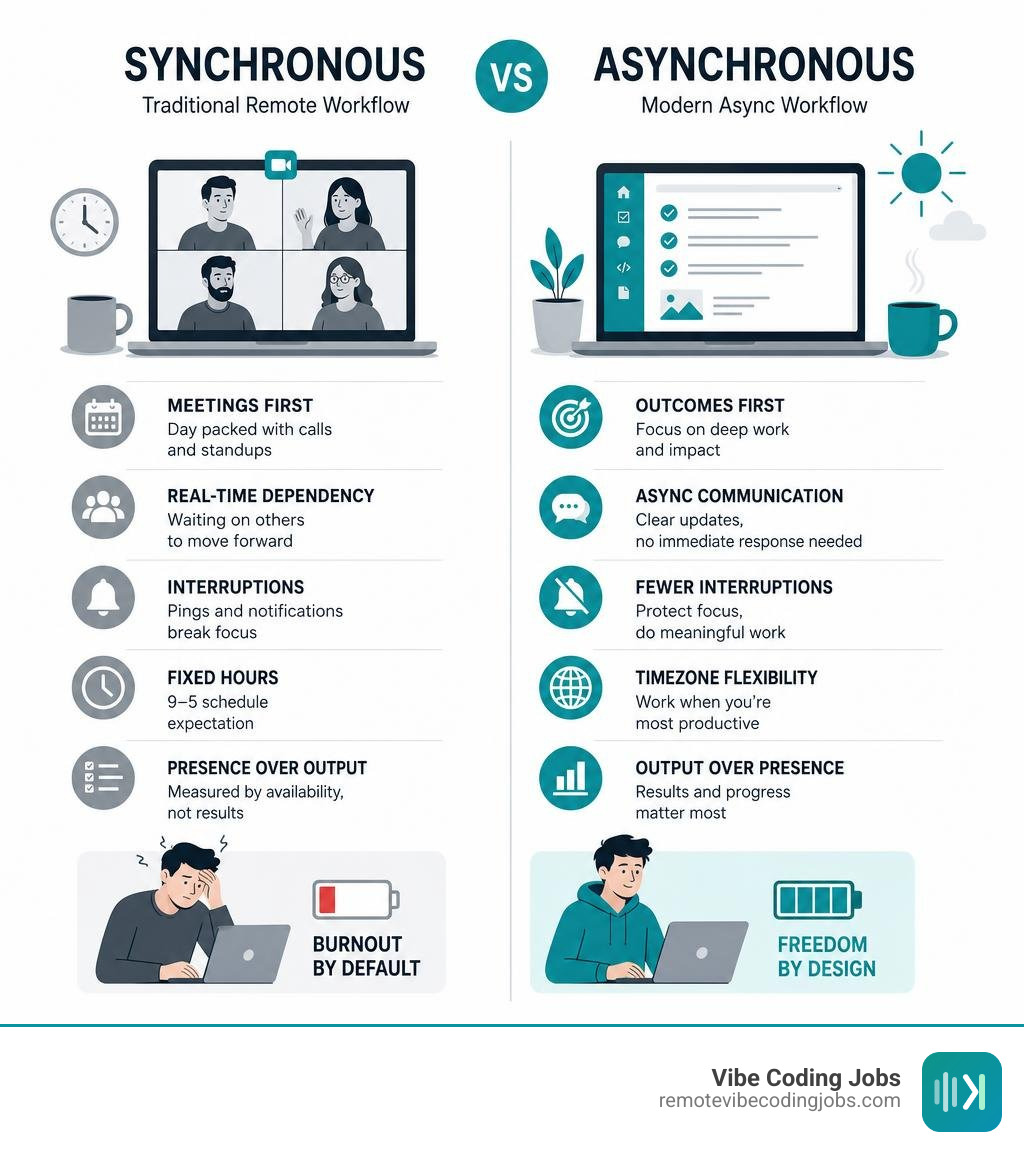
When we talk about true asynchronous development, we are not just talking about working from home in your sweatpants while keeping Slack open on green. Traditional remote work often transposes the physical office directly onto the internet: morning video standups, constant instant messages expecting instant replies, and endless call invites that shatter your afternoon into 30-minute fragments.
In contrast, an authentic meeting-free culture prioritizes deep work and results-oriented output over physical or digital presence. Teams operating this way rely heavily on written documentation, explicit project tickets, and clear acceptance criteria. Rather than calling a quick meeting to resolve ambiguity, engineers write down thought processes, architecture proposals, and code decisions asynchronously.
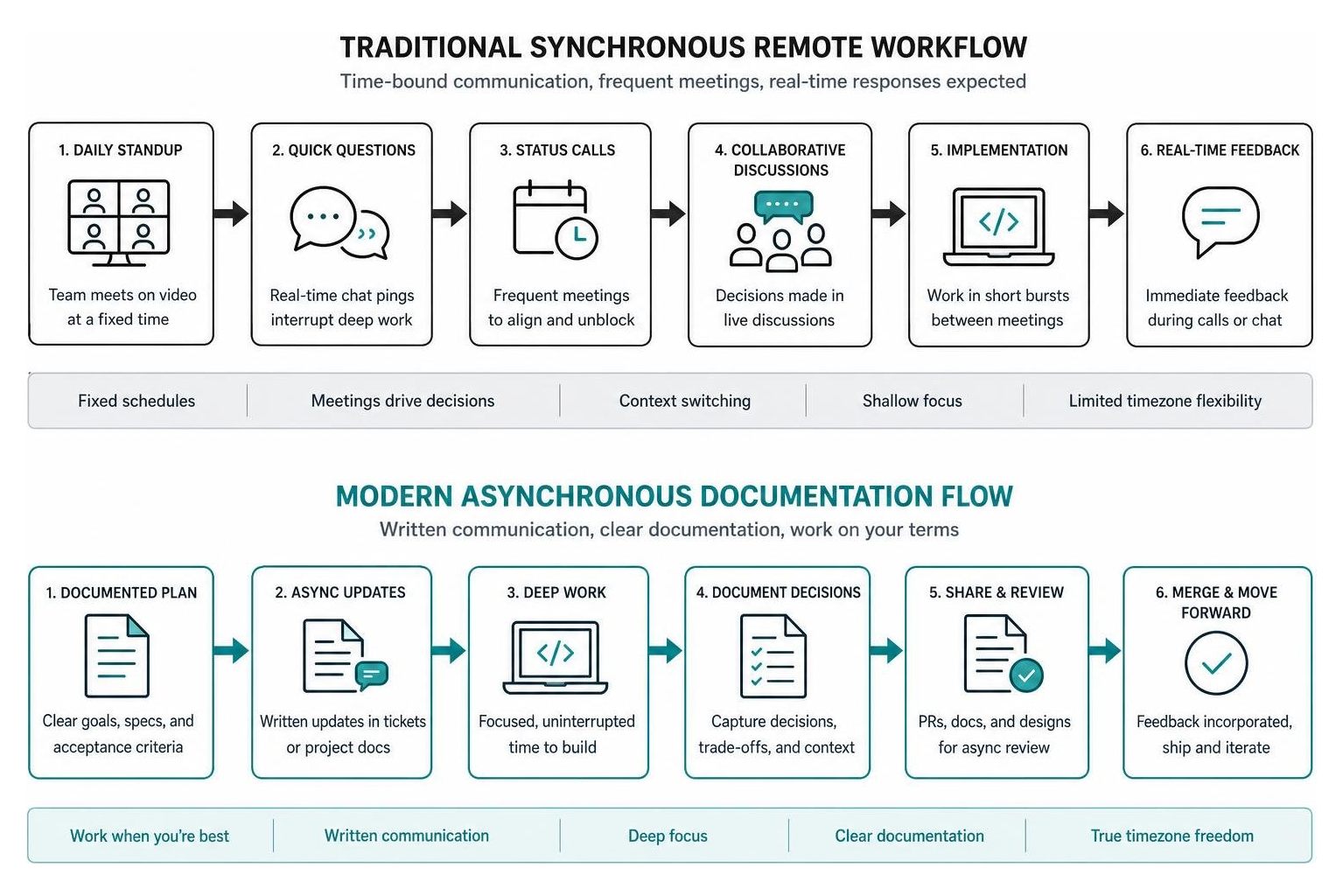
This structure unlocks true timezone freedom and schedule autonomy. Whether you perform your best engineering at 6:00 AM in Warsaw or midnight in Tokyo, your productivity is evaluated by the code you merge and the features you ship—not by how many hours you sat on a video bridge. To explore companies cultivating this exact dynamic, check out our breakdown of Async-First Remote Developer Jobs: Flexible Culture.
Tech Stacks Featured in Async Remote Dev Listings

When reviewing modern async remote dev listings, clear patterns emerge regarding preferred technical stacks. Companies structuring work around non-real-time collaboration favor languages and frameworks built for high concurrency, event-driven integration, and rapid feature iteration.
| Operational Area | Synchronous Meeting Pattern | Asynchronous Documentation Pattern |
|---|---|---|
| Architecture Planning | 2-hour synchronous Whiteboard call | Written Architecture Decision Record (ADR) |
| Daily Progress | 30-minute video standup | Written daily update on ticket thread or Slack |
| Code Reviews | Live screen share pair programming | Detailed PR description with video walkthrough (Loom) |
| Feature Alignment | Real-time consensus meetings | Async proposal with explicit decision deadline |
Backend Architecture in Async Remote Dev Listings
On the backend, non-blocking asynchronous architectures dominate job requirements. Open positions frequently highlight languages and frameworks that handle high-concurrency throughput seamlessly:
- Python & Asyncio Frameworks: Tools like FastAPI and aiohttp are standard across real-time data streaming and AI pipelines. Positions for Python engineers specifically demand deep familiarity with Python asyncio concepts, message queue systems (Kafka, RabbitMQ, ZeroMQ), and non-blocking database connectors.
- Node.js & NestJS: High-volume API integration roles focus heavily on building decoupled webhook systems, implementing resilient retry mechanisms, ensuring API idempotency, and connecting enterprise ERP systems.
- PHP & Laravel Ecosystem: PHP remains a powerhouse in async-first SaaS environments. Roles rely on Laravel paired with Inertia.js, React, and Tailwind CSS to give single-developer owners full control over end-to-end product features without requiring full frontend teams.
Frontend and AI Integration in Async Remote Dev Listings
On the frontend and user application layer, modern async remote dev listings emphasize full-stack flexibility combined with modern AI tooling:
- React, TypeScript, and Vite: React and TypeScript continue to lead as the standard client side stack, typically backed by Tailwind CSS for fast component styling.
- AI-Assisted Workflows (“Vibe Coding”): Employers are actively prioritizing engineers who integrate AI assistants directly into their day-to-day coding setups. Positions for full-stack SaaS developers explicitly list proficiency with AI-assisted dev tools like Claude Code alongside Python/FastAPI and React.
- Rapid Prototyping Tools: Forward-thinking employers are listing tools like Cursor, Bolt, Lovable, and Replit directly in job requirements. Teams like Activus Capital Partners mandate an AI-first workflow to accelerate execution speed and bridge the gap between initial specs and live code deployments.
Compensation Models and Pay Rates for Async Developer Roles

Compensation structures in async remote dev listings vary significantly based on company stage, residency parameters, and engagement models. Async roles can range from hourly AI code evaluation contracts to fully transparent global corporate salary bands. For a broader analysis of how remote benefits stack up, review Async-First Remote Developer Jobs: Benefits.
AI Trainer Contracts and Hourly Freelance Rates
One of the fastest-growing segments of asynchronous remote work involves AI evaluation, RLHF (Reinforcement Learning from Human Feedback), and code benchmarking:
- AI Code Evaluation Contracts: Flexible contract roles for software engineer analysts and AI trainers commonly pay $50 to $100+ per hour. Developers often set their own hours, complete short coding assessments to qualify, and work when they are available.
- Specialist Expert Review Projects: Senior-level engineering review projects, including AI trainer and code quality evaluation work, can reach up to $150 per hour for part-time, project-based evaluation.
- Flexible AI Workflows: Many domain-specific AI contributor roles require zero minimum hours, offering $25 to $130 per hour depending on technical specialization, such as C++ engineering, LLM dataset validation, or backend architecture reviews.
Full-Time Salary Structures and Geographic Variations
For traditional employment and B2B contracts, compensation models reflect geographic residency requirements and technical seniority:
- All-Remote Tech Employers: Established async-first enterprises often provide transparent, region-adjusted salary bands. Senior technical, security, architecture, and operations-adjacent roles at mature remote companies can extend well into six-figure USD ranges, depending on level, location, and scope.
- European B2B Contracts: High-concurrency backend roles in Europe often use hourly or monthly B2B models. A Senior Python Async position in Poland typically pays between 160 to 200 PLN per hour (approx. 22,000 to 55,000 PLN per month), while European SaaS platforms hiring Senior Laravel Developers offer EUR2,000 to EUR3,000 per month for 100% remote, autonomous work.
- Nearshore & Offshore SaaS Listings: Early-stage SaaS startups hiring globally often offer baseline rates around $600 per month plus performance bonuses for junior-to-mid full-stack developers proficient with Claude Code. More structured full-time remote arrangements may include fixed core hours, hardware provisioning, medical insurance, and other Day-1 benefits.
How Async Teams Collaborate Without Daily Meetings
A common question developers ask is: If we don’t hold daily Zoom calls, how does work actually get done?
The answer lies in strict documentation standards and asynchronous collaboration systems. Rather than relying on synchronous alignment, async engineering teams execute work through well-defined tools and processes:
- PR-Driven Communication: Pull requests serve as the primary locus of technical discussion. Developers write comprehensive PR descriptions detailing what changed, why it changed, and how to test it.
- Video & Audio Walkthroughs: Tools like Loom replace screen-sharing meetings. An engineer walking through a complex bug fix records a 2-minute video explaining the solution, allowing teammates in opposite timezones to watch and respond when their workday starts.
- Structured Issue Tracking: Teams use Linear, Jira, or GitHub Issues with clear acceptance criteria. Daily standups are replaced by short, automated text check-ins in Slack or asynchronous thread updates.
- Self-Documenting Codebases: When documentation is mandatory, onboarding becomes seamless. New hires can read repository documentation, search past discussion threads, and start shipping code without scheduling onboarding calls.
To learn more about how distributed teams structure their messaging, check out our guide on Async Remote Developer Jobs: Flexible Communication.
Proven Strategies to Land Meeting-Free Engineering Roles
Finding and securing a role from async remote dev listings requires a slightly different approach than applying for standard corporate jobs. Because async managers cannot oversee your work hour-by-hour, they look for proof that you are self-directed, reliable, and an exceptional writer.
Here is how you can optimize your profile:
- Showcase Written Clarity: Your cover email, pull request samples, and documentation write-ups are evaluated just as heavily as your code. Write clean, concise, and well-structured messages.
- Highlight AI-Assisted Workflows: Demonstrate how you leverage AI coding assistants like Cursor, Claude Code, and Copilot to multiply your output velocity. Positions for applied AI engineers explicitly seek developers who build with AI tools natively in production.
- Provide Public Code Repositories: Async founders often bypass traditional 5-round interview loops in favor of reviewing real code. Link directly to GitHub repositories, live SaaS projects, or open-source contributions.
- Take Advantage of Assessment-Based Hiring: Many flexible platforms evaluate candidates via short, practical skills assessments rather than multi-stage live coding calls on Zoom.
If you are eager to skip corporate recruiter filters and apply directly to roles engineered for self-starters, explore our active board at Async-First Remote Developer Jobs.
Frequently Asked Questions About Async Developer Roles
How do I prove I can work effectively in an async environment?
The best way to demonstrate async competency is through tangible evidence of independent execution. Highlight past experience managing your own schedule, maintain a well-documented public GitHub account, and share blog posts or technical write-ups you have published. Emphasize your ability to unblock yourself using AI tools, official documentation, and clear written updates.
Are AI tools like Cursor and Claude Code required for async roles?
While not universally mandatory across every traditional enterprise, modern async remote dev listings increasingly treat AI tools as a core requirement. Roles in high-velocity startups—such as the full-stack engineering position at Activus Capital Partners or full-stack Python and React roles—explicitly mandate an AI-first workflow. Utilizing AI tools allows individual engineers to maintain high output without needing constant synchronous coordination.
Do async developer positions still require timezone overlap?
It depends on whether the position is fully async or partially async. Fully async roles (such as those described in the GitLab Remote Guide or offered on platform-based async contracts) require zero real-time timezone overlap. Partially async roles may ask for 2 to 4 hours of overlapping availability per day for urgent Slack communications, while allowing you to schedule the remaining hours whenever you choose.
Conclusion
Zoom fatigue is not an inevitable tax you must pay to work remotely in software engineering. By seeking out legitimate async remote dev listings, you can reclaim your calendar, eliminate meeting overhead, and focus entirely on what you do best: writing clean, high-impact code.
Whether you want to build high-throughput backend services using FastAPI and asyncio, ship full-stack SaaS tools with React and Laravel, or contribute flexibly to AI code evaluation at $50–$150/hr, async-first companies are hiring.
Ready to find your next meeting-free engineering role? Browse our curated index of Async-First Remote Developer Jobs: Companies & Roles, or head straight to our main platform to Find Remote Vibe Coding Jobs today!