Why a Curated Coding Job Daily List Is the Smartest Way to Job Hunt in 2026
Getting a curated coding job delivered daily is now one of the fastest ways to land a remote developer role — if you know where to look.
Here are the best resources for daily curated coding jobs in July 2026:
- Remote Vibe Coding Jobs — 1,700+ active remote roles, updated daily, filtered for async-first companies
- Daily Software Engineer Jobs (GitHub) — open repository updated every day with listings across stacks and company types
- Tech Community Newsletters — daily digests covering AI tools, frameworks, and dev news to keep your skills sharp
The software engineering job market in 2026 is noisy. Thousands of roles post every day across LinkedIn, Indeed, Glassdoor, and dozens of niche boards. Checking each one manually wastes hours — and you still miss the best opportunities. One analysis scanned over 3,000 job postings just to identify the top skills for entry-level roles. That’s the scale of signal buried in the noise.
The developers winning right now aren’t applying to the most jobs. They’re applying to the right ones, fast.
That means using curated lists that filter for your stack, experience level, and culture preferences — and checking them every single morning before the roles fill up.
I’m part of the RVCJ Editorial team at Remote Vibe Coding Jobs, where we track the curated coding job daily landscape across AI-assisted development, remote hiring trends, and async-first engineering culture. We’ve spent years helping developers cut through job board noise and land roles at companies that actually fit how they work.
Must-know curated coding job daily terms:
The Shift to AI-Assisted Development and Vibe Coding
The engineering landscape in July 2026 has undergone a fundamental transformation. We have officially moved past the era of simple chatbots into the age of Agentic Engineering. Today, elite developers aren’t spending hours typing out boilerplate code or chasing missing semicolons. Instead, they are practicing “vibe coding.”
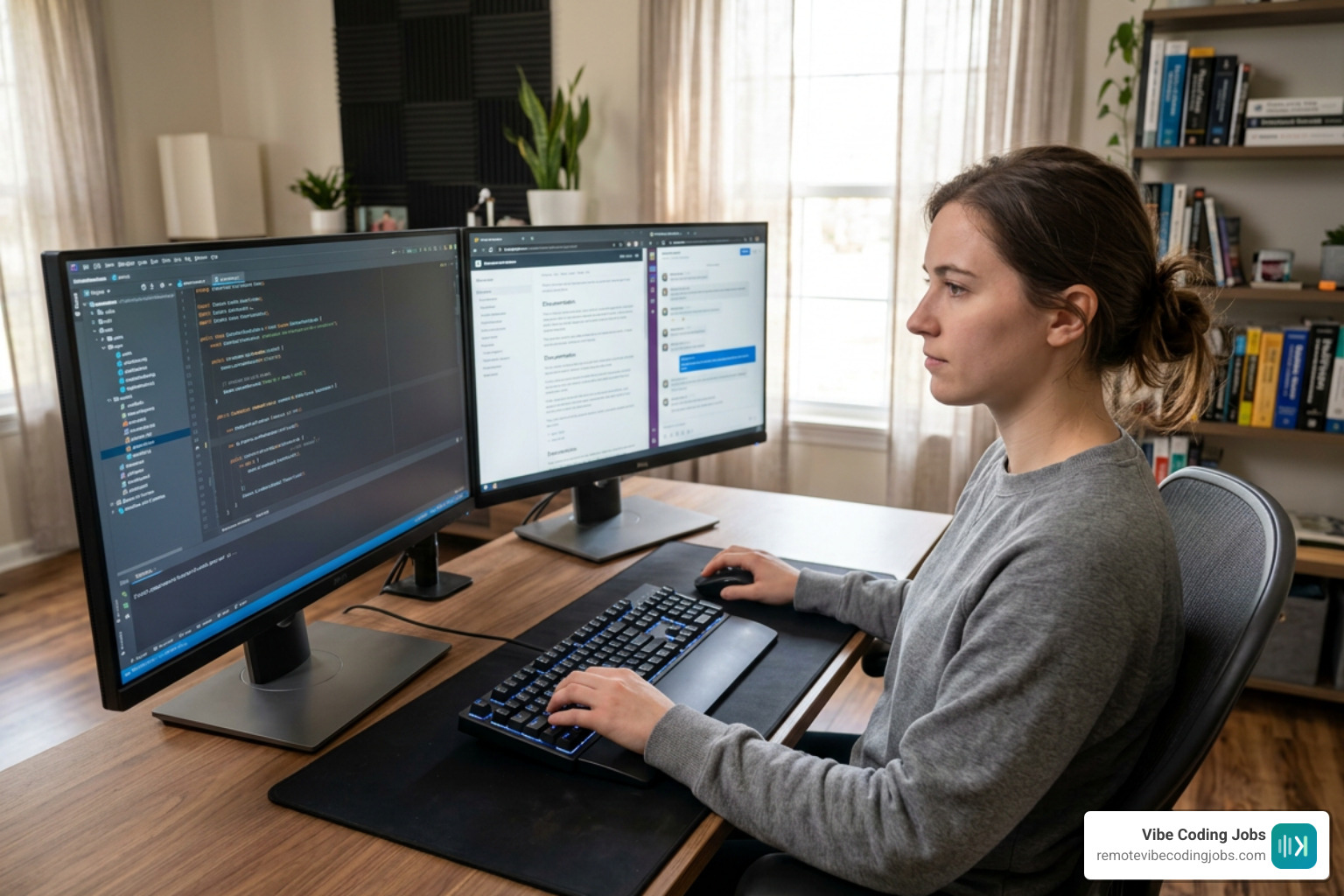
Vibe coding is a development approach where engineers use AI tools like Cursor, GitHub Copilot, Claude Code, and Windsurf to dramatically accelerate their workflow. Rather than writing every single line of code by hand, vibe coders describe what they want, guide AI agents through iterative feedback loops, and focus their energy on system architecture, product design, and quality control.
This shift has created a massive demand for developers who can orchestrate these intelligent systems. In fact, AI-assisted development is the fastest-growing skill in software engineering, with job postings requiring AI tool proficiency increasing by 300% year-over-year. GitHub Copilot now writes an average of 46% of the code in files where it is enabled, and advanced teams report productivity gains of 2x to 5x within the first month of fully integrating AI-native IDEs.
To support these workflows, tools have evolved rapidly. The Model Context Protocol (MCP) has become an industry standard, allowing coding agents to securely connect to databases, development environments, and internal business tools. Instead of building monolithic applications, engineers now design modular, composable skills that AI agents can execute.
For developers looking to navigate this new terrain, understanding the transition from traditional coding to agentic orchestration is critical. If you want to explore how these shifts are redefining software engineering career paths, check out our guide on Vibe Coding Remote Jobs: Career Path, Outlook & Tips to position yourself at the forefront of this movement.
Top Platforms and Niche Boards for Software Engineers
Finding a high-quality software engineering role today requires looking beyond the giant, noisy aggregators. While general job boards can occasionally yield results, specialized platforms and curated lists offer a much higher signal-to-noise ratio.

When we look at the landscape of job boards, we can categorize them into three main buckets:
- Niche AI & Vibe Coding Boards: Platforms like RemoteVibeCodingJobs focus exclusively on roles that embrace AI-assisted workflows and async-first company cultures. Here, you will find companies looking for “AI Pilots,” “Agentic Engineers,” and developers who know how to build with Cursor and Claude.
- Curated Repositories and Aggregators: Open-source directories, such as the
awesome-job-boardsGitHub repository (which boasts 70 stars, 18 forks, and contributions from 20 developers), provide structured, categorized links to job boards by programming language, remote status, and geographic region. - Big Tech & FAANG Trackers: Direct tracking tools scrape official big-tech career pages directly to bypass the typical delay seen on general aggregators.
To help you understand where to focus your daily search, we’ve broken down how general aggregators compare to curated niche boards:
| Feature | General Aggregators (LinkedIn, Indeed, ZipRecruiter) | Niche & Curated Boards (RemoteVibeCodingJobs) |
|---|---|---|
| Daily Curation Quality | Low (heavy algorithmic noise, sponsored posts, expired listings) | High (hand-vetted, fresh daily updates, precise filtering) |
| Focus on Modern Tooling | Rare (usually standard “5+ years React” requirements) | Standard (explicitly lists Cursor, Claude, Replit, and Copilot) |
| Culture Filtering | Basic (Remote vs. Hybrid vs. On-site) | Advanced (async-first, no-meetings, trust-based autonomy) |
| Duplicate Listings | High (same job posted across multiple boards) | Zero to Low (smart duplicate removal algorithms) |
| Application Speed | Slow (often routes through complex ATS portals) | Fast (direct-apply links to official career pages) |
While general platforms like LinkedIn still show thousands of listings—such as 728 Certified Professional Coder Cpc jobs in New York … or generic local listings like $27-$48/hr Coding Jobs New York City, NY (NOW HIRING) —these platforms are often flooded with outdated listings and duplicates. Even if you are looking at other fields of coding, such as medical coding, resources like Get Hired, Not Tired: Your Guide to Landing Medical Coding … emphasize that finding curated, direct sources is always superior to scrolling endlessly through generic platforms.
Why a Curated Coding Job Daily Digest Beats General Aggregators
The math behind the modern job search is brutal. Major job boards crawl and cross-post listings constantly, meaning up to 40% of the jobs you see on any given day are duplicates. A curated coding job daily digest solves this by using smart deduplication algorithms to clean up the noise.
Instead of spending hours clicking through identical listings across six different sites, a curated digest delivers a clean, unified dashboard of unique opportunities. This saves active job seekers an average of 5+ hours per week. More importantly, curated digests prioritize direct-apply links over third-party recruitment agency portals, ensuring your resume lands directly in the hands of the hiring team.
If you are looking to take your search global and target companies that respect your deep work time, check out our insights on how to Land Your Dream Job: Global-Friendly Remote Developer Jobs.
How to Leverage a Curated Coding Job Daily List to Fast-Track Your Career
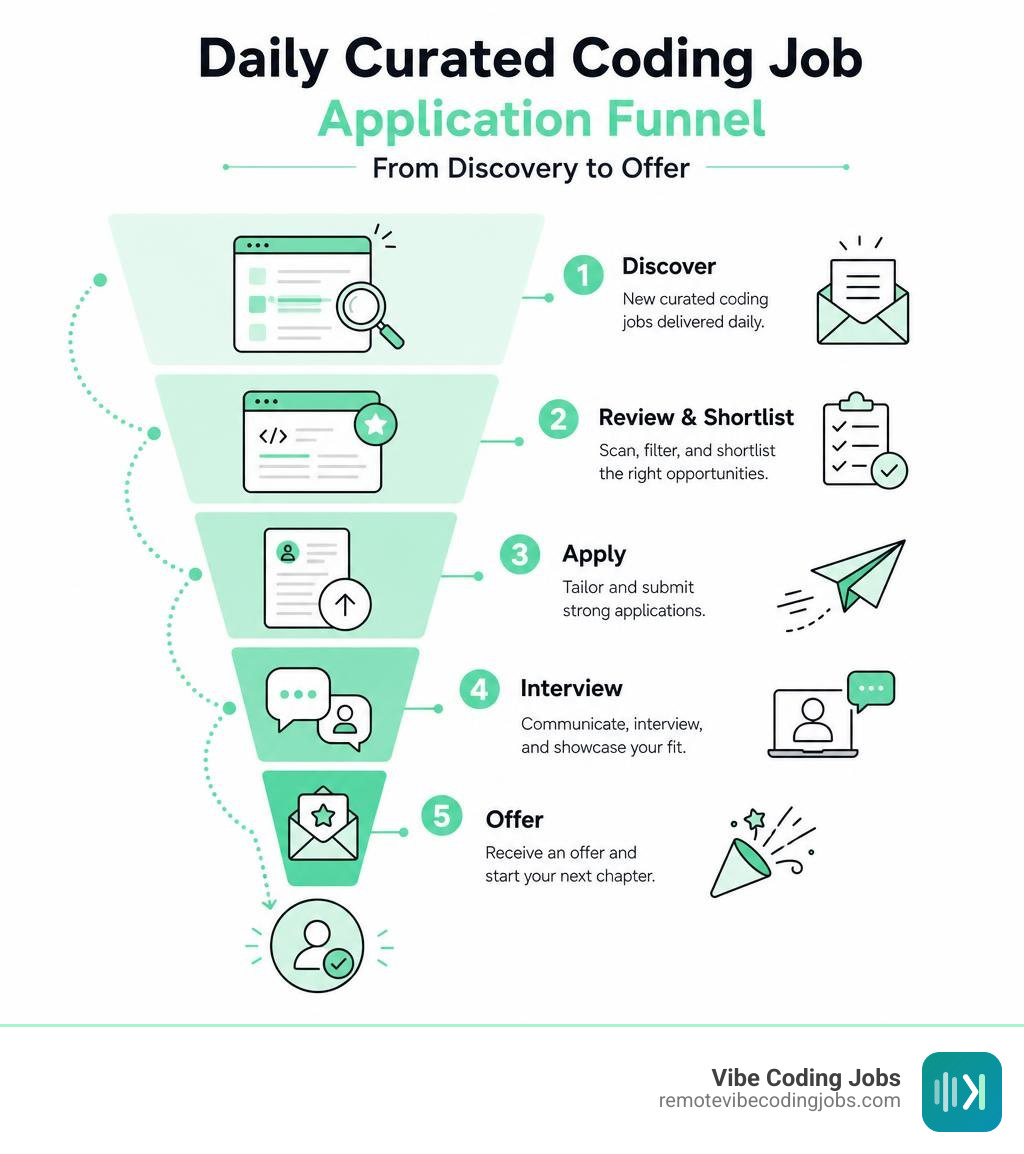
Using a curated list isn’t just about finding jobs; it’s about shifting your daily routine to maximize your chances of getting hired. When a hot remote role is posted, the first 24 to 48 hours are critical. If you apply within that initial window, your application is far more likely to be reviewed before the hiring manager is overwhelmed by hundreds of submissions.
Setting Up Your Curated Coding Job Daily Workflow
To make the most of daily curation, we recommend establishing a highly structured morning routine:
- Time Blocking: Dedicate the first 30 minutes of your workday strictly to scanning your curated feeds and email digests. Treat this as a non-negotiable standup meeting with yourself.
- Custom Filtering: Set up exact keyword filters based on your preferred technology stack (e.g., TypeScript, Python, Next.js) and the AI tools you use (e.g., Cursor, Claude).
- Direct Action: If a matching role appears, do not wait. Use your pre-prepared portfolio templates to submit a highly tailored application immediately.
To see which forward-thinking startups and tech companies are currently recruiting for these modern, AI-fluent roles, take a look at our live database of Who’s Hiring.
Essential Skills and Portfolio Strategies to Stand Out
In July 2026, a traditional PDF resume listing “skills” is no longer enough to get you noticed. Since AI tools can write basic code in seconds, companies are looking for proof that you can architect systems, solve complex product problems, and manage AI-driven workflows.
Here are the technical skills currently in highest demand:
- Core Languages & Frameworks: TypeScript, Python, React, and Next.js remain the dominant stack for rapid MVP development and AI platform integration.
- Prompt Engineering & AI Orchestration: The ability to write precise system prompts, configure LLM-as-a-judge evaluation pipelines, and design schemas for MCP servers.
- System Design Thinking: Understanding how to structure databases, manage state, and maintain secure, scalable cloud architectures.
While practicing with platforms like LeetCode (which features over 4,200 questions) remains useful for maintaining your logical problem-solving sharp, your primary focus should be on building a public portfolio of real, shipping products.

Open-source contributions that demonstrate your ability to collaborate asynchronously, write clean documentation, and review AI-generated code for security and performance will set you miles ahead of other applicants. For a complete breakdown of what modern hiring managers are looking for on your resume, read our guide on How to Get a Vibe Coding Job: Requirements & Qualifications.
Frequently Asked Questions about Tech Job Hunting
What is vibe coding and how does it affect developer salaries?
Vibe coding is an AI-assisted development methodology where engineers guide high-level architecture and product logic while AI tools handle the implementation details.
Because vibe coders are incredibly productive—often delivering features in days that used to take weeks—their market value is exceptionally high. Junior vibe coding roles typically start around $70,000 to $100,000, mid-level positions range from $100,000 to $150,000, and senior or staff roles routinely reach $150,000 to $250,000+. To see how these numbers break down across different experience levels, explore our detailed analysis of the Vibe Coding Salary Range: Average, Entry & Senior.
How do I stand out when applying to remote software engineering roles?
To stand out, you must show, not just tell. Present a portfolio of functional, AI-assisted builds with brief video walkthroughs explaining your architectural decisions.
Additionally, highlight your strong asynchronous communication skills. In an async-first work environment, your ability to write clear, concise documentation, design specs, and pull request descriptions is just as important as your technical execution.
Are companies still hiring entry-level developers in July 2026?
Yes, but the definition of “entry-level” has changed. Companies are less interested in junior developers who only know how to write basic syntax. Instead, they are actively hiring “AI-fluent” entry-level developers who can use tools like Cursor and Claude to rapidly prototype features, build MVPs, and ship functional code independently from day one.
Conclusion
The developer job market in July 2026 belongs to those who adapt. By combining traditional engineering fundamentals with cutting-edge AI-assisted workflows, you can unlock unparalleled productivity and position yourself for the most exciting roles in tech.
Stop wasting your valuable energy scrolling through generic, duplicate-ridden job boards. Let us do the heavy lifting for you. We curate the best remote, async-first, and AI-forward developer opportunities every single day.
Ready to find your next role and take your career to the next level? Find your next remote developer role today on RemoteVibeCodingJobs.