
Why Managing a Remote Async Coding Team Is Harder Than It Looks (And How to Get It Right)
A remote async coding team is one where engineers work independently across time zones, without needing to be online at the same time to move work forward. Here’s what that means in practice:
- No real-time standups required — work is handed off through documentation, tickets, and written updates
- Deep focus is protected — engineers aren’t interrupted by constant pings or mandatory meetings
- Decisions are written down — not made verbally and forgotten
- Anyone can pick up where someone else left off — because context travels with the work
This model sounds ideal. And in many ways, it is.
But managing it well? That’s a different story.
Most engineering teams default to Slack and video calls because that’s what they know. The problem is that real-time tools create a hidden tax: according to RescueTime data, Slack users average just five minutes between communication check-ins. That’s not deep work — that’s a constant interruption loop dressed up as collaboration.
Async-first companies like GitLab have figured this out. Their team handbook — if printed — would run over 2,000 pages. That’s not bureaucracy. That’s what it actually takes to replace live conversation with documentation that scales across 850+ people in different time zones.
The gap between “we work remotely” and “we work async-first” is where most engineering managers lose their minds.
This guide closes that gap.
I’m RVCJ Editorial, the team behind Remote Vibe Coding Jobs, where we cover AI-assisted development, async culture, and remote hiring for engineers building with tools like Cursor, Claude, and Copilot — including everything that goes into making a remote async coding team actually function at scale. Whether you’re managing two engineers across two continents or scaling a distributed team of fifty, the frameworks ahead are built for you.
Remote async coding team word list:
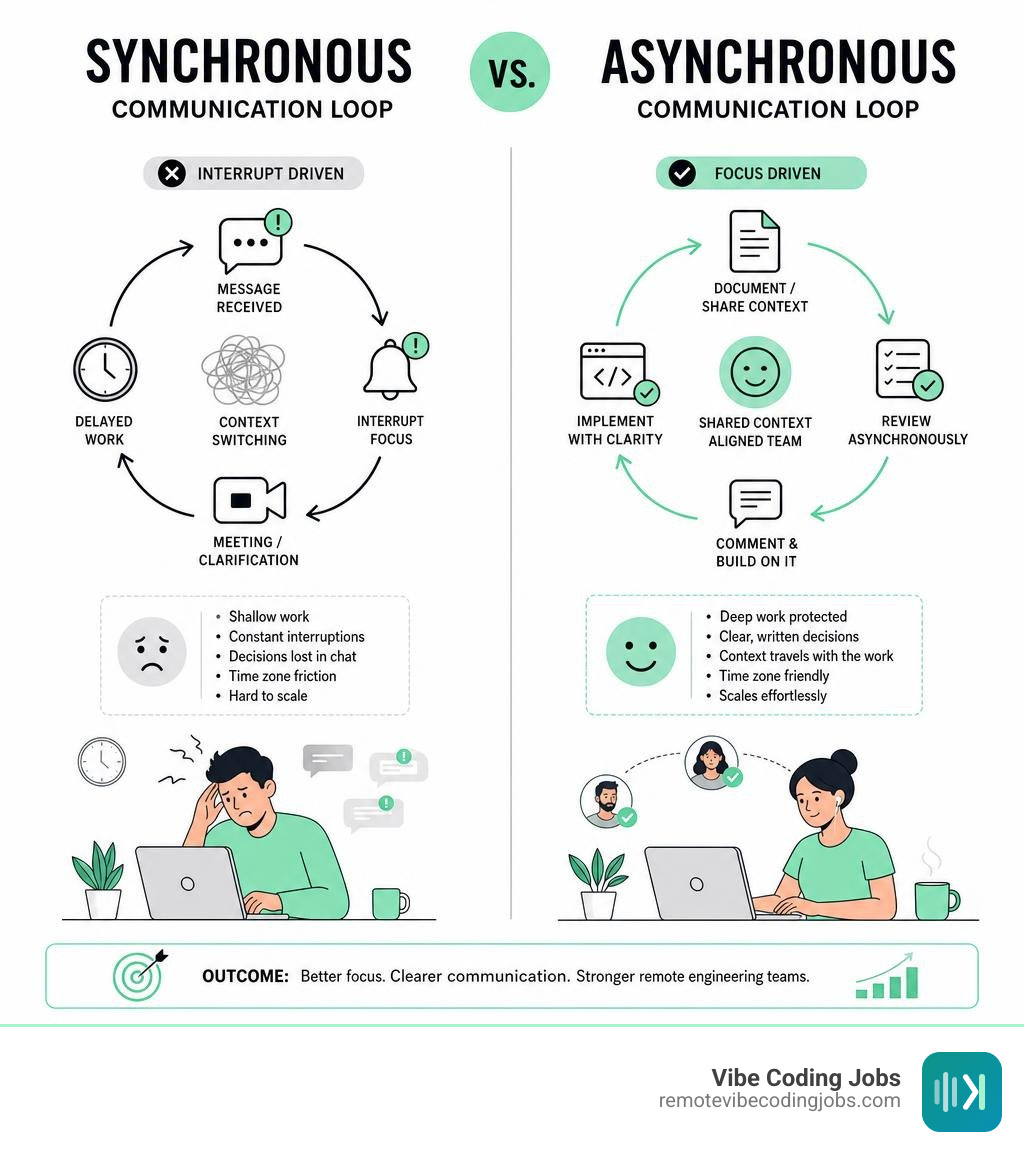
Synchronous vs. Asynchronous Workflows in Software Engineering
To scale a highly productive engineering organization, we have to address the fundamental friction between synchronous development and deep focused work. Traditional software development workflows were built around the physical office model. Even when teams moved to remote environments, they brought their office habits with them. This resulted in endless Zoom calls, daily standups that drain energy, and back-and-forth Slack threads that mimic physical shoulder-tapping.
Synchronous development relies on immediate feedback loops. While it feels fast in the moment, it actually destroys the cognitive momentum required to solve complex architectural problems. If an engineer is interrupted every half hour for a status update or a quick huddle, they never enter a state of flow.
Asynchronous development, on the other hand, operates on the assumption that team members do not need to be online at the same time to move a project forward. In an async-first world, status updates are written down, pull requests contain comprehensive context, and developers have the autonomy to choose when they communicate. This shift is crucial for long-term productivity and employee satisfaction, as discussed in our analysis of Remote Work vs Office Developers.
Defining the Core Mechanics of a Remote Async Coding Team
An asynchronous remote development workflow is built on three core pillars: autonomy, agency, and clear project ownership.
Instead of assigning micro-tasks that require constant check-ins, async managers assign complete ownership of programs or features. When a developer owns a program, they are responsible for its design, implementation, and documentation. They do not wait for a synchronous meeting to get feedback; instead, they write a detailed proposal, tag the relevant stakeholders, and allow them to review it on their own schedule.
Handoffs in a remote async coding team are clean and deliberate. When a developer finishes their portion of the work, they document the current state, outline the next steps, and transfer ownership to the next person. This continuous, documented transition allows projects to advance 24/7 across different time zones without requiring real-time handoff meetings.
As highlighted in the Asynchronous communication for remote work – The GitLab Handbook, this level of agency empowers developers to work when they are most productive, leading to better decision-making and higher-quality code.
The Cost of Constant Interruption: Slack Distraction vs. Deep Work
The modern developer’s biggest enemy is notification fatigue. When teams rely on real-time chat tools like Slack, they inadvertently build an “always-on” culture. Because response times are equated with productivity, developers keep their chat apps open on a second monitor, checking every notification immediately.
The data supports this concern. RescueTime research indicates that Slack users spend only five minutes between communication check-ins on average. This means cognitive focus is shattered hundreds of times a day. It takes an average of 23 minutes to refocus after a single distraction, meaning many developers in synchronous remote environments never experience true deep work.
To combat this, successful async managers implement a “boxed sync” approach. Instead of allowing notifications to stream in constantly, team members are encouraged to batch their communication checks to two or three times a day. When developers have the freedom to close their communication tools for four to five hours at a time, they can focus entirely on writing clean, robust code.
Transitioning away from instant-response expectations is the first step toward building a highly efficient engineering team, a concept we explore in depth in our guide on Async Remote Developer Jobs Flexible Communication.
Overcoming the Core Challenges of a Remote Async Coding Team

While the benefits of an async model are clear, transitioning to this way of working presents real challenges. When your team is spread across multiple continents, you cannot rely on physical proximity or shared working hours to keep everyone aligned. Managers must actively address three main friction points: navigating time zones, losing emotional context in written communication, and preventing information silos.
Mitigating Spec Drift and Production Fragility
One of the most common issues in async engineering is spec drift. Without daily meetings to clarify requirements, a developer might misinterpret a product specification and spend days building the wrong feature. This often leads to production fragility, where code is rushed to meet deadlines without proper architectural alignment, resulting in cost runaway.
To prevent these issues, async-first teams must establish rigorous upfront planning. Before a single line of code is written, the product and engineering leads must co-author an exhaustive specification document that outlines the goals, technical constraints, and edge cases.
For teams looking to build production-ready applications quickly without the overhead of managing a massive engineering team, working with an AI-native software studio can be a game-changer. For instance, Asyncdot: Production-Ready SaaS MVPs in Days. Fixed Price. helps teams launch high-quality, stable products by utilizing a disciplined, fixed-price delivery model that bypasses common MVP failures like spec drift and fragile architectures.
Solving the Time Zone Dilemma and Maintaining Emotional Context
In a truly timezone-agnostic team, you cannot expect a developer in Tokyo to wait for a live review from a developer in New York. To keep work flowing, you must establish clear communication policies.
First, implement a maximum 24-hour response SLA (Service Level Agreement) for all asynchronous communication. This ensures that no thread remains unanswered for more than one business day, preventing multi-day project blocks.
Second, embrace overcommunication. Because written text lacks vocal tone and facial expressions, it is easy for feedback to be misinterpreted as harsh or critical. Encourage developers to include video walkthroughs (using tools like Loom) alongside complex pull requests to explain their thought process and add human context.
Finally, always use explicit deadlines that include the specific date, time, and time zone (e.g., “Please review by Thursday, Oct 15th at 5:00 PM UTC”). This removes ambiguity and allows developers to plan their workdays autonomously, which is a core benefit of Async First Remote Developer Jobs Flexible Hours.
Structuring Communication, Documentation, and Tooling for Async Success
To make an async team work, you must replace real-time conversations with structured, searchable platforms. Relying on a standard chat workspace for all your communication inevitably leads to lost context and information silos.
| Synchronous Chat (e.g., Slack) | Asynchronous Thread-Based (e.g., Twist) |
|---|---|
| Encourages instant, short responses | Encourages thoughtful, long-form updates |
| Information is buried in fast-moving streams | Discussions are organized by clear topics |
| Creates constant distraction and FOMO | Protects deep work and focus time |
| Hard to search and reference later | Serves as a searchable knowledge base |
The Handbook-First Approach: Lessons from GitLab and Doist
The gold standard of async documentation is the “handbook-first” approach, pioneered by companies like GitLab and Doist. At GitLab, the company handbook would span over 2,000 pages if printed. It serves as the single source of truth for every process, policy, and technical decision. If a process isn’t in the handbook, it doesn’t exist.
Similarly, Doist found that traditional chat platforms were not scalable for their globally distributed team, leading them to build Twist—a thread-based communication tool designed specifically to support asynchronous collaboration.
By documenting every decision, async teams build an organizational memory that allows new hires to onboard quickly without needing constant hand-holding. This transparent, documented culture is incredibly powerful. For example, Ghost scaled to $7M ARR with a fully remote, open-source model, sharing their metrics openly and operating without a traditional sales team or constant synchronous meetings.
To learn more about setting up these systems, check out Building a collaborative asynchronous work environment, which provides practical frameworks for transitioning your team to a documentation-first culture.
Selecting the Best Stack for Your Remote Async Coding Team
An effective async tech stack must prioritize transparency, searchability, and structured handoffs.
- Asynchronous Communication: Move away from chat rooms and use thread-based tools like Twist or GitHub Discussions for long-form updates and decision-making.
- Project Management: Tools like Linear or Jira should be used to track task progress, with each ticket containing all necessary context, mockups, and technical requirements.
- Code Collaboration: GitHub or GitLab should serve as the central hub for code reviews, where developers leave detailed inline comments and automated checks run continuously.
Selecting the right tools is critical to preventing communication bottlenecks and ensuring your developers have everything they need to work independently, as detailed in our guide on the Best Async Communication Tools for Dev Teams in 2026. If you are looking to join or build a team that utilizes these cutting-edge platforms, you can find active listings on Vibe Coding Jobs.
The AI Revolution: Autonomous Agents and Multi-Agent Systems in Async Workflows
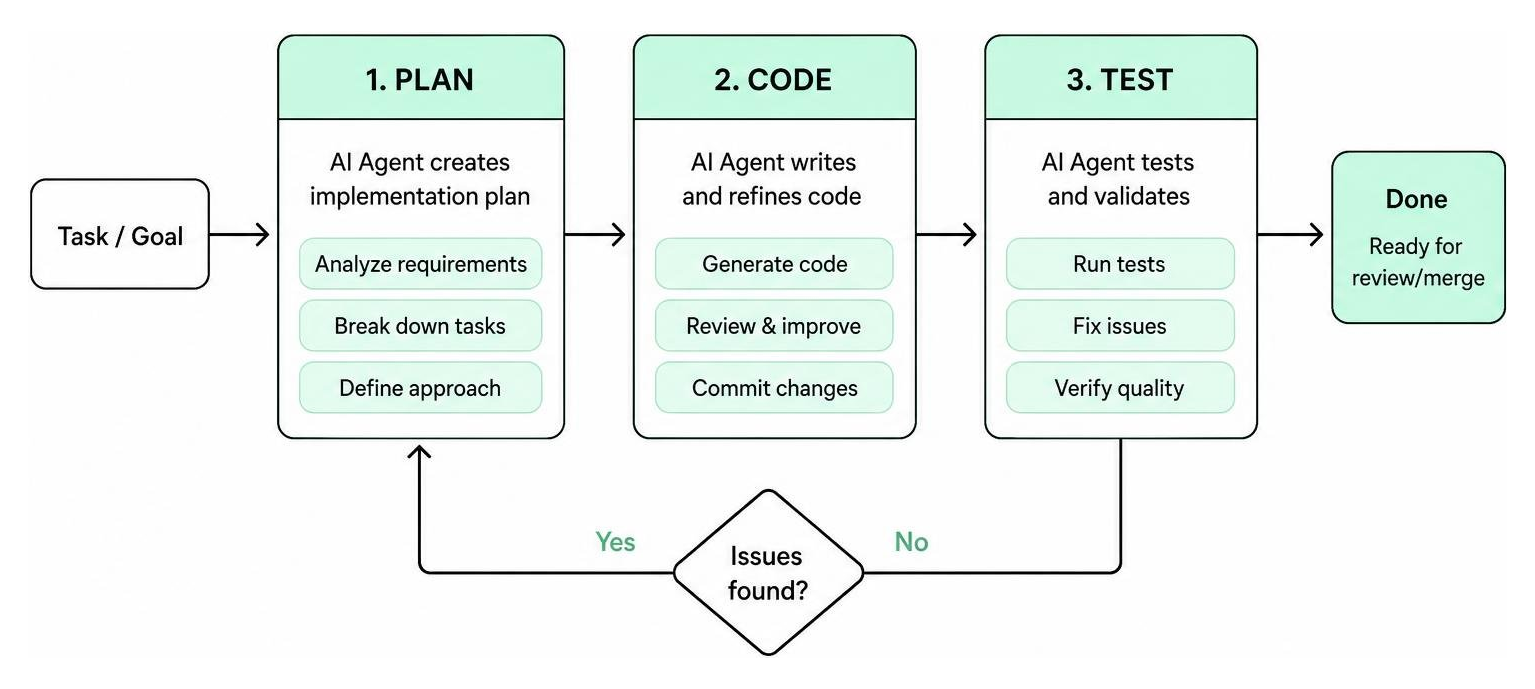
The rise of AI-powered autonomous agents and multi-agent systems is fundamentally changing how a remote async coding team operates. In 2026, AI is no longer just autocomplete for code; it has evolved into a collaborative partner that can plan, execute, test, and self-heal codebases asynchronously. This shift allows human developers to focus on high-level architecture and system design while AI agents handle repetitive, implementation-heavy tasks.
Coordinating AI Coding Agents Without Code Collisions
When you have multiple AI coding agents working on the same codebase simultaneously, coordination becomes a major challenge. If two agents attempt to modify the same file at the same time, they will inevitably create merge conflicts, turning your senior developers into full-time conflict referees.
This is where specialized coordination layers come in. Asynkor — Real-time coordination for AI coding agents solves this problem by introducing atomic file leases and cross-machine snapshots.
By using a Model Context Protocol (MCP) server, Asynkor allows AI agents to communicate and coordinate their work. When an agent wants to edit a file, it acquires an atomic lock in Redis. Other agents see this lease and either wait or pick up different tasks.
Furthermore, as explained in How it works — Asynkor, when an agent completes its task, it uploads content-addressed snapshots and progress notes, allowing the next agent to inherit the exact context and continue the work without needing a manual git pull.
Autonomous Multi-Agent Teams: From Planning to Production
Beyond simple file coordination, we are now seeing the emergence of complete, autonomous multi-agent development teams. These systems run specialized agents in parallel to manage the entire software development lifecycle.
For example, a typical multi-agent architecture includes:
- Planner Agent: Analyzes the issue ticket and drafts a step-by-step implementation plan.
- Coder Agent: Writes the actual code based on the approved plan.
- QA Reviewer Agent: Evaluates the code for quality, performance, and security.
- QA Fixer Agent: Automatically resolves any test, build, or lint failures identified during review.
Platforms like SiftCoder – Your AI Development Team | Autonomous Multi-Agent Coding leverage this multi-agent architecture to run self-healing loops, taking features from raw specifications to production-ready code in minutes.
Similarly, services like EliteCodersAI – Hire an AI developer that never sleeps and WeftCode – Your Complete AI Developer Team allow companies to scale their engineering capacity by integrating autonomous AI teammates directly into their existing Slack, GitHub, and Jira workflows.
These AI tools are rapidly transforming the job market, creating a high demand for developers who know how to guide and collaborate with agentic systems, as discussed in Remote Developer Jobs AI Tools.
Measuring the Tangible Benefits of Async-First Engineering
Adopting an async-first model is not just about convenience; it delivers measurable improvements across every key engineering metric.
First, productivity spikes. By eliminating constant interruptions, developers can spend large, uninterrupted blocks of time in deep focus. This leads to cleaner code, fewer bugs, and faster feature delivery.
Second, it dramatically improves work-life balance and retention. When developers have the autonomy to design their own schedules, burnout rates plummet. They can balance their professional responsibilities with personal commitments, leading to happier, more engaged teams.
Third, it unlocks global hiring diversity. When you remove timezone constraints, your talent pool expands to the entire world. You are no longer limited to hiring developers within a specific geographic radius or timezone corridor.
Finally, while async teams do most of their work independently, they maintain cohesion through periodic synchronous connection. Companies like Buffer and Help Scout have found that investing in regular company retreats creates a measurable spike in trust, productivity, and communication clarity when teams return to their async routines.
To explore how top companies structure these roles, read our guide on Async First Remote Developer Jobs Companies Roles.
Frequently Asked Questions about Async Engineering Teams
How do async teams handle urgent production incidents?
While async teams default to written, delayed communication, they maintain strict emergency protocols for critical production incidents. When a high-severity bug or outage occurs, the team falls back to synchronous communication channels.
Typically, teams use dedicated incident response tools or secure messaging apps like Telegram to coordinate in real time. Once the incident is resolved, the team conducts an asynchronous post-mortem, documenting the root cause, timeline, and preventative steps in the shared handbook so the entire organization can learn from the event.
How do you maintain team connection and culture without daily meetings?
Maintaining a strong team culture without face-to-face meetings requires intentionality. Async-first companies replace physical watercoolers with dedicated social spaces, such as casual chat channels for sharing hobbies, pet photos, and music recommendations.
Additionally, physical connection is maintained through regular company retreats. Distributed companies like Buffer spend significant resources on periodic team gatherings to build deep personal relationships, which sustain trust and collaboration during months of asynchronous work.
What skills should managers look for when hiring async developers?
Hiring for an async team requires looking beyond pure technical ability. Managers must evaluate candidates for:
- Exceptional Written Communication: Since most collaboration happens via text, developers must be able to explain complex technical concepts clearly and concisely.
- Program Ownership: Look for self-motivated individuals who can take a vague problem, research solutions, and drive it to completion without daily supervision.
- AI Tool Literacy: With the rise of vibe coding, developers who can effectively leverage AI assistants like Cursor and Claude will deliver significantly higher output, as detailed in our breakdown of Remote Developer Skills in Demand 2026 Future Proof Your Career.
If you are looking to hire or find a role at an organization that values these skills, browse our curated directory of Async First Companies Hiring Developers Find Your Dream Remote Job.
Conclusion
The future of software engineering belongs to the remote async coding team. As AI-powered autonomous agents, self-healing workflows, and collaborative multi-agent systems continue to mature, the traditional, meeting-heavy development cycle will become obsolete. Managers who embrace documentation-first cultures, clear program ownership, and modern coordination tools will scale highly efficient, creative, and resilient engineering teams.
At Vibe Coding Jobs, we are dedicated to helping developers and managers navigate this exciting transition. Whether you are looking to hire elite async talent or find your next flexible, AI-forward engineering role, we curate the best opportunities in the industry to help you build the future of tech on your own terms.