
Why Finding Free Places to Post Software Developer Jobs Is Harder Than It Looks
Knowing where to post software developer job for free can save your company hundreds, sometimes thousands, of dollars per hire. The best place to start is not a single board, but a mix of free channels that reach developers at different stages of the job search.
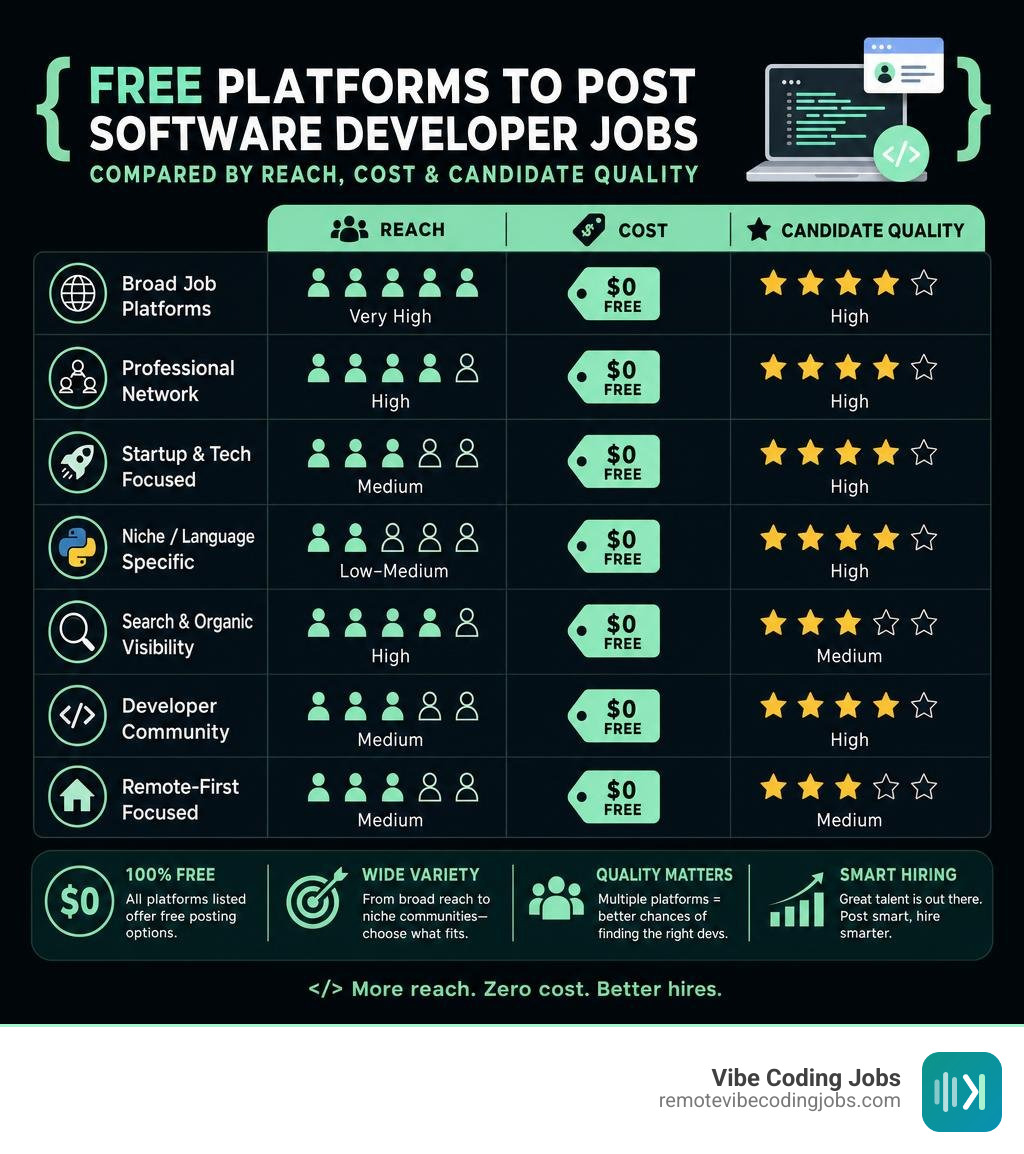
Best Free Channels to Post Software Developer Jobs:
| Channel | Free Posting Method | Best For |
|---|---|---|
| Your own careers page | Publish roles directly on your site | Brand control, direct applications |
| Search-engine job results | Use structured job posting data | Organic visibility, long-tail searches |
| Broad job search engines | Use available free employer posting options | Broad reach, fast applicant volume |
| Professional networking communities | Share roles through company profiles and relevant groups | Passive candidates, referrals |
| Startup and maker communities | Publish roles where early-stage talent already looks | Startup-minded engineers |
| Language-specific communities | Post in ecosystem job forums where allowed | Python, JavaScript, Go, Rust, and other specialized roles |
| Open-source communities | Share opportunities with contributor networks | Engineers with public technical proof |
| Remote-first communities | Promote async and distributed roles | Remote developers and global teams |
Hiring for software developers is only getting more competitive. Roles like web developers, full-stack engineers, and front-end developers are projected to grow 25% from 2022 to 2032, far faster than most other occupations, according to the U.S. Bureau of Labor Statistics. Yet many companies are still burning budget on paid promotion before exhausting the free options that can work just as well.
The real challenge isn’t that free platforms don’t exist. There are plenty. The challenge is knowing which ones actually reach qualified developers and which ones just generate noise.
And the stakes are real. Many paid recruiting channels charge hundreds of dollars for a single 30-day job post. For early-stage teams or companies hiring on a tight budget, that adds up fast.
The good news: free options have improved significantly. General search visibility, professional communities, language-specific forums, and remote-first networks can compete directly with paid channels for developer talent when you know how to use them right.
I’m part of the RVCJ Editorial team at Remote Vibe Coding Jobs, where we cover developer hiring, AI-assisted workflows, and remote recruiting strategies, including exactly where to post software developer job for free without sacrificing candidate quality. Our team has analyzed dozens of job posting workflows and hiring channels to help companies reach the right engineers faster.
Discover more about where to post software developer job for free:
Where to Post Software Developer Job for Free: Top Platforms

When we look at the landscape of free job posting options, they generally fall into three main categories: global search channels, professional networking spaces, and search-engine aggregators. Understanding how these channels operate helps us leverage them without spending a single dollar.
1. Your Own Careers Page
Your company website should be the source of truth for every developer role you are hiring for. Even if you later share the job elsewhere, the original posting should live on a dedicated, indexable careers page.
- The Free Tier: Publishing on your own site is free once your careers page exists. You control the job description, employer brand, application flow, and analytics.
- The Catch: A careers page will not perform well by itself unless it is optimized for search engines, kept up to date, and supported by structured job posting data.
2. Broad Job Search Engines
Large job search engines are useful when you need reach quickly. They are especially helpful for common roles such as full-stack developer, front-end developer, back-end developer, QA engineer, and DevOps engineer.
- The Free Tier: Many broad search channels offer free or organic posting options, although availability, limits, and visibility can vary by country and employer account.
- The Catch: Broad reach can create a high-volume screening problem. If your requirements are vague, you may receive many applications from candidates who do not match your stack, seniority level, or remote-work expectations.
3. Professional Networking Communities
Developers often maintain professional profiles, follow company updates, and discover roles through people they already trust. This makes professional networking communities valuable for referral-driven and passive-candidate hiring.
- The Free Tier: You can usually share roles through your company profile, founder posts, employee advocacy, relevant groups, and direct community engagement.
- The Catch: Organic reach depends heavily on the strength of your network. A job post with no context, salary range, or team story is easy to ignore.
4. Search-Engine Job Results
Search engines do not need to host your job directly to help candidates find it. If your careers page is properly formatted, your job can appear in job-specific search results when developers search for queries like “remote React developer jobs” or “Python backend engineer async team.”
- The Free Tier: This is 100% organic. Use valid job posting structured data so search engines can understand the role, location, salary range, employment type, and application URL.
- The Catch: It requires technical setup. Your page needs clean structured data, accurate expiration dates, and a crawlable application path.
5. Specialized Open-Source and Language Communities
Many programming language and open-source communities maintain job forums, newsletter submission forms, or community boards to keep their ecosystems healthy.
- The Free Tier: Some ecosystem communities allow free job submissions, especially when the role is highly relevant to that technology and follows community rules.
- The Catch: These communities are not for generic spam. Your posting needs to be specific, transparent, and respectful of the audience. A strong listing should clearly state the tech stack, compensation range, remote policy, and why the work is technically interesting.
Niche vs. Remote-First: Choosing the Right Free Platform

Choosing where to post software developer job for free requires balancing general platforms against specialized, niche, or remote-first communities. A broad-net approach might bring in 500 resumes in 48 hours, but how many of those candidates actually know the difference between Java and JavaScript?
Niche and remote-first channels yield fewer applicants, but the alignment with your tech stack and work culture is usually night and day.
Why Niche Boards Win for Sourcing Engineers
Niche platforms are built specifically with developer preferences in mind. Engineers appreciate these channels because they prioritize developer-friendly features:
- Tech Stack Filtering: Developer-focused communities often allow candidates to filter specifically by programming languages, frameworks, and database tools. This means your post for a “Go / Kubernetes Engineer” won’t be cluttered with applications from front-end designers.
- Salary Transparency: Niche communities often require or strongly encourage salary ranges. While some employers hesitate to publish salaries, doing so is highly respected by top-tier engineers. Transparent listings consistently attract higher-quality, active candidates who know their worth.
- Passive Sourcing: Top developers rarely browse only general job boards. They hang out in specialized communities, technical forums, open-source projects, and developer networks. Sourcing from niche communities helps you capture these passive candidates who are highly selective about their next career move.
Where to Post Software Developer Job for Free for Social Impact
If your business is a nonprofit, a civic tech organization, or a mission-driven startup, you can access specialized free communities. Developers are increasingly looking for meaningful work that aligns with their personal values, whether that is fighting climate change, improving healthcare, expanding education, or strengthening public-interest technology.
For social impact hiring, look for mission-aligned communities, open-source civic tech groups, nonprofit technology networks, university volunteer engineering groups, and local civic innovation forums. These spaces help you bypass the noise of commercial job boards and speak directly to engineers who care about your mission.
Where to Post Software Developer Job for Free for Remote Teams
Managing a remote or async-first team means your candidate pool is global, or at least spans multiple time zones. Standard, location-based posting is often inefficient for this. You need channels that understand remote work culture, async communication, and timezone boundaries.
For remote-first hiring, start with your own optimized careers page, then distribute the role through remote-friendly communities, engineering newsletters, open-source groups, and professional networks where async work is already understood. The job description should clearly state timezone expectations, collaboration tools, meeting load, salary range, and whether the role is remote globally or limited to specific regions.
How to Maximize Visibility and ROI on Free Job Postings
To make your free job postings perform as well as, or better than, paid ads, you have to optimize them for organic search algorithms and developer behavior. Here is our step-by-step playbook to maximize your visibility:
- Write Clear, Standardized Job Titles: Avoid internal jargon or creative titles. Nobody searches for “Full-Stack Wizard” or “React Superhero.” Instead, use “Senior Full-Stack Developer (React & Node.js).” This ensures search engines and job discovery tools can match your post with active developer queries.
- Lead with Salary and Benefits: Listings with transparent salary ranges often attract stronger engagement because they build trust immediately. Highlighting your tech stack, flexible hours, and async-first culture upfront keeps qualified candidates on your page longer and reduces low-fit applications.
- Include Screening Questions: Free postings can sometimes attract a high volume of unqualified resumes. Use screening questions such as “How many years of professional experience do you have with TypeScript?” or “Have you shipped production features in a remote async team?” to filter out bulk applicants automatically.
- Direct Candidates to Targeted Landing Pages: Instead of a generic contact form, direct applicants to dedicated pipelines. For instance, if you are looking to scale your engineering team, guide them to specialized pages like our resources to Hire Frontend Developer or Hire Backend Developer. This ensures a seamless applicant experience and higher conversion rates.
Frequently Asked Questions about Free Tech Job Postings
Are there completely free job boards with no hidden fees?
Yes, but it is better to think in terms of free channels rather than relying on one single board. Completely free options can include:
- Your own careers page: Free to publish and fully controlled by your team.
- Search-engine indexing: Free organic visibility when your job pages use valid structured data.
- Language and open-source communities: Many ecosystems allow relevant job posts when they follow community guidelines.
- Founder, employee, and community networks: Sharing roles through trusted technical communities can generate high-quality referrals without paid promotion.
The main limitation is visibility. Free posts often require stronger job descriptions, better SEO, and more manual distribution than paid campaigns.
How do I get my free job posting indexed on Google for Jobs?
Google for Jobs is one of the most powerful organic traffic sources for recruitment. To get your jobs indexed:
- Use Schema Markup: Ensure your website’s careers page uses the official
JobPostingstructured data format. Google’s documentation explains the required and recommended fields for job posting structured data. - Keep Content Fresh: Google prioritizes active, updated listings and may ignore dead links, expired jobs, or outdated pages.
- Publish Direct Application URLs: Make sure each role has a unique, crawlable URL and a clear application path.
- Remove Expired Roles: When a job closes, update or remove the posting so candidates do not land on stale pages.
Is it better to use a free ATS to broadcast developer jobs?
Often, yes. Manually posting to multiple free channels is a massive time sink. A free applicant tracking system can help you write your job description once, keep applications organized, and maintain a cleaner candidate pipeline.
Before choosing an ATS, confirm that it supports structured job posting data, direct application links, screening questions, candidate status tracking, and exportable applicant records. The goal is not just to broadcast the role, but to reduce the manual work of screening, follow-up, and interview coordination.
Conclusion
Finding where to post software developer job for free doesn’t mean you have to settle for low-quality candidates. By strategically combining high-reach general search engines with targeted niche communities, structured job posting data for search-engine indexing, and free multi-board broadcasting tools, you can build a highly efficient, zero-cost developer pipeline.
As software development continues to evolve in 2026, the way we build software is shifting. Traditional coding is rapidly merging with AI-assisted workflows. Today’s most productive engineers are “vibe coders” — developers who leverage advanced AI tools like Cursor, Claude, and GitHub Copilot to build and ship applications at 5x the speed of traditional development.
At RemoteVibeCodingJobs, we specialize in this exact intersection. We aggregate the best remote vibe coding and AI-assisted developer jobs at progressive, async-first companies. If you are looking to hire forward-thinking, highly productive developers who master modern AI engineering tools, we are here to help.
Ready to scale your engineering team? Explore our platform For Employers or go ahead and Post a Job with us today!