
Stop Ghosting Talent with a Better Web Developer Job Posting
Why Most Web Developer Job Postings Lose Great Candidates Before They Even Apply
A poorly written web developer job posting is one of the fastest ways to waste your hiring budget in 2026. With over 11,000 web developer roles currently listed in the US alone, candidates have options – and they scan fast.
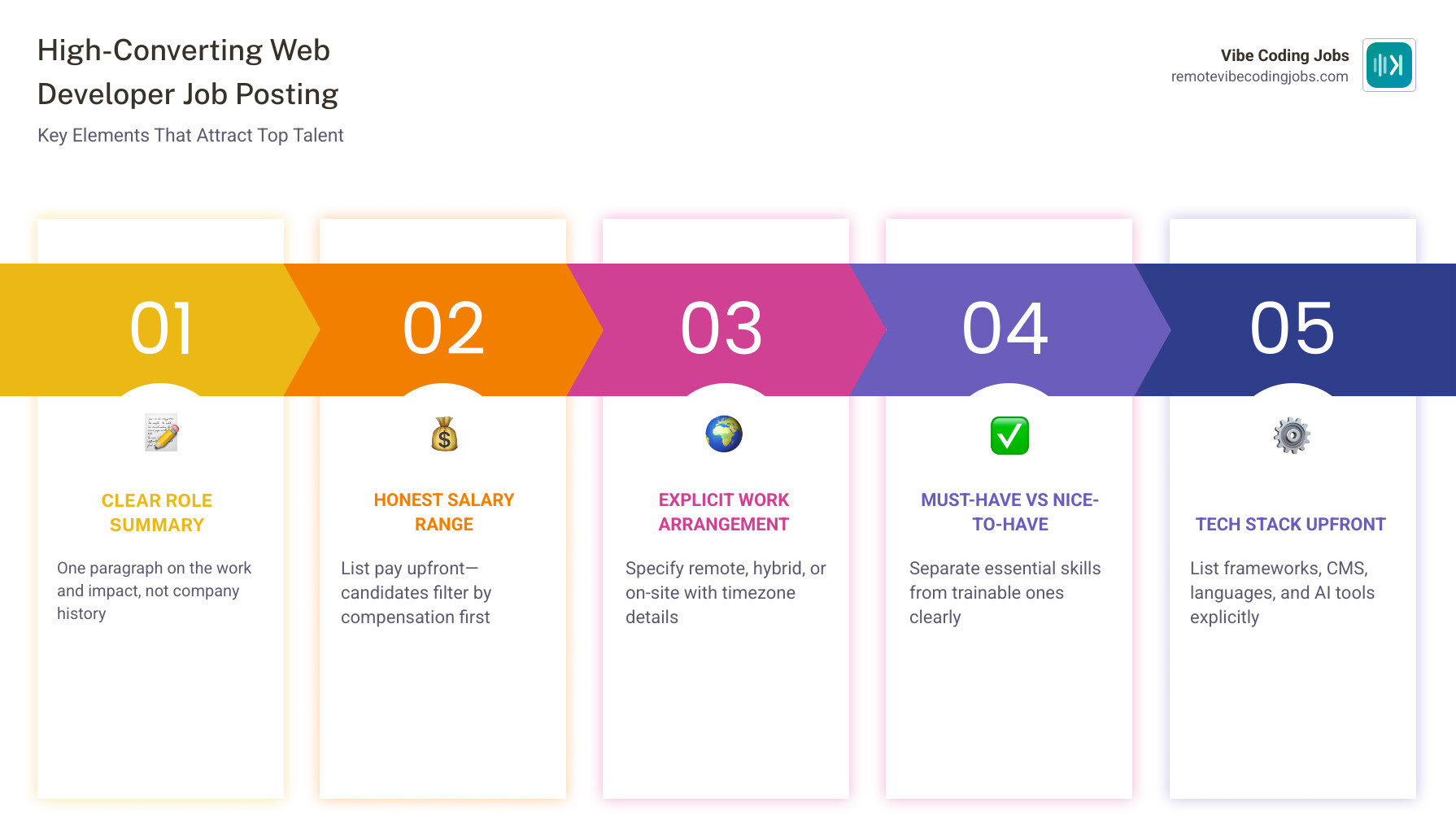
What makes a high-converting web developer job posting?
- Clear role summary – one paragraph explaining the work, not the company history
- Honest salary range – candidates filter by pay first; hiding it costs you applicants
- Explicit work arrangement – remote, hybrid, or on-site with timezone expectations
- Must-have vs. nice-to-have skills – separated, not buried in a wall of bullets
- Tech stack listed upfront – frameworks, CMS, AI tools, and languages
- Application steps – exactly what to submit and when to expect a response
- Success metrics – what does “doing the job well” actually look like?
Here’s the hard truth: the market has shifted. Developers are getting faster at spotting vague, unrealistic, or copy-pasted job descriptions – and they move on in seconds.
The job board data backs this up. Roles with salary transparency, clear remote policies, and specific skill requirements consistently outperform generic postings. Meanwhile, descriptions that bury compensation, list 15 “required” skills, and describe every role as “innovative” blend into the noise.
At RVCJ Editorial, we track AI-assisted development hiring trends and have analyzed hundreds of real web developer job postings across agency, enterprise, and institutional employers. That experience shapes every recommendation in this guide.
Start With the Right Web Developer Job Posting Structure
A strong web developer job posting should feel easy to scan in under 60 seconds. If candidates need detective skills just to figure out compensation, stack, or work policy, we have already lost some of them.
Use this order:
- Role summary
- What the developer will own
- Responsibilities
- Must-have requirements
- Nice-to-have qualifications
- Salary band
- Benefits
- Work arrangement and location policy
- Hiring process
- Application instructions
This format works because it mirrors how candidates actually read. They want to know:
- What is the job?
- Why does it matter?
- Can I do it?
- What does it pay?
- What is the process?
Write a web developer job posting that sells the work, not just the stack
Many teams open with a shopping list of tools: React, TypeScript, Node, GraphQL, AWS, Docker, CI/CD, and approximately 47 other things no one human actually uses before lunch.
That is backward.
Lead with the outcomes. Explain what the person will improve, build, maintain, or launch. Good developers want to understand business impact, not just syntax.
Instead of this:
- Seeking web developer with JavaScript, PHP, React, WordPress, SEO, APIs, analytics, Git, and cloud experience
Write something closer to this:
- Build and improve high-traffic marketing and product web experiences
- Own performance, accessibility, and conversion improvements
- Collaborate with design, content, and marketing teams
- Maintain stable deployment workflows and reduce regressions
That shift matters because modern web roles often include more than page building. Depending on the employer, the work may include:
- User experience improvements
- SEO and structured data
- Analytics implementation
- CMS governance
- Platform maintenance
- Cross-functional collaboration
- Ownership of releases and quality
A senior role should sound like ownership. A junior role should sound like support plus growth. Both should sound real.
Separate day-one requirements from trainable skills in your web developer job posting
One of the biggest conversion killers is the bloated requirement list. If everything is required, nothing is believable.
We recommend splitting qualifications into two groups:
Must-have qualifications
- Skills required on day one
- Core tools the person will use weekly
- Experience level truly needed to do the work safely and independently
Nice-to-have qualifications
- Adjacent frameworks
- Industry experience
- Bonus tooling
- Skills the team can teach after hire
This is especially important when hiring across levels.
For junior or early-career roles, practical ability matters more than inflated credentials. A portfolio, GitHub profile, shipped projects, freelance work, or internship experience can be more useful than a long degree section. Research on AI-assisted roles also shows many employers are becoming more flexible about formal education when the candidate can demonstrate real output.
For senior roles, be clearer about scope:
- 2+ years often maps to execution with support
- 5+ years often maps to independent ownership
- 8+ years often maps to systems thinking, mentorship, and strategic delivery
- 10+ years can justify specialist or lead-level expectations
Include the details candidates screen for first
Here is what candidates usually look for before they read your responsibilities:
- Compensation
- Remote, hybrid, or on-site policy
- Timezone overlap requirements
- Employment type
- Seniority level
- Tech stack
- Interview stages
- Background check expectations
- Start date
Do not hide these below your company values and three paragraphs about being “innovative.” That word has been through enough.
Be specific:
- Remote within approved tax jurisdictions
- Hybrid with two in-office days per week
- On-site with occasional travel
- Full-time, contract, or fixed-term
- Four interview stages over two weeks
- Background check required after offer
- Target start date in July 2026
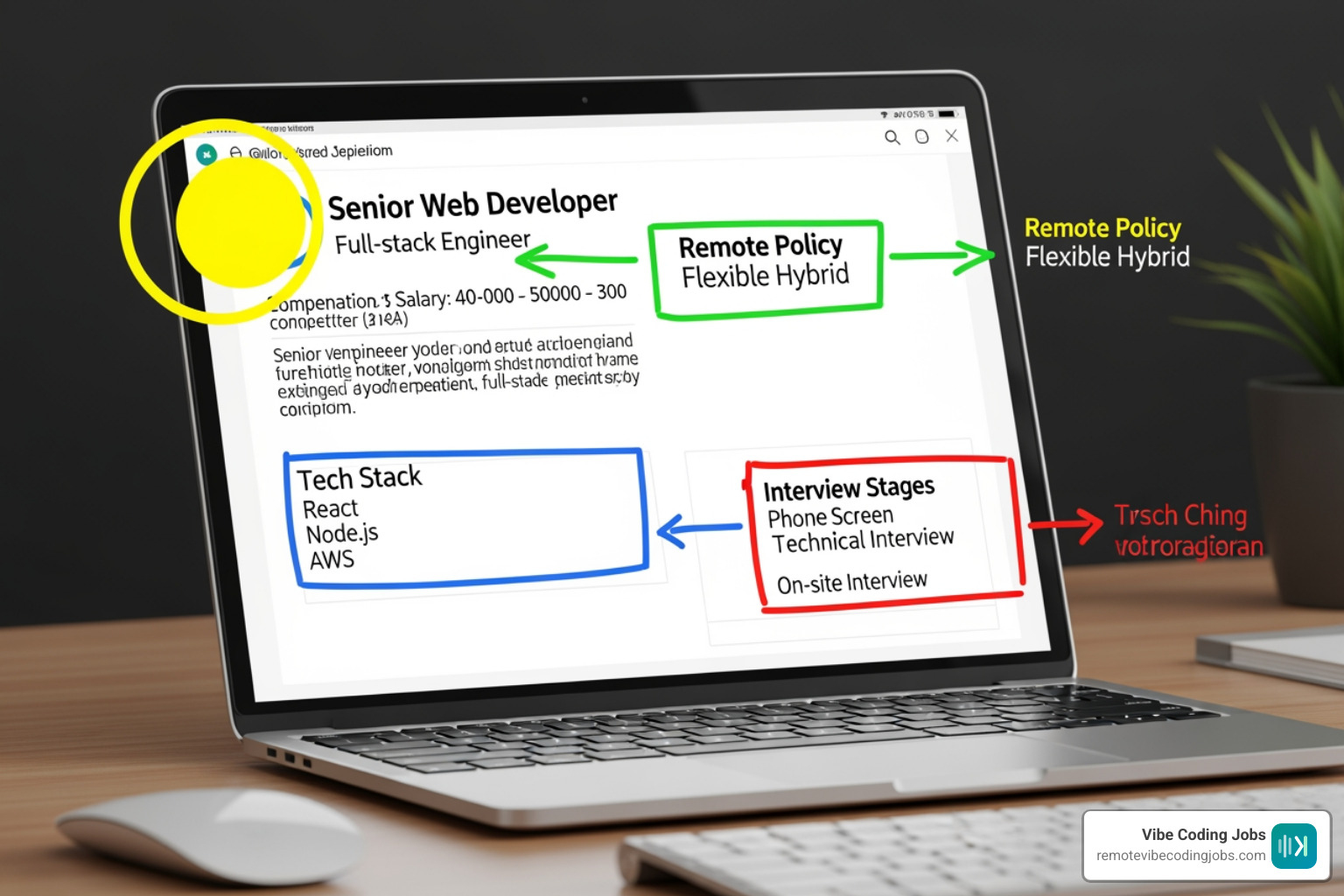
List the Skills Employers Actually Want in 2026
Most postings still ask for the fundamentals first:
- HTML
- CSS
- JavaScript
- Git
But that is just the floor. In 2026, the strongest listings also specify the ecosystem around the work.
Commonly requested skills include:
- TypeScript
- React
- Vue
- Angular
- WordPress
- Headless CMS platforms
- API integrations
- Accessibility and WCAG
- SEO and structured data
- Testing
- Analytics tools
- Tag management
- Deployment workflows
Most in-demand technical skills and frameworks in current postings
From the research, a few patterns stand out.
For modern frontend-heavy roles, employers frequently ask for:
- JavaScript and TypeScript
- React most often, with Vue and Angular still relevant
- Component-based design systems
- Responsive development
- Performance optimization
- API consumption
- Git-based workflows
For CMS and marketing-site roles, the stack often includes:
- WordPress
- PHP
- JavaScript
- HTML/CSS
- SEO fundamentals
- Structured data
- Google Analytics 4
- Google Tag Manager
- Cross-browser testing
- Content editor support
For compliance-oriented roles, employers increasingly ask for:
- WCAG accessibility knowledge
- Section 508 awareness in public-facing environments
- ARIA usage
- Regression testing
- Clear deployment processes through dev, test, and live environments
The useful lesson for hiring teams: list what the role truly needs, not every tool your department has touched since 2019.
Here is the fastest way to match requirements to employer type:
| Employer type | Common priorities | Typical tools/skills |
|---|---|---|
| Creative agency | Visual execution, speed, campaign launches, portfolio quality | HTML/CSS/JS, React, animation, design collaboration |
| Academic institution | Accessibility, CMS upkeep, stakeholder coordination, compliance | WordPress, PHP, WCAG, Section 508, analytics, SEO |
| Enterprise team | Scale, documentation, security, stability, process | TypeScript, React, APIs, testing, CI/CD, governance |
How AI-assisted development is changing the role
AI-assisted development is no longer a side note. It is increasingly baked into web roles, especially in teams that prototype quickly or operate async-first.
That does not mean “let the bot do everything.” It means employers are starting to value a different mix of competencies:
- Prompt engineering
- Reviewing AI-generated code
- Strong debugging skills
- Security and privacy awareness
- Documentation for human and AI collaborators
- Clear standards for when AI can and cannot be used
- Ability to prototype quickly, then harden the output
Some teams call this vibe coding. Others simply describe it as AI-assisted development. The exact label matters less than the practical expectation: developers should know how to use tools like Cursor, Claude, or Copilot without blindly trusting output.
A modern posting can mention AI well by being concrete:
- Experience using AI coding assistants for prototyping, refactoring, or test generation
- Ability to review AI-generated code for quality, accessibility, security, and maintainability
- Comfort working within AI governance and documentation standards
That is much better than writing “must love AI” and hoping everyone interprets that the same way.
If your team is actively hiring for AI-native web work, these pages can help frame adjacent expectations: AI Engineer Jobs and React Jobs (Vibe Coding).
Niche competencies for WordPress and Headless CMS roles
Not all web developer roles are generic frontend jobs in disguise.
For WordPress-heavy roles, employers often want:
- PHP
- Theme and template work
- Gutenberg block experience
- Plugin maintenance
- Content editor support
- SEO implementation
- Performance tuning
- Deployment workflows
- Regression testing
- Design-system consistency
For headless CMS roles, the profile shifts toward:
- Content modeling
- API-first thinking
- Frontend framework integration
- Preview workflows
- Structured authoring experiences
- Cross-system publishing pipelines
- Documentation for editors and developers
In both cases, editor experience matters more than many employers realize. A great site that only one developer can update is not a great site.

Match the Job Description to the Employer Type
A useful web developer job posting reflects the environment around the work. The same person is not being hired the same way by a design agency, a university, and a large enterprise team.
If you copy one template across all three, the mismatch shows.
What creative agencies look for in web developers and creative developers
Creative agencies usually emphasize speed, visual quality, and collaboration with design. These roles often blur into creative developer territory.
Expect agencies to care about:
- Strong portfolio quality
- Motion, animation, or interactive experiences
- Pixel-accurate implementation
- Campaign and landing-page work
- Rapid iteration
- Comfort translating Figma into code
- UI sensibility and brand awareness
A standard web developer in an agency may still handle frontend implementation, CMS builds, and QA. A creative developer, though, usually leans harder into visual storytelling, interaction, immersive builds, and experimentation.
If you are hiring for that kind of role, say so. Do not call it “Web Developer” if the real job is “Build award-chasing microsites with rich motion and design-led interactions.”
How academic institutions write web developer job postings
Academic and public-serving organizations tend to be more structured and compliance-heavy. Their postings usually emphasize:
- WordPress or CMS administration
- Accessibility and WCAG
- Section 508 awareness
- Stakeholder management across departments
- Governance and testing processes
- Regular on-campus presence or defined schedule expectations
- Benefits like tuition remission
- Reliability during critical communications
One public university posting in the research described a salary range of $58,260 to $63,000 for a web developer role requiring at least two years of experience, strong WordPress knowledge, accessibility awareness, SEO understanding, analytics usage, and a formal testing workflow across development stages. For an example of how academic institutions structure these roles, see this Web Developer posting at Purdue University.
These environments often need developers who can balance technical delivery with patience, documentation, and stakeholder communication.
What large corporations and federal-style environments emphasize
Larger organizations and federal-style hiring environments tend to focus on process maturity.
Their postings often include:
- Security expectations
- Documentation standards
- Change management
- Multi-stage interviews
- Panel interviews
- Reference checks
- Background checks
- Identity or work authorization verification
- Cross-team approvals
The work itself may also be broader than “build web pages.” Senior web roles in large organizations may own platform decisions, release quality, integrations, and internal alignment across design, product, marketing, and infrastructure teams.
If you are hiring into this kind of environment, be upfront that the role includes process. Senior candidates are not scared off by structure. They are scared off by surprise structure.
Be Transparent About Salary, Benefits, and Work Arrangements
Transparency is not just nice. It is conversion infrastructure.
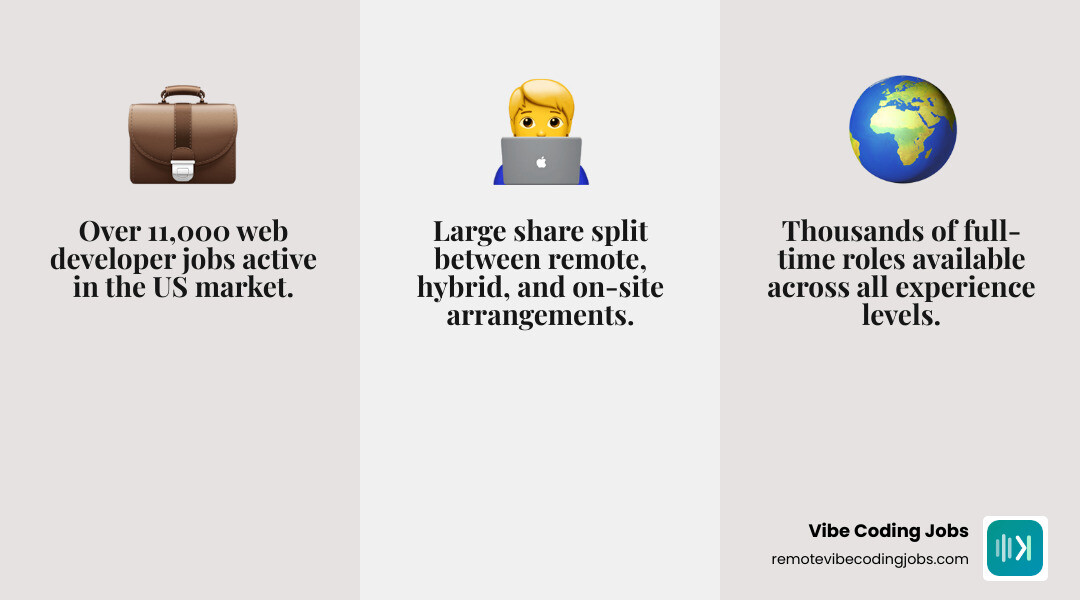
The research shows more than 11,000 web developer jobs in the US market, with thousands marked full-time and a large share split across remote, hybrid, and on-site arrangements. Candidates compare quickly. If your job posting is vague, it loses.
Typical salary ranges from junior to senior web developer roles
Salary varies by stack, seniority, and scope, but the research provides useful anchors.
Examples from current postings include:
- Around $58,260 to $63,000 for a web developer role with 2+ years of experience
- Around $115,000 to $125,000 for a senior web developer with .NET experience
- Around $120,000 to $125,000 for a Java frontend developer with 10+ years of experience
- Around $140,000 to $160,000 for a senior web developer requiring 8+ years of experience
A reasonable way to present salary bands in your posting is by matching them to actual responsibility:
- Junior or early-career: lower range, more support, narrower ownership
- Mid-level: stronger independent execution
- Senior: systems ownership, mentoring, cross-functional leadership
- Specialist or lead: strategic decision-making plus high-accountability delivery
If your role is primarily frontend, it can also help to benchmark adjacent pay pages such as Frontend Engineer Salaries and React Developer Salaries.
Common benefits candidates expect to see in a strong web developer job posting
The best postings include benefits in plain language, not hidden behind “competitive package.”
Common benefits to list:
- Healthcare
- Paid time off
- Retirement plan or match
- Bonus eligibility
- Equipment stipend
- Learning and development budget
- Home office support
- Flexible schedule details
- Tuition remission where relevant
- Visa or work authorization policy
If a benefit is unusual and meaningful, surface it. In academic environments, tuition remission can be a major differentiator. In remote-first environments, async flexibility and deep-work culture matter a lot more than free snacks no one can eat through Zoom.
Remote, hybrid, and on-site language that reduces candidate confusion
Work arrangement language should answer three questions:
- Where can the person live?
- How often do they need to be in person?
- What schedule constraints exist?
Use clear labels and definitions:
Remote
- Open to approved locations only
- Include timezone overlap expectations
- Mention any travel requirements
Hybrid
- State exact office cadence
- Mention whether schedule is fixed or flexible
- Note if candidates must be within commuting distance
On-site
- State office location expectations
- Clarify whether any flexibility exists
- Mention relocation support if offered
Current market data in the research shows large numbers of full-time roles, with remote, hybrid, and on-site all well represented. So vague phrasing like “flexible work environment” is not enough. Candidates want specifics.
Show the Real Hiring Process and the Traits You Want
A lot of employer mistrust comes from one thing: mystery.
If candidates do not know what the process is, how long it takes, or what traits you actually value, they assume the worst. Usually with reason.
Soft skills and ownership traits employers prioritize
Technical skills get people into the pipeline. Ownership traits often decide who gets hired.
Across the research, employers repeatedly signaled that they want developers who are:
- Proactive
- Accountable
- Clear communicators
- Comfortable with urgency
- Thoughtful problem-solvers
- Collaborative across functions
- Product-minded
- Organized in documentation
- Able to spot issues without being told
That last point matters. The strongest job postings describe ownership in behavior terms.
Examples:
- Flags inconsistencies before launch
- Improves workflows without waiting for perfect specs
- Documents decisions and handoffs
- Communicates risks early
- Balances speed with quality
This matters even more in AI-assisted environments, where fast generation increases the need for human judgment.
Typical interview and background check process for corporate or public-sector roles
A clear process reduces drop-off and improves trust. Most corporate and public-sector web developer hiring flows look something like this:
- Recruiter or HR screen
- Hiring manager interview
- Technical interview or portfolio review
- Take-home task or live problem discussion
- Panel interview with cross-functional stakeholders
- Reference checks
- Background check
- Offer and start-date confirmation
Background checks may include:
- Identity verification
- Employment verification
- Criminal background screening where permitted
- Education verification
- Work authorization review
Not every role needs every step. A junior WordPress position probably does not need five rounds and an interpretive dance on caching strategy. But if your organization does require multiple stages, say so upfront.
Clarify overlapping roles so better candidates apply
Many bad applications come from bad labeling.
Here is the simplest breakdown:
Web Developer
- Builds and maintains web experiences
- Focuses on implementation, performance, CMS, integrations, testing, and delivery
Creative Developer
- Bridges design and code for visually rich, interactive experiences
- Often works on animation, motion, immersive storytelling, and experimental builds
UI/UX Designer
- Focuses on user research, interaction design, layout, flows, wireframes, and visual systems
- Usually designs more than implements, though some hybrid roles exist
If your role expects visual design ownership, call that out. If your role is implementation-heavy and not responsible for user research or visual direction, say that too.
A cleaner title means fewer mismatched applicants and better self-selection.
Frequently Asked Questions About a Web Developer Job Posting
What should every web developer job posting include?
At minimum:
- Clear title
- Role summary
- Core responsibilities
- Must-have skills
- Nice-to-have skills
- Salary range
- Work arrangement
- Tech stack
- Benefits
- Hiring process
- Application instructions
- Success metrics for the first 6 to 12 months
If any of these are missing, candidate confidence drops.
How long should a web developer job posting be?
Long enough to answer real questions. Short enough to scan.
For most roles, that means a concise, structured posting rather than a mini novel. Use:
- Short paragraphs
- Bullet points
- Clear section headers
- Tight requirements lists
- Concrete language
A good posting is usually easier to skim than to admire. That is a feature, not a bug.
Should you ask for AI tools or prompt engineering experience?
Yes, if it is genuinely relevant to the role.
In 2026, AI literacy is becoming a meaningful hiring signal in web development, especially for teams using AI for prototyping, documentation, testing, or code generation. But the keyword here is relevant.
Ask for AI-related experience when the role includes:
- AI-assisted development workflows
- Prompting for code generation or refactoring
- Reviewing AI output
- AI governance or compliance expectations
- Building AI-ready content or interfaces
Do not ask for prompt engineering just because it sounds futuristic. Ask for it when your team actually needs it.
Conclusion
A better web developer job posting does not just attract more applicants. It attracts the right applicants, builds trust faster, and reduces wasted interview time.
If we write with clarity around skills, salary, work arrangement, ownership, and process, we make it easier for serious candidates to say yes. We also make it easier for unqualified candidates to self-select out, which is a gift to everyone involved.
For inspiration, it can help to review a few real-world examples from your own market, then build a version that is sharper, more transparent, and more aligned with how developers evaluate jobs in 2026.
If you want to reach AI-native, remote-friendly web talent faster, we recommend posting where candidates already filter for stack, culture, and AI tooling expectations. You can learn more here: post developer jobs
And if your hiring needs extend into adjacent frontend or AI-assisted roles, these pages may help refine your benchmarks:
- Vue Developer Jobs
- DevOps Engineer Jobs
- Machine Learning Engineer Jobs
- Ruby on Rails Developer Jobs
- JavaScript Jobs (Async-First)
Write the posting your best candidates wish they would find. They are probably one vague bullet list away from scrolling past.