Remote React Fullstack Jobs in 2026: What You Need to Know Before You Apply
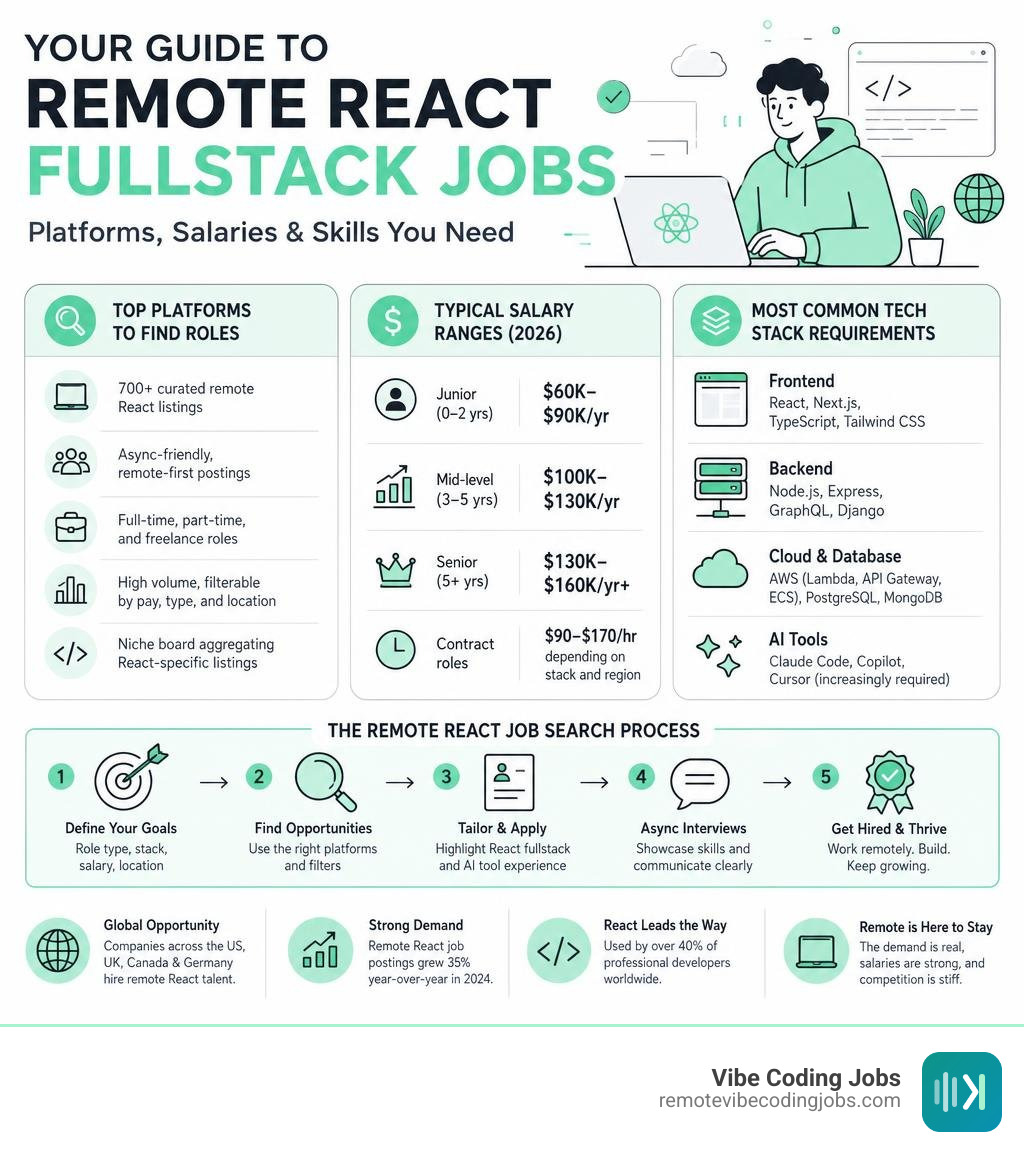
If you’re hunting for remote React fullstack jobs, here’s a quick snapshot of what the market looks like right now:
Top ways to find roles:
- Remote Vibe Coding Jobs — curated daily listings for AI-assisted and async-first React roles
- Company Career Pages — direct applications to tech companies and startups
- General Job Aggregators — high volume search engines filterable by pay, type, and location
- Developer Communities — networking in Discord servers and GitHub discussions
Typical salary ranges (2026):
- Junior (0–2 yrs): $60K–$90K/yr
- Mid-level (3–5 yrs): $100K–$130K/yr
- Senior (5+ yrs): $130K–$160K/yr+
- Contract roles: $90–$170/hr depending on stack and region
Most common tech stack requirements:
- Frontend: React, Next.js, TypeScript, Tailwind CSS
- Backend: Node.js, Express, GraphQL, Django
- Cloud: AWS (Lambda, API Gateway, ECS), PostgreSQL, MongoDB
- AI tools: Claude Code, Copilot, Cursor (increasingly required)
React is the dominant web framework in 2026 — used by over 40% of professional developers worldwide. And remote work hasn’t slowed down. Remote React job postings grew 35% year-over-year in 2024, and that momentum has continued. Companies across the US, UK, Canada, and Germany account for nearly two-thirds of all remote React fullstack postings. The demand is real, the salaries are strong, and the competition is stiff.
What’s changed most recently is what companies expect. It’s no longer just React and Node.js. Employers now want developers who actively use AI coding assistants — tools like Claude Code, Codex, and Cursor — as part of their daily workflow. Some job postings explicitly list this as a hard requirement, not a nice-to-have.
That means finding the right role requires more than a keyword search. You need to know where to look, what stacks are in demand, and how compensation differs by region and experience level.
I’m part of the RVCJ Editorial team at Remote Vibe Coding Jobs — we cover AI-assisted development, async hiring practices, and curate verified remote React fullstack jobs for developers who build with tools like Cursor, Claude, and Copilot. This guide breaks down the best platforms and strategies so you can cut through the noise and find roles that actually match your stack and work style.
Remote react fullstack jobs further reading:
Top Platforms to Find Remote React Fullstack Jobs

Navigating the landscape of remote engineering opportunities can feel overwhelming. To find high-quality remote react fullstack jobs, you need to look beyond generalized, spam-heavy boards and focus on platforms that cater to modern engineering workflows, transparent salaries, and geographical alignment.
When you target the right platforms, you save hours of application time and gain access to hiring managers who value your specific skill set. Let’s look at the best places to search for your next role.
Curated Niche Platforms for AI-Assisted and Async Roles
At Remote Vibe Coding Jobs, we believe the traditional way of writing code is shifting. Modern, forward-thinking companies are looking for “vibe coders”—developers who act as creative orchestrators, leveraging AI tools like Claude, Cursor, v0, and Lovable to build applications at lightning speed.
We curate daily listings specifically filtered by tech stack, async-first cultures, and open-mindedness toward AI-assisted development. If you want to work for a company that values your system design skills and output over how many lines of code you manually type, checking out Remote React Developer Jobs is your best starting point.
On our platform, we filter out companies with outdated, high-friction hiring processes and focus on modern environments that encourage “vibe coding” workflows. This means you can find roles where you are expected to design architectural systems, write high-level prompts, and orchestrate complex applications rather than getting bogged down in manual boilerplate.
Remote-First Job Directories and Timezone-Aligned Boards
For broader searches that still maintain a high-quality filter, dedicated remote-first job directories are invaluable. These directories focus heavily on timezone overlap, contract clarity, and verified remote companies.
- Timezone-Aligned Filtering: When searching for remote roles, prioritize platforms that allow you to filter by timezone overlap. This ensures you don’t waste time applying to roles that require you to work midnight shifts or attend meetings outside your preferred working hours.
- Contract and Employment Type: Look for directories that clearly categorize positions by contract type. Whether you want a full-time W-2 role, a freelance gig, or a part-time B2B contract, clear geographic targeting helps you find roles that match your legal and tax setup.
- Startup Directories: Fast-growing startups often have less bureaucratic hiring processes and are quicker to adopt cutting-edge stacks. Focus on directories that highlight async-friendly work environments and modern developer tooling, where you can find roles that explicitly value autonomy and deep work.
Traditional General Job Boards and Company Career Pages
While niche boards offer higher curation, high-volume general job boards still hold a massive share of the market. The trick is knowing how to filter them effectively.
- Indeed: As one of the largest job aggregators globally, you can find a massive volume of roles by searching Indeed Remote React Developer Jobs. To avoid the noise, use precise search terms like “React Node fullstack remote” and filter by “Within 35 miles” (if you want local remote) or select “Fully Remote” with specific pay filters. Indeed listings also give you a realistic look at competitive contract roles, project budgets, and timezone requirements (such as requiring a 6-to-8-hour overlap with PST or EST).
- Workable & Direct Portals: Many scaling tech companies and specialized cloud consultancies post directly to their own applicant tracking systems. For example, you can find specialized listings like the Full Stack Web Developer at RevStar position, which combines modern React development with advanced cloud architecture and AWS infrastructure.
In-Demand Tech Stacks and Remote Work Dynamics

Securing a competitive remote full-stack role in 2026 requires more than a surface-level understanding of JavaScript. You need to prove you can own features end-to-end, from crafting pixel-perfect interfaces to optimizing database queries and deploying cloud infrastructure.
Frontend Excellence with React and Next.js
The frontend expectations for full-stack developers have matured. It is no longer enough to throw together a basic React SPA. Companies expect highly optimized, SEO-friendly, and performant web applications.
- Next.js: Next.js is the undisputed industry standard for React-based production web apps. It bridges the gap between frontend design and backend routing. If you want to stand out, browse Remote Next.js Developer Jobs to see how organizations leverage server components, static site generation, and serverless API routes.
- Figma to Code: A highly valued skill in remote setups is the ability to take high-fidelity Figma mockups and convert them into clean, accessible, and responsive Tailwind CSS components without losing any design details.
- Component Design: Writing reusable component libraries using TypeScript generics and robust design systems (like Material UI, Radix, or Shadcn) ensures that your frontend code remains maintainable as the engineering team scales. You can explore modern frontend expectations on our dedicated Remote React Developer Jobs page.
Robust Backends and Cloud Infrastructure
On the backend, fullstack developers are expected to design secure, scalable APIs and manage data pipelines efficiently.
- Node.js & Express: This remains the most common backend companion to React. Employers typically look for strong experience in clean API architecture, security best practices, and runtime optimization when hiring for Node.js and React roles.
- TypeScript: Strong typing across both the frontend and backend is a non-negotiable requirement for modern mid-to-senior engineering roles. Using TypeScript ensures type safety from your database schema all the way to your React components. If you are fluent in strict typing, explore Remote TypeScript Developer Jobs to find teams that value clean, self-documenting codebases.
- Databases & Cloud: You should be comfortable with both relational databases like PostgreSQL (schema design, query optimization) and NoSQL solutions like MongoDB or DynamoDB. Furthermore, modern fullstack roles often require familiarity with AWS services (Lambda, API Gateway, ECS, OpenSearch) to deploy and scale applications. See how consultancies structure these roles by reviewing modern full-stack job requirements on our Remote React Developer Jobs page.
Embracing Async-First and Deep Work Cultures
Working remotely is about more than just writing code from a different desk; it is about adapting to a distinct operational culture.
The most successful remote developers thrive in environments that prioritize deep focus and asynchronous communication over constant, disruptive Slack messages. If you prefer long stretches of uninterrupted time to solve complex architectural problems, you should target companies listed under Remote React Jobs Deep Work.
Similarly, working across borders requires an understanding of asynchronous collaboration. This means documenting your technical decisions in clear Engineering Requirement Documents (ERDs), writing descriptive pull request summaries, and communicating progress proactively. To find organizations that structure their workflows this way, look through Remote React Jobs Async First.
Salary Benchmarks and Regional Compensation Trends
Salaries for remote react fullstack jobs vary significantly based on your geographical location, the location of the hiring company, and your contract structure (W-2 vs. B2B contract).
While companies in the US, UK, Canada, and Germany account for 65% of all remote React job postings, talent is distributed globally. This has led to a highly competitive, multi-tiered compensation landscape.
The table below outlines the realistic salary expectations for remote React fullstack developers in 2026 across different regions and experience levels:
| Experience Level | North America (USD) | Western Europe (EUR) | Eastern Europe / LATAM (USD) | Asia-Pacific (USD) |
|---|---|---|---|---|
| Junior (0-2 Years) | $70,000 – $95,000 | €50,000 – €65,000 | $30,000 – $50,000 | $25,000 – $45,000 |
| Mid-Level (3-5 Years) | $105,000 – $135,000 | €70,000 – €90,000 | $55,000 – $80,000 | $50,000 – $75,000 |
| Senior (5+ Years) | $140,000 – $180,000+ | €95,000 – €130,000 | $85,000 – $120,000 | $80,000 – $115,000 |
| Lead / Architect | $185,000 – $240,000+ | €135,000 – €170,000 | $120,000 – $150,000 | $110,000 – $140,000 |
To see how these numbers translate into active listings, you can browse Remote Full Stack Developer Jobs for transparent compensation data.
Additionally, if your strengths lie heavily within the core language ecosystem, check out the salary trends on our Remote JavaScript Developer Jobs page to compare frontend-leaning versus full-stack-focused compensation packages.
Frequently Asked Questions about Remote React Fullstack Jobs
What are the most critical skills for a remote full-stack React developer in 2026?
To stand out in the 2026 hiring market, you need a balanced mix of core engineering excellence and modern workflow efficiency:
- Strong TypeScript Proficiency: Writing strict, type-safe code across the entire stack is essential for minimizing bugs in distributed teams.
- Modern React & Next.js: Mastery of React Server Components (RSC), server actions, and state management.
- AI Tool Integration: Active daily use of AI coding assistants (like Cursor, Claude Code, and Copilot) to accelerate boilerplate generation, allowing you to focus on system design and business logic.
- Cloud & Database Management: The ability to write optimized SQL/NoSQL queries and deploy serverless functions (like AWS Lambda) to keep infrastructure lean and cost-effective.
How do I prepare for a remote full-stack React interview without LeetCode?
Many remote-first companies have abandoned traditional, high-stress algorithmic puzzles in favor of practical, real-world assessments. To prepare for these interviews:
- Build and Document Real Projects: Create 2 or 3 high-quality, production-ready applications. Ensure they have clear READMEs, architectural diagrams, and clean commit histories to prove ownership.
- System Design & API Contracts: Practice explaining how you would design a system from scratch, including database schemas, API endpoints, and frontend state management.
- Focus on Practical Assessments: Look for companies that evaluate you based on a take-home project or a collaborative pair-programming session using real-world code. You can find these stress-free opportunities by filtering for Remote React Jobs No LeetCode.
What is the average salary for remote full-stack React developers?
On a global scale, the average salary for a remote React fullstack developer ranges between $120,000 and $160,000 annually.
However, this is highly dependent on where the company is headquartered and your level of experience. US-based companies hiring remote talent tend to pay the highest rates (often exceeding $150,000 for senior engineers), while contract-based roles globally can range from $50/hour for mid-level developers to over $150/hour for specialized technical leads and architects.
Conclusion
The market for remote React fullstack jobs in 2026 is full of opportunity, but the ways developers build software are changing rapidly. The rise of AI-assisted development—or “vibe coding”—means that the most successful engineers are those who know how to leverage tools like Cursor and Claude to build faster, write cleaner code, and focus on high-level system architecture.
If you are ready to skip the generic job boards and find remote positions at modern, forward-thinking companies that value your output and support async-first, AI-native workflows, we are here to help.
Explore our curated directory at Remote React Developer Jobs to find your next career step, and take advantage of our free playbooks and fast application tools to land your dream remote role today!