
How to Get Hired as a Remote React Frontend Dev
Why the Market for a Remote React Frontend Dev Has Never Been Bigger
If you’re a remote React frontend dev, the job market in May 2026 is stacked in your favor.
Here’s a quick snapshot of what’s available right now:
| Platform | Available Roles |
|---|---|
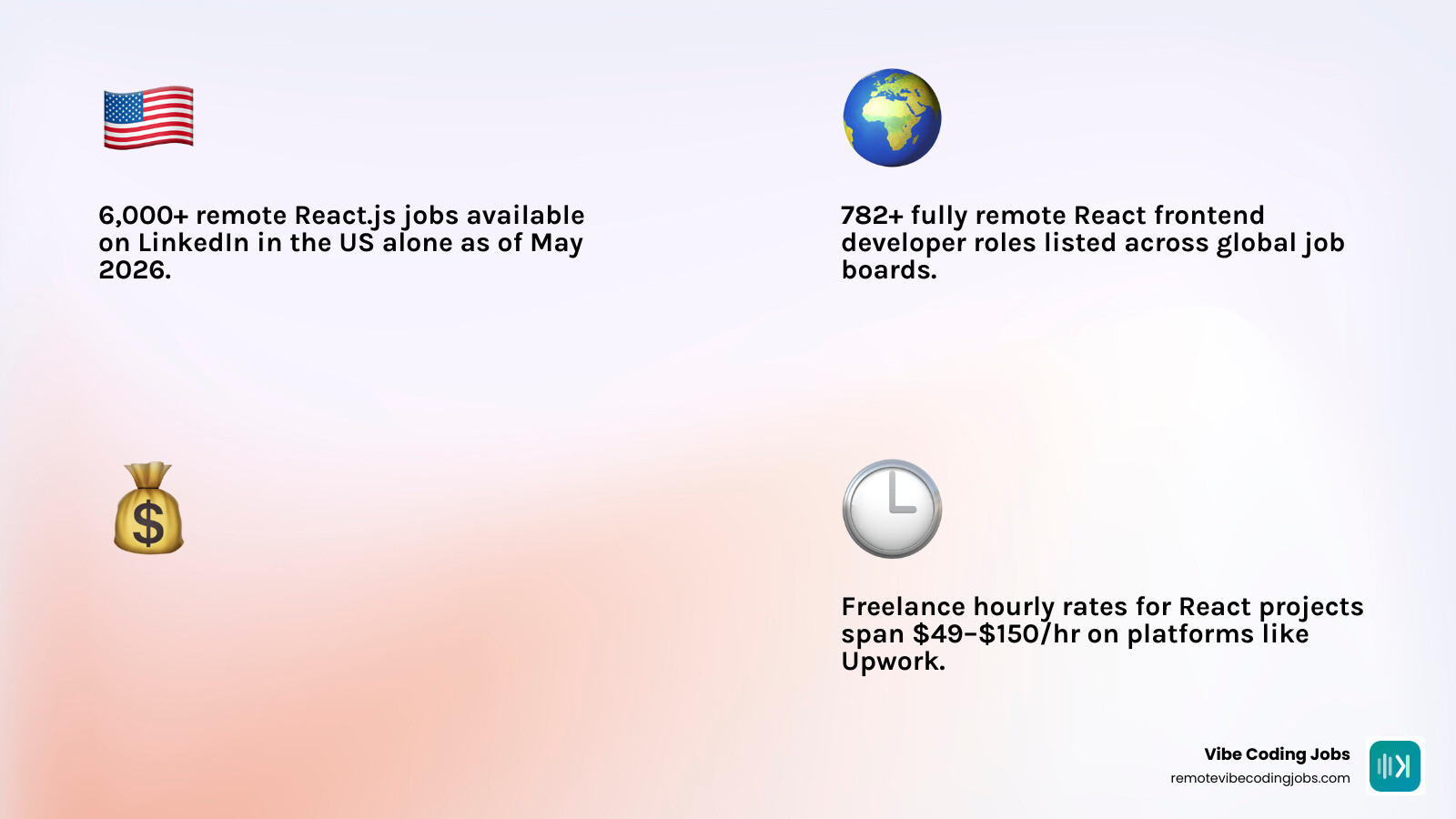
| LinkedIn (US) | 6,000+ React.js remote jobs |
| Global job boards | 782+ fully remote React roles |
| Upwork (freelance) | 2,987+ React.js projects |
| Specialized boards | 164+ hidden roles not on LinkedIn |
Key facts at a glance:
- Salaries range from ~$70K/year for mid-level to $213K+ for senior/principal roles
- Freelance hourly rates run $49–$150/hr on Upwork
- Most roles require React 18+, TypeScript, and Next.js
- Employment types include full-time, contract, part-time, and freelance
The demand is real and it’s growing. But so is the competition.
React has become the dominant frontend framework in remote hiring. And in 2026, something has shifted: employers aren’t just looking for developers who know React — they want developers who can ship fast using AI-assisted workflows. Tools like Cursor and Claude Code are showing up in job descriptions alongside TypeScript and Redux.
This guide walks you through exactly how to get hired — from the skills you need, to the platforms worth your time, to what makes a candidate stand out in a crowded field.
I’m part of the RVCJ Editorial team at Remote Vibe Coding Jobs, where we track hiring trends and curate global opportunities for developers building with AI-native tools — including the latest openings for every level of remote React frontend dev. Our work sits at the crossroads of async-first culture and modern engineering, so everything in this guide comes from what we’re seeing in real job postings right now.
The 2026 Market for a Remote React Frontend Dev
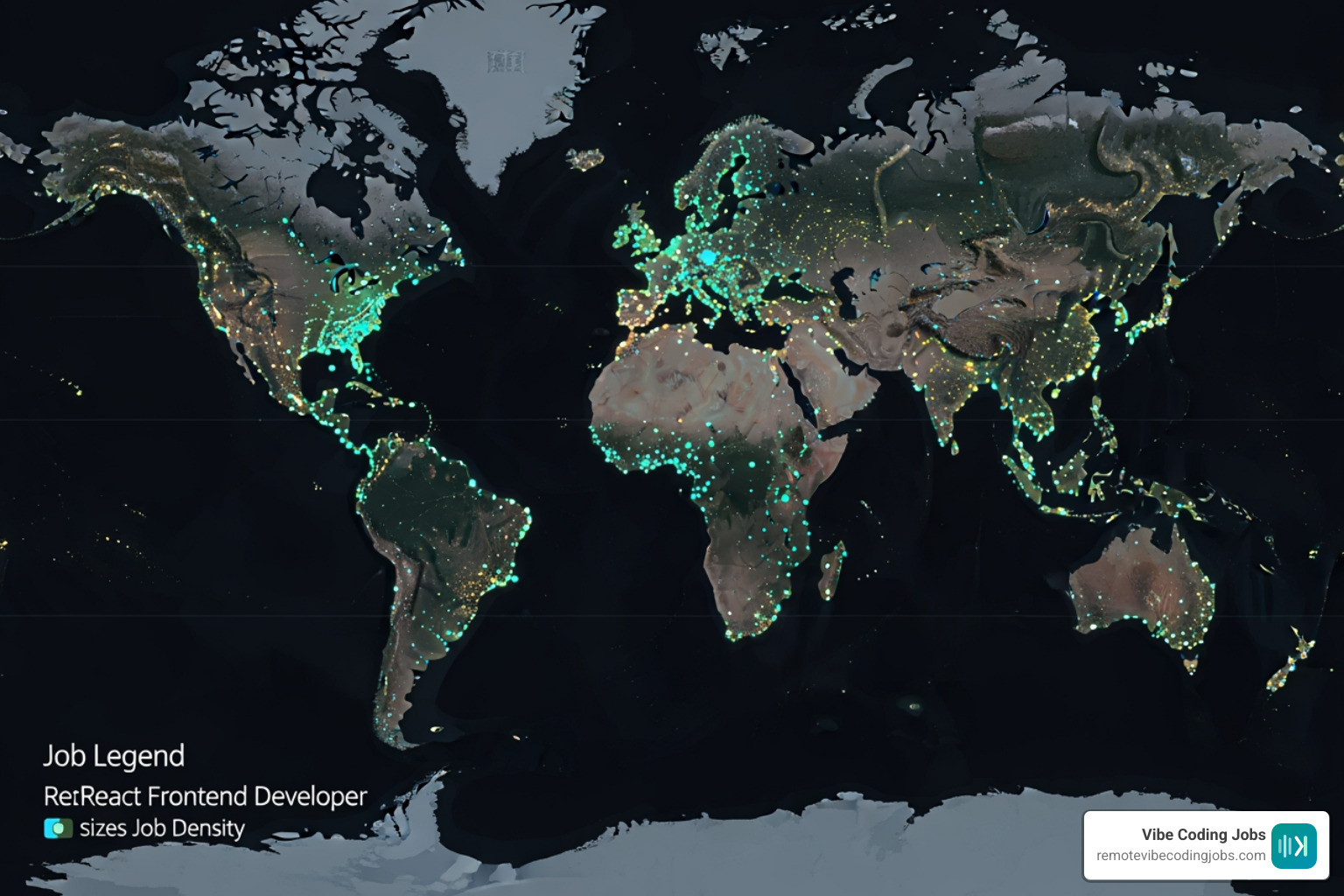
As we move through May 2026, the landscape for any remote react frontend dev is characterized by high volume and high expectations. Currently, there are over 784+ Remote React.js Jobs, May 2026 available globally. In the United States alone, LinkedIn shows more than 6,000 remote React roles, with over 3,500 of those being truly remote-first positions.
The market isn’t just large; it’s diverse. We are seeing a massive surge in “hidden” jobs—roles that aren’t posted on the major aggregators. Research indicates that roughly 81% of high-quality remote React jobs are not found on LinkedIn. This means that to find the best opportunities, you need to look where others aren’t looking.
High-Paying Roles for a Remote React Frontend Dev
The financial upside for specialized frontend talent has hit new heights. While entry-level roles might start around $70,000, senior positions are regularly breaking the $200,000 barrier. For example, UI Developer roles in specialized sectors like cybersecurity or fintech are commanding ranges between $142,320 and $213,480.
Common high-tier job titles we see daily include:
- Senior React Engineer: Focused on complex state management and performance.
- Frontend Architect: Designing the scalable foundations of large-scale SPAs.
- Principal Full Stack Developer: Roles that lean heavily on React but manage the entire feature lifecycle.
For a detailed breakdown of what you can expect to earn based on your location and experience, check out our guide on React Developer Salaries. If you’re ready to start browsing these high-tier positions, you can find them on our Remote React Developer Jobs board.
Essential Skills for a Remote React Frontend Dev
To land a job in 2026, you need more than just a basic understanding of components. The “standard” stack has evolved. Employers are now looking for:
- React 18+: Proficiency with Concurrent Rendering, Transitions, and Server Components.
- TypeScript 5.0: This is no longer optional; it is a near-universal requirement for senior roles.
- Next.js 14/15: Increasingly the go-to framework for React-based frontend roles due to its SEO and performance benefits.
- Tailwind CSS: The dominant choice for rapid, scalable UI development.
Beyond the core library, we see a heavy emphasis on state management (Redux Toolkit, Zustand, or Jotai) and testing (Cypress, Playwright, or Vitest). If you want to dive deeper into the specific requirements for these modern roles, read our Remote React Developer Jobs Guide.
Mastering the “Vibe Coding” Workflow
The most significant trend we’ve observed in 2026 is the rise of “Vibe Coding.” This isn’t just a buzzword; it’s a fundamental shift in how a remote react frontend dev works. Vibe coding refers to AI-assisted development where you act more like a software architect or “pilot” than a manual code typist.

By leveraging AI, developers are seeing productivity gains of 2x to 5x. This allows you to focus on high-level logic, user experience, and architecture while the AI handles the boilerplate. Companies are now explicitly hiring for this skill set. You can explore these specific opportunities on our React Vibe Coding Jobs page.
AI-Native Tools for Modern Frontend
To compete in this new era, you must master the tools of the trade. The modern dev environment is no longer just VS Code with a few extensions. It’s an integrated AI experience:
- Cursor & Windsurf: AI-native code editors that understand your entire codebase.
- Claude Code: Using advanced LLMs to refactor, debug, and generate complex React hooks through natural language.
- v0.dev: Rapidly generating UI components from prompts that are production-ready.
- Agentic Development: Using AI agents to handle repetitive tasks like writing unit tests or documentation.
The shift toward “Agentic Workflows” means that “LeetCode” style interviews are becoming less relevant. Employers care more about your ability to ship features fast and maintain a high “vibe” of code quality. Check out React No LeetCode Jobs to find companies that value shipping over puzzles.
Async-First Communication and Culture
Working remotely requires a different social and technical muscle. Most top-tier companies, such as Grafana Labs, operate on an “async-first” basis. This means:
- Documentation-First: If it isn’t written down, it doesn’t exist.
- Loom/Slack Workflows: Replacing hour-long meetings with 2-minute video walkthroughs.
- Timezone Overlap: Many “fully remote” jobs still require a 4–6 hour overlap with specific timezones (like EST or CET) for collaborative “sync” time.
A great example of this culture in action can be seen in roles like the Senior Frontend Engineer – Alerting, where communication is as critical as the code itself.
Top Platforms to Find Remote React Jobs
Don’t just stick to the “Big Three” job boards. The best remote react frontend dev roles are often found in niche communities.
- Specialized Boards: Platforms like ours focus specifically on the culture and tech stack, filtering out the noise of traditional boards.
- The Hidden Job Market: Many companies post directly to their career pages or niche Slack groups.
- Direct-to-Company: Following companies like Grafana Labs or Alerting Ireland often yields better results than waiting for an aggregator to pick up the post. For instance, check out the Senior Frontend Engineer Alerting Ireland listing for a look at a high-intent role.
Freelance and Contract Opportunities
If you prefer flexibility over a 40-hour salary, the freelance market is booming. On platforms like Upwork, React.js developers are earning median rates of $49–$150/hr. These roles often involve:
- Project-based work: Building an MVP for a startup.
- Staff Augmentation: Joining a team for 3–6 months to help ship a major version.
- Deep Work: Roles that allow for intense, focused development without the overhead of corporate meetings. You can find these on our React Deep Work Jobs list.
Global vs. Geographic Restrictions
“Remote” doesn’t always mean “work from a beach in Bali.” Many companies have legal or tax restrictions. We see three main categories:
- Worldwide: Truly location-independent.
- Timezone Restricted: Requires being within CET ±3 hours or having a PST/EST overlap.
- Country Specific: Remote, but you must reside in the US, Ireland, or another specific country for tax compliance.
Pay attention to these details in listings like Senior Frontend Engineer Alerting to ensure you are eligible before applying.
How to Stand Out in the Remote Market
In a market where everyone knows the basics, your portfolio needs to prove you can handle the “vibe” of a modern engineering team.
| Feature | Traditional Portfolio | AI-Native Portfolio |
|---|---|---|
| Primary Focus | Code syntax and “how” | Impact, speed, and “what” |
| Project Type | To-do apps, weather apps | Live, clickable SaaS prototypes |
| Documentation | Basic README | ARCHITECTURE.md for AI context |
| Evidence | GitHub commits | Performance metrics (Lighthouse) |
Companies are increasingly looking for contributors who understand the open-source ecosystem. Check out React Open Source Jobs to see how contributing to public projects can boost your hireability.
Building an AI-First Portfolio
Your portfolio shouldn’t just be a list of links. It should be a demonstration of your ability to convert Figma designs into clean, scalable code at high velocity. Show off:
- Clickable Prototypes: Use tools like Lovable or v0 to show how fast you can go from idea to functional UI.
- Performance Metrics: Include Core Web Vitals scores for your projects.
- No-BS Approach: Focus on real-world problem solving. See what we mean at React No BS Jobs.
Nailing the Remote Technical Interview
The interview process for a remote react frontend dev has changed. You might face:
- Live Vibe Coding: Instead of a whiteboard, you’ll be asked to build a feature using Cursor or Claude while explaining your architectural choices.
- System Architecture: Discussing how you’d structure feature-based modules for a large-scale e-commerce site.
- State Management Debates: Defending why you chose Zustand over Redux for a specific use case.
Preparation is key. Look at roles like Senior Frontend Engineer Alerting to understand the high-level responsibilities companies expect you to discuss during the technical round.
Frequently Asked Questions about Remote React Roles
What is the average salary for a remote React developer in 2026?
The average ranges significantly by experience. Mid-level developers typically earn $70k–$115k, while seniors and architects range from $140k to over $213k. Freelance rates average $49–$150/hr.
Do I need to know Next.js to get a remote React job?
In 2026, yes. Most modern remote job postings for React developers list Next.js as a primary requirement or a very strong “nice-to-have” because of its dominance in the production environment.
How does “vibe coding” change the hiring process?
It shifts the focus from “Can you write a for-loop?” to “Can you direct an AI to build a scalable system?” It prioritizes architectural thinking, prompt engineering, and the ability to review and secure AI-generated code.
Conclusion
The path to becoming a successful remote react frontend dev in 2026 is about embracing the future of development. By combining deep React expertise with AI-native “vibe coding” workflows, you position yourself at the very top of the talent pool.
At Remote Vibe Coding Jobs, we are dedicated to helping you find companies that value this high-velocity, async-first way of working. Whether you’re looking for a senior role at a global tech giant or a deep-work contract, the opportunities are out there.
Ready to find your next role? Browse our curated Remote React Developer Jobs and join the future of software engineering today.