
Don’t Get Audited: A Guide to Legit Vibe Coding Company Listings
The Fast Way to Find Legit Vibe Coding Company Listings in 2026
If you’re searching through vibe coding company listings, here’s a quick-reference breakdown of the most trusted places to find verified companies and open roles right now:
| Source | What It Lists | Best For |
|---|---|---|
| Goodfirms | 149 verified vibe coding companies | Hiring a dev agency |
| RemoteVibeCodingJobs | Curated remote vibe coding jobs | Job seekers |
| GitHub: awesome-vibe-coding | Tools, platforms, communities | Researchers and builders |
The landscape for finding AI-first development companies and jobs has exploded in the last 18 months. What started as a niche term — coined by computer scientist Andrej Karpathy in early 2025 — has become a full hiring category, with companies across every industry posting roles specifically for vibe coders, AI-first developers, and prompt engineers.
But not every listing out there is worth your time. Some company directories are outdated. Some job boards mix in roles that have nothing to do with AI-assisted development. And a few listings are just plain unverified.
That’s the problem this guide solves.
Whether you’re a developer looking for your next remote role or a founder vetting AI development partners, knowing which listings are legit — and which ones waste your time — matters more than ever.
I’m RVCJ Editorial, the editorial team behind Remote Vibe Coding Jobs, where we curate global remote developer roles for AI-first teams and cover the full landscape of vibe coding company listings, from verified agency directories to async-first job boards. We’ve tracked this market since its early days and know exactly what separates signal from noise.
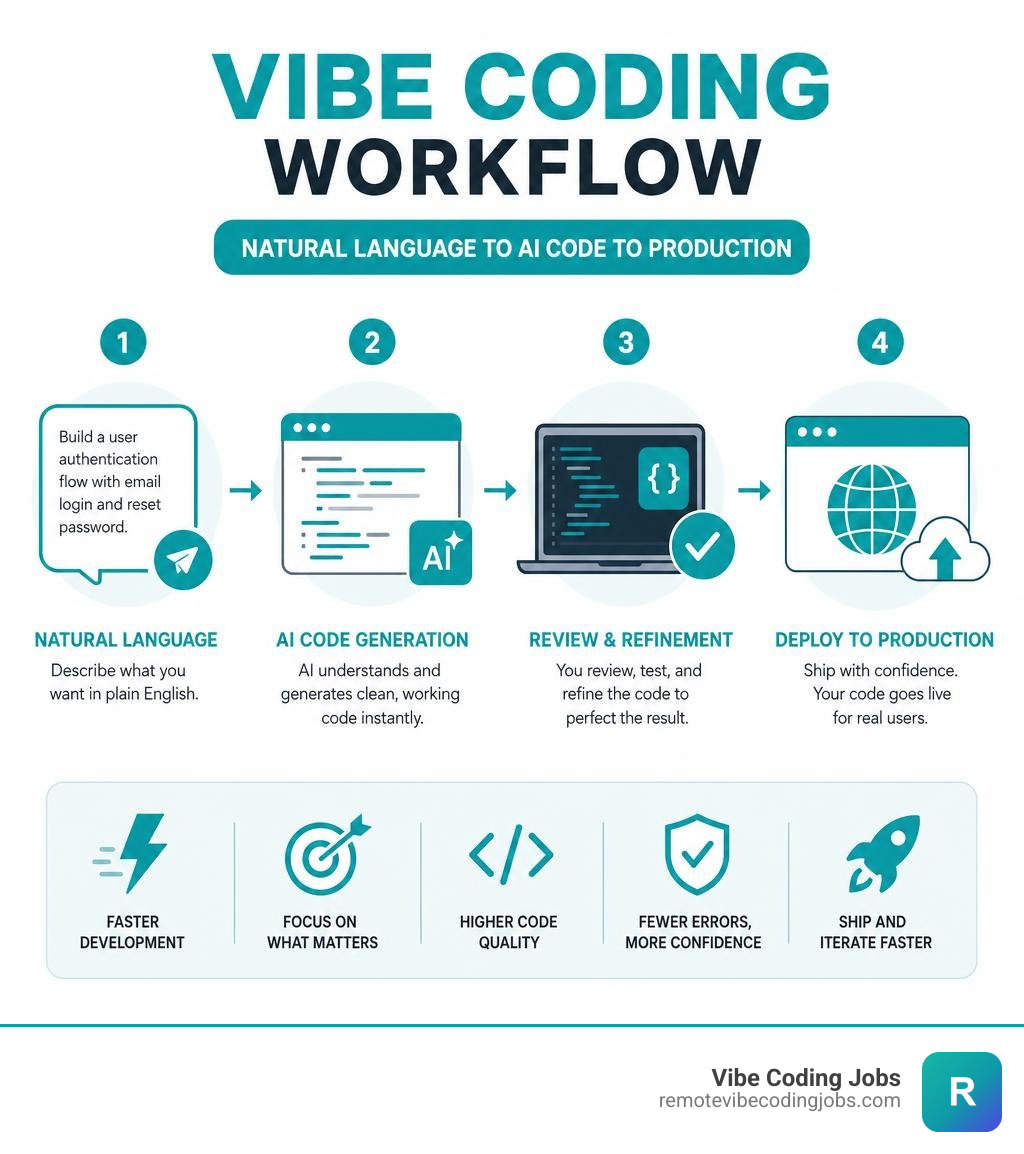
Vibe coding company listings terms made easy:
What is Vibe Coding and How is it Reshaping Software Development?
At its core, vibe coding represents a fundamental shift in how human beings interact with computers. In traditional software development, engineers spend years mastering complex syntax, memory management, and language-specific quirks. They manually type out thousands of lines of code, compile, debug, and repeat.
Vibe coding turns this paradigm on its head. Instead of writing code line by line, you describe the “vibe” of what you want in plain, natural language. Highly advanced, agentic AI platforms then take over the heavy lifting. They write the frontend, build the backend, spin up the database, and handle the deployment. The human’s role shifts from a manual builder to a director, architect, and quality controller.
This evolution from basic autocomplete tools to fully autonomous AI agents has completely redefined productivity. Today, developers use agentic workflows that can run independently for hours, solving complex multi-step problems with minimal human intervention.
The global developer community has embraced this shift with open arms. For proof, look no further than the open-source community: the filipecalegario/awesome-vibe-coding – GitHub repository has amassed over 4,700 stars and hundreds of forks, serving as a massive directory of tools, frameworks, and communities driving this movement forward.
At the enterprise level, companies are racing to make this technology accessible to everyone. Startups like Vibe: Making everyone a software engineer | Y Combinator, founded by Stripe alumni who previously scaled massive payment systems, are building platforms that empower non-technical users to turn their thoughts into fully functional, production-ready applications through simple, conversational interfaces.
Best Industries and Use Cases for Vibe Coding
While vibe coding is incredibly powerful, it is not a magic bullet for every single software engineering problem. It shines brightest in specific areas where speed, user interface design, and rapid iteration are paramount:
- SaaS Products and MVPs: Building a Minimum Viable Product used to take months and cost tens of thousands of dollars. With vibe coding, founders can build and launch a fully functional SaaS application in a matter of weeks.
- Internal Business Tools: Every company needs custom dashboards, CRM integrations, or data visualization portals. Vibe coding allows operations teams to spin up these tools in days without clogging the core engineering queue.
- Rapid Prototyping: Designing a new feature and want to see how customers interact with it? You can vibe-code a high-fidelity prototype in an afternoon, run user tests, and gather immediate feedback.
- Web3 and Decentralized Apps: Integrating wallets, querying smart contracts, and displaying on-chain data can be complex. AI-native tools streamline the boilerplate setup, allowing developers to focus on the unique mechanics of their protocol.
If you are a developer looking to apply your AI-assisted building skills to these high-growth sectors, checking out curated job boards is the best place to start. You can find active opportunities on our page dedicated to Companies Hiring Vibe Coders.
Where to Find Legit Vibe Coding Company Listings in 2026
As the market expands, finding verified vibe coding company listings has become a challenge. You don’t want to waste your time pitching to agencies that don’t actually understand agentic workflows, nor do you want to apply to job postings that are just using “AI” as a buzzword.
If you are looking to hire an AI-first agency or partner with a development shop, the directory on Goodfirms is an excellent starting point. It currently lists 149 vibe coding companies complete with verified client reviews, hourly rates, and detailed breakdowns of their service capabilities. These verified reviews ensure you are working with teams that have a proven track record of shipping software using modern AI toolchains.
For those looking for a comprehensive analysis of the top agencies in this space, editorial guides like the Best Vibe Coding Companies 2026 – Fively provide deep dives into agency methodologies, tech stacks, and real-world case studies of successful AI-driven product launches.
How to Filter Vibe Coding Company Listings for Remote Roles
If you are a job seeker looking for a remote position at an AI-first company, you need to be strategic about how you filter listings. Not all remote jobs are created equal. To find a truly modern, high-performing environment, look for companies that explicitly champion:
- Async-First Communication: True remote productivity relies on written documentation, clear task definitions, and autonomy, rather than endless back-to-back video meetings.
- AI-Native Toolchains: Look for listings that mention daily use of tools like Cursor, Claude Code, Lovable, or v0.
- Outcome-Over-Hours Culture: AI-fluent developers are often 5x to 10x faster than traditional developers. You want to work for a company that rewards you for shipping value, not for sitting in a chair for eight hours.
To simplify your search, we maintain a continuously updated directory with detailed reviews of company environments. You can check out our curated guide on Best Companies Hiring AI Developers Remote Culture Ratings to find teams that match your working style.
Red Flags to Avoid in Unverified Vibe Coding Company Listings
When browsing unverified directories, keep your guard up. Here are the most common red flags to watch out for:
- The “AI Wrapper” Agency: Some traditional agencies simply rebranded their website with “AI” and “Vibe Coding” keywords but still build software using slow, outdated manual processes while charging premium rates.
- Ghost Job Postings: Many companies post listings to collect resumes or look innovative to investors without having an active budget to hire.
- Vague Technical Requirements: If a listing asks for a “Vibe Coder” but requires ten years of experience in legacy enterprise systems without mentioning any modern AI tools, they likely do not understand the role.
To steer clear of these pitfalls, we recommend focusing on platforms that vet their listings. You can explore verified opportunities directly through our portal on Companies Hiring AI Developers Vibe Coders.
The Financial Impact: How Startups Leverage Vibe Coding for 10x Growth
The financial implications of vibe coding for early-stage companies are nothing short of revolutionary. In the traditional startup playbook, a non-technical founder had to raise a massive pre-seed round of $250,000 to $500,000 just to hire a development agency or a couple of senior engineers to build a basic prototype.
Today, platforms like Replit Agent, Lovable, and Bolt.new allow founders to build, deploy, and iterate on complete, database-backed applications for a couple hundred dollars. This drops the barrier to entry to near zero.
By utilizing a dedicated agency like Vibe Coding Company – Build Software & SaaS 70% Cheaper, 5x Faster, startups can bypass traditional agency overhead entirely. They can build and launch a polished, production-ready SaaS in weeks instead of months, saving up to 70% of typical development costs.
Similarly, firms like Vibe Coding: AI-First Development demonstrate that human-guided AI development can accelerate time-to-market by 10x. By focusing human intelligence on user experience, system architecture, and strategic direction while letting AI handle the repetitive coding, startups can achieve an incredible competitive edge.
Cost Structures and Runway Extension for Early-Stage Startups
Vibe coding fundamentally alters the cash-flow dynamics of a young startup. Instead of carrying a heavy monthly burn rate of engineering salaries before even knowing if customers want the product, founders can transition to highly variable, project-based cost structures.
- More Shots on Goal: Traditional development budgets might give a startup three attempts to build a product that customers love before running out of money. Vibe coding gives founders 33 shots on goal, allowing them to rapidly pivot, tweak features, and run experiments based on real user feedback.
- Runway Extension: By reducing initial product development costs from $100,000 to $5,000, a startup’s runway is extended by months or even years, giving them the breathing room required to find true product-market fit.
If you want to understand how this financial shift is creating new career opportunities and how you can position yourself to benefit, read our guide on Vibe Coding Career Remote Jobs Benefits Application Tips.
Investor Expectations and Due Diligence in the AI Era
The rapid adoption of AI-assisted development has not gone unnoticed by the venture capital community. Investors are rapidly adjusting their valuation models, funding timelines, and due diligence frameworks.

In the past, a founder could raise a seed round on a pitch deck and a wireframe. Today, because building software is so accessible, investors expect to see a working prototype, early user data, and clear signs of traction before writing a check. According to insights from Vibe Coding: A Guide for Startups and Founders – J.P. Morgan, the expected timeline for demonstrating product-market fit is compressing from five years down to just one year.
Because anyone can build a basic app over a weekend, the value of a startup is no longer just the code itself; it is the learning velocity of the team, the proprietary data they collect, and their ability to acquire and retain customers.
Preparing Your Codebase for Technical Due Diligence
If you have built your MVP using AI tools and are preparing for an investment round, you must be ready for technical due diligence. Investors will want to ensure your product is secure, legally sound, and scalable. Be prepared to answer questions on:
- Intellectual Property (IP) Ownership: Ensure your AI tool’s terms of service grant you full ownership of the generated code.
- Licensing and Dependencies: AI tools sometimes pull in open-source libraries with restrictive licenses. You must audit your dependencies to avoid legal issues.
- Architecture and Security: Ensure your app doesn’t contain common security vulnerabilities or hardcoded API keys generated by the AI.
To learn more about how top-tier teams prepare their technical infrastructure for fundraising, check out our resource on Best Companies Hiring AI Developers.
Risks, Technical Debt, and Transitioning to Production-Grade Code
While vibe coding is an incredible tool for getting from 0 to 1, it comes with real risks if left unchecked. AI models are trained on public data, which means they can introduce security vulnerabilities, use deprecated libraries, or hallucinate entirely non-existent package dependencies.
Furthermore, because it is so easy to generate code, it is equally easy to generate massive technical debt. If you keep prompting the AI to add feature after feature without a clean architectural plan, you can quickly end up with a “spaghetti codebase” that is incredibly difficult to maintain or scale.
| Feature | Vibe-Coded Prototype | Production-Grade Application |
|---|---|---|
| Development Speed | Extremely high (hours to days) | Moderate (structured sprints) |
| Code Structure | Often loosely coupled, redundant | Modular, refactored, clean |
| Security Gates | Minimal or basic | Static analysis, automated audits |
| Test Coverage | Rarely has comprehensive unit tests | Robust integration & unit test suites |
| Scalability | Limited by database/architectural choices | Optimized queries, caching, microservices |
Transition Strategies from Prototype to Production
To successfully scale a product past the prototype stage, you need a clear transition strategy. The most successful teams use a “human-in-the-loop” approach, combining the speed of AI with the discipline of traditional engineering:
- Establish Automated Quality Gates: Implement automated linters, static analysis tools, and security scanners in your CI/CD pipeline to catch AI errors before they hit production.
- Layer Automated Testing: Use AI to help write unit and integration tests, ensuring that future changes do not break existing functionality.
- Refactor Systematically: Once a feature is proven to drive user value, have an experienced engineer review and refactor the code to ensure it is clean, modular, and scalable.
To explore how remote teams successfully manage this balance and scale their products, read our deep dive on Vibe Coding Remote Jobs Benefits Growth Success.
The Evolving Job Market: From Vibe Coders to Cleanup Specialists
The software development job market is undergoing a massive transformation. We are seeing the rise of entirely new roles that did not exist a few years ago.
One of the most fascinating trends is the emergence of the “vibe code cleanup specialist.” Because non-technical founders and junior developers are generating massive amounts of code using AI, companies are finding themselves with functional but highly messy codebases. They are actively hiring experienced, AI-fluent engineers specifically to reverse-engineer, refactor, audit, and secure these AI-generated systems.
This trend is reflected in active job listings. For example, the Job Opening Vibe Coding Engineer | AIT specifically calls for developers who are experts at using tools like Replit, Lovable, and Cursor to rapidly build prototypes while maintaining clean, production-ready code.
Far from replacing software engineers, AI is elevating their role. The modern developer is no longer a syntax typewriter; they are a system architect, a creative problem solver, and a strategic director. To understand where the market is heading and how salaries are adjusting, check out our comprehensive analysis of Remote Vibe Coding Jobs Career Market Growth.
Frequently Asked Questions about Vibe Coding
Can you get a vibe coding job without a computer science degree?
Absolutely. Many AI-first companies care far more about what you can build and how fast you can iterate than where you went to school. A strong portfolio of functional, deployed applications built using AI tools — combined with a solid understanding of software fundamentals and prompt engineering — is often more than enough to land a great role. To learn more about entering this field, read our guide on Remote Vibe AI Coding Jobs.
What are the most popular tools used by vibe coding companies?
The toolchain is evolving rapidly, but the most popular tools used by professional vibe coding companies today include:
- Cursor: A powerful, AI-first code editor built on top of VS Code that allows for seamless codebase indexing and multi-file editing.
- Claude Code: Anthropic’s command-line tool that can autonomously write, test, and run code directly in your terminal.
- Bolt.new & Lovable: Incredible browser-based platforms for building, running, and deploying full-stack web applications using natural language.
- v0 by Vercel: The industry standard for generating beautiful, modern UI components using Tailwind CSS and React.
How much can you earn as a professional vibe coder?
Compensation in this space is highly competitive because AI-fluent developers are incredibly productive. Based on current market data:
- Entry-level / Junior: $70,000 to $100,000 per year.
- Mid-level: $100,000 to $150,000 per year.
- Senior AI-First Developers: $150,000 to $250,000+ per year.
- Freelance / Contract Rates: $100 to $300 per hour, driven by the ability to deliver projects 5x faster than traditional developers.
Conclusion
The era of writing every single line of code by hand is drawing to a close. Vibe coding has democratized software creation, allowing founders to launch startups for a fraction of the traditional cost and enabling developers to build at speeds that were unimaginable just a few years ago.
But as the market floods with new players, finding legitimate, high-quality opportunities requires the right filter.
At RemoteVibeCodingJobs, we are committed to helping you navigate this exciting new frontier. We aggregate the absolute best remote vibe coding jobs at async-first companies, curating daily listings filtered by remote culture, tech stack, and modern AI tools.
Ready to take your AI-first development career to the next level? Skip the noisy, unverified directories and Find Remote Vibe Coding Jobs Now to apply for verified roles today!