
How to hire software engineers without losing your mind
Why Hiring Software Engineers Is Harder Than It Looks in 2026
Hiring software engineers is one of the most time-consuming and expensive things a tech company can do right now. The average role takes 66 days to fill — and specialized positions like robotics or embedded systems can stretch to six months.
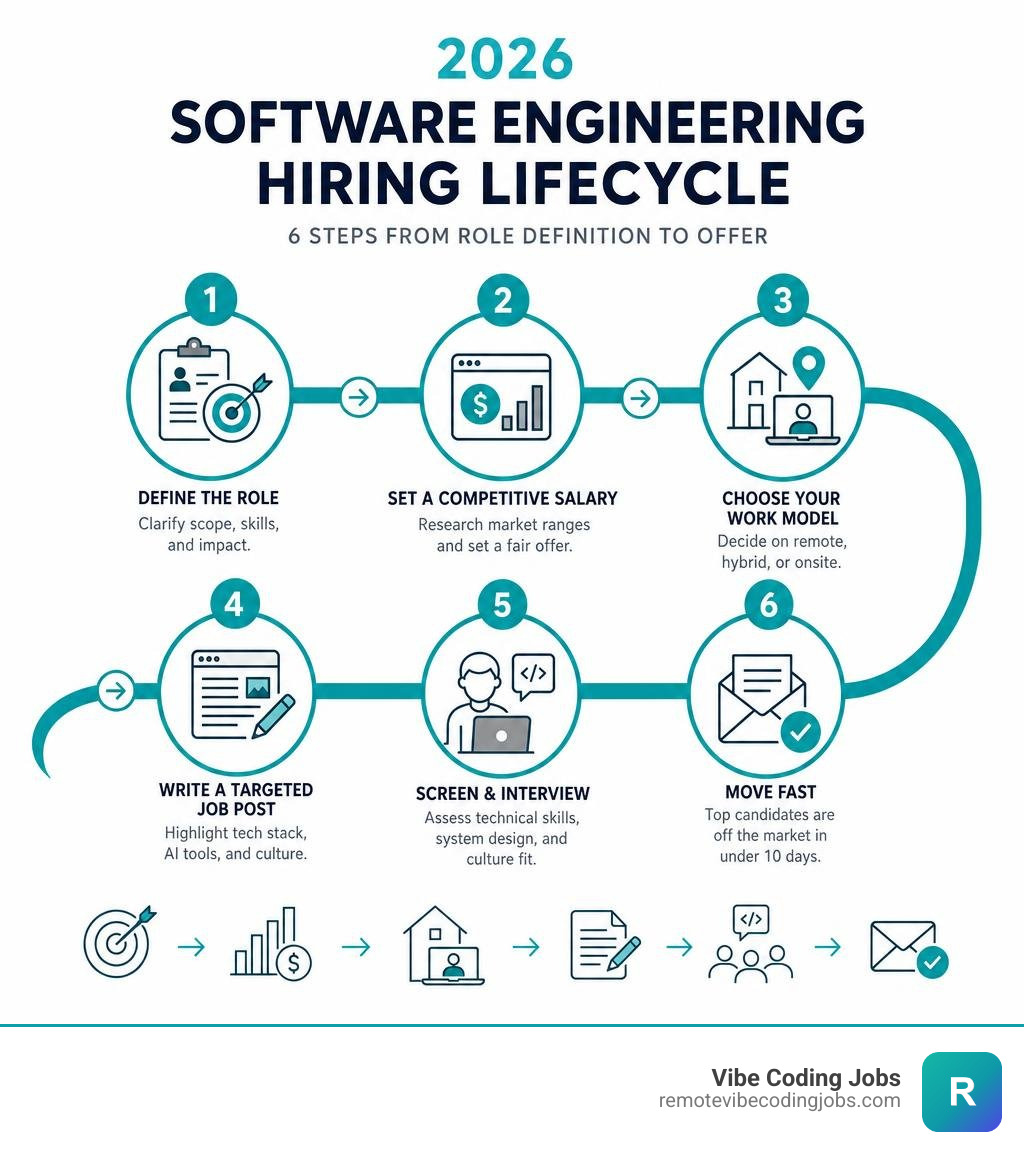
Here’s a quick overview of what the process looks like in 2026:
- Define the role — backend, full-stack, AI-native, embedded, etc.
- Set a competitive salary — LA ranges run from $60K (entry-level) to $313K+ (senior/staff)
- Choose your work model — remote, hybrid, or onsite all affect your talent pool
- Write a targeted job post — highlight tech stack, AI tools, and culture
- Screen and interview — technical assessments, system design, culture fit
- Move fast — top candidates are off the market in under 10 days
The LA market is especially competitive. Companies in Silicon Beach, Santa Monica, and Culver City — including YC-backed startups like GOAT and Karat Financial — are all fishing from the same talent pool. At the same time, remote work has made that pool both bigger and more crowded.
The good news? A clear process makes all the difference. Whether you’re an early-stage startup or a scaling tech company, knowing what engineers want and where to find them puts you ahead of most hiring managers.
I’m RVCJ Editorial, the team behind Remote Vibe Coding Jobs — we cover developer hiring, AI-assisted workflows, and remote engineering careers, with hands-on experience tracking what works when hiring software engineers in today’s fast-moving market. The sections below break down everything you need to hire well without burning out your team.
Simple Hiring software engineers word guide:
Mapping the Los Angeles Tech Landscape for Hiring Software Engineers
To successfully navigate hiring software engineers in the Southern California region, you must understand where the talent gathers. Los Angeles has matured into a top-tier global tech hub, often anchored by the term “Silicon Beach.” This coastal strip—stretching across Santa Monica, Venice, Marina del Rey, and Playa Vista—is home to both massive tech giants and highly funded startups.
However, the geographic footprint of LA tech has expanded. Culver City has emerged as a major hub for entertainment-tech and streaming platforms, while Pasadena houses deep-tech, aerospace, and robotics companies spun out of Caltech and JPL. For companies looking to build out their teams, understanding these neighborhoods is crucial:
- Silicon Beach (Santa Monica & Venice): High concentration of consumer tech, adtech, and social media platforms. Talent here expects premium offices or highly flexible hybrid models.
- Culver City: The intersection of media and technology. High demand for frontend specialists, full-stack product builders, and mobile engineers.
- Downtown LA & Pasadena: Strong focus on enterprise software, fintech, aerospace, and hard tech.
If your company is targeting local candidates, your physical location dictates your talent pool due to LA’s infamous traffic. This is why hybrid and remote-first policies are highly effective tools for talent acquisition. If you want to see who is leading the charge in remote and AI-centric development across the country, check out our guide on the Best Companies Hiring AI Developers to see how modern engineering hubs are structured.
Defining the Roles, Skills, and Tech Stacks in Demand
When hiring software engineers, the first step is pinpointing the exact specialization your product needs. The days of simply posting for a generic “software developer” are long gone. Today, roles are highly segmented, and the rise of AI-assisted development has changed what we look for in candidate profiles.
In the current market, the most in-demand roles fall into several key buckets:
- Backend Engineers: Responsible for system architecture, scalability, database design, and API reliability.
- Full-Stack Engineers: Generalists who can own features end-to-end, moving seamlessly from database queries to UI components.
- Embedded & Robotics Engineers: Highly specialized professionals who program physical hardware, crucial for LA’s booming aerospace, defense, and hardware startup sectors.
- AI/Vibe Coders: Engineers who are highly proficient at using AI-native development tools (like Cursor, Claude Code, and GitHub Copilot) to build and ship software at 3x to 10x the speed of traditional workflows.
Hiring software engineers with specialized skills
If you are looking to build foundational products or rapid prototypes, you may need engineers who specialize in high-ambiguity environments. For example, teams building core platform layers—such as identity, security, payments, and safety—often require deep infrastructure expertise. You can see how leading AI companies structure these roles by reviewing the Full-Stack Software Engineer, Applied Foundations | OpenAI description, which highlights the need for robust, secure, and highly scalable systems.
On the other hand, if your focus is primarily on user interface design, rapid iteration, and user experience, you should focus on dedicated frontend specialists. To streamline this process, you can work with platforms designed to help you Hire Frontend Developers who are already vetted for modern UI frameworks and responsive design practices.
Key programming languages and frameworks required by LA employers
To attract the right talent, your job description must speak the right technical language. In the Los Angeles market, the most frequently requested technologies include:
- Languages: Python (dominant in AI/ML and backend data processing), TypeScript/JavaScript (the standard for modern web applications), Go (highly popular for microservices), and C++ (essential for aerospace, gaming, and robotics).
- Frameworks: React and Next.js dominate the frontend landscape, while Node.js, Ruby on Rails, and Django remain popular backend choices.
- Infrastructure & Cloud: AWS and Google Cloud Platform (GCP) are standard, with container orchestration via Kubernetes and Docker being a baseline requirement for mid-to-senior roles.
For teams building at the absolute cutting edge of enterprise AI applications, the technical bar is even higher. For instance, roles like the Senior Software Engineer, Full-Stack – Scale GP | Careers | Scale AI | Scale AI position require engineers who can seamlessly integrate traditional React/TypeScript frontends with Python-based backend microservices, vector databases, and large language models (LLMs).
Structuring Competitive Compensation and Work Arrangements
To win top talent, you must offer competitive compensation packages. In 2026, candidates look beyond the base salary; they evaluate equity options, performance bonuses, comprehensive healthcare, 401(k) matching, and lifestyle-oriented perks (such as wellness stipends or home office allowances).
Navigating salary ranges for hiring software engineers in 2026
Salary transparency is now the law in California, meaning you must list realistic salary ranges on your job postings. The salary landscape in LA varies widely depending on experience level, company type, and technical specialization:
- Entry-Level (0-2 years): Typically ranges from $60,000 to $160,000, with over 1,000 entry-level software engineering jobs listed across the Orange County and Los Angeles areas.
- Mid-Level (2-5 years): Generally sits between $122,000 and $235,000.
- Senior/Staff (5+ years): Ranges from $178,000 to $313,000+. Major consumer tech companies like Snap Inc. or fast-growing YC startups routinely offer base salaries at the top end of this bracket, paired with significant equity.
To get a broader perspective on how remote compensation compares to local physical markets, explore our comprehensive Remote Senior Software Engineer Salary Guide 2026.
Here is a breakdown of typical base salaries by experience level in the Los Angeles area:
| Experience Level | Typical Salary Range (LA) | Key Focus Areas |
|---|---|---|
| Entry-Level (0-2 Years) | $60,000 – $160,000 | Basic coding, bug fixing, learning workflows, using AI copilots |
| Mid-Level (2-5 Years) | $122,000 – $235,000 | Feature ownership, system integration, database optimization |
| Senior (5+ Years) | $178,000 – $313,000+ | System architecture, team mentorship, scaling infrastructure, AI agent deployment |
Remote, hybrid, and onsite work dynamics
The debate between remote, hybrid, and onsite work is highly active. In Los Angeles, where commute times can easily exceed an hour each way, offering flexible work arrangements is a powerful recruiting tool.

While some hardware, aerospace, and robotics roles strictly require onsite presence, the vast majority of software roles are now either hybrid (2-3 days in the office) or fully remote. Forward-thinking companies are increasingly adopting “async-first” work cultures, which prioritize clear documentation, written communication, and structured workflows over endless Zoom meetings.
To see which companies are leading this operational shift, check out our curated list of Vibe Coding Companies Hiring in 2026 to understand how remote, AI-fluent teams are structuring their daily operations.
Designing an Efficient and Stress-Free Interview Process
A long, disorganized interview process is where good candidates go to die. With the average time-to-fill standing at 66 days, companies that can compress their hiring timeline to 2-3 weeks gain a massive competitive advantage.
To build an efficient pipeline, we recommend a 4-step interview structure:
- Initial Screen (30 mins): A brief conversation to assess mutual alignment on role expectations, salary, and culture.
- Practical Technical Assessment (1-2 hours): Instead of abstract algorithmic puzzles, use a practical exercise. Have candidates build a small feature, debug a realistic codebase, or conduct a system design session that mirrors the actual work they will do.
- Deep-Dive Technical & System Architecture (1 hour): Discuss past projects, architectural trade-offs, and how they collaborate with cross-functional teams.
- Culture & Leadership Fit (45 mins): Ensure alignment with your company values, communication style, and working habits.
Many modern tech companies are moving away from traditional whiteboard tests. If you want to attract top-tier practical builders who thrive on shipping real features rather than memorizing algorithms, consider adopting strategies from our guide on No Leetcode Interview Companies.

Early-stage YC startups vs established tech companies
The hiring process and candidate expectations differ dramatically depending on your company’s maturity.
- Early-Stage YC Startups: These companies must hire for speed, high adaptability, and extreme ownership. Startups cannot afford specialized specialists who only write code; they need product-minded generalists who can talk to customers, prototype rapidly, and handle deployment. Compensation is heavily weighted toward equity, and the hiring timeline is often compressed into days.
- Established Tech Companies: Enterprise employers focus on specialized expertise, process adherence, and operational excellence. For instance, when looking at entry-level programs like the Software Development Engineer – 2026 (US) – Job ID: 3177934 | Amazon.jobs track, the hiring process is highly structured, focusing heavily on leadership principles, scalability, and long-term potential within a massive corporate framework.
Frequently Asked Questions about Hiring Software Engineers
How long does it typically take to fill a software engineering role?
On average, it takes 66 days to hire a software engineer. However, this timeline varies based on specialization. A standard full-stack or frontend role might take 30 to 45 days, while specialized roles in robotics, embedded systems, or niche AI infrastructure can easily take 3 to 6 months to secure the right talent.
What are the most active hiring companies in Los Angeles right now?
Some of the most active employers in the LA tech ecosystem include established consumer-tech brands like GOAT, logistics platforms like Curri, and financial tech infrastructure companies like Karat Financial. Additionally, there is an active crop of early-stage YC startups setting up shop in Silicon Beach. To explore more companies that are aggressively hiring remote, hybrid, and AI-native talent, check out our directory of Companies Hiring Vibe Coders and AI Developers.
What is the entry-level software engineering market like in 2026?
The entry-level market is highly active but incredibly competitive for candidates. There are currently over 1,000 entry-level software engineering jobs listed across the Greater Los Angeles and Orange County areas. To stand out when hiring for these roles, companies typically look for:
- 0-2 years of professional experience (including high-quality internships or co-ops).
- A strong portfolio of live, deployed applications (rather than static school projects).
- Demonstrated proficiency with modern development workflows, including version control (Git) and AI-assisted coding tools (like Cursor or GitHub Copilot) to boost initial output.
- A solid foundation in at least one general-purpose programming language (such as Python, TypeScript, or Java).
Conclusion
Hiring software engineers in 2026 does not have to be a stressful ordeal. By clearly defining your technical requirements, setting transparent and competitive compensation packages, and designing a practical, human-centric interview process, you can attract the absolute best talent the market has to offer.
Furthermore, embracing the transition toward AI-assisted development (or “vibe coding”) allows your team to achieve 3x to 10x faster development cycles, meaning you can build more ambitious products with smaller, highly efficient teams.
At RemoteVibeCodingJobs, we specialize in connecting forward-thinking companies with elite, AI-fluent developers who know how to build fast and communicate asynchronously. If you are ready to scale your engineering team with elite, vetted professionals, you can Hire top talent through Jellyvision to streamline your recruitment pipeline today.