
How to Navigate the New Era of AI Powered Developer Roles
What Are AI Assisted Engineer Roles — and Why They Matter in 2026
AI assisted engineer roles are software engineering positions where developers use AI tools — like Cursor, Claude, or GitHub Copilot — to write, test, and deploy code faster and at higher quality than traditional manual methods.
Here’s a quick breakdown of what defines these roles:
| Feature | AI-Assisted Engineer Role |
|---|---|
| Core focus | Architecture, orchestration, and validation — not manual syntax |
| Key tools | Cursor, Claude, LangChain, LangGraph, vector databases |
| Common tasks | Building LLM pipelines, agentic workflows, RAG systems |
| Top industries | Fintech, healthtech, industrial, professional services |
| Salary range | ~$83K entry-level to $392K+ for senior/distinguished roles |
| Work style | Often remote or hybrid; async-friendly |
The job market has shifted fast. There are now over 37,000 AI engineer positions listed in the United States alone — spanning startups, banks like Citi, industrial giants like Caterpillar, and energy companies like Aker BP. These aren’t niche research jobs. They’re production engineering roles that ship real products.
The bottleneck in software development has moved. It’s no longer how fast you can type — it’s how quickly you can validate, iterate, and deploy. Engineers who understand this shift are landing the most competitive roles and compensation packages in the industry right now.
I’m the RVCJ Editorial team at Remote Vibe Coding Jobs — we cover AI-assisted development, remote hiring trends, and career guidance for developers navigating AI assisted engineer roles using tools like Cursor, Claude, Copilot, and Windsurf. Our coverage spans job market data, real-world role breakdowns, and practical advice for engineers building with AI at the center of their workflow.
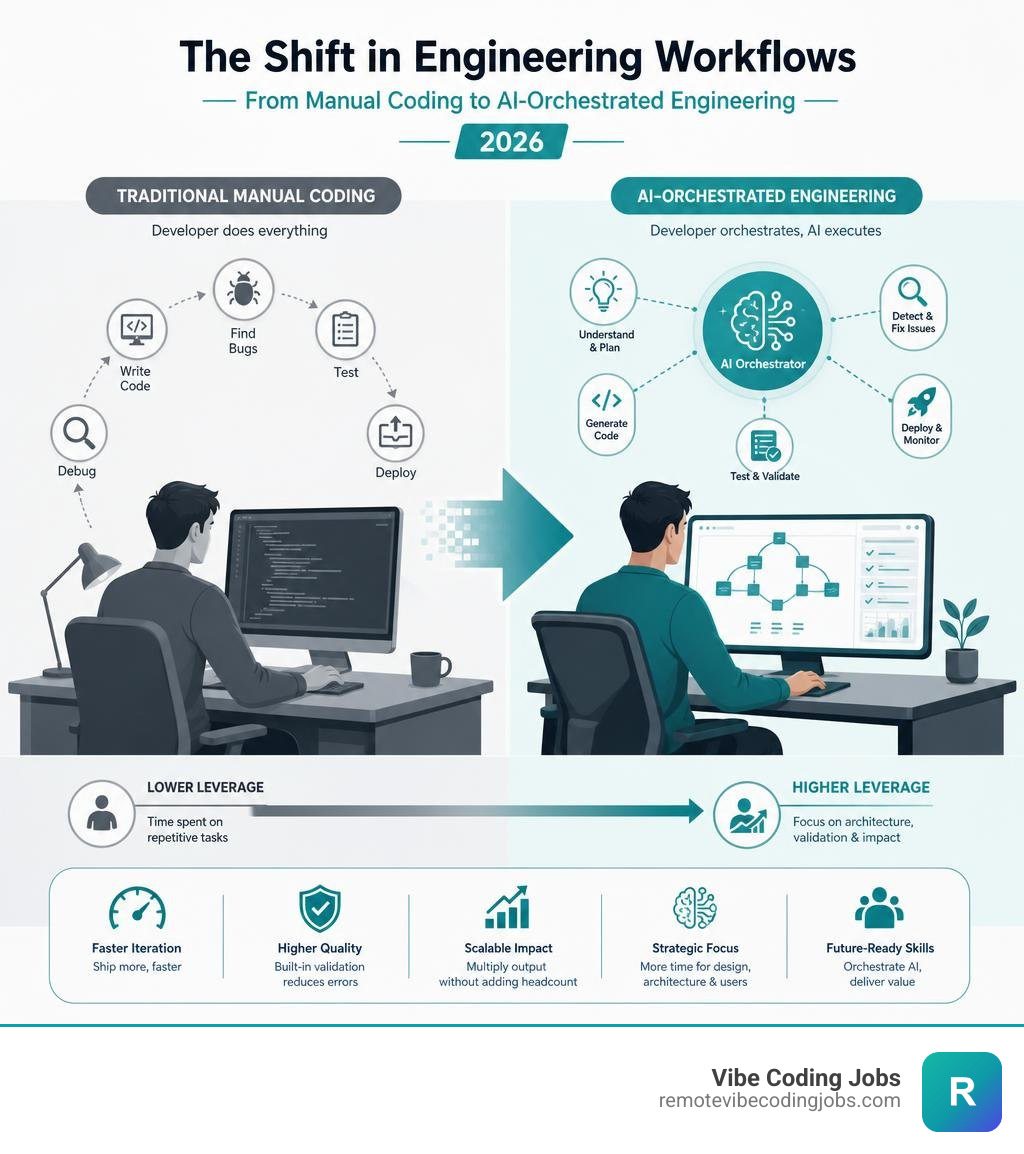
Common AI assisted engineer roles vocab:
The Rise of AI Assisted Engineer Roles in Modern Software Development
The software engineering landscape is undergoing its most profound industry transformation since the transition from assembly language to high-level programming. In 2026, the traditional image of a developer staring at a blank text file, manually typing out repetitive boilerplate code line by line, is rapidly disappearing. Instead, we are witnessing the explosive rise of AI assisted engineer roles—positions designed specifically to leverage generative artificial intelligence to achieve unprecedented levels of productivity.
This shift does not mean human developers are obsolete. Far from it. As we explore in our detailed breakdown, Is AI Replacing Developers The Future of Coding in 2026, AI tools are acting as massive cognitive multipliers. Rather than replacing the human mind, these technologies are shifting the developer’s primary value away from syntax memorization and placing it squarely on high-level system design, logical validation, and creative problem-solving.
What makes this transformation so unique is its speed. Companies across every sector—from lean Silicon Valley startups to century-old manufacturing firms—are realizing that an engineer fluent in AI orchestration can build, test, and ship features up to five times faster than a traditional developer. As a result, the demand for professionals who can seamlessly integrate AI into their daily engineering workflows has skyrocketed, creating a highly lucrative and dynamic new job market.
Defining the AI-Assisted Engineer vs. Traditional Developer
To understand how to navigate this new era, we must first define what makes an AI-assisted engineer fundamentally different from a traditional software developer or a pure data scientist.
A traditional developer spends a massive portion of their day focused on manual syntax—writing boilerplate code, wrestling with compiler errors, manually configuring API integrations, and writing repetitive unit tests. Their value is heavily tied to how deeply they have memorized the syntax of specific languages or the quirks of legacy frameworks.
Conversely, an AI-assisted engineer treats the actual writing of code as a solved problem. They view large language models (LLMs) as highly programmable functions grounded in a specific codebase. Instead of typing out code, their day is spent on system architecture, prompt engineering, and defining the precise logical boundaries of what the software needs to accomplish. They act as directors, orchestrating AI tools to generate the necessary code, while dedicating their own cognitive energy to verifying correctness, managing security, and optimizing system performance.
This distinction is beautifully illustrated by companies actively hiring for these capabilities. For instance, the role of Senior Software Engineer, AI Assisted Engineering Support – Navan focuses specifically on building internal AI engineering assistants and agents. These tools automate code generation, handle complex refactoring, and maintain codebase quality. In this paradigm, the developer’s role is to build “the intelligence layer” for the entire development team, moving the bottleneck from typing speed to rapid validation and deployment.
Core Technical Skills for AI Assisted Engineer Roles
If manual syntax is taking a backseat, what technical skills are companies actually looking for when hiring for AI assisted engineer roles? The modern AI-assisted engineering stack is a blend of robust software engineering principles and cutting-edge AI orchestration frameworks.
Here are the core technical skills currently dominating the job market:
- Languages: Python remains the undisputed king of the AI ecosystem due to its deep integration with machine learning libraries. However, TypeScript and JavaScript are equally vital for building modern frontends, full-stack applications, and API integrations that connect with AI services.
- Agentic Frameworks: Knowing how to build multi-agent systems is one of the most sought-after skills in 2026. This includes hands-on experience with frameworks like LangChain, LangGraph, and Crew.ai, which allow developers to build autonomous, multi-step AI agents that can use tools and reason through complex workflows.
- API and Backend Development: Building lightweight, highly performant microservices is crucial. Frameworks like FastAPI are heavily used to build the backend services that expose LLM pipelines to user interfaces.
- Vector Databases & RAG Pipelines: Because generic LLMs lack real-time or proprietary knowledge, mastering Retrieval-Augmented Generation (RAG) is essential. Engineers must understand how to serialize complex codebases or enterprise data, store them in vector databases (like Pinecone, Milvus, or pgvector), and retrieve relevant context to ground AI models in factual data.
To stay competitive, engineers must treat these tools not as experimental playthings, but as core infrastructure components. For a deeper dive into how these skills translate into long-term career growth, see our guide on AI Assisted Development Career Growth Job Market Opportunities.
Inside the Daily Workflow: Building, Fine-Tuning, and Vibe Coding
What does the day-to-day work actually look like when you step into one of these roles? It is a loop of rapid prototyping, system orchestration, and rigorous testing.
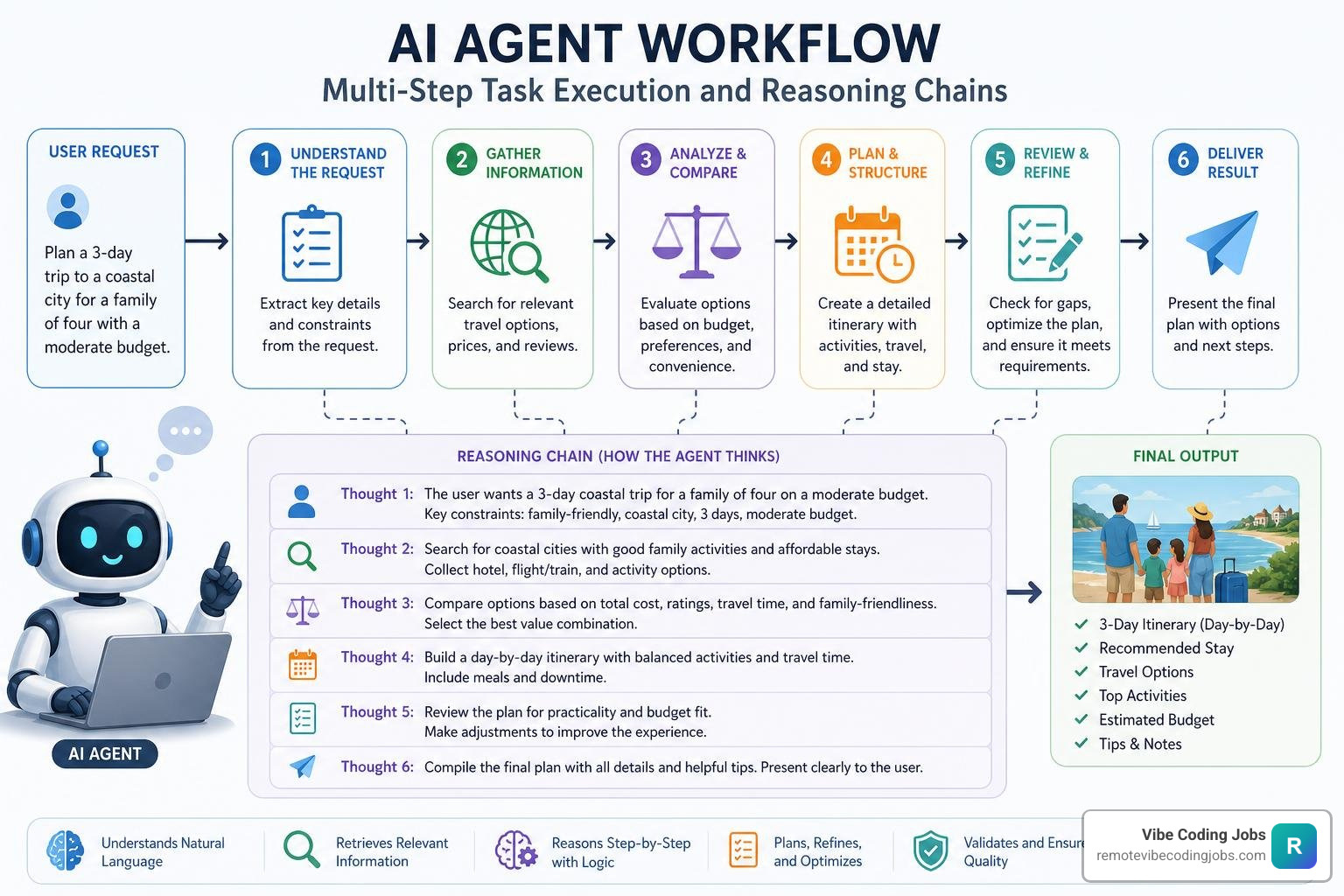
The daily operations of an AI-assisted engineer are highly visual and systemic. Instead of writing code sequentially, developers spend their time configuring agentic workflows, setting up evaluation pipelines, and monitoring model latency.
To illustrate how radically this changes developer productivity, consider this comparison:
| Workflow Phase | Traditional Manual Coding | AI-Assisted “Vibe Coding” |
|---|---|---|
| Boilerplate & Setup | Hours spent manually configuring environments, databases, and routing. | Minutes. AI tools generate complete, working scaffolding from a natural language prompt. |
| Feature Implementation | Writing logical structures, loops, and integrations line-by-line. | Prompting AI to write features, then reviewing, adjusting, and accepting code blocks. |
| Debugging & Errors | Manually searching stack traces, looking up documentation, and guessing solutions. | Feeding the error trace back to the AI for instant diagnosis and targeted code fixes. |
| Testing | Writing repetitive unit tests and integration tests by hand. | Instructing the AI to generate comprehensive test suites based on the code’s behavior. |
| Primary Focus | Syntax, implementation details, and language-specific rules. | System architecture, security, performance, and user experience. |
The Shift to Vibe Coding and Rapid Prototyping
At the heart of this workflow evolution is a concept known as vibe coding. While the term sounds casual, it represents a highly efficient paradigm of rapid prototyping. Vibe coding refers to the practice of using natural language prompts to guide advanced AI coding environments—such as Cursor, Claude, and WindSurf—to build entire applications or features at the speed of thought.
In a vibe coding workflow, the engineer acts as the creative director. They describe the desired feature, the database schema, and the user flow in plain English (or structured markdown). The AI editor then handles the heavy lifting: generating the frontend components, setting up the API endpoints, and writing database migrations.
This allows developers to bypass the tedious “blank page” phase of software development. Instead of spending days building a basic proof-of-concept, an AI-assisted engineer can ship a fully functional prototype in a matter of hours. The developer’s focus shifts instantly to refining the user experience, hardening security protocols, and optimizing the system architecture.
Orchestrating Multi-Agent Systems and LLM Pipelines
Once a prototype is established, the daily work shifts toward building production-grade intelligence. This rarely involves a single, simple call to an OpenAI or Anthropic API. Instead, AI-assisted engineers build complex, multi-step agentic workflows and LLM pipelines.
These systems are designed to handle complex business processes by breaking them down into logical chains of action. For example, an agent might receive an unstructured user request, run a reasoning chain to determine the user’s intent, call an external database tool to retrieve relevant customer records, validate the retrieved data, and then generate a structured, auditable response.
This level of engineering is highly visible in industrial and enterprise applications. For example, the Lead Software Engineer, Gen AI at Caterpillar is tasked with building multi-agent systems, context management layers, and long-term memory architectures. These systems power AI-infused processing pipelines and autonomous assistants for global industrial operations. In these environments, the engineer must ensure that the agents possess robust tool-use capabilities, clear fallback logic, and strict output validation to prevent unpredictable behavior in high-stakes settings.
How Companies Structure and Hire for AI-First Engineering Teams
As organizations realize the massive leverage that AI-assisted engineers bring to the table, they are fundamentally restructuring their technical teams to maximize this productivity.

Hiring trends indicate that companies are no longer looking for isolated AI research labs. Instead, they want cross-functional builders who can integrate AI directly into existing business processes.
Organizational Alignment: Product, Platform, or Dedicated AI Pods
When a company hires an AI-assisted engineer, where do they actually sit within the organization? Currently, we see three primary organizational models:
- Dedicated AI Delivery Pods: Many forward-thinking companies are building highly focused, cross-functional pods aligned to specific business domains. These pods are designed to act as the “cross-functional glue” between business leaders and deep technical infrastructure. A prime example of this model is seen at energy giant Aker BP, which is building seven distinct AI delivery pods to transform into an AI-native company. Within these pods, the AI Solutions Engineer – Aker BP acts as the technical anchor, translating complex business challenges into production-ready AI solutions while collaborating closely with security, MLOps, and data governance teams.
- Platform Engineering Teams: In larger enterprises, AI-assisted engineers often sit on platform teams. Their job is to build the shared “intelligence layer”—such as custom IDE extensions, internal RAG platforms, and centralized LLM API gateways—that enables all other developers in the company to build AI features safely and consistently.
- Product Engineering Teams: In highly agile startups and product-focused companies, AI-assisted engineers are embedded directly into product teams. They own features end-to-end, leveraging AI to build user-facing capabilities like autonomous agents, smart search, and personalized recommendation engines.
Compensation Benchmarks and High-Demand Industries
Because the productivity gains of AI assisted engineer roles are so clear, companies are offering incredibly competitive compensation packages to attract top talent. The hiring boom is particularly aggressive in fintech, healthtech, professional services, and heavy industrial sectors where automation yields immediate financial returns.
According to real-world job market data from mid-2026, typical salary ranges span a wide spectrum based on experience and location:
- Entry-Level / Junior: $83,000 to $110,000 annually.
- Mid-Level / Senior: $140,000 to $200,000+ (with companies like Sentry offering $150K–$190K, and Workday listing senior roles up to $288K).
- Staff / Principal: $170,000 to $330,000.
- Distinguished / Director: $280,000 to $392,000+ (particularly in high-cost hubs like NYC and San Francisco).
For a comprehensive breakdown of remote compensation benchmarks and how to position yourself for these premium salaries, check out our guide, Remote Machine Learning Engineer Jobs Your 2026 Guide.
Key Challenges, Risks, and Mitigation Strategies in Production
While the speed of AI-assisted development is exhilarating, deploying these systems into production environments comes with unique, high-stakes challenges. “It seemed to work when I prompted it” is not a valid shipping criterion for enterprise software.
Managing Technical Debt, Model Drift, and Hallucinations
When engineers use AI to generate large volumes of code quickly, they run the risk of introducing massive technical debt. If the generated code is not thoroughly reviewed, modularized, and documented, the codebase can quickly become a tangled, unmaintainable mess. AI-assisted engineers must maintain strict software craftsmanship standards, using robust code review processes to ensure the generated code is clean and auditable.
Furthermore, running AI models in production introduces challenges like model drift (where a model’s performance degrades over time as real-world data changes) and the ever-present threat of hallucinations (where the model confidently generates false information).
To mitigate these risks, production-grade AI engineering requires:
- Deterministic Evals: Setting up automated evaluation pipelines that run hundreds of structured tests against the LLM’s outputs to measure accuracy, latency, and safety before code is shipped.
- Explicit Fallback Logic: Designing systems that detect when an LLM is uncertain or when an API call fails, seamlessly routing the request to a traditional deterministic algorithm or a backup model.
- Human-in-the-Loop Checkpoints: Implementing manual validation gates for high-risk actions, such as executing financial transactions or generating legally binding documents.
Career Progression and Future Outlook for AI Assisted Engineer Roles
As the field matures, clear career progression paths are emerging for AI-assisted engineers. Developers are no longer limited to moving up the traditional “Junior to Senior to Manager” ladder.
Instead, they can transition into highly specialized, high-impact roles:
- AI Systems Architect: Designing the complex, enterprise-wide infrastructure that connects data warehouses, vector databases, and LLM orchestration layers.
- AI Platform Leader: Guiding the development of internal tools, guardrails, and developer platforms that empower entire organizations to build with AI safely.
- Applied AI Research Lead: Bridging the gap between cutting-edge academic model research and practical, production-ready product features.
For those just starting out, the entry-level market is highly accessible if you possess the right project portfolio. Learn how to break into the industry with our guide on AI Coding Jobs Entry Level Market Remote.
Frequently Asked Questions about AI-Assisted Engineering
What is the difference between an AI engineer and a traditional software engineer?
While a traditional software engineer focuses heavily on writing manual syntax, managing compiler rules, and building deterministic logic, an AI engineer focuses on orchestration, system architecture, and managing non-deterministic systems. AI engineers treat LLMs as programmable components, using prompt engineering, RAG pipelines, and agentic frameworks to build intelligent applications, prioritizing system validation over manual typing.
What are the most important tools to learn for AI-assisted development?
To excel in AI assisted engineer roles, you should master:
- AI Editors: Cursor, Claude, and WindSurf for daily “vibe coding” and rapid prototyping.
- Orchestration Frameworks: LangChain, LangGraph, and Crew.ai for building multi-agent pipelines.
- Data & Context: Vector databases (Pinecone, pgvector) and RAG architecture.
- Backend Scaffolding: Python, TypeScript, and FastAPI for building performant APIs.
How much can you earn in an AI-assisted engineering role?
Salaries are highly competitive. Entry-level roles typically start around $83,000 to $110,000. Mid-to-senior engineers can easily command between $140,000 and $250,000, while Staff, Principal, and Distinguished AI Engineers at major enterprises or funded startups frequently earn between $280,000 and $392,000+ in total compensation.
Conclusion
The era of the manual syntax-writer is giving way to the era of the AI-orchestrator. Navigating AI assisted engineer roles requires a shift in mindset: moving from “how do I write this code?” to “how do I architect, validate, and scale this system?”
At RemoteVibeCodingJobs, we specialize in helping developers make this transition. We aggregate remote “vibe coding” (AI-assisted development) jobs at forward-thinking, async-first companies. Our platform offers curated daily listings filtered by culture, tech stack, and your favorite AI tools like Cursor and Claude.
Ready to land your next high-leverage role? Explore our curated job board and Find Remote Cursor and Copilot Developer Jobs to kickstart your career in the AI-first era today!