
Digital Footprints and Culture Matched AI Jobs
Why Culture Matched AI Jobs Are Changing How Developers Find Work
Culture matched AI jobs are roles at AI and tech companies where hiring goes beyond skills — matching candidates to organizations based on shared values, work styles, and team dynamics.
Here’s what that looks like in practice:
| What You Care About | What to Look For |
|---|---|
| Async-first work | No standups, minimal meetings, deep work culture |
| Flat hierarchy | Anyone can contribute, best idea wins |
| Ethical AI | Mission-driven, safety-conscious teams |
| Engineering-driven | Builders in charge, not managers |
| High trust, low politics | Autonomy, ownership, no micromanagement |
Finding a job that pays well is hard enough. Finding one where you’ll actually thrive — where the culture matches how you work best — is even harder.
The traditional hiring process focuses almost entirely on technical skills. Can you write Python? Have you shipped LLM systems? Check, check. But skills alone don’t predict whether you’ll last two years at a company or burn out in six months.
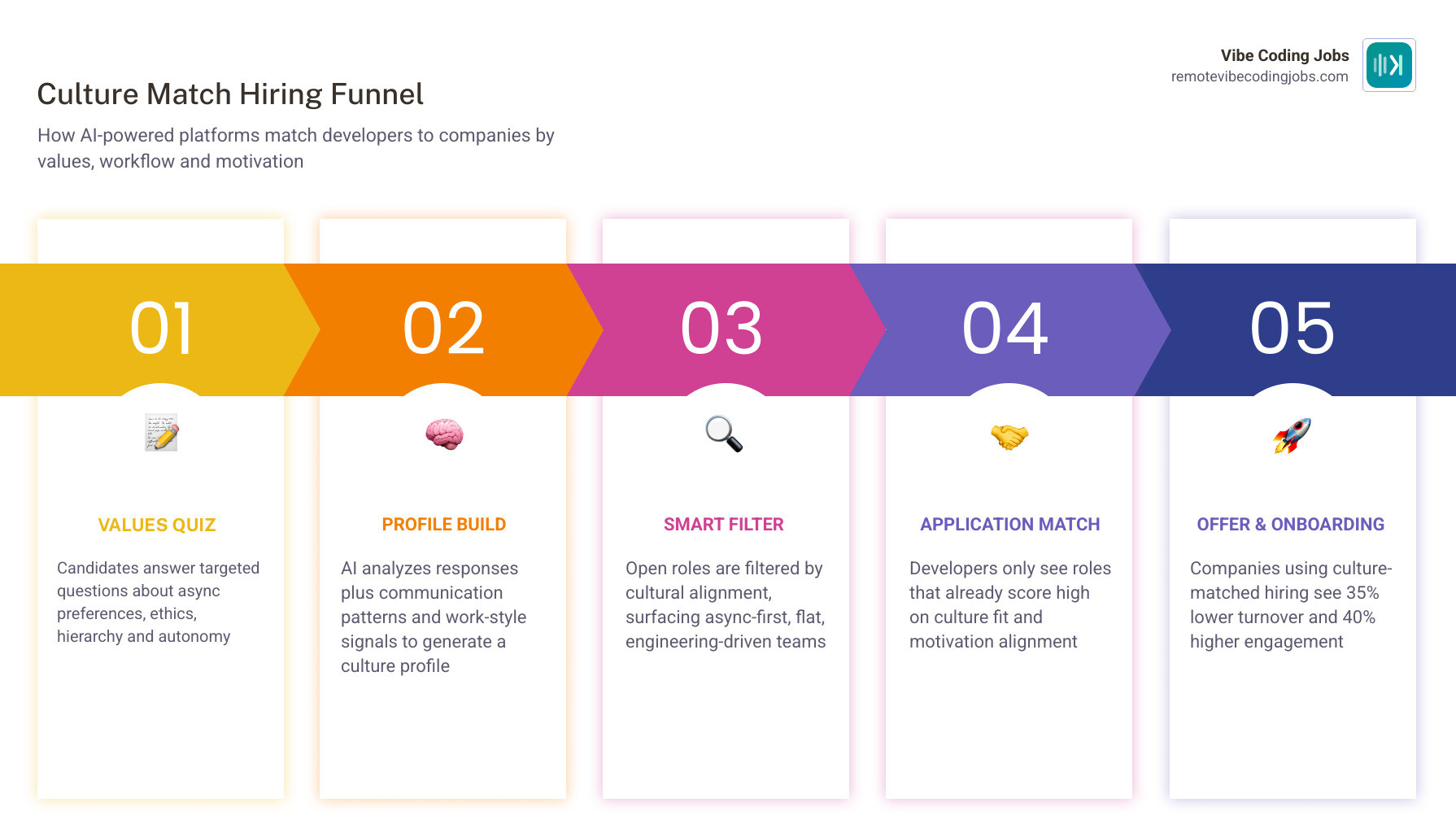
That’s shifting fast. By May 2026, platforms built on real employee reviews — not company marketing copy — are helping developers filter roles by culture values like “Async-First,” “Flat Hierarchy,” and “Ethical AI” before they even look at the job description. AI-powered matching tools now analyze communication styles, work preferences, and motivation alongside technical fit. The result? Companies using culture-matched hiring report a 35% reduction in employee turnover in the first year alone.
For developers who live in tools like Cursor, Claude, and GitHub Copilot, culture fit isn’t a soft concern — it’s a workflow concern. An async-first company means no one interrupts your flow state. An engineering-driven culture means you’re not fighting for resources. A high-trust environment means you ship things instead of attending meetings about shipping things.
This guide breaks down exactly how to find, evaluate, and land culture-matched AI jobs that fit the way you actually work.
I’m RVCJ Editorial, the team behind Remote Vibe Coding Jobs — we cover AI-assisted development, async hiring trends, and remote career guidance for developers navigating the fast-moving world of culture matched AI jobs. We’ve spent years tracking how AI-native companies hire, what makes engineering cultures actually work, and where the best-fit opportunities are hiding.
Simple guide to culture matched ai jobs:
Defining Culture Matched AI Jobs in 2026
In the landscape of May 2026, culture matched AI jobs represent a fundamental pivot in how we think about employment. It’s no longer just about whether you can tune a hyperparameter or orchestrate a multi-agent system; it’s about whether your “digital footprint”-your work habits, communication style, and ethical compass-aligns with the company’s internal “vibe.”
At Vibe Coding Jobs, we see this manifest through curated culture values. Instead of reading “marketing fluff,” candidates are looking at real employee feedback to find companies that offer true autonomy. For some, that means an environment with “open-source DNA” where anyone can push to main. For others, it’s a mission-driven focus on AI safety, a topic often discussed more broadly in resources like Artificial intelligence safety.
The Shift from Skill-Only to Culture Matched AI Jobs
Traditional hiring was a keyword game. If your resume said “Python” and “LLM,” you got a call. But the industry realized that technical skill is the baseline, not the finish line. Today, companies are using AI to analyze implicit signals to predict fit. This includes:
- Communication Styles: Does the candidate thrive in the long-form, thoughtful writing required for Async First Remote Developer Jobs?
- Problem-Solving Patterns: AI tools can now identify innovative patterns in how a developer approaches a bug, looking for “vibe” markers like curiosity and resilience rather than just the final code.
- Behavioral Dynamics: Smart matching engines look for collaborative decision-making styles that fit within flat hierarchies, ensuring a new hire won’t struggle with a lack of traditional “boss” figures.
Identifying AI-Native Organizations
An AI-native organization is one where the culture is built around the capabilities of modern tools. In these companies, you aren’t just using an AI assistant; your entire workflow revolves around it. You might find yourself at a company that manages over 100 microservices where LLMs handle the boilerplate, allowing you to focus on high-level architecture.
According to our No BS Tech Companies Hiring Remotely guide, these meritocratic cultures prioritize “shipping” over “researching.” They use tools like Cursor and Claude Code to prototype in hours what used to take weeks. If a company values “deep work” and has zero standups, they are likely an AI-native firm that understands the value of a developer’s flow state.
The Business Case for Cultural Alignment in AI Teams

Why are companies obsessed with culture matched AI jobs? Because the data is undeniable. When a team “clicks,” the output isn’t just slightly better—it’s exponentially more effective.
| Metric | Traditional Hiring | Culture-Matched Hiring |
|---|---|---|
| First-Year Turnover | Baseline | 35% Reduction |
| Employee Engagement | Baseline | 40% Increase |
| Team Productivity | Baseline | 20% Higher |
| Time-to-Hire | ~23 Days | ~9 Days |
As noted in our breakdown of Remote Developer Jobs AI Tools Benefits Stack Workflow, the cost of a “bad vibe” hire in AI is massive. In a field where systems are complex and the pace is grueling, a single toxic personality or a mismatch in work-life expectations can derail an entire product cycle.
Impact on Innovation and Retention
Culture-matched teams demonstrate 20% higher productivity. Why? Because they spend less time navigating politics and more time building. When you hire for cultural alignment, you aren’t just filling a seat; you’re ensuring long-term growth. Professionals who feel their values are reflected in their work are 25% more likely to stay, reducing the “brain drain” that plagues most tech giants. High-retention AI engineering roles are almost always found in companies that prioritize this alignment over pure technical wizardry.
Reducing Time-to-Hire with Smart Matching
By using advanced matching algorithms, organizations are seeing a 30% reduction in time-to-hire. Instead of sifting through thousands of irrelevant resumes, AI-driven match scores surface the top talent who already understand the mission. This isn’t just about speed; it’s about quality. When one in five interviewed candidates receives an offer (compared to the industry average of one in fifty), you know the matching is working.
How to Find and Assess Culture Matched AI Jobs

Finding these roles requires a different strategy than the “spray and pray” application method of the past. You need to look for transparency and real-world feedback.
- Take Culture Quizzes: Use tools that ask you what you care about—whether it’s eco-friendly missions or startup environments.
- Analyze the Tech Stack: Does the company use “Vibe Coding” tools? Check out Vibe Coding Career Path Remote Jobs Benefits Interview Tips to see if their workflow matches your preferred tools like Cursor or Claude.
- Read the “Undercurrent”: Look for reviews on sites like Glassdoor or Blind, but filter for mentions of “autonomy,” “trust,” and “politics.”
Navigating the Market for Culture Matched AI Jobs
The market is currently flooded with roles, but the “best” ones are often hidden. To find them, use filters for “Async-First” or “Flat Hierarchy.” Companies like those listed in our Best Companies Hiring AI Developers list often skip the major job boards entirely, preferring to hire from specialized communities where the culture is already established.
Salary transparency is another major marker. In 2026, a culture-matched role usually comes with a clear salary range—often between $150k and $490k for senior AI roles—right in the job description. If they’re hiding the pay, they’re likely hiding other cultural red flags too.
Evaluating Technical Vibe and Workflow
Before you sign an offer, you need to understand the “technical vibe.” This is where Vibe Coding Jobs Remote Career Interview Culture comes in. Ask these questions during the interview:
- “Do you use AI co-pilots for boilerplate, or is manual coding required for everything?”
- “How do you handle prompt versioning and evaluation suites?”
- “Is the engineering team allowed to choose their own tools (like Cursor or Windsurf)?”
A company that forces you to use outdated workflows isn’t an AI-native organization, no matter what their “About Us” page says.
Balancing Technical Excellence with Cultural Fit
There is a common misconception that hiring for “fit” means lowering the bar for “skill.” In culture matched AI jobs, the opposite is true. We are looking for people who are so technically proficient that they can lead the shift toward AI-assisted development.
For example, a Senior AI Systems Engineer specializing in LLM orchestration and multi-agent systems isn’t just writing prompts; they are designing multi-layer architectures with core, companion, and situational protocols. This requires a high level of “backend thinking” combined with an understanding of the specific cultural context—in this case, theological consistency and Spanish-first communication.
Building Diverse and Cohesive AI Teams
One of the greatest benefits of AI-driven culture matching is the ability to find “transferable skills” in non-traditional backgrounds. We’ve seen teachers move into tech by mapping classroom management to stakeholder management, and gaming PMs improve financial products through engagement strategies.
By focusing on success patterns rather than just industry experience, companies can build teams that are diverse in background but cohesive in values. This is essential for Remote Work Pros Cons 2026, where a shared understanding of “how we work” replaces the physical proximity of an office.
The Role of AI in Cultural Content Training
Culture isn’t just about the employees; it’s about the products they build. Roles like AI Cultural & Humor Content Specialists are proof that culture is becoming a technical requirement. These specialists train AI to understand humor, pop culture, and conversational nuances.
To succeed here, you need:
- Native-level fluency in the target culture’s conversational style.
- Deep pop culture knowledge to explain jokes and archetypes.
- Creative writing skills to vary tone and maintain human-likeness.
Frequently Asked Questions about AI Culture Matching
What are the top culture values for AI engineers in 2026?
The most sought-after values are Async-first (respect for deep work), Ethical AI (commitment to safety and transparency), Engineering-driven (leadership that understands the code), and High-trust environments (autonomy to ship without micromanagement). Many also look for Flat hierarchies where the best argument wins, regardless of seniority.
How does AI-driven matching reduce hiring bias?
AI-powered tools used in modern recruitment use objective data and pattern recognition to evaluate candidates. By focusing on “implicit signals” like problem-solving style and communication patterns rather than just names or universities, these tools can surface talent that human recruiters might overlook, promoting a fairer, more diverse workforce.
Can I find culture-matched roles for remote vibe coding?
Absolutely. In fact, most “vibe coding” roles are inherently remote-first. Check our Vibe Coding Remote Benefits Culture Career guide for a deep dive. These companies specifically look for developers who use AI tools like Cursor and Claude to work faster and more independently, making them perfect for async-first, remote cultures.
Conclusion
The era of the “faceless” AI job is over. As we move through 2026, your digital footprint—the way you code, communicate, and collaborate—is your most valuable asset. By seeking out culture matched AI jobs, you aren’t just finding a paycheck; you’re finding a team that empowers you to do your best work.
Whether you’re a Senior AI Engineer building multi-agent systems or a Job Posting for Developer Community and Talent Lead scaling a network of world-class builders, the goal remains the same: find the vibe that matches your own.
Ready to stop searching and start matching? Find your next culture matched AI job on Remote Vibe Coding Jobs today.