
Why Vibe Coding Had to Grow Up into Context Engineering
Why Vibe Coding Had to Grow Up: Prompt Engineering vs Context Engineering
The debate around prompt engineering vs context engineering is one of the most important shifts happening in AI-assisted development right now — and if you’re building with AI tools daily, it directly affects how reliable your output is.
Here’s the short answer:
| Prompt Engineering | Context Engineering | |
|---|---|---|
| What it is | Crafting the right instruction or question | Curating everything the model sees |
| Scope | Single input-output pair | Full session: history, docs, tools, memory |
| State | Stateless | Stateful |
| Scalability | Breaks at enterprise scale | Built for production |
| Skill type | Linguistic craft | Systems architecture |
| Best for | One-off tasks, quick outputs | Multi-step agents, consistent production AI |
Think of it this way: prompt engineering is how you talk to the model. Context engineering is what you let it read.
Both matter. But as AI tasks get more complex — multi-file edits, long agent sessions, enterprise workflows — the context layer becomes the real differentiator between AI that works in a demo and AI that works in production.
In the early days of tools like ChatGPT, writing a clever prompt felt like a superpower. But as Andrej Karpathy and others have noted, the future of reliable AI isn’t better phrasing — it’s better context management.
We’re at an inflection point. Vibe coding got developers building fast. Context engineering is what makes what they build actually hold up.
As RVCJ Editorial — covering AI-assisted development, remote work trends, and modern engineering workflows — we’ve tracked the prompt engineering vs context engineering debate closely as it moved from Twitter threads to production infrastructure decisions at serious engineering teams. In the sections below, we’ll break down exactly what changed, why it matters, and how to think about both disciplines together.
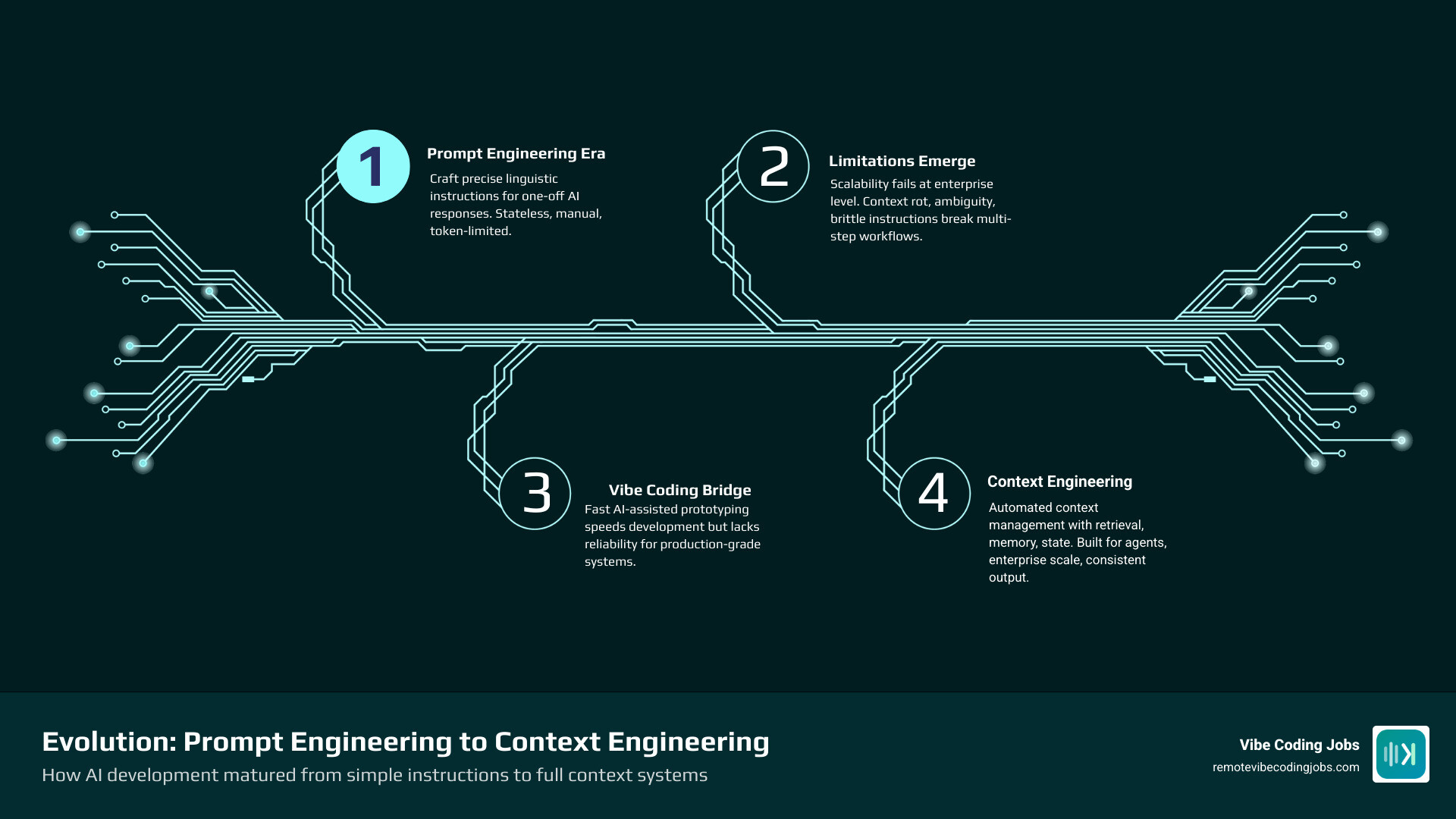
Explore more about prompt engineering vs context engineering:
Defining the Shift: Prompt Engineering vs Context Engineering
In the landscape of May 2026, we have moved past the era where “AI whisperers” were the most sought-after experts. While 76% of developers now use or plan to use AI coding tools, the way we interact with these models has fundamentally matured. The shift from prompt engineering vs context engineering represents a move from linguistic craft to system architecture.
Prompt engineering is essentially a sentence-level skill. It focuses on the phrasing, the tone, and the structure of the instruction. It asks the question: “How should I word this so the LLM understands?” It’s the user-facing layer, often involving techniques like few-shot prompting or chain-of-thought reasoning. Research from early 2025 showed that chain-of-thought techniques could improve reasoning accuracy by 15-30% on multi-step tasks, proving that how we ask still matters.
However, context engineering is a systems-level craft. It isn’t just about the instruction; it’s about the entire informational environment the model inhabits. It involves programmatically assembling the system prompts, the retrieved documents (RAG), the conversation history, and the tool outputs. In a modern production AI system, the user’s prompt might only account for 5% of the total tokens, while the other 95% is managed by context engineering.
As explained in the Context Engineering vs Prompt Engineering: The Difference Explained (2026) | SurePrompts, the leverage has shifted. Prompt engineering optimizes the instruction, while context engineering optimizes the evidence the model reasons over.
The Limitations of Prompt Engineering vs Context Engineering at Scale
Why did prompt engineering hit a ceiling? The problem is scalability and state. Prompt engineering is inherently stateless. Every time you start a new chat, you have to “re-explain” the rules, the style, and the codebase. For a single-turn task, like writing a regex, this is fine. But for building a complex feature across a monorepo, it’s a nightmare of manual copy-pasting.
This is where the “vibe” starts to break. To understand the roots of this, you can read more about what is vibe coding. Vibe coding allowed us to move fast by following our intuition, but at scale, “vibes” aren’t reproducible.
The limitations of a prompt-only approach include:
- Brittle Instructions: Small changes in wording can lead to wildly different results.
- Manual Tweaking: Developers spend up to 30% of their time reactive-fixing prompts that break after model updates.
- Information Silos: The model only knows what you’ve pasted in, missing the “institutional knowledge” hidden in Slack threads or Jira tickets.
Context engineering addresses this by treating the input as an automated data pipeline. Instead of a human manually crafting a 500-word prompt, a system assembles a 50-word template with 40,000 tokens of perfectly curated, relevant data.
Diagnosing Failures in Prompt Engineering vs Context Engineering
When an AI agent fails, how do we know where to look?
If the model saw the right data but gave a bad answer (wrong format, weird tone), you have a prompt engineering problem. This is usually solved with better linguistic constraints or role framing.
However, if the model hallucinated because it didn’t have the latest API docs, or if it “forgot” the goal of the conversation after 20 turns, you have a context engineering problem. One common failure mode is “Context Rot,” where the quality of the model’s response degrades as the conversation history grows and becomes a “mush” of irrelevant tokens. Another is “Grounding Errors,” where the model prioritizes its internal training data over the specific business rules you provided.
To avoid these, modern vibe coding tools have started integrating automated context management, ensuring that the “mental world” of the model stays sharp and relevant.
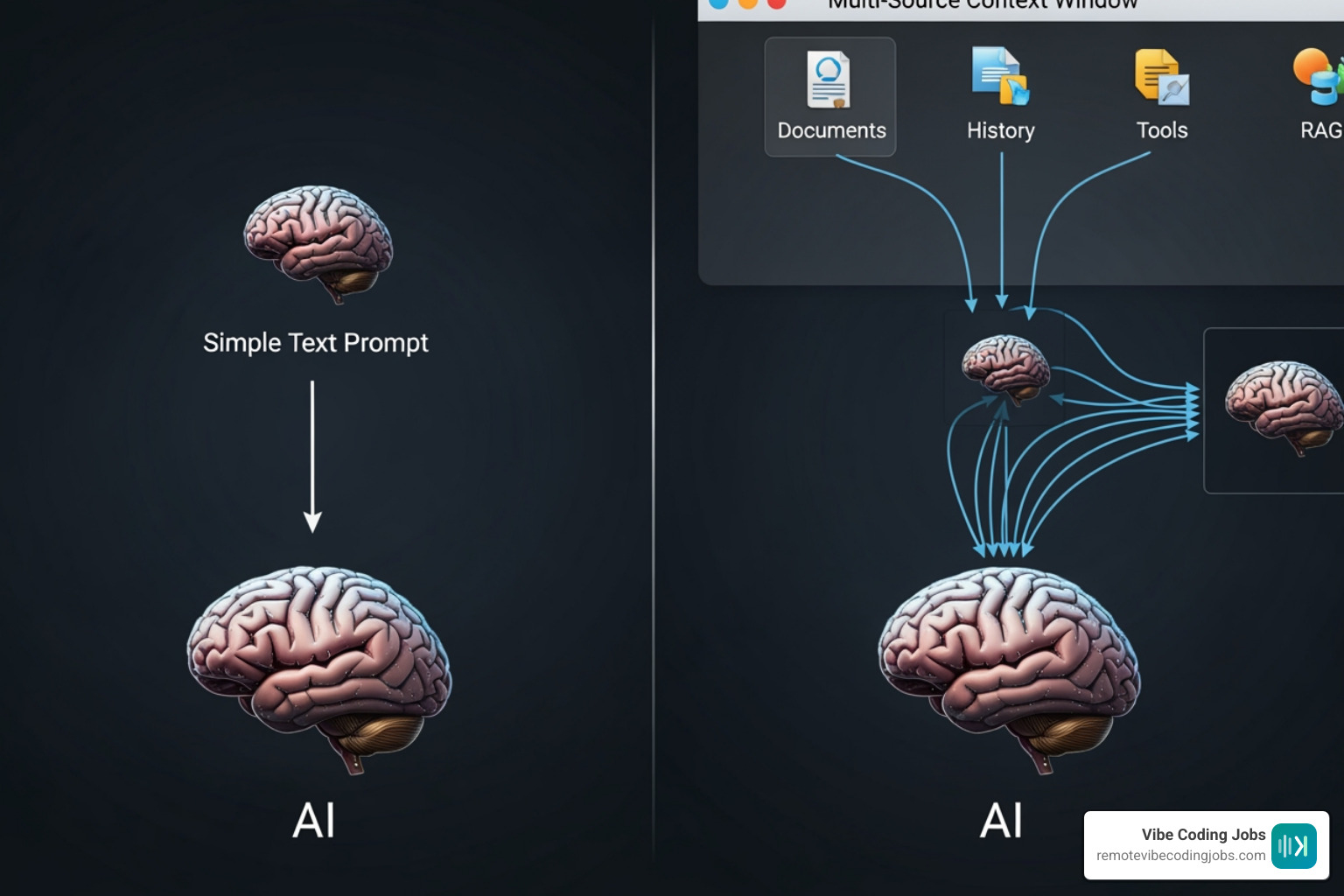
Why Context Engineering is the New Enterprise Standard
For enterprises, the stakes are higher than “getting a cool demo to work.” Reliability and output consistency are the primary barriers to AI adoption. This is why context engineering has become the gold standard.
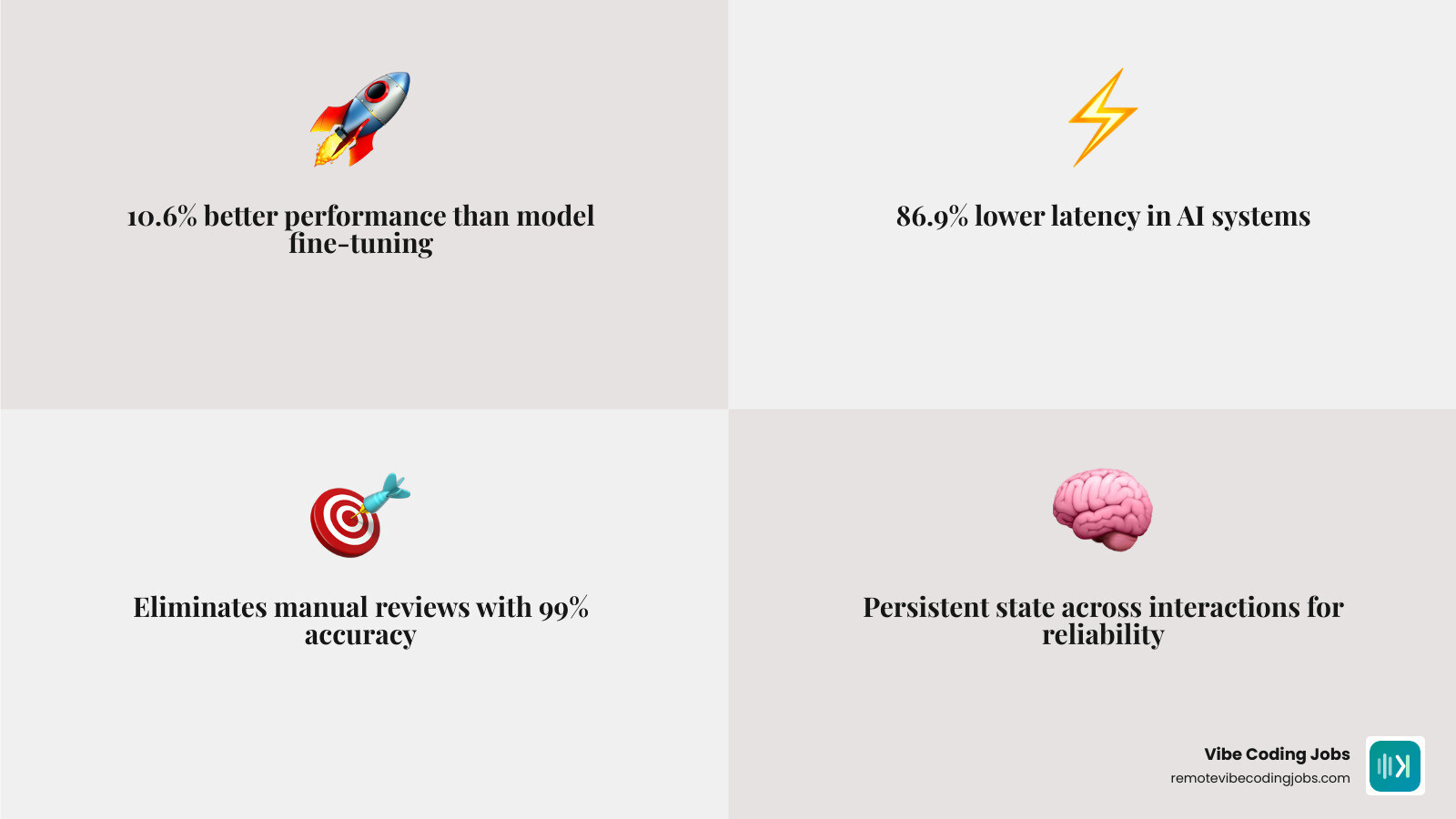
By December 2025, research showed that context editing delivers 10.6% better performance than model fine-tuning, with a staggering 86.9% lower latency. For a company like HomeLight, implementing context engineering allowed them to achieve 99% accuracy and eliminate manual reviews.
As noted in the Context vs Prompt Engineering: December 2025 Guide | Extend, context engineering provides a persistent state across interactions. It allows an AI system to “remember” business rules, document schemas, and historical decisions without them being hardcoded into every single prompt.
Moving Beyond the “LLM Whisperer”
The era of the “LLM Whisperer” has evolved into the era of the AI System Architect. We are moving from “artisan” hand-crafted prompts to “industrial” design.
In this new paradigm, we don’t just ask the AI to “be a senior engineer.” We build a system that feeds it the specific FastAPI schemas, the recent error logs, and the team’s API style guide from Confluence. This is what we call “decision-grade context.”
If you’re just starting out, our learn vibe coding tutorial can help you bridge the gap between simple instructions and these more complex, context-aware workflows. The goal is to move from “what to know” instructions to “how to act” instructions, letting the automated context pipeline handle the “knowledge” part.
Addressing the Attention Budget
Even with the massive context windows of 2026 (some reaching millions of tokens), we still have an “attention budget.” LLMs use transformer architecture, which has a quadratic complexity relative to sequence length. This means that as you add more tokens, the model’s attention can get diluted.
The “lost-in-the-middle” phenomenon is a real risk: models often pay more attention to the very beginning and the very end of the context window, ignoring crucial details buried in the center.
Context engineering solves this through:
- Token Prioritization: Deciding which information is “high-signal” and which is “noise.”
- Signal Distillation: Summarizing long histories into concise “state” snapshots.
- Strategic Ordering: Placing the most critical instructions and data at the start or end of the window where attention is highest.
The Architecture of Context: Retrieval, Memory, and State
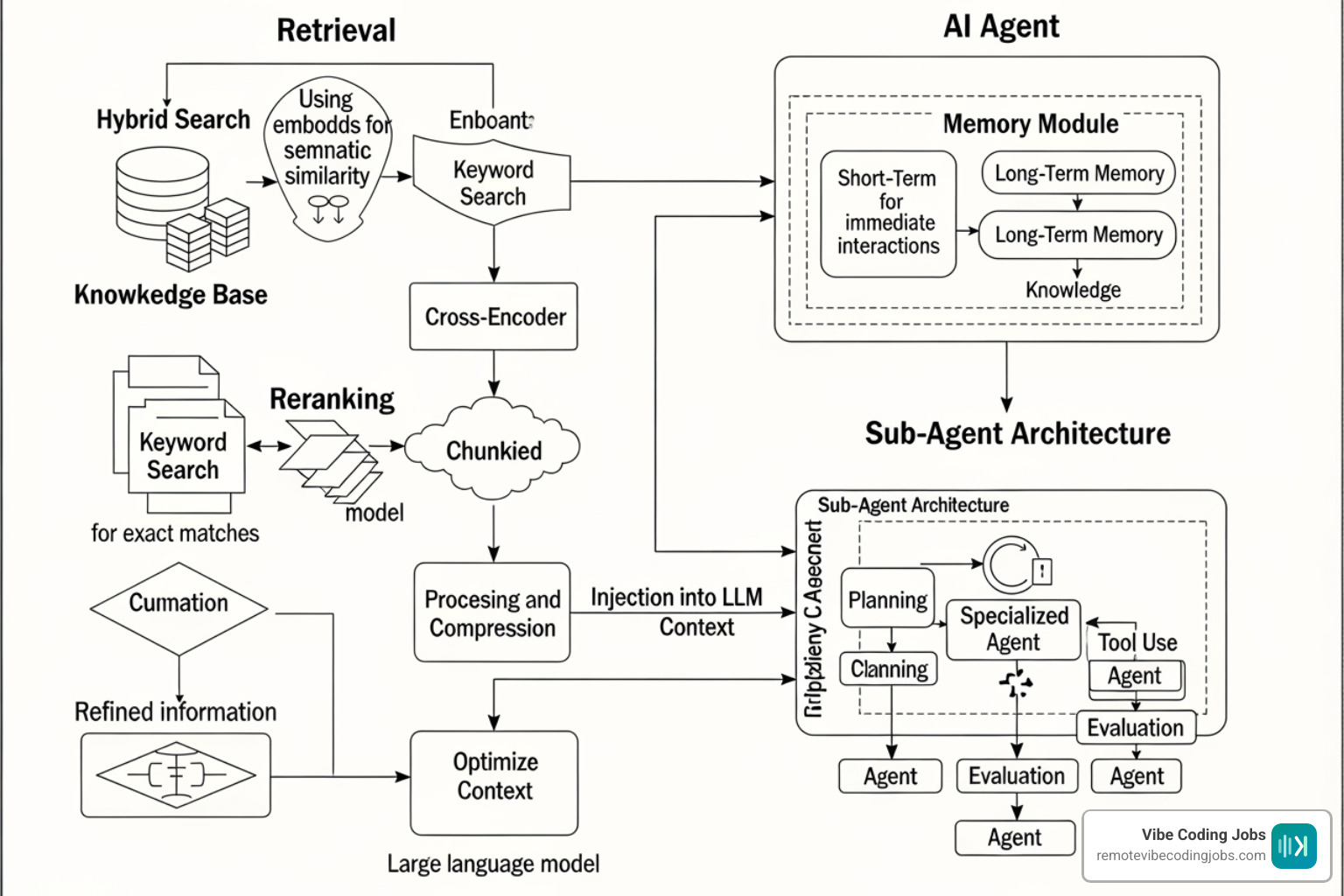
Effective context engineering is built on three pillars: retrieval, processing, and management. We don’t just dump data into the model; we architect how that data flows.
A typical context engineering pipeline looks like this:
- Retrieval: Using hybrid search (combining vector search with keyword search) to find relevant documents.
- Reranking: Using cross-encoder models to ensure the top 3–5 most useful fragments are selected.
- Processing: Compressing or summarizing the data to fit the attention budget.
- Injection: Dynamically inserting this data into the system prompt.
As discussed in Context Engineering vs Prompt Engineering | Context Patterns, this process turns the LLM into a reasoning engine within a larger, stateful system.
Core Components of Effective Context Management
To build production-grade AI, we use several advanced techniques:
- Just-in-Time (JIT) Retrieval: Instead of loading everything at the start, the agent uses tools to fetch specific data only when it needs it.
- Progressive Disclosure: The agent starts with a high-level overview and “drills down” into details as the task progresses.
- Model Context Protocol (MCP): An emerging industry standard (introduced by Anthropic) that allows AI agents to connect to external tools, databases, and APIs seamlessly.
- Scratchpad Methods: Giving the agent a “space to think” or a internal note-taking file can deliver up to a 54% improvement in specialized benchmarks by preventing internal contradictions.
Managing Long-Horizon Agent Workflows
When an agent is working on a task that lasts hours or involves hundreds of steps, context management becomes critical. We use “Compaction” techniques to summarize a conversation that is nearing its limit, re-initiating a new context window with that summary to maintain long-term coherence.
We also use Sub-agent Architectures. A lead agent might delegate a deep research task to a sub-agent. The sub-agent does the “heavy lifting” in its own context window and returns a distilled 1,000-token summary to the lead agent. This prevents “Context Poisoning,” where irrelevant search results or intermediate errors clutter the main agent’s memory.
Frequently Asked Questions about AI Interaction
Is prompt engineering becoming obsolete in 2026?
Not exactly. It is evolving into a sub-skill within context engineering. We still need to write clear system prompts and tool descriptions. However, the “art” of finding the one magic word to fix a hallucination is being replaced by the “science” of providing the right data. Prompt engineering is now about setting the “behavioral constraints” (the style and tone), while context engineering provides the “knowledge foundation.”
Why do AI agents fail more often due to context than prompts?
Most agent failures aren’t because the model didn’t “understand” the instruction. They fail because of:
- Missing Data: The RAG pipeline didn’t find the right file.
- Stale Information: The model was looking at an old version of the documentation.
- Context Overflow: The window was so full of tool outputs that the original goal got lost.
- Unhandled Edge Cases: The context didn’t provide a “plan B” for when a tool fails.
How do prompt and context engineering work together?
They are layered disciplines. Think of context engineering as the foundation and the walls of a house, and prompt engineering as the interior design. Context engineering ensures the model is “grounded” in reality and has the facts it needs. Prompt engineering ensures the model communicates those facts in a way that is useful to the user. When used together, they have a multiplicative effect on performance.
Conclusion
The transition from prompt engineering vs context engineering is a sign of the professional maturity of the AI field. We are moving away from ephemeral “chatting” and toward building structured, reusable AI knowledge systems.
For us at RemoteVibeCodingJobs, this shift is exciting because it enables the kind of autonomous, high-quality work that async-first companies crave. If you want to see how this looks in practice, you can check out our RemoteVibeCodingJobs Compare: Vibe Coding vs Traditional guide to see how these methodologies are changing the way we hire and work.
Best Practices for 2026:
- Think in Tokens: Always be aware of your attention budget and prune irrelevant history.
- Use Structured Context: Use XML tags, JSON, or Markdown to separate instructions from data.
- Audit Your Evidence: If the AI fails, check the context snapshot first. Did it even see the right information?
- Adopt MCP: Use the Model Context Protocol to give your agents standard access to your tech stack.
- Automate the Pipeline: Move away from manual copy-pasting and toward automated RAG and memory systems.
The future of AI development isn’t about being a better “writer” — it’s about being a better “architect.” By mastering context engineering, you’re not just getting better answers; you’re building a more reliable, scalable, and intelligent future.