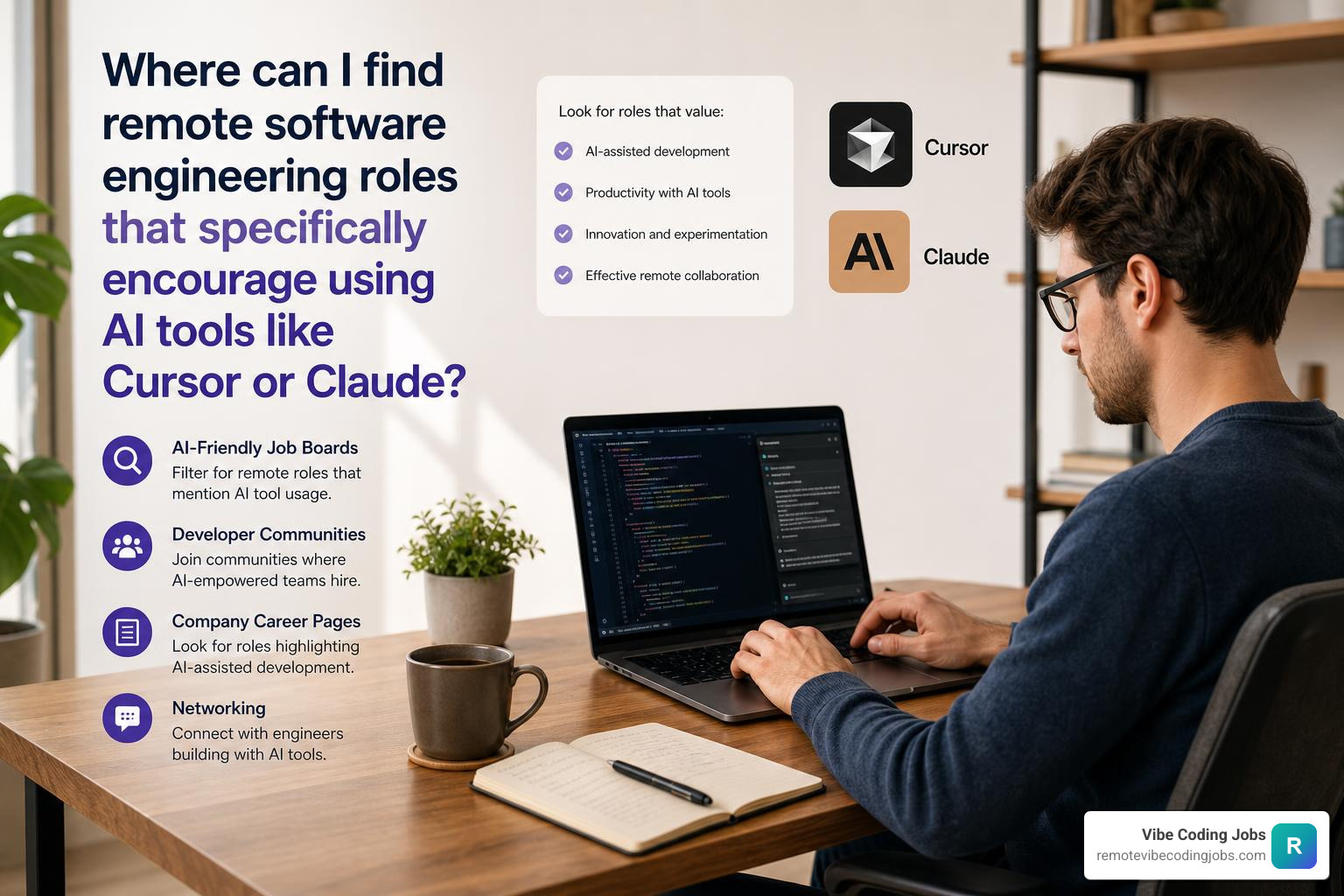
X Insider Tips for Finding AI-Friendly Remote Software Roles
Where Can You Find Job Boards Dedicated to AI-Native and Vibe Coding Roles?
As we move deeper into 2026, the traditional methods of finding software engineering jobs have broken down. General platforms like LinkedIn or Indeed are flooded with generic postings, and they completely lack the filters needed to identify companies that actively encourage—or even mandate—the use of AI coding assistants.
To solve this, specialized platforms have emerged to aggregate roles that treat AI-assisted development as a core competency. We built RemoteVibeCodingJobs to serve as the premier directory for curated daily listings, allowing you to filter remote positions by culture, tech stack, and specific AI tools like Cursor, Claude Code, and Copilot. Our mission is to connect AI-fluent builders with async-first companies that view AI as a force multiplier rather than a shortcut.
While we focus on curating the absolute best opportunities with a free playbook and fast application processes, the ecosystem is growing rapidly. Forward-thinking companies like Domino Data Lab, Weights & Biases, and Supabase are leading the charge in hiring remote vibe coders. To better understand how the industry is categorizing these roles and what companies are leading the charge, you can read our breakdown of AI Coding Tools: Vibe Coders.
The rapid expansion of these specialized platforms is a direct response to a massive shift in how companies hire. You can track this trajectory in our analysis of Cursor & Copilot Developer Jobs: Remote AI Growth.
Tip 1: Leverage Niche Job Boards Built for Vibe Coders
If you are looking for a role where you can spend your day orchestrating AI agents rather than manually writing boilerplate code, general job boards will waste your time. They dilute AI-specific roles and fail to filter out “AI-resistant” companies—those legacy organizations that still view tools like Cursor or Claude Code as security liabilities or “cheating.”
By focusing your search on niche job boards built specifically for vibe coders, you bypass these hurdles entirely. These specialized directories only list companies that have modernized their workflows. When you apply to a role featured on RemoteVibeCodingJobs, you are targeting async-first companies that not only permit AI tools but often provide dedicated AI tool budgets, giving you company-funded access to frontier models and premium IDE subscriptions.
How Do You Identify AI-Friendly Job Postings on Traditional Platforms?

If you do choose to search on traditional platforms, you must learn how to read between the lines. Genuinely AI-native companies leave distinct “green flags” in their job descriptions.
For example, a recent posting by the developer platform Coder for a Senior Software Engineer (AI Solutions) explicitly lists Claude Code, Cursor, and similar agent tooling throughout the development lifecycle. Similarly, a posting by VanHack for an AI-Native Full-Stack Engineer states:
“This is not an ‘AI-curious’ role—you’ll be expected to operate Cursor agents, write effective rules and plans, and use AI code review as part of your daily workflow from day one.”
Another excellent example is an AI-Augmented Full-Stack Engineer posting, which explicitly mandates proficiency with Cursor, Claude, the GPT stack, or GitHub Copilot to translate Product Requirements Documents (PRDs) into deployed web applications in record time.
To learn more about how companies are formally structuring these expectations, check out our guide on Cursor & Copilot Developer Jobs: Remote Coding.
Tip 2: Decode Job Descriptions for “AI-Native” Keywords
To find these roles on broader platforms, set up highly specific search alerts. Look for terms that indicate a modernized software development lifecycle (SDLC), such as:
- “AI-DLC” (AI-Native Development Lifecycle): Indicates the company has restructured its entire development pipeline around AI orchestration.
- “Agentic loops” and “sub-agents”: Shows the team is building or utilizing multi-agent systems to write and review code.
- “Cursor rules” or
.cursorrules: A massive green flag indicating the team maintains in-repo context files to guide AI behavior. - “Expert editor” or “Orchestrator”: Signals the company values your engineering judgment and architectural skills over your typing speed.
Avoid postings that focus heavily on manual syntax memorization or list AI tools merely as an optional “nice-to-have” alongside traditional, rigid development requirements.
Tip 3: Target Forward-Thinking Industries and Async-First Startups
The adoption of AI-native workflows is not uniform across the tech industry. Early-stage startups, MLOps platforms, and async-first agencies are leading the charge because they prioritize shipping velocity above all else.
Companies like Domino Data Lab, Weights & Biases, and Supabase are actively hiring vibe coders because their business models rely on rapid prototyping and high-velocity iteration. Conversely, legacy enterprise environments—such as healthcare, banking, or government contracting—are adopting these tools much slower due to strict compliance, data privacy, and intellectual property hurdles. If you want to use Cursor and Claude daily, target companies that have built their culture around async communication and high autonomy.
What Skills and Qualifications Do AI-First Hiring Managers Look For?
The shift to AI-native development has fundamentally changed what it means to be a “highly qualified” engineer. In 2026, hiring managers care less about your ability to write clean boilerplate from scratch and more about your ability to direct, validate, and scale code written by AI agents.
| Aspect | Traditional Software Engineering | AI-Native Software Engineering |
|---|---|---|
| Core Craft | Writing syntax, implementing boilerplate, manual debugging | Specifying requirements, steering AI agents, validating output |
| Velocity Indicator | Lines of code written, hours logged | Features shipped, deployment frequency, agent orchestration |
| Testing Focus | Manual unit testing, post-hoc QA | Test-Driven Development (TDD) as an AI instruction contract |
| Context Management | Personal mental model of the codebase | Maintaining .cursorrules, system prompts, and context files |
| Code Generation | 100% manual typing | 90% AI-generated, 10% custom manual overrides |
In an AI-first environment, your primary role shifts from writer to editor and architect. To see how extreme this leverage can get, look at this d89ad8ded9a714a5ef83a3937ea4e235 Gist, which documents how a single AI-native engineer reached 353 commits in a single day (and maintained consistent daily counts of 200–300+ commits) by orchestrating AI agents. In this setup, a two-person engineering team built and operated over 35 TypeScript applications and services.
To achieve this level of efficiency, you must know your tools inside and out. You should understand how different IDEs handle agentic workflows by reading our Cursor vs Windsurf: Best AI Coding Tools Comparison. If you need to expand your toolkit beyond the industry standards, explore the options in our list of the Best Cursor Alternatives for Remote Developers in 2026, and stay updated on the broader landscape with our resource on AI Coding Tools for Vibe Coding.
Tip 4: Master the Art of AI Orchestration and Validation
To stand out to AI-first hiring managers, you must demonstrate mastery over two core disciplines:
- AI Orchestration (Context Management): You must know how to feed the AI the exact context it needs. This means writing highly effective
.cursorrulesfiles, managing session context files to maintain continuity across multi-session agent workflows, and structuring prompts to minimize hallucinations. - Deterministic Validation: Because AI can generate code at an unprecedented rate, your primary bottleneck is validation. You must be an expert in Test-Driven Development (TDD), where the test itself becomes the contract the AI agent must satisfy. You must also be highly proficient in integration testing (using tools like Testcontainers), Behavior-Driven Development (BDD via Playwright or Maestro), and automated contract testing.
Tip 5: Build a Portfolio Showcasing AI-Assisted Builds
Traditional portfolios that only show a finished product are no longer sufficient. Hiring managers want to see how you build.
When preparing your GitHub profile, include repositories where you have documented your AI-assisted development process. Share your prompt histories, include your custom .cursorrules or .cursor/rules/ configurations, and write detailed READMEs explaining how you steered the AI to solve complex architectural challenges. Showing that you built a complex, multi-service application in a weekend by orchestrating Claude Code is a massive proof of your efficiency multiplier.
How Do Interview Processes Differ for AI-Assisted Engineering Roles?
The interview process for AI-native roles looks radically different from the traditional tech hiring pipeline. Forward-thinking companies have realized that banning AI tools during an interview is like forcing an accountant to use an abacus instead of Excel.
Instead of traditional, high-pressure LeetCode grinds, AI-friendly companies utilize “AI-allowed” practical assessments. They want to see how you interact with your tools in real-time. To understand the security and compliance boundaries that companies establish during these processes, read our guide on Cursor & Copilot Developer Jobs: Integration & Security. For a look at how these hiring methodologies have shifted over time, check out AI Coding Tools: Evolution.
During an AI-native interview, hiring managers evaluate you on a highly specific set of criteria:
- Engineering Judgment: Can you identify when an AI-generated solution is technically correct but architecturally flawed?
- Prompting and Steering: How quickly can you redirect an AI agent when it gets stuck in an error loop?
- Validation Rigor: Do you immediately write tests to verify the AI’s output, or do you blindly trust and commit the code?
- Tool Selection: Do you know when to use a fast, cost-efficient model (like Claude 3.5 Haiku) versus a highly reasoning model (like Claude 3.5 Sonnet or OpenAI o1)?
- Context Control: How well do you organize your project’s codebase (e.g., using Domain-Driven Design) to make it easily readable for AI agents?
Tip 6: Prepare for “AI-Allowed” Take-Home Assessments
When a company gives you an “AI-allowed” take-home assessment, do not try to hide your tool usage. In fact, the worst thing you can do is submit perfect code with zero explanation of how you got there.
Instead, treat the take-home as a collaborative exercise between you, the AI, and the hiring team. Document your workflow. Explain the prompts you used, how you structured the context, and how you validated the output. If the tool introduced a bug or a security vulnerability, highlight it in your submission and show how your engineering judgment caught and corrected the error. This level of transparency and critical thinking is exactly what hiring managers are looking for.
What Compensation and Remote Work Policies Are Typical for These Positions?
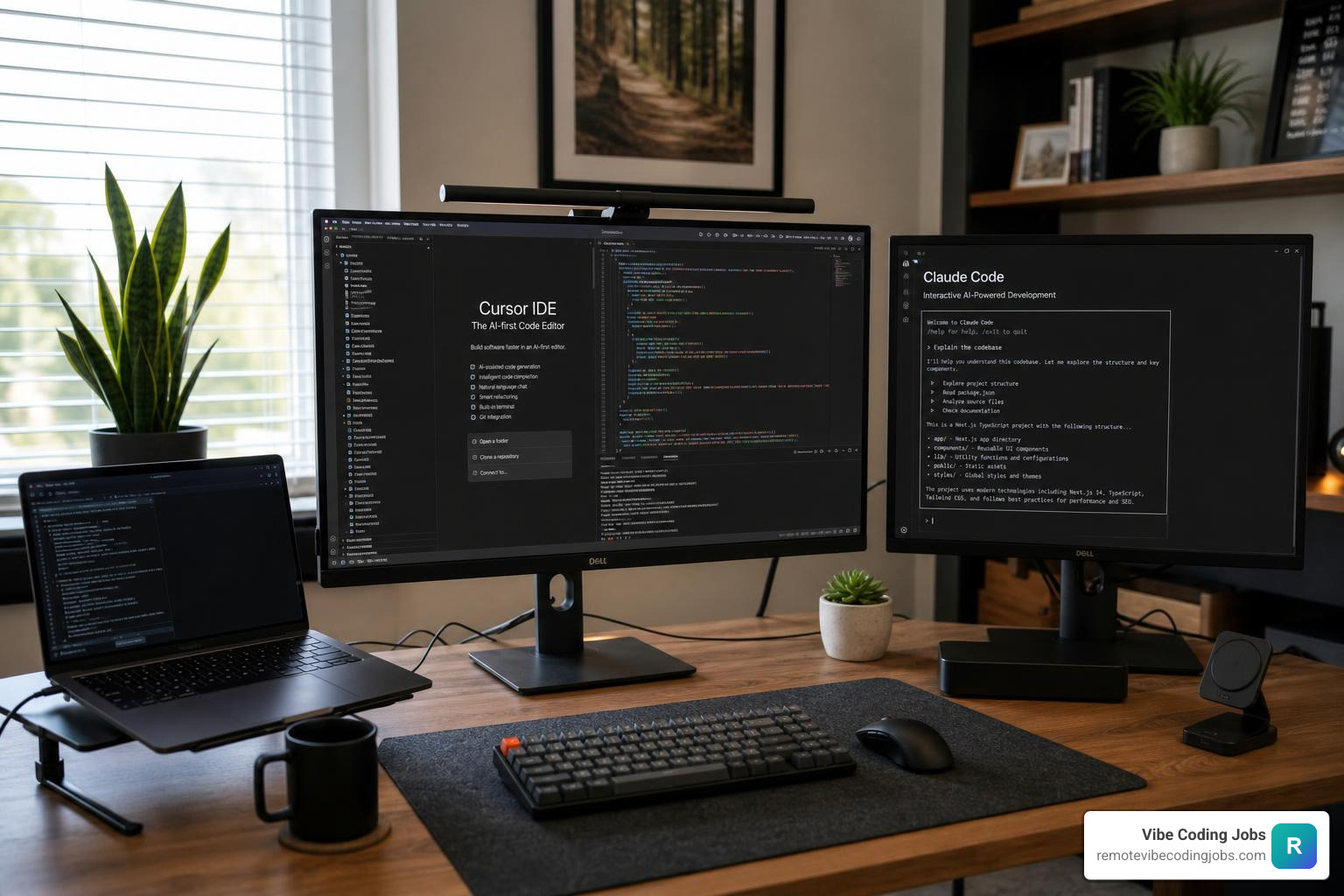
Because AI-native engineers can operate with the output of a multi-person team, their compensation packages reflect this massive leverage. Companies are willing to pay top-tier rates for developers who can ship production-quality code at startup speed.
A look at real-world compensation benchmarks from June 2026 highlights this premium:
- Grafana Labs offers a Staff AI Engineer role paying $174,986 to $209,983, requiring deep experience with Claude Code, Cursor, and multi-agent AI systems.
- Coder offers a Senior Software Engineer (AI Solutions) role with a salary range of $165,000 to $249,000, fully embracing an AI-DLC workflow.
- G2i Inc. regularly hires AI Evaluators for Software Engineering at contract rates of $100 to $200 per hour, tasks that require evaluating the engineering judgment and correctness of tools like Claude Code and OpenAI Codex.
- Lago offers Senior Full-Stack Developer (AI-First) roles paying $1,800 to $3,500 USD per month for remote developers in Eastern Europe, leveraging automated pipelines where code must pass review by 5+ bots before a human ever looks at it.
To explore how these roles fit into long-term career paths, read our resource on Cursor & Copilot Developer Jobs: Remote Career. For a deeper dive into salary variations across different regions and seniority levels, check out our analysis of Cursor & Copilot Developer Jobs: Salary & Remote Description.
Tip 7: Understand the Compensation Premium for AI-Native Efficiency
When negotiating your salary for an AI-native role, shift the conversation away from “hours logged” and focus entirely on output and shipping velocity.
If you can use Cursor and Claude to build, test, and deploy features 5x faster than a traditional developer, you are saving the company the cost of hiring multiple engineers. Frame your value proposition around this efficiency. Highlight your ability to own projects end-to-end—from database schema design to frontend deployment—using AI as your force multiplier.
If you are ready to find high-paying remote positions that value this level of leverage, you can search open roles directly through remotevibecodingjobs.com/remote-jobs/ai-engineer.
Frequently Asked Questions About AI-Native Remote Software Roles?
Can I use Cursor or Claude in traditional software engineering interviews?
No, unless you have explicit permission. You must always ask the hiring manager or recruiter before using AI tools during a live coding session or take-home test.
While AI-native companies encourage it, many legacy organizations still view AI usage as a form of plagiarism or a security risk. If you use these tools without disclosure, you risk immediate disqualification. If you want to use them, frame your request proactively: explain that you are highly efficient with Cursor or Claude and would love to demonstrate how you use them to build and validate code in real-time.
Do AI-native roles pay less because of increased developer productivity?
Absolutely not. In fact, the opposite is true. While AI increases your productivity, it also increases your market value.
Companies do not pay you for the manual labor of typing; they pay you for the business value you deliver. An engineer who can leverage AI to design, build, and ship a complex feature in two days is vastly more valuable than an engineer who takes two weeks to write the same code by hand. The productivity gains of AI-native development allow companies to run leaner, highly efficient teams, and they are eager to distribute those savings to top-tier “one-person team” builders.
What are the security implications of using tools like Claude Code in enterprise environments?
Data privacy and intellectual property protection are the primary reasons some companies remain hesitant to adopt AI coding tools.
To mitigate these risks, forward-thinking employers establish strict security guidelines. Many provide enterprise-grade, secure access to frontier models where data is not used for training.
During the application process, you can stand out by demonstrating strong security hygiene: explain how you configure your local environment, how you manage API keys securely, and how you ensure sensitive company data is never exposed to public LLM endpoints.
Conclusion
The software engineering landscape in June 2026 is undergoing a massive transformation. The era of manual boilerplate writing is rapidly giving way to a new paradigm of high-velocity AI orchestration. To position yourself for the best remote roles in this new environment, remember these 7 insider tips:
- Leverage niche job boards like RemoteVibeCodingJobs to bypass AI-resistant companies.
- Decode job descriptions for key green flags like “AI-DLC,” “agentic loops,” and
.cursorrules. - Target forward-thinking industries and async-first startups that prioritize shipping velocity.
- Master the art of AI orchestration and deterministic validation (TDD).
- Build a portfolio that showcases how you build with AI, not just the final product.
- Prepare for “AI-allowed” assessments by documenting your collaborative workflow.
- Negotiate your compensation based on your output and delivery leverage.
The demand for software engineers who can effectively partner with AI tools like Cursor and Claude will continue to skyrocket. By treating these tools as a core competency rather than a secret shortcut, you position yourself at the very forefront of the industry.
Ready to find your next remote role? Visit RemoteVibeCodingJobs today to browse our curated daily listings and kickstart your AI-native career.