
Why Junior iOS Engineers Struggle to Stand Out in 2026
To compete for iOS developer jobs in 2026, junior engineers need more than a few tutorial apps. Focus on proving that you can ship a reliable feature from idea to release: write Swift and SwiftUI, handle async work safely, test and debug your code, use Git and CI/CD, and explain the tradeoffs behind your decisions.
The fastest way to stand out is to build one or two portfolio projects that look like real product work:
- Solve a clear user problem, not just a clone.
- Include API calls, loading and error states, tests, and basic offline behavior.
- Publish the app or share a clean GitHub repo with a short technical write-up.
- Use AI coding tools to speed up research and routine work, but review every line and understand the architecture.
There are still thousands of iOS openings in the United States, across fintech, healthcare, ecommerce, AI, and consumer apps. But entry-level roles are tighter because teams increasingly expect engineers to contribute to production code, collaborate well, and use modern tools such as SwiftUI, Swift Concurrency, REST APIs, Git, and automated delivery pipelines. For broader context on how mobile development fits into the wider software industry, see Software development.
AI-assisted development changes the bar; it does not remove it. Tools can generate boilerplate, suggest tests, and help explore an unfamiliar codebase. Employers still need developers who can spot incorrect output, protect user data, debug crashes, make sound product decisions, and ship an App Store-ready experience.
I am Di Su, a software engineer with more than 10 years of experience building user-focused products, improving workflows, and connecting technical work to measurable business results. In this guide to iOS developer jobs, I will show you how to turn those production-minded habits into a stronger portfolio, better applications, and clearer career options.
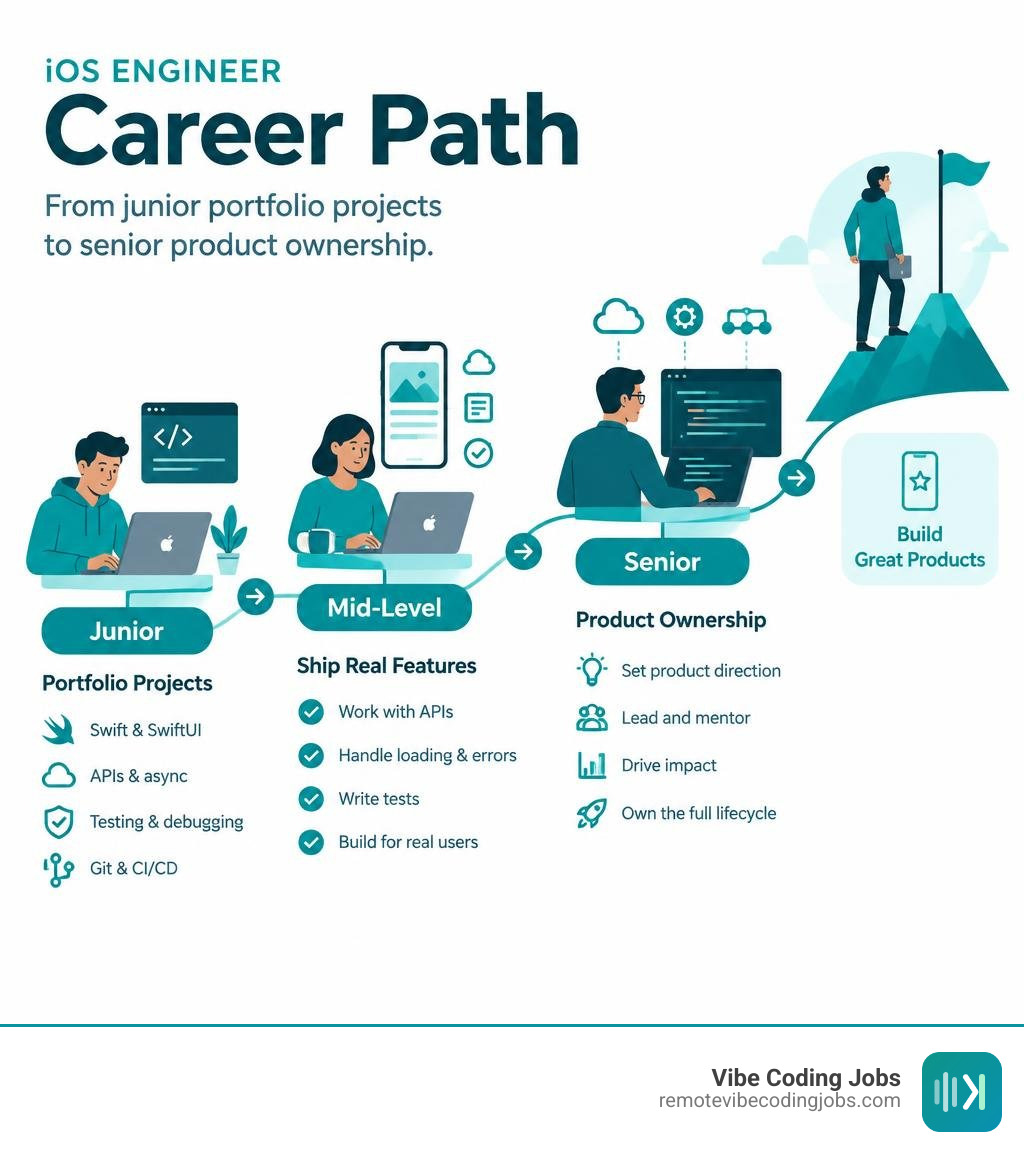
Handy ios developer jobs terms:
The Modern Reality of iOS Developer Jobs in 2026
The market for mobile talent has changed dramatically. While there are over 2,000 active iOS roles listed across the United States alone—and thousands more globally across thousands of open mobile positions—the barrier to entry looks entirely different than it did five years ago. Engineering managers are no longer hiring based on raw syntax recall or the ability to build a basic list view in Xcode.
Today, teams expect developers to have a firm grasp on production standards from day one. Startups and enterprise engineering orgs want candidates who understand full-lifecycle ownership: writing clean architecture, wiring robust network layers, managing local persistence, monitoring crash rates, and orchestrating weekly release cycles. Because AI coding assistants have made basic code generation instantaneous, the true value of an engineer lies in system design, debugging skill, and high product taste.
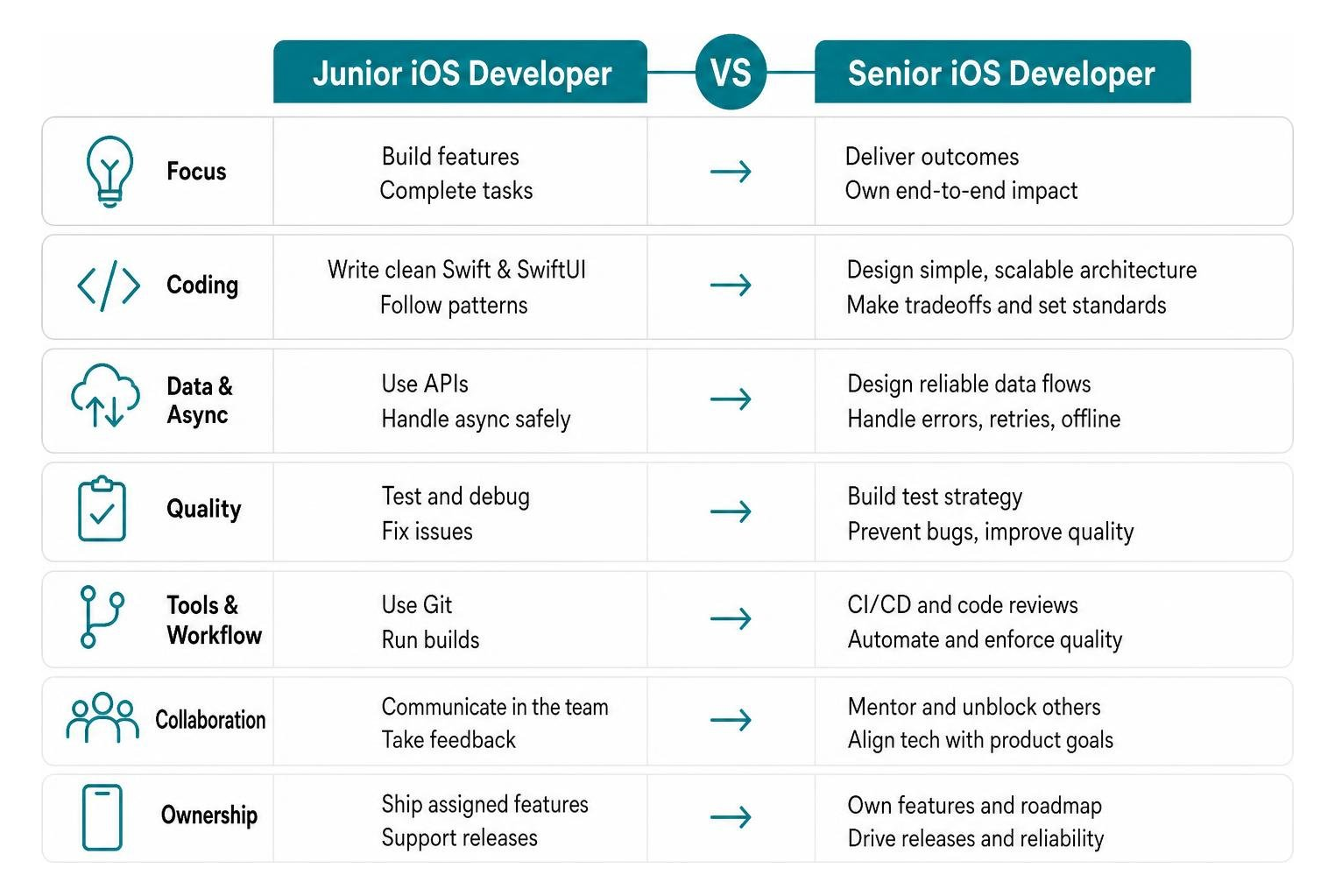
Why Junior Developers Struggle in Entry-Level iOS Developer Jobs
The primary reason entry-level applicants struggle to land interviews is the “tutorial trap.” Recruiters and hiring leads review hundreds of applications featuring the exact same cookie-cutter projects: a basic weather app, a generic To-Do list, or a movie database browser that simply pulls data from a public REST endpoint.
These projects fail to demonstrate engineering rigor. They rarely contain:
- Robust error handling and offline state caching.
- Modular architecture that isolates business logic from UI components.
- Meaningful unit tests, snapshot tests, or UI integration suites.
- Consideration for memory management, thread safety, or battery efficiency.
When teams compare vibe coding vs traditional development, they quickly see that anyone can prompt an LLM to generate standard UI code. What companies desperately need are engineers who know how to fit generated components into a larger, maintainable codebase without introducing silent regressions or security flaws.
Shifting Skill Demands: SwiftUI, Swift Concurrency, and AI-Assisted Workflows
The iOS ecosystem has converged on modern declarative patterns. If your experience is solely rooted in legacy imperative UIKit patterns with storyboards and delegation callbacks, you will find it difficult to navigate modern codebases. Modern mobile teams prioritize:
- Swift Concurrency: Mastering
async/await, structured concurrency tasks,Actors, and isolation domains under the strict concurrency checking of modern Swift compilers. - Declarative State Management: Building reactive, performant user interfaces using SwiftUI combined with state modeling tools like
@Observableor unidirectional frameworks. - AI-Native Engineering: Using tools like Cursor, Claude Code, and GitHub Copilot to accelerate test writing, documentation, and SDK prototyping while maintaining strict code verification.
Modern companies look for engineers who thrive in distributed environments. If you want to build native iOS features on your own schedule, exploring swift async first jobs is a great way to find remote-first teams that value clear written documentation and autonomous execution over constant meetings.
Navigating Compensation, Work Models, and Industry Demand
Mobile developer compensation reflects both geographic market dynamics and technical specialization. While broad remote developer salaries remain competitive, iOS developers with expertise in on-device machine learning, real-time audio/video streaming, or complex payment systems command top-tier offers.
Salary Benchmarks and Experience Tiers for Remote iOS Developer Jobs
Compensation for iOS roles spans several distinct tiers based on technical scope:
- Entry-Level & Associates ($60K–$100K): Focus on learning core mobile engineering practices, maintaining feature modules, fixing UI bugs, and expanding test coverage.
- Mid-Level Engineers ($100K–$150K): Build end-to-end features, implement REST/GraphQL network integrations, profile UI performance with Instruments, and manage TestFlight distributions.
- Senior Engineers ($150K–$225K): Lead technical architecture, integrate complex frameworks (e.g., Core ML, StoreKit 2, Metal), optimize app startup times, design CI/CD delivery pipelines, and mentor junior developers.
- Staff & Lead Architects ($220K–$300K+): Define multi-app platform strategies, cross-system communication protocols, and engineering productivity standards across globally distributed teams.
Contract arrangements also offer strong opportunities, ranging from $60,000 to $150,000+ annually for dedicated remote roles, depending on time-zone overlap requirements and technical specialization.
Remote vs Hybrid: Where Top Tech Hubs and Distributed Teams Hire
While major metropolitan hubs like San Francisco, New York, Los Angeles, and Denver continue to offer dense clusters of hybrid and on-site roles, the mobile engineering ecosystem is heavily distributed.
Fintech, digital health, consumer social, and enterprise productivity companies routinely hire for remote ios developer jobs. Many remote companies require 3 to 4 hours of core collaboration overlap (frequently across US Pacific or Eastern time zones), while async-first startups offer complete location independence as long as you deliver polished, high-performing code.
How to Stand Out: Building Production-Ready iOS Portfolios
The best way to escape the junior hiring bottleneck is to build like an experienced engineer. Instead of spreading your energy across ten shallow demo apps, build one comprehensive, fully polished application that demonstrates end-to-end craft.
When designing your showcase project, use building portfolio with ai tools to rapidly prototype UI concepts, mock API backends, and generate initial unit test suites. This allows you to spend the bulk of your engineering time solving hard architectural problems.
Mastering Core Architecture: From TCA to On-Device Core ML
To impress technical hiring managers, your codebase should demonstrate modern architectural patterns:
- Predictable State Architecture: Use modern patterns like The Composable Architecture (TCA) or clean MVVM-C (Model-View-ViewModel-Coordinator) to ensure unidirectional data flow and testability.
- Resilient Offline Storage: Implement persistent caching using SwiftData or Core Data, handling offline queueing and background sync gracefully.
- Hardware & System Integrations: Take advantage of native platform capabilities such as App Intents, Live Activities, Lock Screen widgets, and local machine learning models running directly via Core ML or Apple Neural Engine runtimes.
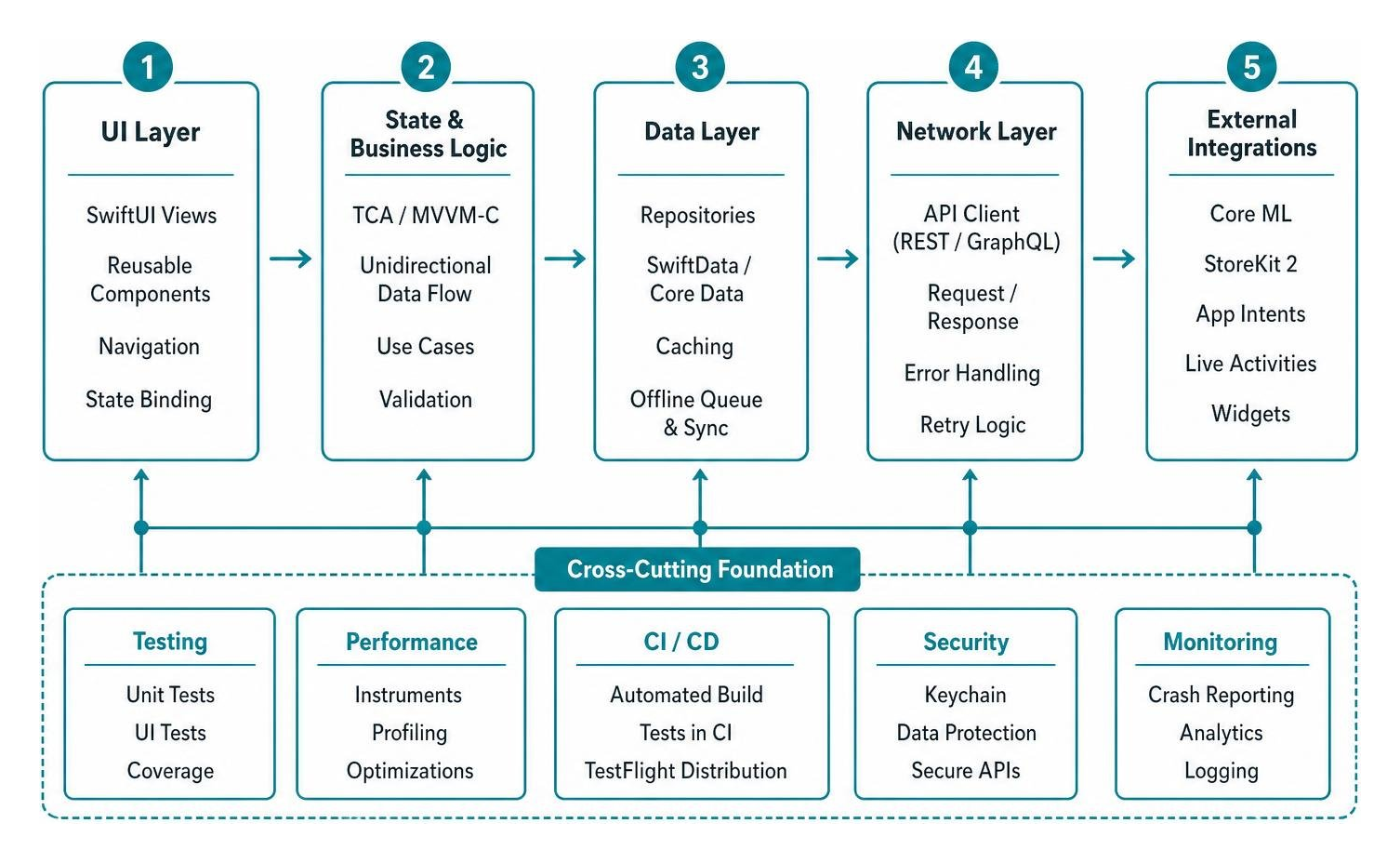
Showing that you can take a complex user interaction and break it down into modular, isolated, testable components signals that you will be productive in a large enterprise repository immediately.
Leveraging Vibe Coding Tools to Ship Faster and Better
Working with AI coding assistants is no longer a gimmick—it is a core productivity expectation. In modern engineering teams, top developers use AI to accelerate their day-to-day workflow:
- Cursor IDE & Claude Code: Exploring unfamiliar frameworks, refactoring legacy codebases, and drafting boilerplate networking models from JSON payloads.
- Automated Test Scaffolding: Generating comprehensive edge-case assertions and snapshot tests for SwiftUI views.
- Performance Profiling Assistance: Analyzing crash stack traces and memory allocation logs to pinpoint leaks and retain cycles.
Comparing cursor vs copilot shows how AI-first code editors allow you to treat the LLM as an active development partner. However, you must always be the final reviewer: verify memory semantics, check thread safety, and ensure compliance with Apple Human Interface Guidelines.
Acing the iOS Engineering Hiring Pipeline
Landing an offer requires navigating a multi-stage technical interview process. The typical hiring funnel for iOS developers follows a structured sequence:
- Initial Recruiter Screen: High-level discussion covering your experience, project background, and team fit.
- Technical Take-Home or Live Coding: Building a small, functional feature in Swift or refactoring an existing project.
- Architecture & System Design Interview: Designing an end-to-end mobile system (e.g., an offline-first image feed, a real-time messaging client, or a payment checkout flow).
- Deep-Dive Behavioral & Culture Fit: Evaluating your communication, problem-solving mindset, and experience collaborating in agile teams.
To connect with companies that respect your time and use realistic technical assessments, keep an eye out for swift no bs jobs where evaluation is focused on real-world capabilities.
Navigating Live Architecture Reviews and Alternative Assessments
Many forward-thinking teams are moving away from arbitrary data-structure challenges. Instead, they assess your practical mobile knowledge through remote coding jobs no leetcode alternative assessments.
During these reviews, be prepared to discuss:
- Memory Management: How ARC (Automatic Reference Counting) functions, how to identify strong reference cycles using Xcode Instruments, and when to use
weakvsunownedreferences. - Concurrency Primitives: The difference between main-actor execution, cooperative thread pools, and handling asynchronous task cancellation safely.
- Protocol-Oriented Design: Structuring your code using Swift protocols to enable dependency injection, easy mocking, and modular package organization with Swift Package Manager (SPM).
Proving End-to-End Ownership from TestFlight to App Store Release
One of the quickest ways to prove senior-level maturity as a junior or mid-level developer is showing mastery of release engineering:
- CI/CD Pipelines: Automating builds, unit test execution, and code linting using GitHub Actions, Fastlane, or Xcode Cloud.
- Release Management: Managing beta testing distribution through TestFlight, monitoring crash rates with Firebase Crashlytics or Sentry, and writing clear release notes.
- Monetization & Store Compliance: Understanding StoreKit 2 for in-app purchases and subscriptions, adhering strictly to App Store review guidelines, and respecting user privacy frameworks (ATT).
Having an active app on the App Store that uses automated deployment pipelines instantly puts you in the top 10% of applicants.
Frequently Asked Questions About iOS Engineering Careers
What are the most critical skills to get hired for iOS roles today?
The foundational stack for modern iOS development centers on Swift and SwiftUI. You should be thoroughly comfortable with Swift Concurrency (async/await, Actors), RESTful API integration, persistent storage (SwiftData or Core Data), Git version control, and unit testing with XCTest. Familiarity with CI/CD tools (Fastlane, Xcode Cloud) and crash-monitoring services gives you a decisive advantage.
How is AI-assisted development changing entry-level mobile expectations?
AI tools have significantly raised the productivity baseline. Because writing basic boilerplate is automated, hiring teams now place greater emphasis on code quality, architectural understanding, security awareness, and debugging skills. Developers must demonstrate that they understand what generated code does and how it affects device performance, memory, and user privacy.
What salary can I expect as an iOS engineer across different career levels?
In the United States and international remote markets, entry-level roles typically range from $60,000 to $105,000 annually. Mid-level developers earn between $100,000 and $155,000, while senior engineers earn between $140,000 and $225,000+ depending on company size, industry, and total equity packages. Contract roles typically pay between $40 and $150 per hour depending on technical specialization.
Conclusion
Breaking out of the junior tier and securing a great mobile developer role comes down to intentional execution. Move beyond tutorial clones, build projects that solve authentic user problems, master modern Swift concurrency and declarative UI, and leverage AI coding tools to accelerate your workflow without sacrificing code quality.
At RemoteVibeCodingJobs, we curate daily remote developer positions across async-first, AI-native companies. Whether you are building real-time mobile features, training on-device models, or shaping consumer user experiences, explore curated swift jobs to find your next career opportunity and ship software that matters.