
Why Async Communication Dev Roles Are Reshaping How Engineers Work
Async communication dev roles are remote engineering positions where written messages, shared docs, and recorded updates replace live meetings as the default way to collaborate.
Here’s what that means in practice:
| Feature | Async-First Role |
|---|---|
| Default communication | Written (Slack, Notion, docs) |
| Meetings | Rare, optional, or batched |
| Work schedule | Flexible — you set your hours |
| Decision-making | Documented for anyone to read later |
| Deep work | Protected by design, not by luck |
These roles exist across the full stack — Backend, Full Stack, ML, and AI engineering — at companies that trust you to ship without a daily standup.
The difference between a standard remote job and a true async-first role is significant. Most “remote” jobs just move meetings to Zoom. Async-first companies eliminate the meeting culture entirely, replacing it with strong documentation, written design reviews, and outcome-based accountability.
One developer put it simply in a Reddit thread on async work culture: “I personally like it because I can set my own schedule and no one cares what time I’m working as long as my projects get done.”
That’s the core appeal — and in 2026, with over 260 async-first developer roles currently listed and AI tools like Cursor and Claude accelerating individual output, this work model is becoming the default for the best remote engineering teams.
We’re RVCJ Editorial, the team behind Remote Vibe Coding Jobs, covering AI-assisted development, async work culture, and remote hiring trends — including the growing category of async communication dev roles where vibe coding and deep work intersect. In this guide, we’ll break down everything you need to know to thrive in — or land — one of these roles.
The Rise of Async Communication Dev Roles in 2026
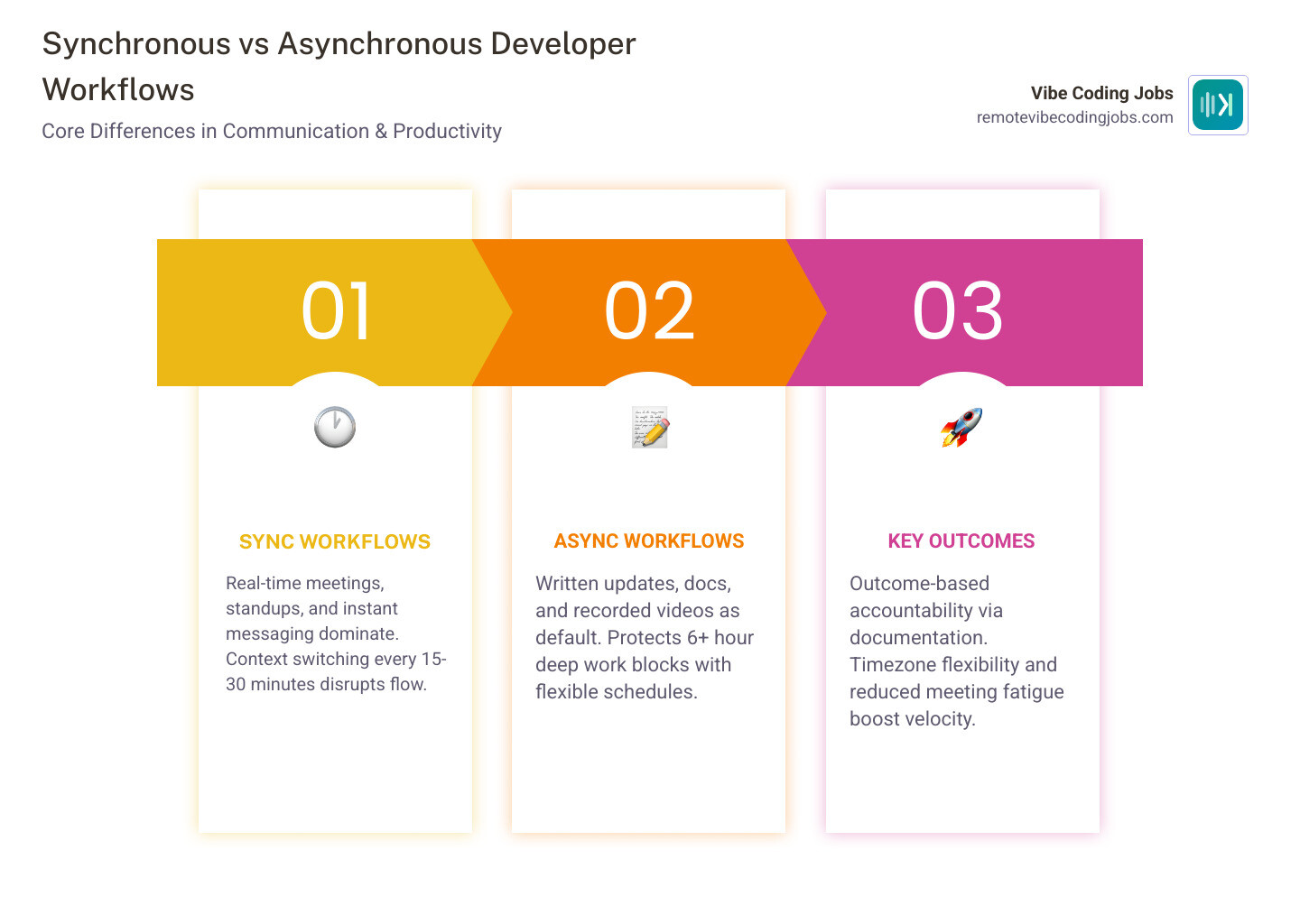
By April 2026, the tech landscape has shifted fundamentally. We’ve moved past the “Zoom exhaustion” era of 2020 and into a period where deep work is the ultimate competitive advantage. For Python and Fullstack engineers, async communication dev roles represent the pinnacle of professional freedom. In these environments, deep work isn’t just a buzzword; it’s the default setting.
Companies like GitLab have pioneered this for years, proving that you can scale a global engineering team without a single mandatory 9 AM standup. The core philosophy is simple: we trust you to manage your time, and we prioritize high-quality written documentation over “quick syncs.” This Async-first remote developer jobs culture workflow communication allows developers to stay in a flow state for six or seven hours straight—something that is virtually impossible in a traditional office or a meeting-heavy remote culture.

Essential Skills for Async Communication Dev Roles
Thriving in an async environment requires a different “soft skill” stack than what you might be used to. Because you aren’t chatting in the breakroom or jumping on calls to explain a bug, your writing must be your superpower.
- Strong Writing: You need to be able to explain complex architectural trade-offs in a Notion doc or a GitHub PR description so clearly that a teammate in a different timezone can understand it without asking for a follow-up call.
- Self-Motivation: Without a manager checking your “active” status on Slack, you must be the driver of your own productivity.
- Reliability Engineering Mindset: In async teams, you aren’t just writing code; you’re building systems that are resilient by default. This includes Async-first remote developer jobs productivity benefits like better documentation and more thoughtful code reviews.
- Coachability: You must be open to feedback that comes through text, which can sometimes feel blunter than a face-to-face conversation.
Transitioning from Traditional Remote to Async-First
If you’re moving from a “remote-lite” company (where they just moved the office politics to Zoom) to a true async-first role, the transition can be jarring. You’ll notice the disappearance of the daily calendar block. Instead, you’ll find:
- Meeting-Free Days: Many teams designate 4 out of 5 days as entirely meeting-free.
- Design Docs Over Brainstorming: Instead of a 1-hour whiteboard session, someone writes a detailed proposal. Everyone else leaves comments on their own time.
- Decision Logging: Decisions aren’t made in a private call; they are logged in tools like Linear or Notion so there is a “paper trail” for the whole team.
This shift in Async-first remote developer jobs communication workflow ensures that no one is ever a “blocker” simply because they are asleep or in a different timezone.
The Tech Stack: Tools and Architectures Powering Deep Work
The tools we use in async communication dev roles are designed to reduce friction and eliminate the need for real-time presence. While a traditional company lives in Outlook and Teams, an async-first engineering team lives in a specialized ecosystem.
| Synchronous Tool | Asynchronous Alternative | Why It Wins for Devs |
|---|---|---|
| Zoom / Teams Call | Loom / Video Snippets | Watch at 2x speed; no scheduling required. |
| Slack (Real-time) | Slack (with Async Norms) | Notification snoozing; threaded, long-form replies. |
| Whiteboard Session | Eraser / FigJam / Notion | Persistent, editable, and accessible to everyone. |
| Status Meeting | Linear / Automated Updates | Real-time project tracking without the talking. |
Check out our full guide on the Best async communication tools for dev teams in 2026 to see how these integrate into a modern workflow.
Event-Driven Architectures and Async Processing
It’s no coincidence that the most successful async companies also build highly asynchronous software. If your team communicates via events and messages, your code likely does too. Roles focusing on Asynchronous Processing at companies like Klaviyo require expertise in:
- Apache Pulsar & Kafka: Managing high-throughput message streams.
- Python & Go: Building the microservices that consume those streams.
- Event-Driven Design: Ensuring systems are decoupled, much like the teams that build them.
Managing Alignment Without Standups
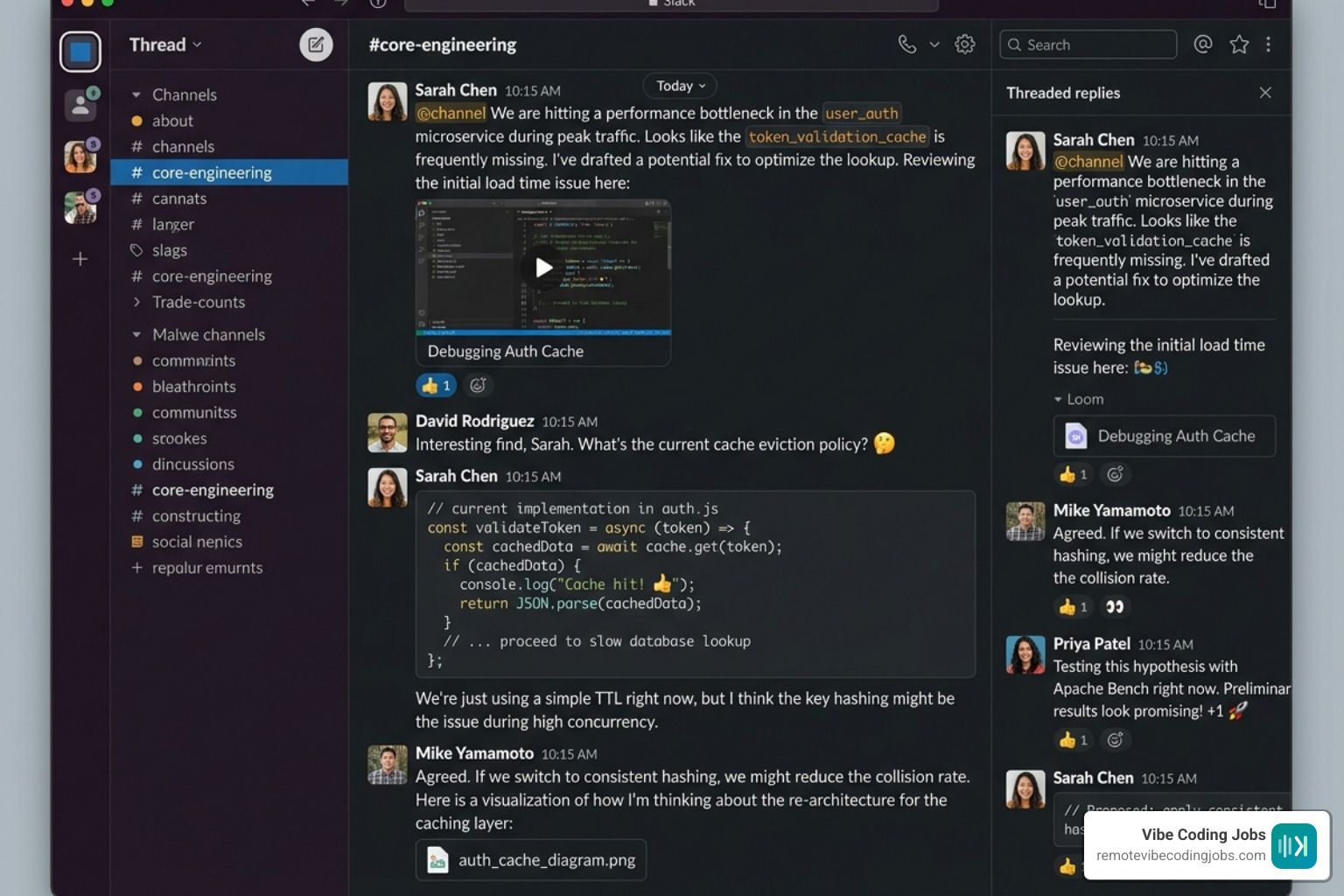
How do we stay on the same page without a 15-minute morning ritual? We use asynchronous communication techniques like automated Slack standups. Instead of everyone talking at once, a bot pings the channel, you type your update, and everyone reads it when they start their day.
Weekly digests and incredibly detailed Pull Request (PR) descriptions become the lifeblood of the team. A good PR in an async-first company doesn’t just say “fixed bug”; it includes a video walkthrough, a link to the design doc, and an explanation of the “why” behind the logic.
Navigating the Realities of 100% Async Engineering Teams
We have to be honest: 100% async isn’t always a walk in the park. Based on real-world experiences from Reddit’s ExperiencedDevs community, some developers find that total async can lead to “micromanagement via messages.” If a manager expects a Slack reply within five minutes, that isn’t async—it’s just a meeting with extra steps.
Other challenges include:
- Information Silos: If documentation isn’t perfect, knowledge can get trapped in one person’s head.
- Isolation: Without the “watercooler,” you have to be intentional about social connection.
- Constant Anxiety: Some devs feel the need to always be “on” to prove they are working.
As one Redditor noted, “Going fully asynchronous is too far, IMO. Much better to have a few well-defined synchronous meetings and then push everything else asynchronous.” This is why many of the best async communication dev roles actually use a “90/10” model—90% async, with 10% high-value sync time for team bonding or complex architectural debates.
Overcoming the “Lost in Translation” Challenge
Text lacks tone. A short “Please fix this” can sound like a command or a helpful suggestion depending on the reader’s mood. To combat this, we advocate for flexible culture practices like:
- Mindful Communication: Using emojis to convey tone and being overly polite in PR reviews.
- Video Snippets: Using Loom to explain complex logic where text might fail.
- Emotional Check-ins: Managers spending 1-on-1 time (usually sync) asking about the person, not just the tickets.
Onboarding Juniors in an Async Environment
This is perhaps the biggest challenge. Juniors often learn by “osmosis”—overhearing seniors talk or looking over someone’s shoulder. In an async-first team environment, this is impossible.
To succeed, companies must provide “Documentation Accessibility.” Every process, from setting up the dev environment to deploying to production, must be written down. Senior devs in these roles often act as “Reliability Engineers” for the onboarding process, ensuring that a new hire can get their first PR merged without needing to hop on a single call.
Vibe Coding and AI-Assisted Workflows in Async Environments
The most exciting development in 2026 is the rise of Vibe Coding. This is the art of using AI tools like Cursor, Claude, and v0 to handle the boilerplate, allowing the developer to focus on the “vibe”—the high-level architecture, the user experience, and the product logic.
In async communication dev roles, vibe coding is a force multiplier. If you can use an AI agent to scaffold a backend in 10 minutes instead of two hours, you have more time for the deep work that async culture prizes. This flexible hours model works perfectly with AI; the AI doesn’t care what timezone you’re in, and it’s always ready to “pair program.”
Integrating AI Tools into Async Workflows
Modern async-first companies are actively hiring for “AI-Native” workflows. This means:
- Prompt Engineering: Writing clear instructions for AI agents to generate unit tests or documentation.
- Agentic Workflows: Setting up automated systems that can handle routine tasks like dependency updates or basic bug triaging.
- Rapid Prototyping: Using tools like v0 to turn a text description into a functional React component in seconds.
Career Growth: Salaries and Top Companies for Async Devs
The financial rewards for these roles are significant. Because async-first companies can hire from anywhere, they often pay “tier 1” salaries to attract global talent.
- Airbnb: Offers Staff Software Engineer roles that are “Remote Eligible” across the US, with base pay ranges between $204,000 and $255,000.
- Klaviyo: Their Asynchronous Processing team hires Senior Engineers with salaries ranging from $148,000 to $222,000.
- LiveChat: Focuses on an outcomes-based culture with Senior Backend roles that prioritize reliability and integration pragmatism.
Where to Find High-Paying Async Communication Dev Roles
Finding these jobs requires looking beyond the standard “Remote” filter on LinkedIn. You need to look for top companies that explicitly mention “async-first,” “documentation-heavy,” or “no-meeting culture” in their handbooks.
At Remote Vibe Coding Jobs, we track over 260 of these roles daily. We specifically filter for companies that allow you to use tools like Cursor and Claude to accelerate your workflow, ensuring you find a role that matches your tech stack and your desire for deep work.
The 4-Day Work Week and Async Flexibility
Many async-first companies are also leaders in the 4-day work week movement. Because the work is outcome-based, it doesn’t matter if it takes you 32 hours or 40 hours to hit your goals. If you ship your features and your code is clean, you’re done.
This model supports a level of work-life balance that is impossible in synchronous roles. You can go to the gym at 10 AM, have a two-hour lunch with your family, and do your deep work at 11 PM if that’s when your brain is sharpest. As long as you are hitting your outcomes, you have total autonomy.
Frequently Asked Questions about Async Dev Roles
What does ‘async-first’ mean for a developer?
It means your default mode of work is solitary deep work. You communicate through written updates, documentation, and pull requests. You might go several days without a single live meeting, and you are expected to move projects forward without needing real-time approval from a manager.
How do async teams handle urgent production incidents?
Async-first does not mean “slow.” For urgent incidents, teams usually have a “break glass” protocol—a specific Slack channel or an On-Call rotation (using PagerDuty) where communication becomes synchronous until the fire is out. Once resolved, the team reverts to async for the post-mortem.
Is vibe coding compatible with async-first companies?
Absolutely. In fact, they are a perfect match. Vibe coding (AI-assisted development) allows you to produce high-quality code and documentation faster. In an async-first company, your value is measured by your output and your ability to communicate clearly through text—both of which are enhanced by AI tools like Claude and Cursor.
Conclusion
The era of the “meeting that could have been an email” is ending for top-tier engineers. Async communication dev roles are the future for Python and Fullstack developers who value their time, their focus, and their “vibe.”
By combining an async-first culture with the power of AI-assisted development, you can reclaim your schedule and do the best work of your career. Whether you’re looking for a Staff role at Airbnb or a specialized Backend position at a fast-growing startup, the opportunities have never been better.
Ready to find your next deep-work destination? Browse the latest curated listings at https://remotevibecodingjobs.com and join a community where deep work is the default, not the exception.