Vibe Your Way Into These Remote Replit Coding Jobs
Remote Vibe Coding Opportunities Are Exploding in 2026 — Here’s What You Need to Know
Remote vibe coding opportunities are growing fast, with over 1,600 active remote roles live across 270+ companies right now. Here’s a quick snapshot of what’s available:
- Entry-level roles: $70,000–$100,000/year
- Mid-level roles: $100,000–$150,000/year
- Senior roles: $150,000–$250,000+/year
- Freelance rates: $100–$300/hour
- Top tools required: Cursor, Claude, GitHub Copilot, Windsurf, v0.dev
- Top role types: Full-Stack AI Developer, Product Builder, GTM Engineer, AI PM, UX Designer
- Top industries hiring: Fintech, healthcare, SEO/marketing, enterprise software, AI startups
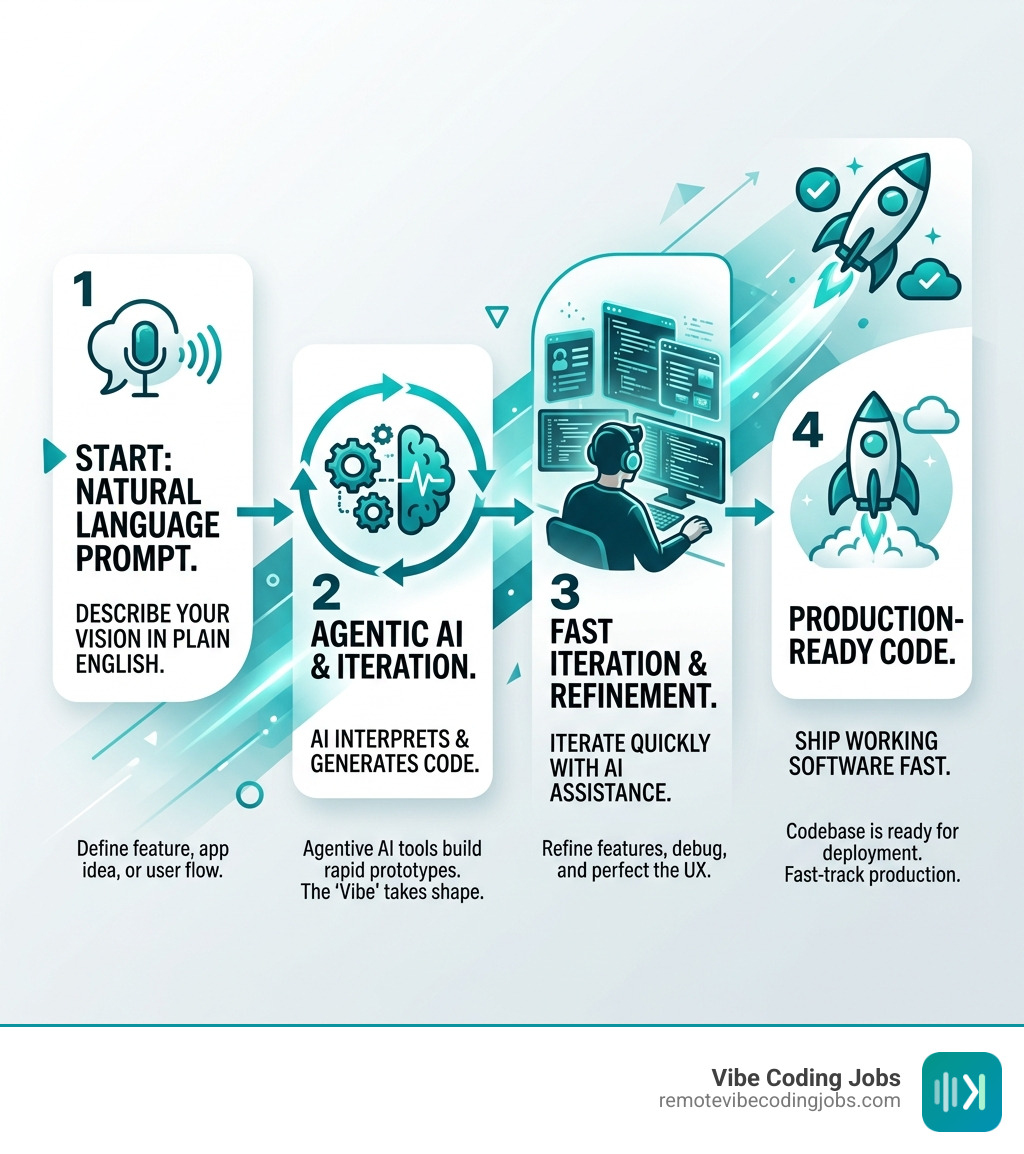
So what exactly is vibe coding? In short, it’s a development approach where you use AI tools — like Cursor or Claude — to describe what you want, iterate fast, and ship working software without writing every line by hand. The term was coined by Andrej Karpathy in 2025, and it’s quickly reshaping how companies hire, build, and ship.
The biggest shift? Vibe coding moves the developer’s role from typing syntax to architecting solutions. You’re the strategist. The AI handles the repetitive parts.
And companies love it — especially async-first teams that measure output, not hours.
I’m RVCJ Editorial, the editorial team behind Remote Vibe Coding Jobs, covering AI-assisted development, remote hiring trends, and career guidance for developers building with tools like Cursor, Claude, and Replit — everything you need to evaluate remote vibe coding opportunities with confidence. Read on for a curated breakdown of the best roles, tools, salaries, and strategies to land your next remote vibe coding job.
What is Vibe Coding and Why It’s Dominating 2026
As we move through April 2026, the landscape of software development has shifted dramatically. The term “vibe coding,” famously popularized by Andrej Karpathy and championed by tech legends like Steve Yegge, isn’t just a buzzword anymore—it’s a professional standard. At its core, What is Vibe Coding? is the practice of “agentic engineering.” It’s about maintaining a flow state where the distance between a thought and a working feature is bridged by AI.
In the old days (pre-2025), a developer might spend hours debugging a semicolon or a memory leak. In 2026, vibe coders spend that time on rapid prototyping and refining the user experience. By leveraging tools like Replit and Cursor, builders can spin up entire MVPs in the time it used to take to set up a local environment. This is the primary reason why Vibe Coding vs Traditional Development is the hot debate in engineering circles: one focuses on the “how” (syntax), while the other focuses on the “what” (the vibe and the value).
The Shift from Syntax to Strategy
The transition from being a “code typist” to a “software architect” is the defining career move of this decade. In remote vibe coding opportunities, your value isn’t measured by how many lines of code you can manually produce, but by your ability to direct AI agents to build complex systems.
Human-AI collaboration is the new baseline. You provide the creative spark, the system design, and the high-level logic; the AI handles the boilerplate. This requires a deep understanding of our Vibe Coding Workflow Guide, which emphasizes iterative prompting and architectural oversight. You are no longer just a worker in the factory; you are the foreman overseeing a digital workforce.
Why Async-First Companies Love Vibe Coders
Modern remote companies are ditching the “Slack firehose” and mandatory 9 AM standups. They are moving toward a no-BS culture that prioritizes deep work and autonomy. Vibe coders are a perfect fit for this environment because they are inherently output-oriented.
When you can ship a feature in two hours using AI that would have taken two days manually, the need for micromanagement disappears. Companies hiring for remote vibe coding opportunities look for builders who can thrive with location freedom and measure their success by what they deploy, not how many hours they sat in a Zoom chair. Check out our guide on Vibe Coding Remote Benefits Culture Career to see how these companies are restructuring the workday around human creativity.
Top Remote Vibe Coding Opportunities in 2026
The job market is currently flooded with roles that didn’t exist three years ago. We are seeing a massive surge in Remote Vibe AI Coding Jobs that prioritize speed and “vibe” over traditional seniority metrics. Whether you’re a Full-Stack AI developer or a Product Builder, the opportunities are vast.
One notable example is the Kilo Code Call for Engineers, where high-agency builders are needed to work on AI IDE extensions that process over 6 trillion tokens per month. These roles aren’t just for software engineers; they are for “GTM Engineers” and “Technical Product Managers” who use code as a tool to solve business problems.
AI-First Startups and Rapid Prototyping
Startups are the primary engine behind remote vibe coding opportunities. These companies need to ship MVPs and experimental projects at a breakneck pace. They don’t have time for six-month dev cycles. They want “Vibe Coders” who can take a rough prompt and turn it into a functional prototype by the end of the day.
If you have high agency and an ownership mindset, you’ll find plenty of Companies Hiring Vibe Coding Experts that are willing to pay top dollar for your ability to iterate. These roles often involve building LLM integrations, content pipelines, and frontend dashboards where the “vibe” of the UI matters as much as the logic behind it.
Enterprise Vibe Coding in Fintech and Healthcare
It’s not just the scrappy startups anymore. Large-scale sectors like fintech and healthcare are adopting agentic workflows to handle massive data pipelines and complex compliance requirements. We are seeing AI Coding Jobs Remote Opportunities in these industries that pay upwards of $200,000/year.
In these sectors, vibe coding is used for:
- Log Analysis: Building AI agents to troubleshoot trading platform stability.
- Genomics: PMs using vibe coding to prototype orchestration workflows.
- Fintech: Automating payment solutions and risk assessment tools at high velocity.
Essential Tech Stacks and AI Tools for Vibe Coders
To succeed in remote vibe coding opportunities, you need to master the 2026 toolkit. Gone are the days of just “knowing Java.” Today, you need to be fluent in the AI-human interface.
Our research shows that the most requested tools include Cursor (the AI-native code editor), Claude (for reasoning and code generation), and Replit (for rapid deployment). You should also keep an eye on newcomers like Windsurf and v0.dev. For a full breakdown, see our list of Must-Have Vibe Coding Tools and our comparison of Vibe Coder Tools Copilot Cursor.
Mastering the Prompt-to-Code Pipeline
Vibe coding is a conversation. Mastering the prompt-to-code pipeline involves more than just asking for a “to-do list app.” It requires:
- Structured Prompting: Giving the AI context, constraints, and specific architectural goals.
- Iterative Debugging: Using the AI to explain errors and suggest fixes in real-time.
- LLM Orchestration: Knowing when to use Claude for logic and GPT-4 for creative UI elements.
This Vibe Coder Toolkit Services guide explains how to build a personal library of prompts that act as your “digital scaffolding” for every new project.
Frontend and Backend Frameworks for AI Speed
While AI writes the code, you still need to know which frameworks play best with AI generators. The current “Golden Stack” for vibe coding includes:
- Next.js & React: For lightning-fast frontend development.
- Tailwind CSS: Because AI is incredibly good at generating utility-first styling.
- Python (FastAPI): The preferred choice for backend AI integrations and data handling.
- TypeScript: Essential for maintaining type safety when AI generates large blocks of code.
For those looking to level up their skills, the Remote Coding Membership: Learn Skills That Scale – Eat Wander Explore offers a portfolio-first roadmap that integrates these modern tools into a structured learning path.
Salary Trends and Career Growth in Remote Vibe Coding Opportunities
The financial upside for vibe coders is significant. Because a single vibe coder can often do the work of 2-3 traditional developers, companies are willing to offer premium compensation.
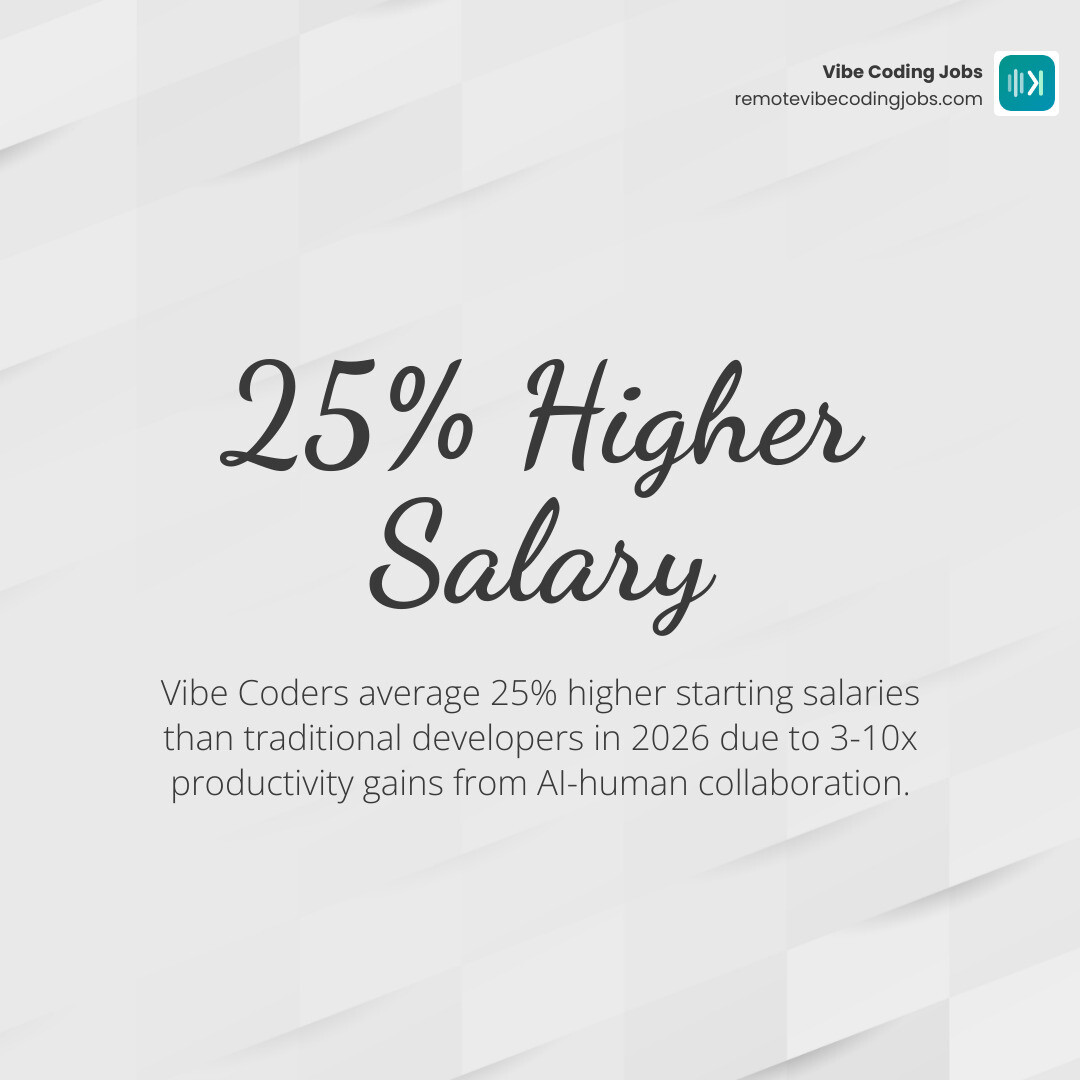
According to our Vibe Coding Salary Guide 2026, the productivity multiplier is the key. When you can ship 3-10x faster, you aren’t just an expense; you’re a massive value-add. This has created a high Vibe Coding Salary Remote AI Potential for those who can prove their efficiency.
From Junior Vibe Coder to AI Systems Architect
The career path for a vibe coder is evolving. You might start as a Junior Vibe Coder ($70k-$100k), focusing on shipping small features and internal tools. As you master agentic workflows, you move into “Product Engineering,” and eventually into an “AI Systems Architect” role ($150k-$250k+).
In this senior stage, you aren’t just building apps; you are building the systems that allow AI agents to build apps. Explore the Vibe Coding Remote Career Path Opportunities to see how you can scale your seniority without having to grind through 10 years of manual syntax.
Freelance vs Full-Time Vibe Coding Roles
One of the best parts about remote vibe coding opportunities is the flexibility in how you work.
- Full-Time: Offers stability, benefits (like the 28 days PTO we see at many AI startups), and equity packages.
- Bounty-Based/Freelance: Vibe coders are charging $100–$300/hour for specialized AI implementations.
We’ve seen a rise in “AI Pilots” who take on short, high-impact sprints (1-4 hours) to solve specific technical bottlenecks. Check out the latest Vibe Coding Salary Trends Remote to see which model fits your lifestyle.
How to Land a Vibe Coding Role Without LeetCode
The “Whiteboard Interview” is dying. In 2026, hiring managers for remote vibe coding opportunities don’t care if you can reverse a binary tree on a chalkboard. They want to see what you’ve actually built.
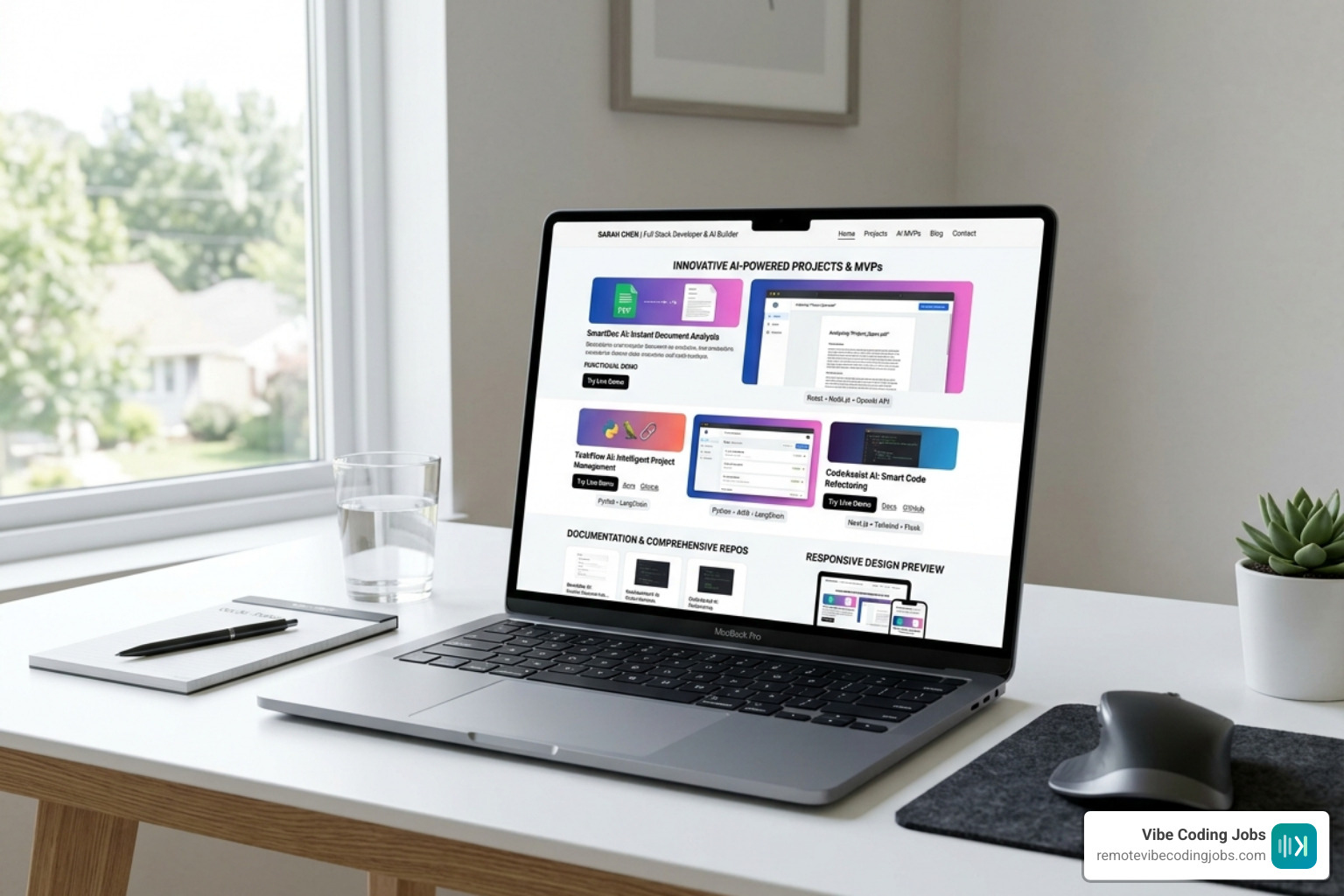
This is a “Proof-of-Work” economy. Your portfolio is your resume. We recommend focusing on a How to Get a Vibe Coding Job strategy that emphasizes Vibe Coding Portfolio Projects. Show them a live URL of a tool you built using Cursor and Claude, and explain the architectural decisions you made along the way.
Preparing for the Agentic Interview
The “Agentic Interview” is the new standard. Instead of a LeetCode puzzle, you’ll likely be asked to:
- Live Prototype: Build a small feature in 30 minutes using your AI tools of choice.
- System Walkthrough: Explain how you orchestrated different AI agents to solve a problem.
- AI Pairing: Work alongside the interviewer to refine a prompt-generated block of code.
This approach proves you can actually deliver value in a real-world setting. It’s about Vibe Coding Jobs Remote Career Success through practical application.
Building Your Vibe Coding Portfolio
What should be in your portfolio?
- Functional MVPs: Not just tutorials, but real tools that solve a problem (e.g., an AI-powered SEO analyzer).
- Open-Source Contributions: Show that you can work within a shared codebase.
- Documentation: Explain your “vibe”—how you use prompts, how you handle AI hallucinations, and how you ensure code quality.
This is the best way to navigate the Vibe Coding Careers Remote Job Market Skills Growth and stand out from the crowd.
Frequently Asked Questions about Remote Vibe Coding Opportunities
What are the best remote vibe coding opportunities for beginners?
Junior roles and internships are plentiful, especially at AI startups that value “AI fluency” over years of experience. Many companies are looking for “AI Pilots” or “Junior Product Builders” who are comfortable learning in public. You can find these in our Vibe Coding Jobs Remote AI Assistant section.
Do I need a CS degree for remote vibe coding opportunities?
No. While a degree can provide a foundation, the industry has shifted to a “portfolio-first” model. If you can prove you can ship functional, elegant code using AI, most remote-first companies will prioritize your practical skills over a diploma. Check out these Vibe Coding Remote Jobs Career Path Outlook Tips for self-taught success stories.
Which companies are hiring for vibe coding roles?
A wide range of Companies Hiring Vibe Coders Remote AI Coding are active right now. This includes AI-first SEO agencies, fintech startups like those automating global security, and healthcare innovators building patient-care tools.
Conclusion
The era of the “syntax-first” developer is making way for the “vibe-first” architect. Remote vibe coding opportunities offer a unique path to high pay, location freedom, and a more creative way of working. By mastering tools like Cursor, Claude, and Replit, you can bypass the traditional gatekeepers of the tech industry and start shipping software that feels like magic.
At RemoteVibeCodingJobs, we are dedicated to helping you navigate this AI-native future. Whether you are looking for your first junior role or a senior architect position, we provide the curated listings and resources you need to succeed.
Ready to find your next role? Browse the latest Vibe Coding Remote Job Guide or check out specific opportunities at companies like Replit to start your journey today. The vibes are calling—will you answer?