
The Vibe Coding Tech Stack: What Actually Works in 2026
The vibe coding tech stack you choose is the single biggest factor in how fast you ship — and whether your app holds up in production.
Here’s the short answer for developers who want it fast:
| Layer | Best Choice | Alternative |
|---|---|---|
| Frontend | Next.js App Router | Remix, SvelteKit |
| UI Components | shadcn/ui + Tailwind CSS | Bootstrap |
| Database + Auth | Supabase (Postgres, RLS, Auth) | Firebase |
| Resend | SendGrid | |
| Payments | Stripe | Lemon Squeezy |
| Deployment | Vercel | Railway, Netlify |
| AI IDE | Cursor | Windsurf |
| AI Model | Claude 3.5 Sonnet | GPT-4o, Gemini 2.0 Flash |
This combination — sometimes called the Leverage Stack — is what experienced vibe coders use to go from idea to paid MVP in hours, not weeks.
Vibe coding flipped software development on its head. Instead of writing every line by hand, you describe what you want in plain language and let AI generate the code. Andrej Karpathy coined the term in early 2025, but by April 2026 it’s become the default workflow for solo builders, indie hackers, and remote developers shipping real SaaS products. Developers using structured vibe coding workflows report building complex applications 20-50x faster than traditional methods.
The catch? Most people don’t fail because the AI writes bad code. They fail because they picked the wrong stack. An AI agent handed an open-ended choice between dozens of frameworks, databases, and hosting options will produce inconsistent, bloated results. Give it a tight, well-defined stack and it builds cleanly, predictably, and fast.
That’s exactly what this guide covers.
We are RVCJ Editorial, the team behind Remote Vibe Coding Jobs — we cover AI-assisted development workflows, vibe coding tech stacks, and remote hiring trends for engineers building with tools like Cursor, Claude, and Supabase. Our hands-on experience tracking what real vibe coders ship in production means every recommendation here is grounded in what actually works, not what looks good on a listicle.
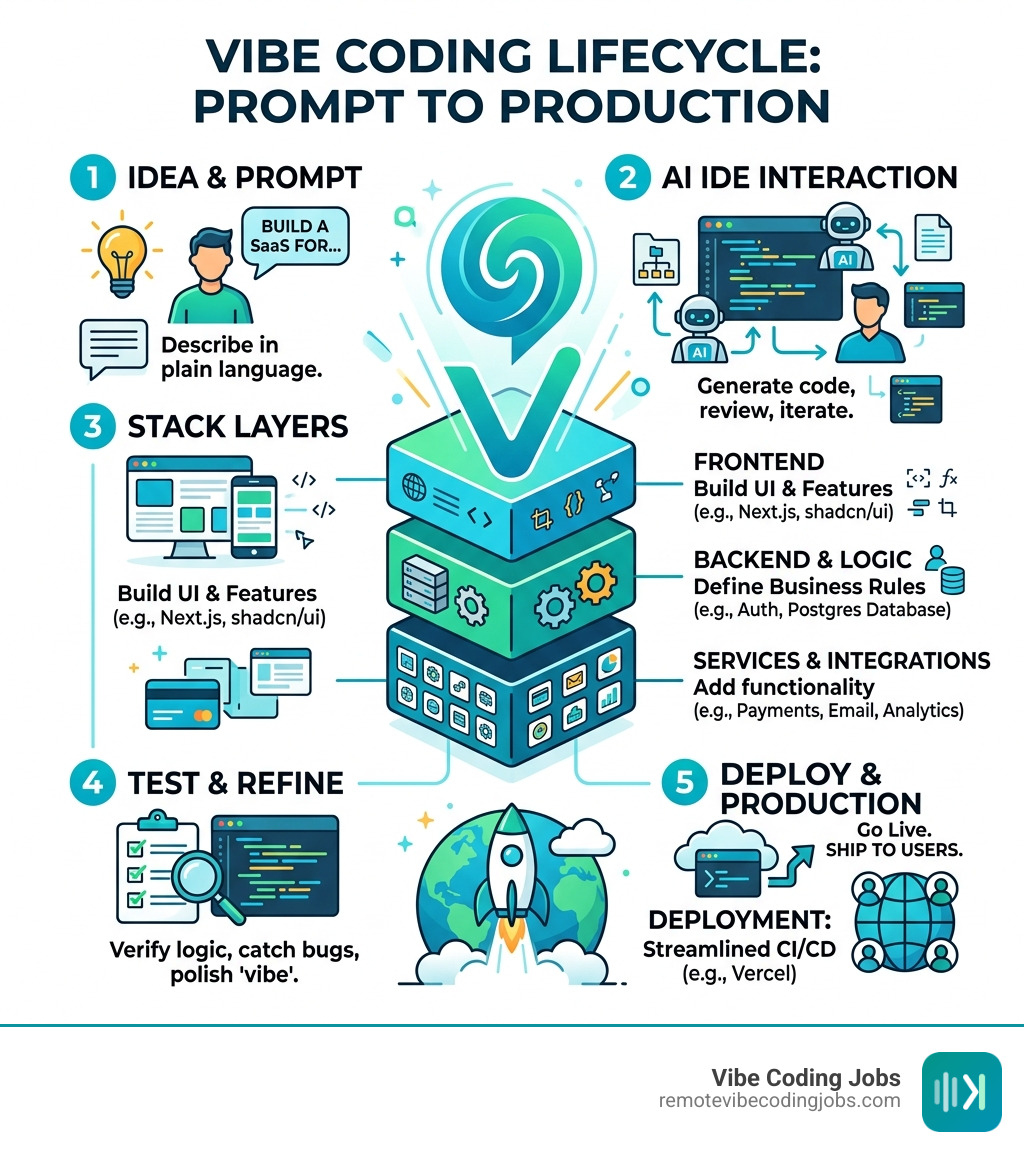
Understanding the Vibe Coding Tech Stack
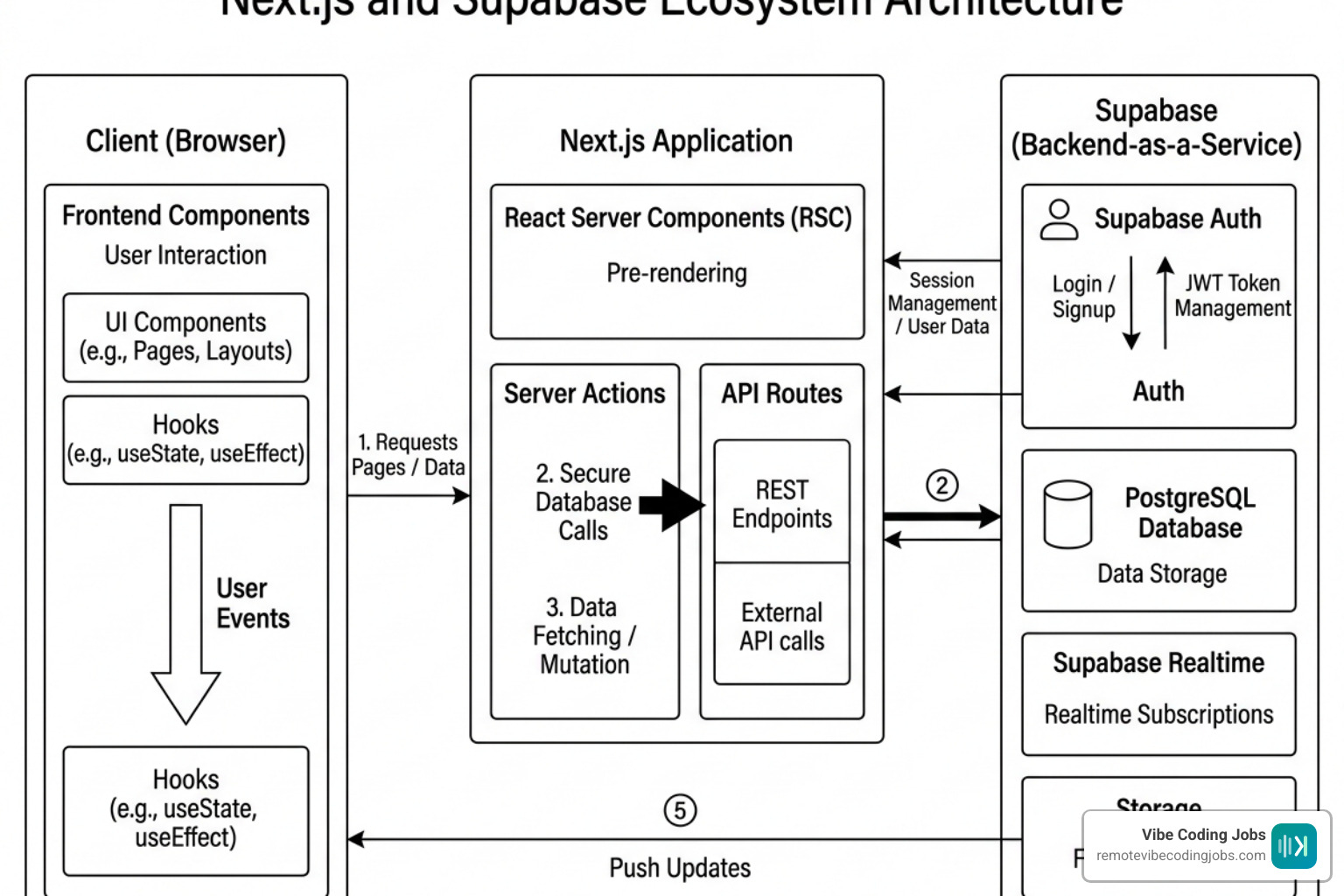
When we talk about a vibe coding tech stack, we aren’t just listing popular tools. We are identifying an ecosystem where AI agents and human “vibe coders” can communicate without friction. In 2026, the most successful builders have moved away from over-engineered microservices and toward opinionated, full-stack frameworks that provide a “source of truth” for the AI. This evolution is detailed in recent analysis of the tech stack for vibe coding today’s applications.
The core of this modern stack is almost always Next.js. Its App Router and Server Actions are absolute game-changers for AI-assisted development. Because Server Actions allow you to write server-side logic directly alongside your UI components, the AI doesn’t have to jump between separate frontend and backend repositories. It can see the whole “vibe” of a feature in one file.
To style these apps, shadcn/ui and Tailwind CSS are the undisputed champions. AI models like Claude 3.5 Sonnet have been trained on millions of Tailwind lines; they can generate complex, responsive layouts with terrifying accuracy. By using shadcn/ui, you give the AI a set of high-quality, accessible components that it can copy-paste and modify without breaking your design system.
For a deeper dive into the specific coding languages that dominate this space, check out our guide on the top programming languages for vibe coding in 2026.
Why Next.js + Supabase is the Gold Standard
If Next.js is the brain, Supabase is the nervous system. It provides a managed PostgreSQL database, Authentication, Storage, and Real-time capabilities all in one package.
The real magic for vibe coding lies in Row Level Security (RLS). In a traditional stack, you’d spend hours writing complex middleware to ensure User A can’t see User B’s data. With Supabase RLS, you define these rules at the database level. This means you can tell your AI agent: “Ensure all tables have RLS enabled so users can only access their own rows,” and the security is baked in automatically. This prevents the common pitfall where an AI might accidentally “forget” an authorization check in a new API route.
Selecting the Right Model for Your Vibe Coding Tech Stack
Your choice of Large Language Model (LLM) is the “engine” of your stack. While the landscape shifts weekly, three giants dominate the April 2026 scene:
- Claude 3.5 Sonnet (Anthropic): Widely considered the “Vibe King.” It has an incredible grasp of React and Next.js patterns and tends to follow complex instructions better than its peers.
- GPT-4o (OpenAI): Excellent for multimodal tasks, like when you want to upload a screenshot of a dashboard and say, “Build this.”
- Gemini 2.0 Flash (Google): Known for its massive context window. If you have a legacy project with thousands of lines of code, Gemini can “read” the whole thing to understand the context before making changes.
Understanding how to leverage these is part of mastering the essential AI tools for vibe coding.
The Three Main Vibe Coding Stack Patterns
Not every project requires a full production setup. We categorize the vibe coding tech stack into three distinct patterns based on your goals:
| Feature | Sprint Stack | Leverage Stack | Control Stack |
|---|---|---|---|
| Goal | Idea to Prototype | Launching a SaaS | High Scale / Compliance |
| Primary Tool | Bolt.new / Replit | Cursor / Next.js | VS Code / Custom Backend |
| Database | Built-in / SQLite | Supabase / Neon | Managed Postgres / RDS |
| Deployment | 1-Click (Instant) | Vercel | AWS / Docker / Fly.io |
| Best For | Testing a “vibe” | Building an MVP | Enterprise apps |
The Sprint Stack for Rapid Prototyping
The Sprint Stack is for those 3 A.M. moments when you have an idea and need to see it live before sunrise. Tools like Replit Agent, Bolt.new, and Lovable allow you to prompt an entire application into existence within a single browser tab. These platforms handle the hosting, database setup, and deployment automatically. It’s “zero config” coding. While limited in long-term customizability, it’s the fastest way to validate a concept.
The Leverage Stack for Modern SaaS
This is where most of our community at Remote Vibe Coding Jobs lives. It’s the sweet spot between speed and professional-grade infrastructure. By combining Next.js, Supabase, Stripe, and Resend, you are using tools that are “vibe-compatible.” They have excellent documentation that LLMs know by heart, and they offer free tiers that let you prototype for $0 before scaling.
To see why these tools are non-negotiable, see our list of must-have vibe coding tools and this community guide on the vibe coding tool stack.
Choosing Your AI Interface and Model

The interface is where your “vibes” become reality. While VS Code is a classic, the rise of Agentic IDEs has changed the game.
Optimizing Your Vibe Coding Tech Stack with Agentic IDEs
Cursor is currently the gold standard. Its “Composer” mode allows the AI to write code across multiple files at once. You can say, “Add a billing page with Stripe integration,” and Cursor will create the new page, update your sidebar navigation, and add the necessary environment variables.
Windsurf is a strong alternative, offering a “Cascade” feature that acts as an autonomous agent, running terminal commands, reading files, and fixing its own bugs. Both of these tools support MCP (Model Context Protocol) servers, which allow the AI to interact directly with your local files, Google Docs, or even your database schema.
For a full breakdown of the current landscape, read about the best AI coding tools for 2026.
Essential Supporting Tools for Production
Even when “vibing,” you cannot ignore the fundamentals. Git and GitHub are non-negotiable. AI will eventually make a mistake that breaks your app; having a commit history allows you to “time travel” back to when things worked.
We also recommend forcing your AI to use Prettier and ESLint. This ensures that even if the AI writes the code, it follows a consistent style that a human can read later. As the industry evolves, staying updated on the evolution of AI coding tools will help you keep your supporting stack sharp.
Step-by-Step Workflow: From Idea to Production
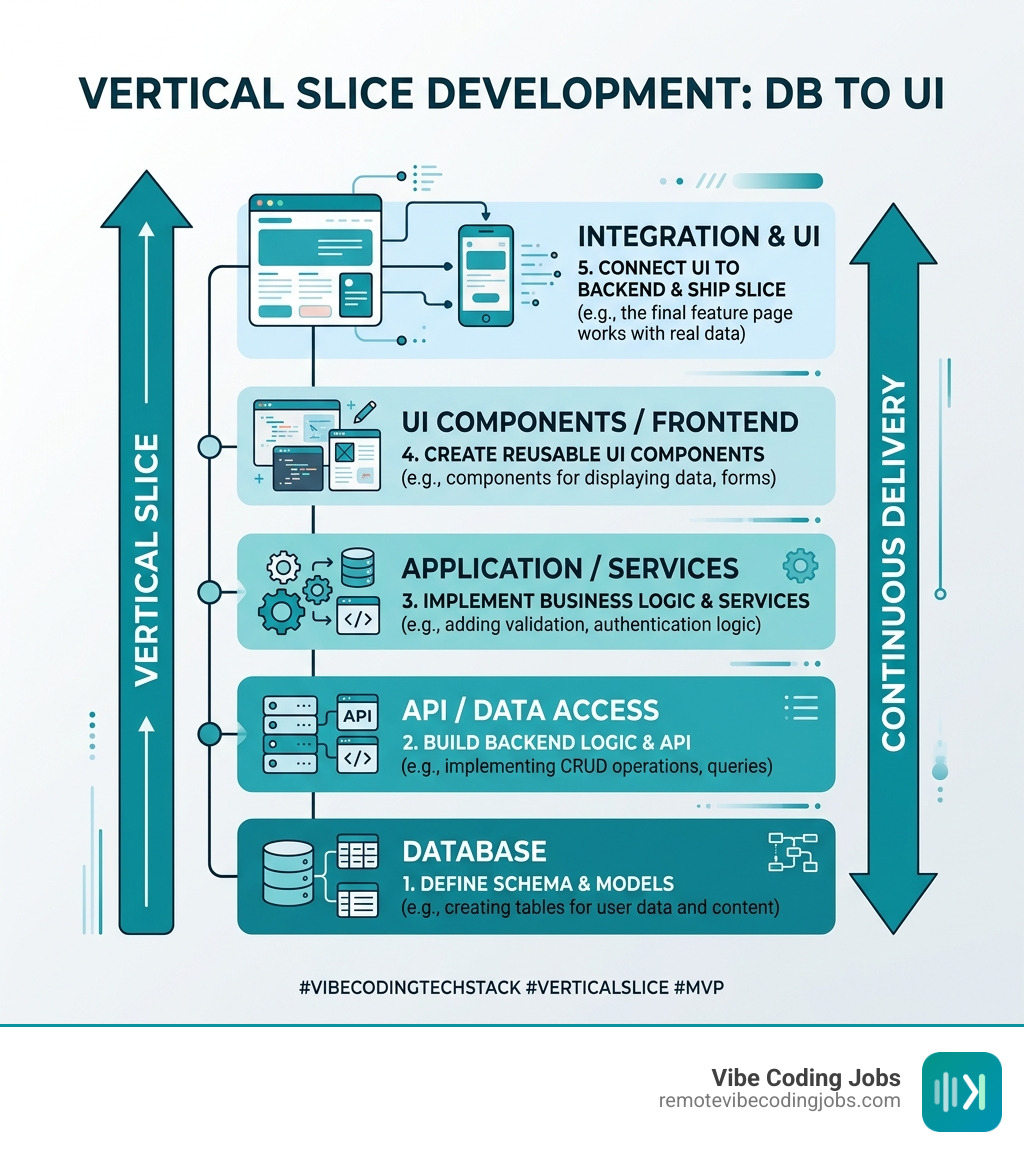
To go from an idea to a production-ready MVP, you need more than just a prompt. You need a structured workflow.
- PRD Generation: Start by asking your AI (we recommend Claude) to generate a Product Requirements Document (PRD) based on your idea.
- The Rules File: Create a
.cursor/rules/directory or aCLAUDE.mdfile. This acts as the “memory” for your project, telling the AI exactly which vibe coding tech stack you are using, your naming conventions, and common pitfalls to avoid. - Vertical Slices: Don’t ask the AI to “build the whole app.” Instead, build in vertical slices. For example, “Step 1: Build the user authentication flow and database schema for the ‘Books’ table.”
- Documentation: After every feature, ask the AI to document the core logic in an
ai/docs/folder. This helps the AI maintain context as the project grows.
This structured approach is essential for anyone looking to master AI coding tools for vibe coding. For a deeper look at implementation, see this structured workflow for vibe coding full-stack apps.
Handling Security and Scaling
Vibe-coded apps are often criticized for being “messy,” but they don’t have to be insecure. By using the Leverage Stack, you get security out of the box:
- Supabase RLS handles data isolation.
- Clerk or Supabase Auth handles secure logins and sessions.
- Stripe Webhooks ensure users only get what they pay for.
As you grow, you can add monitoring tools like Sentry for error tracking and Logtail for logs. Because you are using serverless infrastructure (Vercel and Supabase), scaling is often as simple as moving from a free tier to a paid one.
Common Pitfalls and Golden Rules
We’ve seen thousands of developers transition to vibe coding, and the ones who succeed follow these “Golden Rules”:
- Commit Frequently: Treat every successful AI change like a checkpoint in a video game. If the AI goes off the rails in the next step, you can just revert.
- The 150-Line Rule: Keep your components small. If a file exceeds 150 lines, ask the AI to refactor it. Smaller files are easier for AI to “reason” about and lead to fewer bugs.
- Verification Checklists: Before you deploy, run a checklist: Does it build? Is the type-checking passing? Does the responsive design work on mobile?
- Trust, but Verify: Never blindly copy-paste code. Use
git diffto see exactly what the AI changed.
For those working remotely, we have a specific guide on the best Claude Code practices for remote developers in 2026.
Frequently Asked Questions about Vibe Coding
Is vibe coding secure enough for production?
Yes, provided you use the right vibe coding tech stack. By relying on managed services like Clerk for auth and Supabase for database security (RLS), you offload the most dangerous security tasks to experts. Always use environment variables for secrets and never commit your .env file to GitHub.
Do I need to know how to code to use these stacks?
You don’t need to be a Senior Architect, but you do need “logic literacy.” You need to understand how a database relates to a frontend and how an API call works. Vibe coding is about being a “Director” rather than a “Cameraman.” You provide the vision; the AI handles the execution.
How much does a professional vibe coding stack cost?
You can start for $0. Most of the tools in the Leverage Stack (Vercel, Supabase, Resend) have generous free tiers. Once you start getting traffic, a typical SaaS will cost around $40–$60 per month to run — significantly cheaper than traditional “no-code” platforms which can scale into the hundreds very quickly.
Conclusion
Vibe coding isn’t just a trend; it’s a fundamental shift in how software is created. By choosing a robust vibe coding tech stack like Next.js, Supabase, and Cursor, you are positioning yourself to build faster and more reliably than ever before.
The future of work belongs to the “AI-fluent” professional — the developer who knows how to orchestrate these tools to ship value. At Remote Vibe Coding Jobs, we are dedicated to helping you find the companies that value this high-speed, high-leverage way of working.
Ready to put your new stack to the test? Find remote vibe coding jobs and start building the future today.