What Is the Overview of Vibe Coding Jobs in 2026?
As of August 2026, “vibe coding” has officially transitioned from an internet meme coined by tech visionaries into a formalized, high-demand job category across global tech recruitment. Once viewed as an informal hackathon strategy, companies now explicitly list roles like AI Vibe Coding Engineer, Lead Vibe Coding Engineer, and Technical Assistant (Vibe Coder) on major job boards.
At its core, vibe coding is the practice of developing software by guiding AI coding agents—such as Cursor, Claude Code, OpenAI Codex 5.5, and Windsurf—using natural language, high-level system architecture, and rapid iterative prompting. Instead of spending hours manually typing out syntax, boilerplate functions, and bracket configurations line-by-line, a vibe coder operates as a technical director. You set the product vision, craft context-rich instructions, evaluate generated code, and iterate until the feature or full-stack application is live.
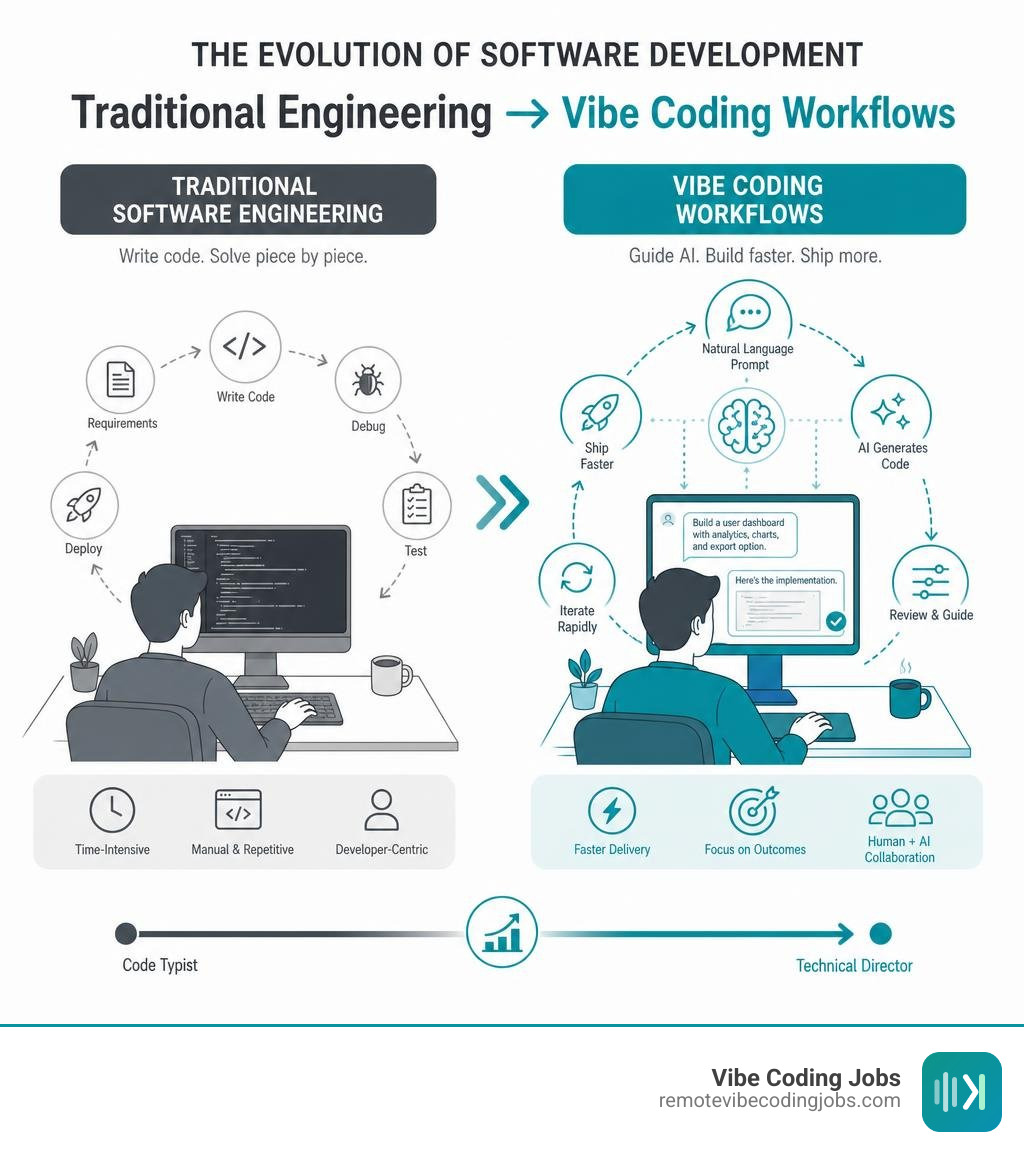
This evolution represents a massive paradigm shift in the software industry. Engineering organizations are moving away from treating developers as line-by-line “code typists” and reorienting their teams around prompt-driven technical architects and agile product builders. Whether in fintech, healthcare, retail giants like Walmart, or early-stage AI startups, companies are restructuring their engineering workflows. They realize that a skilled vibe coder can build, test, and ship production-ready applications in days—work that historically required an entire team of full-stack engineers months to execute.
What Is a Vibe Coding Job and How Does It Differ From Traditional Software Development?
The term “vibe coding” was originally popularized by former OpenAI Head of AI Andrej Karpathy to describe a loose, flow-state style of programming where human developers delegate syntax generation entirely to Large Language Models (LLMs). By 2026, the tech industry formalized this concept into a core engineering discipline.
In traditional software development, up to 80% of a developer’s time is consumed by writing syntax, configuring environment dependencies, reading API documentation, and fixing minor compiler bugs. Vibe coding completely flips this ratio. In a vibe coding job, your primary focus shifts to:
- Solution Architecture & System Design: Defining data schemas, API contracts, microservices, and component hierarchies.
- Context Engineering & Prompt Design: Supplying AI agents with precise business rules, repository structures, and constraint-based instructions.
- Verification & Quality Oversight: Reviewing AI outputs, testing user flows, auditing security guardrails, and guiding agents out of hallucination loops.
Real-world applications of vibe coding extend far beyond basic landing pages. Engineering teams deploy vibe coders to build full-stack web applications, set up complex database architectures on Supabase or Firebase, automate Digital Forensics and Incident Response (DFIR) security workflows, and rapidly deploy interactive prototypes directly to Vercel or Netlify.
When developers adopt structured vibe coding methodologies, they consistently achieve 2x to 5x productivity gains within their first month. To understand how these approaches stack up, check out our deep-dive on Compare: Vibe Coding vs Traditional.
| Workflow Dimension | Traditional Software Engineering | Vibe Coding Workflow |
|---|---|---|
| Primary Task | Manual syntax implementation & manual debugging | Solution architecture, prompt guidance & output verification |
| Development Speed | Weeks to months per feature | Hours to days per production MVP |
| Primary Tooling | Standard IDEs, manual compilers, documentation search | Cursor, Claude Code CLI, Codex CLI, Windsurf, v0, Lovable |
| Core Skillset | Deep syntax memorization & language-specific rules | System logic, context engineering & product intuition |
| Candidate Evaluation | LeetCode algorithms & whiteboarding tests | Live prompt-and-build challenges & deployed portfolio MVPs |
How Do the Daily Work Environment and Remote Work Dynamics Look?
The vast majority of vibe coding roles are structured as fully remote, async-first positions. Because vibe coding leverages rapid execution tools, engineering managers no longer judge performance by hours spent sitting at a desk or lines of code added to a pull request. Instead, evaluation focuses entirely on shipped features, product velocity, and working software.
In a daily remote setting, a vibe coder might start their morning by reviewing product briefs, writing prompt specifications in an AGENTS.md project file, and kicking off multi-agent CLI tasks in Claude Code or Codex CLI. Rather than sitting in lengthy daily standup meetings, team members communicate asynchronously through Loom videos, GitHub PR comments, and detailed documentation.
Because teams operate across global time zones, written clarity is paramount. You can explore how top companies structure these distributed cultures in our guide to Async-First Remote Developer Jobs: Culture, Tools, Salary. Strong written communication, combined with structured project handoffs, is often the single most important hiring criterion for remote vibe coding teams.
What Are the Most In-Demand Vibe Coding Roles and Salary Ranges in 2026?
The market demand for AI-fluent developers has created lucrative compensation packages across every experience tier. Based on our real-time market data across global job postings and startup offers, vibe coding compensation is structured as follows:
- Junior Vibe Coders (1–2 years experience): $70,000 to $100,000 per year, with top-tier funded startups offering up to $120,000. Entry-level part-time or technical assistant positions start at $25.00 per hour.
- Mid-Level AI Developers (2–4 years experience): $120,000 to $180,000 per year.
- Senior Vibe Coders & AI Systems Architects (5+ years experience): $180,000 to $280,000 per year, with total compensation exceeding $350,000 at FAANG and top AI infrastructure firms.
- Freelance Vibe Coders: Typical billing rates range from $75 to $150 per hour, with high-demand specialists commanding $100 to $300 per hour for rapid MVP contract sprints.
To explore full compensation datasets across geographical regions and experience tiers, review our comprehensive Vibe Coding Salary Guide: Data & Market Research.

Beyond specialized startups, traditional corporate employers actively hire for AI-assisted development skills under various titles:
- Forward Deployed Engineer at Airtable: $223,000 – $316,200/yr
- Developer Advocate, AI Infrastructure at Lavendo: $150,000 – $250,000/yr
- Sr. Manager Data Science – Gen AI & Content Systems: $118,300 – $219,800/yr
- Senior Manager, Supplier To Serve at Walmart: $80,000 – $155,000/yr
- Vibe Coding Engineer at AIT: BDT 35,000 – 75,000/month
Let’s take a closer look at the top three job categories leading the market in 2026.
1. AI Vibe Coding Engineer & Full-Stack AI Developer
The AI Vibe Coding Engineer is the most common job title posted by mid-stage startups and product agencies. In this role, you take raw product requirements, UI/UX mockups, or user stories and rapidly translate them into functional, full-stack web applications and microservices.
Your daily tasks involve using AI dev environments like Cursor and Windsurf to build frontend interfaces in React or Next.js, connecting them to cloud backends like Supabase, and integrating third-party APIs (Stripe, OpenAI, Twilio).
Employers recruiting for these roles typically ask for 1 to 2 years of hands-on experience with LLM prototyping and rapid software delivery. Real-world job listings—such as the Job Opening Vibe Coding Engineer | AIT —highlight that companies value deployed portfolio projects and a fast execution mindset far more than formal university degrees.
- Typical Salary Range: $110,000 – $180,000 / year
- Core Focus: Rapid feature delivery, MVP prototyping, end-to-end full-stack integration.
2. Lead Vibe Coding Engineer & AI Systems Architect
As organizations scale their AI development efforts, they require senior engineering leaders to establish company-wide standards for prompt-driven workflows, code governance, and system architecture. The Lead Vibe Coding Engineer or AI Systems Architect serves as this technical anchor.
Rather than just building individual features, a Lead Vibe Coding Engineer designs testing frameworks, prompt validation pipelines, and CI/CD automation rules to ensure AI-generated code meets strict security, performance, and scalability standards. You train junior developers on advanced context engineering techniques, constraint-based prompting, and Model Context Protocol (MCP) integrations.
Senior job descriptions expect candidates to possess a strong background in full-stack architecture, cloud infrastructure (AWS/GCP), and DevOps pipelines alongside expert-level mastery of AI coding assistants.
- Typical Salary Range: $130,000 – $250,000+ / year
- Core Focus: AI engineering governance, architectural design, context optimization, security auditing.
3. Non-Engineering Vibe Coders (Product Managers, Designers, & Marketers)
One of the most exciting shifts in 2026 is the rise of non-engineering professionals using vibe coding tools to build real software. Product managers, UX designers, and digital marketers are no longer reliant on engineering teams to build internal tools, customer dashboards, or interactive marketing campaign widgets.
Using visual AI builders like Lovable, v0 by Vercel, and Bolt.new, non-technical creators can prompt fully responsive web applications into existence over a single afternoon. This capability has created specialized cross-functional roles where domain experts combine business acumen with AI coding tools to ship software directly.
Salaries in this hybrid space span a wide spectrum ($45,000 to $351,000 per year) depending on domain seniority and organizational impact. To learn how non-engineers are breaking into technical roles, explore our breakdown on AI Coding Jobs: Entry Level, Growth, Remote Perks.
- Typical Salary Range: $45,000 – $351,000 / year (varies by role & industry)
- Core Focus: Internal tool creation, rapid design-to-code prototyping, autonomous feature experimentation.
Which Essential AI Tools and Technical Skills Do Employers Expect You to Know?
To secure a vibe coding job in 2026, you must master the modern AI development stack. Employers expect candidates to seamlessly combine AI editors, terminal CLI agents, visual prototyping tools, and serverless cloud infrastructure.
To dive deeper into setting up your workspace, check out our guide on Must-Have Vibe Coding Tools and review standard community references like the open-source README.md repository.

Must-Have AI Coding Editors and CLI Agents
Your primary workstation consists of AI-native code editors and command-line interface (CLI) agents:
- Cursor & Windsurf: The leading AI-first IDEs. They index your entire codebase, enabling multi-file edits, natural language refactoring, and real-time inline prompt generation. Read our comparison on Cursor vs Windsurf for Developers in 2026: Which is Best?.
- Claude Code CLI & OpenAI Codex 5.5 CLI: Terminal-based autonomous agents that excel at deep architectural reasoning, multi-file search-and-replace tasks, and execution of shell commands. Terminal CLIs allow developers to manage file-based memory banks (
/memory-bank), enforce project rules inAGENTS.md, and execute complex refactoring runs while keeping context window headroom above 50%. - GitHub Copilot: Widely used in enterprise environments for real-time auto-completion and pull-request synthesis.
AI App Builders, Rapid Infrastructure, and Cloud Stack
Speed is the ultimate metric in vibe coding. Employers look for candidates who can take an AI-generated codebase and host it on production infrastructure in minutes:
- Frontend Prototyping Builders: Lovable, v0 by Vercel, Bolt.new, and Replit Agent allow you to convert design prompts and wireframes into clean React/Tailwind codebases instantly.
- Zero-Friction Cloud & Database Infrastructure: Supabase and Firebase for instant authentication, PostgreSQL database setups, and storage; Vercel and Netlify for continuous integration and static/serverless deployment.
- Agentic Infrastructure & Protocols: Model Context Protocol (MCP) servers, vector databases (Pinecone, Qdrant), and RAG pipelines for connecting LLMs to internal company data sources.
Core Engineering Intuition and Verification Literacy
Can you vibe code without knowing any programming syntax? You can build simple prototypes, but landing a high-paying, professional vibe coding job requires verification literacy.
When an AI agent generates code, you must possess enough foundational technical intuition to read the output, understand how components interact, and spot hidden bugs or performance bottlenecks. Employers expect a working knowledge of:
- TypeScript / JavaScript: The default web development stack for AI tools.
- Python: Essential for AI data pipelines, backends, and agent scripting. Read our complete guide on Top Programming Languages for Vibe Coding 2026.
- Modern Web Frameworks: React, Next.js, and Node.js.
- API Standards: REST, GraphQL, and webhook integrations.
Do You Need a Computer Science Degree to Land a Vibe Coding Job?
The short answer is no. In 2026, the traditional requirement for a 4-year Computer Science degree or an expensive coding bootcamp has largely collapsed for vibe coding roles.
When evaluating applicants, companies prioritize a candidate’s “geeky-techie spirit,” speed of execution, and live portfolio of deployed applications over academic credentials or grade point averages. Hiring managers recognize that knowing how to guide an AI agent to build a secure, functional app in 48 hours is vastly more valuable to a business than the ability to write a binary tree traversal algorithm on a whiteboard.
In fact, many entry-level roles—such as part-time remote Technical Assistants ($25/hr)—specifically seek out candidates with logical problem-solving abilities and strong prompting skills rather than traditional engineering backgrounds. You can learn more about these low-barrier hiring paths in our guide to Remote Coding Jobs: No LeetCode, No Tests, Easy Hiring.
Key non-degree qualities employers actively seek include:
- High Curiosity & Self-Directed Learning: Demonstrated ability to pick up new AI tools, libraries, and frameworks within hours.
- Clear written instruction and prompt structure: Ability to communicate complex logic clearly to both AI agents and human teammates.
- Product & UX Intuition: Understanding what makes an application user-friendly, responsive, and valuable to customers.
- Relentless Problem-Solving: Staying calm when an AI agent gets stuck and knowing how to break down complex bugs into small, solvable prompts.
Why Juniors and Non-Technical Career Switchers Can Outperform Traditional Coders
In many instances, self-taught developers, career switchers, and junior builders adapt to vibe coding workflows faster than senior developers with 15 years of traditional experience.
Traditional senior developers often suffer from “syntax inertia”—they are used to manually writing code and can resist delegating control to AI agents, frequently stopping to manually edit code that an AI could fix in seconds. Conversely, junior builders and career switchers embrace AI-native workflows from day one without legacy habits holding them back. Read our detailed analysis on Why Junior Developers Outperform Seniors in the AI Age.
Furthermore, candidates transitioning from non-technical careers bring valuable domain expertise. A former accountant who vibe-codes a niche financial reporting app, or a former nurse who builds a clinic scheduling workflow, brings deep industry insight that a pure computer scientist lacks.
How Can You Build a Standout Portfolio and Pass the Vibe Coding Interview Process?
The interview process for a vibe coding job looks completely different from traditional tech interviews. You will rarely be asked abstract LeetCode algorithms or whiteboarding puzzles. Instead, employers use live prompt-and-build challenges.
During a vibe coding technical interview, you are given a product requirement (e.g., “Build a real-time collaborative task dashboard connected to Supabase with Stripe payments”) and 60 to 90 minutes to build it live using your preferred AI toolstack (Cursor, Claude Code, Lovable). The interviewer evaluates how efficiently you prompt, how you structure your project rules, how you handle terminal errors, and how you verify the final output.
To prepare for these practical assessments, read our step-by-step strategy on how to Build a Developer Portfolio with AI Tools: 2026 Guide.
Designing an Agent-Friendly, Fully Deployed Project Portfolio
Sending a standard PDF resume is no longer enough. To stand out, you need a public portfolio containing 2 to 3 fully deployed, functional SaaS MVPs.
You can easily build these over a single weekend by following our framework for a Vibe Coding First SaaS Weekend.
When structuring your GitHub repositories for your portfolio projects, make them “agent-friendly”:
- Include an
AGENTS.mdFile: Show potential employers how you structure instructions, constraints, and architecture rules for AI coding tools. - Clean Git Commit History: Commit early and often. Demonstrate a logical progression of feature builds, testing passes, and prompt iterations.
- Modular File Structure: Avoid messy, single-file monoliths. Organize code cleanly into reusable components, API routes, and database utility files.
- Live Deployment Links: Every project must have a working production URL hosted on Vercel, Netlify, or Cloudflare Pages.
Navigating Technical Interviews and Common Vibe Coding Pitfalls
During live technical interviews, the AI model will inevitably make a mistake or hallucinate a non-existent API package. How you react determines whether you get hired.
Top candidates demonstrate clear recovery strategies:
- Context Clearing: When an AI agent gets confused or stuck in an error loop, use commands like
/clearor/compactto reset the context window and re-feed clean project rules. - Git Rewinding: If an AI prompt breaks your working codebase, use Git rollbacks (
/rewindorgit reset) immediately rather than trying to stack fix-up prompts on top of broken code. - Granular Prompting: Break big features down into tiny, step-by-step prompts guided by an
implementation-plan.mdfile rather than asking the model to build an entire system in a single massive prompt.
Avoid common pitfalls like leaving API keys hardcoded in frontend components, shipping unvalidated security vulnerabilities, or relying on bloated, unmaintained third-party dependencies. For a complete blueprint on interview preparation, explore How to Get a Vibe Coding Job: The Complete Guide.
Where Can You Find Remote Vibe Coding Jobs and How Do You Transition in 30 Days?
Finding active vibe coding job openings requires looking beyond traditional job boards that cater primarily to legacy software roles. Dedicated AI job portals offer curated opportunities tailored to your stack.
At Remote Vibe Coding Jobs, we aggregate over 200 active, verified vibe coding listings at any given time. Our platform filters roles specifically by AI tool requirements (Cursor, Claude Code, Windsurf), remote work culture, and compensation transparency. You can also research verified employers in our directory of Companies Hiring Vibe Coders & AI Developers.
Step-by-Step 30-Day Vibe Coding Career Action Plan
If you want to transition into a full-time or freelance vibe coding career within the next month, follow this structured 30-day execution roadmap:
- Days 1–10: Toolstack Mastery & Fundamentals
Install Cursor, VS Code, and Claude Code or Codex CLI. Learn basic web architecture (HTML/CSS, TypeScript, React basics, REST APIs). Practice configuring
AGENTS.mdand setting up project memory banks. - Days 11–20: Build & Deploy Sprint Take on our structured Vibe Coding 30-Day Challenge. Build two complete full-stack web applications from scratch (e.g., an AI content tool or a micro-SaaS dashboard). Connect your apps to Supabase for authentication/database storage and deploy live to Vercel.
- Days 21–30: Portfolio Optimization & Job Applications Create an agent-friendly GitHub portfolio. Write clear README files detailing your prompt architecture and build process. Submit applications directly to async-first remote openings on Remote Vibe Coding Jobs.
What Are the Frequently Asked Questions About Vibe Coding Jobs?
Is vibe coding a real job title or just an industry buzzword?
Vibe coding is a recognized, formal job title and engineering skill set. Major tech startups, enterprise software firms, and retail companies explicitly recruit for titles like “AI Vibe Coding Engineer,” “Lead Vibe Coding Engineer,” and “AI-Assisted Technical Assistant.” These positions offer verified annual salaries ranging from $70,000 for entry-level roles to over $280,000 for senior engineers.
How much can I expect to make as an entry-level vibe coder?
Entry-level vibe coders with 1 to 2 years of practical AI building experience typically earn between $70,000 and $100,000 per year, with competitive tech startups paying up to $120,000. Part-time or junior technical assistant positions offer hourly rates starting around $25.00 per hour.
Can I land a vibe coding job without prior software engineering experience?
Yes. Companies hiring vibe coders prioritize practical shipping speed, prompt engineering mastery, product intuition, and live portfolio MVPs over computer science degrees or traditional engineering backgrounds. If you can systematically direct AI tools to build working, secure software, you can land a job in this field.
What Is the Future Outlook for Your Vibe Coding Career?
The shift toward AI-assisted development is a permanent evolution in how software is created. As AI models become more capable, the value of manual syntax typing will continue to decline, while the demand for skilled technical directors, system architects, and creative problem solvers will skyrocket.
By choosing a vibe coding career path today, you position yourself at the forefront of the software industry. You transition from a manual coder into a high-leverage product owner capable of turning complex business ideas into production-ready software in a fraction of the time.
Ready to launch your vibe coding career? Explore curated, async-first remote openings, filter by your favorite AI tools, and apply to top hiring companies today on Remote Vibe Coding Jobs.