
Find Remote Software Jobs Without the Noise
Start with curated remote listings that fit your stack and experience level. Look for a clear remote location policy, a recent posting date, salary details when available, and a direct path to apply. Before sending your resume, check the role on the company’s careers page. That quick step can save you from chasing an expired post.
For AI-assisted coding roles, read past the title. Does the team name the tools it uses? Does it explain how engineers work across time zones? A smaller, focused board can help you find better matches, but no board can guarantee a live opening or a reply.
I’m Di Su, a software engineer with over 10 years of experience building web products and tools that make complex searches easier to use. I’ll use that lens to help you assess curated remote listings and choose where to spend your application time.
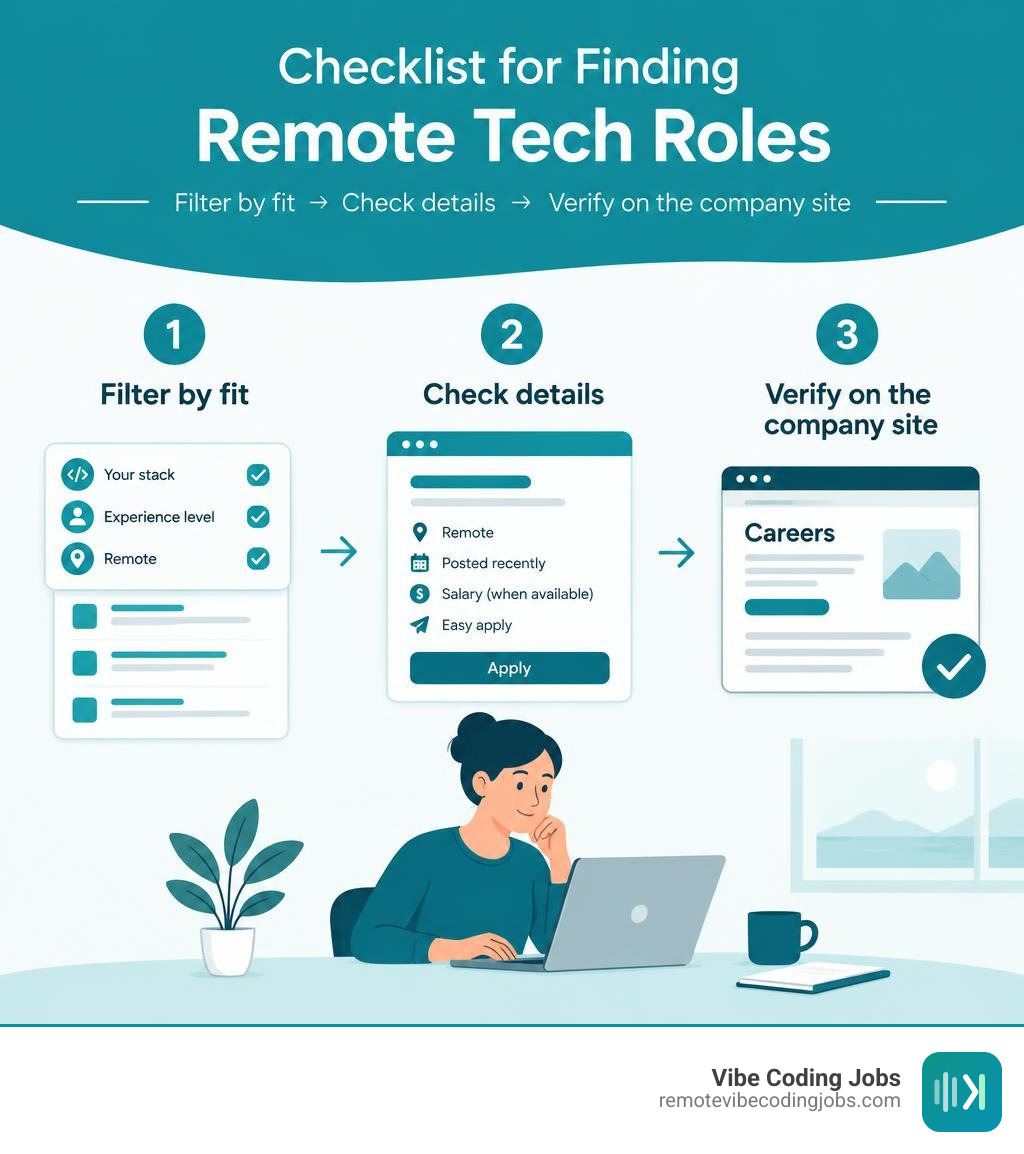
Basic curated remote listings terms:
Why Software Engineers Rely on Curated Remote Listings in 2026

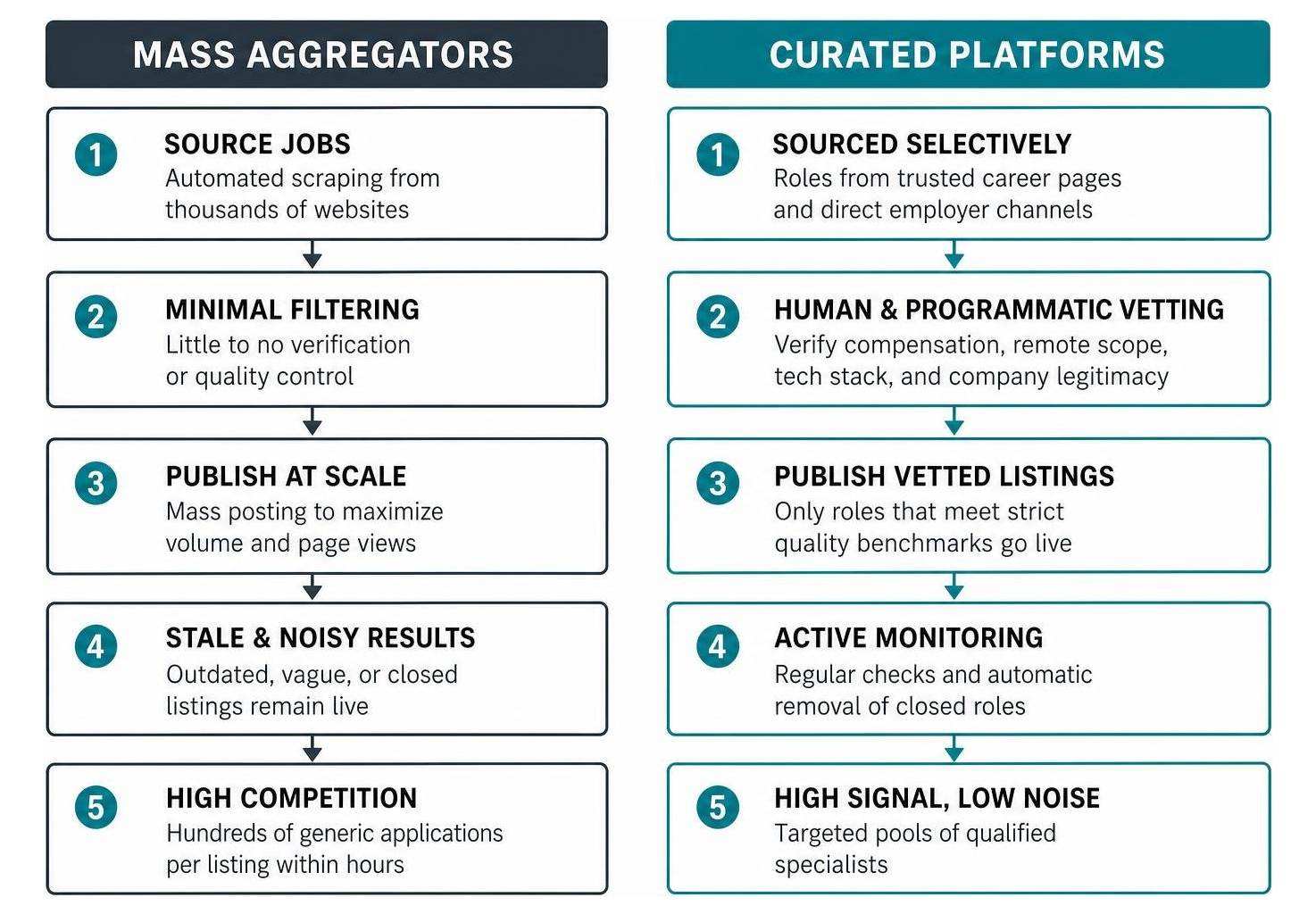
Hunting for a distributed engineering role on mass-market employment sites in 2026 often feels like shouting into an algorithmic void. Traditional aggregators scrape millions of web pages indiscriminately, populating feeds with zombie postings, hidden hybrid mandates, misleading location parameters, and outright recruitment scams. When thousands of applicants apply to a single scraped position within minutes, high-signal candidates get buried under automated resume spam.
Specialized platforms solve this signal-to-noise problem through deliberate quality control. Rather than maximizing page views by hosting millions of generic posts, curated repositories filter every position against strict benchmarks: verifiable compensation, unambiguous timezone expectations, legitimate remote infrastructure, and scam-free employers. According to recent community research on top remote job boards, developers increasingly bypass bloated search engines in favor of tight-knit platforms where smaller, highly focused applicant pools translate to significantly higher interview conversion rates.
| Feature / Criteria | Mass Job Aggregators | Curated Tech Platforms |
|---|---|---|
| Vetting Process | Automated scraping with minimal filtering | Human verification or strict programmatic screening |
| Salary Transparency | Often hidden or unverified platform estimates | Explicit salary bands and equity figures disclosed upfront |
| Remote Scope | Frequently vague (disguised hybrid mandates) | Explicit geographic, country, and timezone constraints |
| Listing Freshness | High frequency of stale, closed, or ghost postings | Active monitoring with automatic pruning of closed roles |
| Applicant Competition | 500+ generic applications per listing within hours | Targeted applicant pools of qualified specialists |
| Tech Stack Detail | High-level keywords without workflow context | In-depth breakdown of toolchains, AI tools, and async practices |
Key Differences Between Aggregators and Hand-Screened Boards
The operational architecture of a hand-screened board differs fundamentally from a passive aggregator. Aggregators deploy automated web crawlers that ingest every career page they index, often leaving postings live months after an internal engineering team has filled the vacancy. In contrast, dedicated discovery sites invest substantial human hours and specialized algorithms to cross-reference open roles against live applicant tracking systems (ATS).
This human-in-the-loop screening ensures that every listing links directly to an active ATS endpoint rather than an ad-heavy intermediary. For developers targeting async first remote developer jobs, these platforms confirm whether a company truly operates asynchronously with written documentation or merely claims to be flexible while demanding eight hours of synchronous video meetings every day.
Trade-offs Between Free Channels and Paid Curation
Navigating remote discovery platforms involves choosing between open-access directories and premium, subscription-based repositories. Both approaches provide distinct advantages depending on your career stage and urgency:
- Free Curated Channels: Ideal for broad discovery and early-stage browsing. Free platforms monetize through employer listing fees or community sponsorships, providing accessible search filters without subscription barriers. The trade-off is slightly higher applicant volume compared to closed networks.
- Paid Subscription Networks: Ideal for senior specialists seeking private startup listings, executive engineering roles, or complex international relocation tracks. Premium services spend hundreds of hours per week vetting roles and maintaining proprietary talent pipelines. The subscription fee filters out casual applicants, keeping competition exceptionally low.
Investing in a curated channel is fundamentally an investment in candidate return on investment (ROI). Spending hours submitting hundreds of generic applications on unvetted boards burns mental bandwidth; targeting a dozen vetted roles with direct ATS links dramatically accelerates your job search timeline.
Top Categories of Curated Job Platforms for Tech Talent
Curated directories categorize tech opportunities by technical domain, geographic scope, and compensation tiers rather than blunt location radius tags.
High-Paying and $100K+ Tech Opportunities with Curated Remote Listings
Senior engineers, staff architects, and engineering managers require precise compensation visibility. High-earning directories exclusively index positions offering base compensations above six figures, eliminating lower-tier support roles and entry-level positions from search feeds.
Understanding modern vibe coding salary benchmarks is critical when evaluating these high-tier postings. Premium curated feeds highlight transparent compensation packages—often displaying base pay ranges from $160,000 to well over $300,000 alongside upfront equity percentages—enabling lead software architects and senior contributors to negotiate from a position of data-backed clarity.
Global Remote, Early-Career, and Visa Sponsorship Channels
Navigating international remote work requires precise compliance and legal vetting. Many traditional boards tag jobs as “Remote” only for candidates to discover in the final interview stage that the company cannot legally hire outside its domestic borders.
Specialized international directories eliminate this friction by separating roles into precise jurisdictional tracks:
- Worldwide Independent Contracting: Roles allowing engineers to invoice from any country via international contractor agreements.
- Employer of Record (EOR) Hiring: Companies leveraging global compliance platforms to hire full-time employees across South America, Europe, Asia, and Africa.
- Visa Sponsorship & Relocation: Platforms dedicated to engineering talent seeking global mobility, complete with verified work permits and relocation packages.
Whether you are looking for early-career opportunities that provide international mentorship or verified visa sponsorship pathways, niche global feeds provide the legal parameters upfront.
Unconventional, Contract, and Veteran-Friendly Niches
Curated marketplaces also serve specialized demographics and non-traditional working arrangements. Contract-focused directories curate vetted fractional engineering roles, short-term implementation sprints, and embedded systems consulting work.
Furthermore, niche communities actively champion veteran software engineers, military spouses, and digital nomads by highlighting employers with flexible, async-native operating models that support frequent relocation and unconventional work schedules.
Modern Tech Stacks: Finding AI-Assisted and Vibe Coding Roles

The rise of conversational programming and agentic workflows has transformed how engineering teams build software. Forward-thinking startups no longer measure engineering output solely by raw keystrokes or memorized syntax; they value architectural oversight, system design, and high-velocity prototyping powered by artificial intelligence.
Discovering the best companies hiring AI developers for remote roles requires boards that actively filter for modern engineering cultures rather than legacy enterprise requirements.
AI-First Engineering Workflows and Toolstacks
AI-native engineering teams expect their developers to leverage modern acceleration tools to ship code faster and maintain lean architectural footprints. When browsing curated listings for cutting-edge roles, look for explicit alignment with the remote developer tools stack for 2026, including:
- Intelligent IDEs & Editors: Mandated workflows centered around Cursor, Claude Code, and Copilot for conversational code creation.
- Autonomous Dev Pipelines: Integration of human-in-the-loop review models that guide automated code generation, test scaffolding, and continuous deployment.
- Rapid Prototyping Frameworks: Leveraging tools like v0, Replit, and full-stack component systems to iterate on functional wireframes in hours instead of weeks.
These teams prioritize rapid architectural execution over outdated LeetCode memorization, testing candidates on their ability to orchestrate complex software systems with AI assistance.
Evaluating Quality and Culture in Curated Remote Listings
Finding a healthy remote workspace requires evaluating a company’s internal communication architecture. Hand-screened boards look for specific signals that separate healthy distributed environments from burnout-heavy monitoring cultures.
Evaluating modern async first developer culture means looking for transparent documentation standards, core overlap hour limitations, and dedicated no-meeting blocks. When teams decouple collaboration from immediate real-time responses, engineers gain uninterrupted focus time to master new tools and accelerate their overall remote developer career growth.
Strategic Blueprint to Maximize Your Remote Job Search
Relying on a single job board—no matter how well curated—is rarely enough to secure a top-tier software engineering position. Maximizing your search velocity requires a systematic, multi-pronged discovery routine.
- Source High-Signal Openings: Monitor 2–3 niche boards that align specifically with your tech stack and working preferences.
- Cross-Verify the Opening: Navigate directly to the company’s official career page to verify that the ATS requisition remains open and active.
- Tailor Your Proof-of-Work: Back up your application by showcasing production-ready code, live deployed demos, and case studies outlined in your killer remote developer portfolio.
- Direct Outreach: Connect directly with engineering leads or hiring managers on professional networks with a concise note referencing a specific technical challenge their team faces.
Automating Listing Alerts and Verification
To stay ahead of competitive applicant pools, automate your discovery workflow using modern feed aggregators and alerts. Setting up targeted RSS feeds or webhook notifications for specific search tags ensures you see verified roles the moment they are indexed.
Executing this proactive strategy is critical to landing high-impact remote coding roles before a listing reaches thousands of external views across broad social channels.
Frequently Asked Questions About Curated Remote Job Discovery
How do curated job boards eliminate ghost jobs and expired listings?
Curated directories use a combination of automated ATS synchronization and direct human reviews. High-quality boards query applicant tracking software APIs (such as Greenhouse, Lever, and Ashby) daily to confirm whether a requisition is still accepting candidates. When a hiring team unpublishes or closes a role internally, the curated platform automatically prunes the listing from its active search index, saving candidates from applying to expired openings.
What distinguishes vibe coding and AI developer roles on curated boards?
Vibe coding and AI-assisted engineering roles center on human-in-the-loop AI orchestration, rapid prototyping, and conversational software architecture. Unlike legacy software roles that evaluate candidates through artificial whiteboard algorithms, AI-first listings emphasize practical system deployment using tools like Cursor, Claude Code, and agentic workflows. These companies seek builders who can turn product intent into production code quickly, making practical portfolio-driven coding jobs their primary hiring focus.
Can international engineers find visa-sponsored or true work-from-anywhere roles?
Yes. Dedicated global curated boards specifically tag positions based on international employment structures. By filtering for “Worldwide,” “Employer of Record (EOR),” or “Visa Sponsorship,” international developers can bypass domestic-only constraints and target organizations legally equipped to hire talent across multiple jurisdictions and timezones.
Conclusion
Securing a high-leverage remote software engineering role in 2026 requires cutting through the clutter of mass-market job boards. By focusing your search on vetted, hand-screened platforms with clear salary transparency, verified remote boundaries, and modern engineering cultures, you dramatically improve your application-to-interview conversion rate.
At RemoteVibeCodingJobs, we curate daily opportunities at high-growth startups and async-first engineering teams leveraging AI-native workflows. Ready to find your next technical challenge? Explore curated remote Swift developer opportunities and start applying with confidence today.