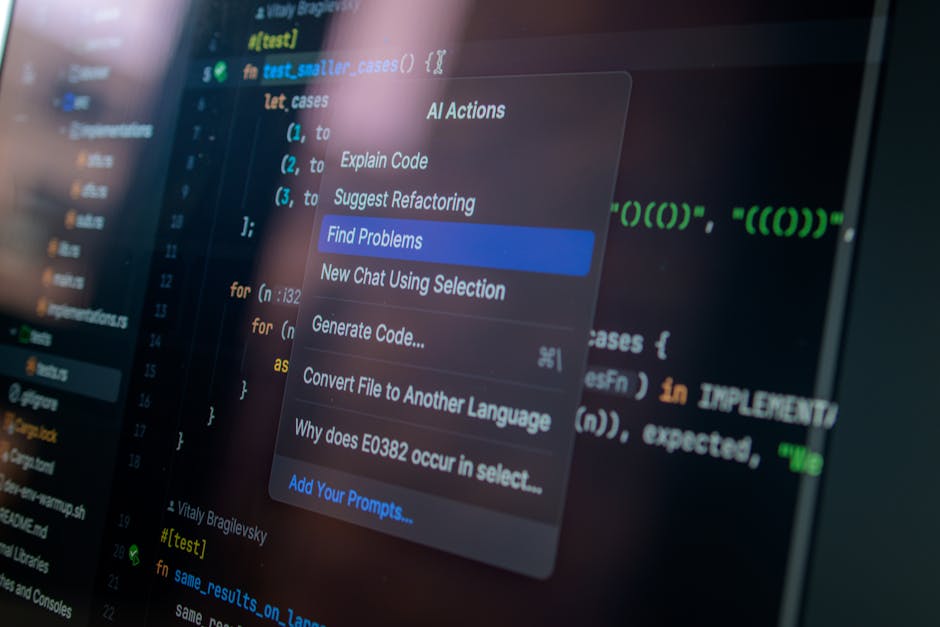
Why “Vibe Coding” Is the Term That Defined a Generation of AI Development
Why is it called vibe coding comes down to one person, one tweet, and one very deliberate choice of words.
Here’s the short answer:
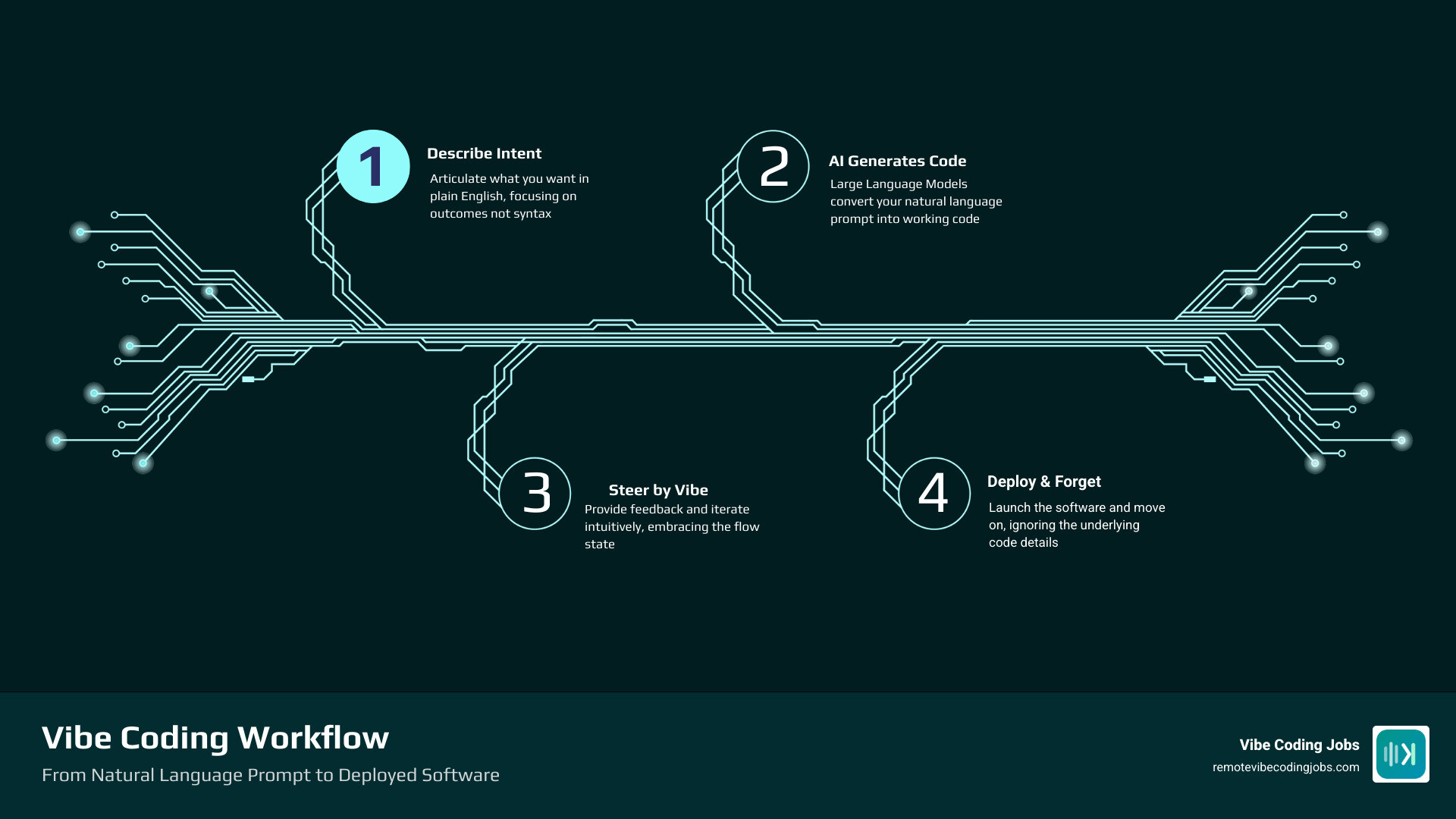
Andrej Karpathy, co-founder of OpenAI and former AI Director at Tesla, coined the term in February 2025. He used the word “vibe” to describe a new way of building software — where you describe what you want in plain English, let an AI generate the code, and fully give in to the vibes, embrace exponentials, and forget that the code even exists.
The name stuck because it nails the feeling:
- You’re not writing syntax line by line
- You’re not debugging logic from scratch
- You’re steering by intent — describing outcomes, not instructions
- The AI handles the “how”; you focus on the “what”
It’s less like engineering and more like directing. That’s the vibe.
This is a genuinely new mindset — not just a new tool. And the name “vibe coding” captures that shift better than any technical term could. It spread fast, got picked up by Merriam-Webster in March 2025 as a trending expression, and was named Collins Dictionary’s Word of the Year for 2025.
We’re RVCJ Editorial, the team behind Remote Vibe Coding Jobs — we cover AI-assisted development, developer hiring trends, and the tools shaping how software gets built, which means we’ve tracked the question of why is it called vibe coding from Karpathy’s original tweet all the way through its cultural explosion. If you want to understand not just the name but what it means for your career, read on.
The Origin Story: Who Coined the Term?
To truly understand why is it called vibe coding, we have to look at the man who started it all. Andrej Karpathy isn’t just any developer; as a founding member of OpenAI and the former head of AI at Tesla, his words carry massive weight in the community.
In February 2025, Karpathy took to social media to describe a phenomenon he was experiencing. He noticed that with the latest Large Language Models (LLMs), he was no longer “writing code” in the traditional sense. Instead, he was having a conversation. He famously stated that “English is the hottest new programming language,” and he wasn’t joking.
This wasn’t a sudden break from history, but rather the next logical step in the Vibe coding history. For decades, software development has been a story of moving further away from the machine. We started with punch cards and raw binary, moved to Assembly, then to high-level languages like C and Python, and then to frameworks that handled the heavy lifting.
Vibe coding is simply the ultimate layer of abstraction. We are no longer worrying about where the semicolon goes; we are articulating a vision. When Karpathy coined the term, he was acknowledging that we’ve reached a point where the machine understands our intent so well that the technical implementation details can — for the first time — stay “under the hood.”
Why is it called vibe coding?
If we were being boring, we might call it “Intent-Based Prompt Engineering” or “High-Level Generative Orchestration.” But those names don’t capture the magic of a Saturday morning spent building a full-stack app in your pajamas without ever opening a debugger.
The term “vibe” was chosen because it represents a shift from instruction to intuition. In a traditional workflow, you are a builder laying bricks. In a vibe coding workflow, you are an architect describing a feeling.
| Feature | Traditional Manual Coding | Vibe Coding |
|---|---|---|
| Primary Tool | Code Editor (VS Code, Vim) | AI-Native IDE (Cursor, Windsurf) |
| Input Method | Syntax (Java, Python, C++) | Natural Language (English, “Vibes”) |
| Focus | How the code works | What the product does |
| Debugging | Manual log analysis & breakpoints | Conversational refinement with AI |
| Speed | Linear (Human-paced) | Exponential (AI-paced) |
When we talk about What is Vibe Coding, we’re talking about “giving in to the vibes.” This means accepting that the AI is going to handle the 90% of the “grunt work” — the boilerplate, the API integrations, the CSS centering — so that you can stay in a state of pure creative flow. You “forget that the code even exists” because, for the duration of the build, the code isn’t the point. The result is the point.
Why is it called vibe coding in the context of developer intuition?
There is a fascinating neuroscientific side to this. When you are deep in a vibe coding session, you aren’t using the same part of your brain that solves a math equation. Instead, you’re tapping into pattern recognition and high-level creative direction.
According to research into the neuroscience of flow, traditional coding often requires heavy lifting from the prefrontal cortex — the part of the brain responsible for logical, sequential planning. Vibe coding, however, allows that part of the brain to quiet down.
As explored in Vibe Coding: When Your IDE Becomes a Dance Floor, the process becomes “soul-channeled.” You aren’t fighting the machine; you’re dancing with it. You might ask the AI to “make the sidebar feel more modern” or “add a bit of ‘pop’ to the animation,” and because the LLM understands the “vibe” of modern design, it executes the logic for you. It’s about creative direction over manual labor.
Why is it called vibe coding instead of AI-assisted engineering?
This is where the community gets a little spicy. Prominent developers like Simon Willison have pointed out a key distinction: not all AI-assisted programming is vibe coding.
- AI-Assisted Engineering: You use an AI to write a function, but you review every line, write unit tests, and ensure it fits perfectly into a rigid architectural plan.
- Vibe Coding: You describe a feature, the AI spits out 200 lines of code, you run it, it works, and you move on to the next feature without necessarily reading every line.
Vibe coding is often associated with “Software for One” or low-stakes projects. It’s perfect for the journalist who needs a custom tool to scrape data or the founder building a “weekend experiment” to test a market. It’s about rapid prototyping where the speed of the “vibe” is more important than the perfection of the “engineering.”
Some skeptics ask, Is Vibe Coding Cheating?, but we believe that’s the wrong question. It’s not cheating; it’s a different sport entirely. It’s about leveraging a force multiplier to go from zero to one in record time.
The Cultural Impact: From Slang to Word of the Year
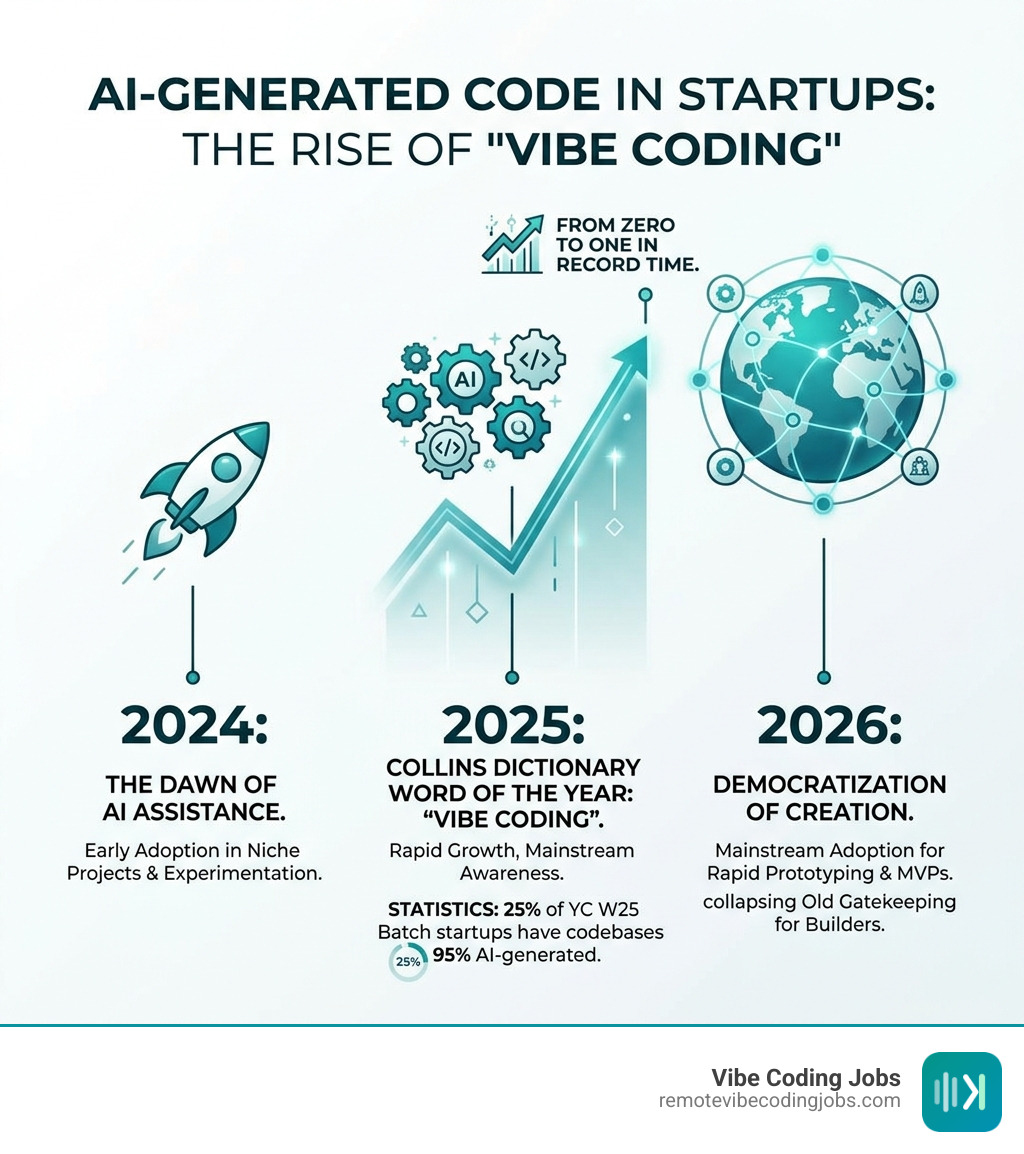
The speed at which “vibe coding” moved from a Karpathy tweet to a global phenomenon is a testament to how much it resonated with the zeitgeist. By the time April 2026 rolled around, it was no longer just a term for “AI nerds.” It was a mainstream cultural pillar.
In late 2025, Collins Dictionary officially named “vibe coding” its Word of the Year. They noted that the term perfectly captured how language is evolving alongside technology. It wasn’t just about the tech; it was about the democratization of creation.
The impact has been most visible in the startup world. Statistics from the Y Combinator Winter 2025 batch revealed a staggering shift: 25% of startups in that cohort had codebases that were 95% AI-generated. These founders weren’t “coding” in the 2010s sense; they were vibe coding their way to MVPs in days instead of months.
This has led to a collapse of old gatekeeping. You no longer need a four-year computer science degree to build a functional, beautiful application. While this makes some “traditional” engineers nervous, we see it as an incredible expansion of the “builder class.”
The Reality Check: Risks and Professional Standards
We love a good vibe, but we also have to be real: you can’t always vibe your way through a mission-critical banking system or a healthcare database. There is such a thing as a “vibe coding hangover,” and it usually hits when you realize you’ve built a “maintenance crime scene” that no human can understand.
Recent data has highlighted some of the growing pains of this revolution:
- Security Vulnerabilities: A CodeRabbit analysis of GitHub pull requests found that AI-co-authored code contained 2.74x higher security vulnerabilities than human-written code.
- Code Quality: The same study showed that AI-generated code had approximately 1.7 times more “major” issues, including misconfigurations.
- The Productivity Paradox: In a METR randomized controlled trial from July 2025, experienced developers using generative AI tools were actually 19% slower on complex tasks, despite believing they were 20% faster.
When you vibe code, you often skip the “boring” stuff like refactoring and documentation. Analysis from GitClear showed that code refactoring dropped from 25% to under 10% between 2021 and 2024, while code duplication increased fourfold. This is the “trust debt” we incur when we let the machine do the thinking without the human doing the checking.
To avoid these pitfalls, savvy developers are using a curated stack of Vibe Coding Tools. They use tools like Cursor for the “vibe” but integrate automated security scanners and AI-powered reviewers to catch the “slop” before it hits production.
Frequently Asked Questions about Vibe Coding
What types of projects are best for vibe coding?
Vibe coding shines brightest when the cost of failure is low and the need for speed is high. We recommend it for:
- MVPs (Minimum Viable Products): Validating an idea quickly.
- Internal Tools: Building a custom dashboard for your team.
- Personal Automations: Scripts to organize your digital life.
- Throwaway Prototypes: Testing a UI concept or a specific API.
If you’re just starting, check out our guide on Getting Started with Vibe Coding.
How has the term evolved since its introduction?
Since Karpathy’s tweet, the term has professionalized. We now see the rise of “VibeOps” — the practice of managing AI-generated infrastructure — and “Enterprise Vibe Coding,” where teams use strict governance and “human-in-the-loop” review cycles to make vibe coding safe for big business. You can read more about this in our State of Vibe Coding 2026 report.
Do you need to know how to code to vibe code?
This is the million-dollar question. While you can build something with zero knowledge, the best vibe coders are often those who do understand the fundamentals. Knowing what a “variable,” “loop,” or “API endpoint” is allows you to give much better “vibes” to the AI.
Think of it like being a film director. You don’t need to know how to fix the camera’s internal circuitry, but you absolutely need to know what a “wide shot” is and why “lighting” matters. Architectural judgment and system design are the new “must-have” skills.
Conclusion
The era of the “code typist” is ending, and the era of the “Product Engineer” has begun. Why is it called vibe coding? Because we have finally moved past the mechanical struggle of syntax and into the realm of pure intent.
At RemoteVibeCodingJobs, we’ve seen this shift firsthand. We aggregate remote roles at async-first companies that don’t just “allow” AI tools — they demand them. These companies value 10x productivity and the ability to architect solutions over the ability to memorize LeetCode algorithms.
If you’re ready to stop fighting the machine and start vibing with it, we’re here to help you find your next role. Check out our Vibe Coding Remote Jobs Guide to see how you can position yourself in this new market.
The future of software isn’t just written; it’s felt.
Ready to find your next AI-powered role? Browse curated vibe coding jobs at RemoteVibeCodingJobs.com