
The Fastest-Growing Way to Work Remotely in Tech Right Now
A remote freelance vibe coder is a developer who uses AI tools like Cursor, Claude, and Bolt.new to build software faster — and gets paid to do it from anywhere in the world.
Here’s a quick snapshot of what that looks like in practice:
| What You Do | How You Do It |
|---|---|
| Build MVPs and prototypes | Prompt AI tools instead of hand-writing code |
| Find freelance gigs | Platforms like RemoteVibeCodingJobs.com (1,696+ roles live) |
| Set your rate | $100–$300/hour is typical for experienced vibe coders |
| Work location | Fully remote, async-first — 144+ “work from anywhere” roles |
| Tools you need | Cursor, Claude, Windsurf, Bolt.new, Lovable |
The demand is real. Over 270 companies are actively hiring right now, and job boards dedicated to this niche update their listings daily.
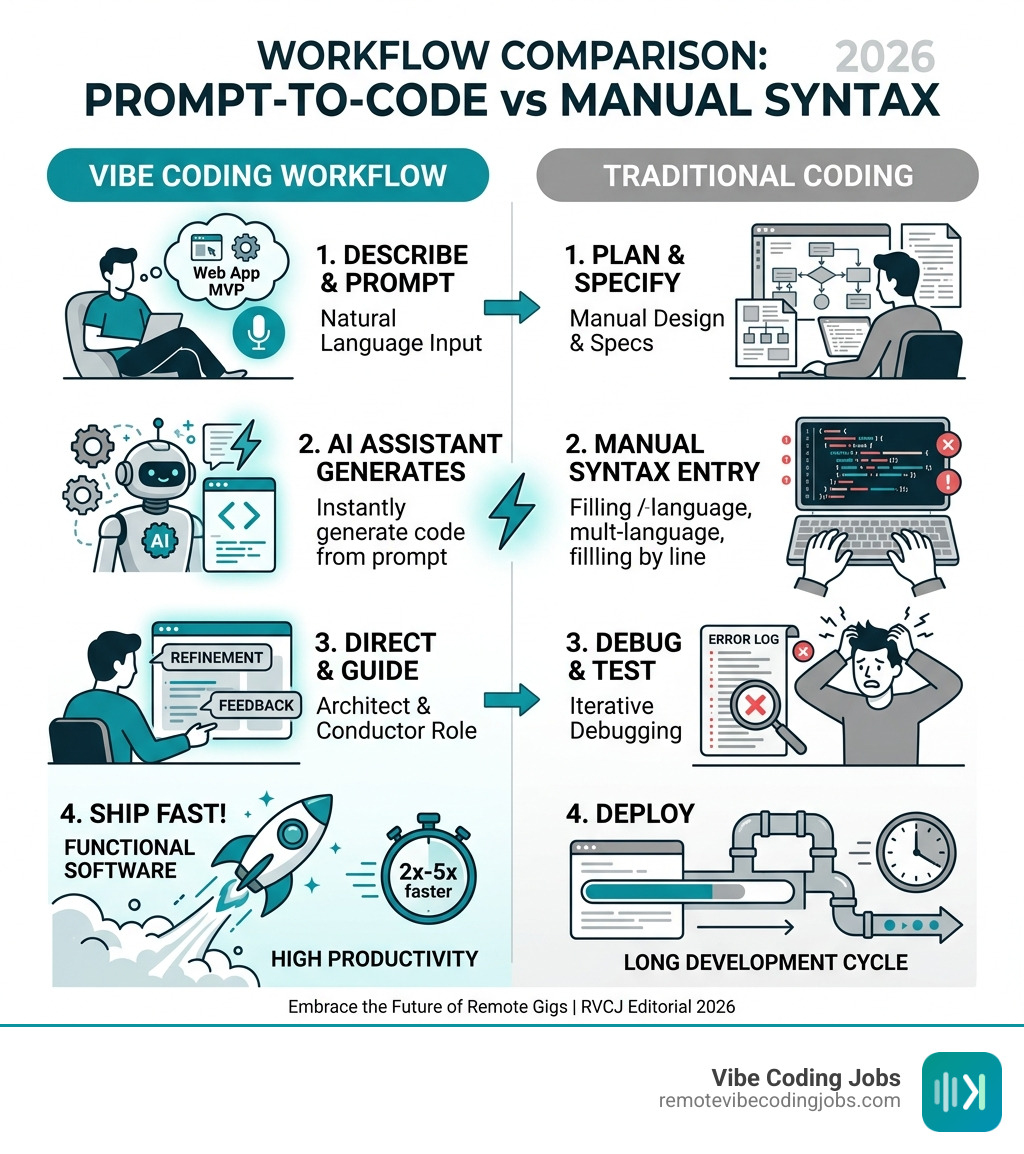
What’s driving this? A shift in how software gets built. Instead of typing syntax line by line, vibe coders describe what they want and let AI handle the heavy lifting. The developer’s job moves from writing code to directing it — think software architect, not code typist.
Andrej Karpathy, former Tesla AI Director and OpenAI co-founder, helped popularize this approach in 2025. Since then, it has gone from a niche experiment to a legitimate career path with serious earning potential.
Developers who make the switch consistently report 2–5x productivity gains within the first month of practice. That speed advantage is exactly why freelance rates are so high.
I’m RVCJ Editorial, the team behind Remote Vibe Coding Jobs — we cover AI-assisted development, remote hiring trends, and career guidance for developers building with Cursor, Claude, Copilot, and Replit, with a specific focus on helping people land work as a remote freelance vibe coder. In the sections below, we’ll walk you through the exact tech stack, platforms, and strategies that top vibe coders are using to land high-paying remote gigs in 2026.
Defining the Remote Freelance Vibe Coder in 2026
By April 2026, the term “vibe coding” has matured from a viral trend into a specialized professional discipline often referred to as agentic engineering. At its core, being a remote freelance vibe coder means you are an AI-fluent professional who prioritizes shipping functional, soulful, and elegant software over the manual labor of hand-writing every line of syntax.
As popularized by industry leaders like Andrej Karpathy, this approach leverages agentic workflows where the developer acts more like a conductor than a typist. Instead of getting bogged down in semi-colons and boilerplate, you maintain a “builder identity.” You aren’t just a “React Developer” or a “Python Scraper”; you are a builder who uses the best tools available to solve problems.
For a deeper dive into how this is reshaping the market, check out our article on What Are Vibe Coding Jobs? A Guide to the Future of Remote Work. The fundamental difference lies in the Vibe Coding vs Traditional Development paradigm: one is about implementation labor, the other is about architectural intent.
Shifting from Syntax to Strategy
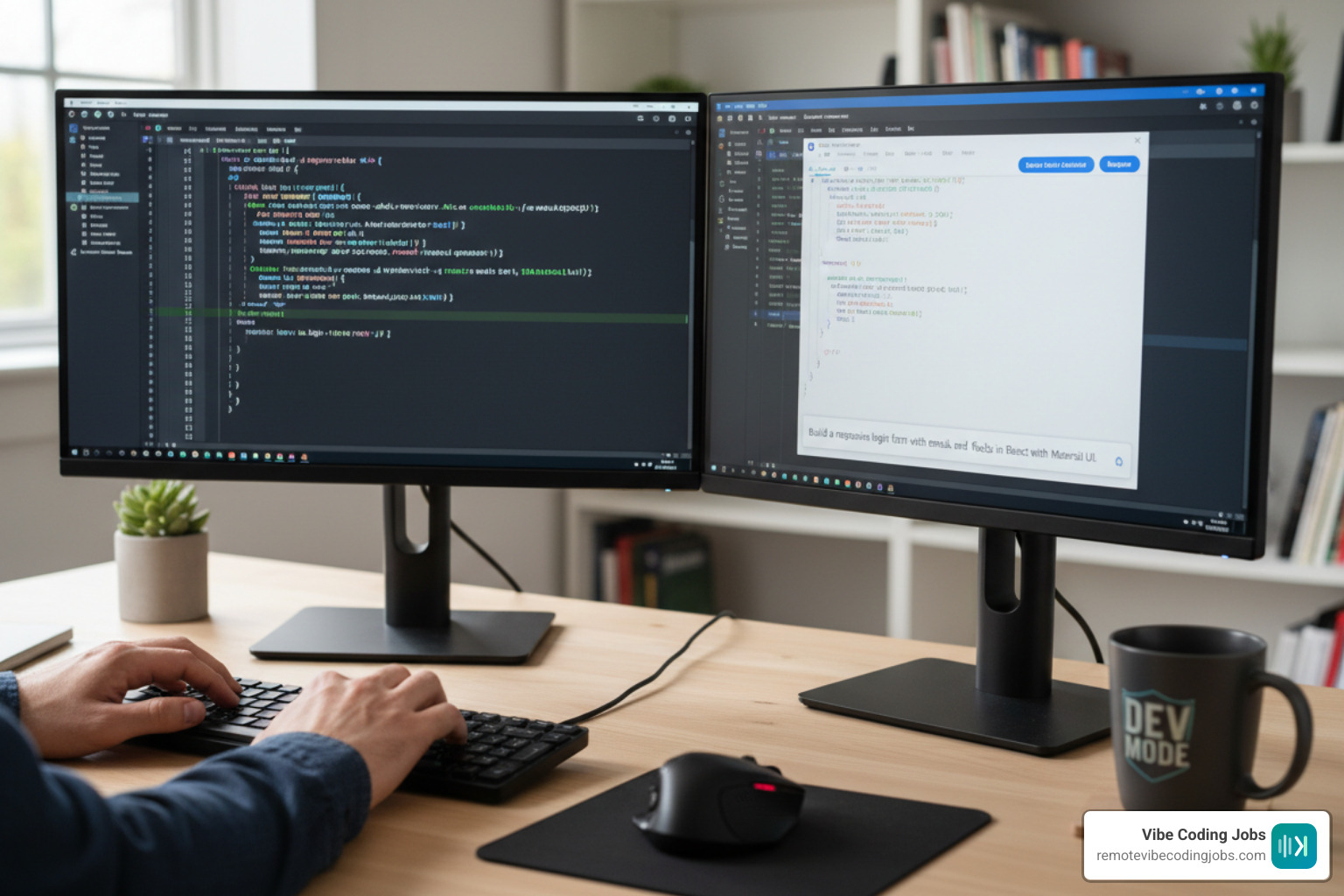
In this new era, your value isn’t measured by your WPM (words per minute) but by your “vibe”—your ability to guide an LLM to the correct solution through strategic thinking. This involves high-level system design and an evolved form of prompt engineering. You need to know how to structure an application so that the AI can effectively build the components.
Many skeptics initially asked, Is Vibe Coding a Real Job? By 2026, the answer is a resounding yes. Companies are no longer looking for “code monkeys”; they are looking for strategists who can leverage AI to reduce a six-month roadmap into a six-week sprint.
The Rise of the AI-First Developer
The modern remote freelance vibe coder is often a hybrid of a product engineer and a creative technologist. Because AI handles the routine tasks, you have the mental bandwidth to focus on UI/UX taste, user empathy, and product-market fit.
Statistics show that AI-first developers achieve 2-5x productivity increases within their first month of adopting tools like Cursor and Claude. For a freelancer, this productivity isn’t just a “bonus”—it’s a massive income multiplier. If you can do a week’s worth of work in two days, your effective hourly rate skyrockets, allowing for a lifestyle of true location independence.
The Essential AI Tech Stack for Vibe Coding Gigs
To succeed as a remote freelance vibe coder, you need a stack that supports rapid iteration and deep context. The “Big Three” tools currently dominating the landscape are Cursor, Claude, and Windsurf.
| Feature | Cursor | Windsurf | GitHub Copilot |
|---|---|---|---|
| Primary Strength | Context-aware codebase chat | Agentic “Flow” state | Integration with GitHub ecosystem |
| Best For | Iterative feature building | Autonomous task execution | Basic autocomplete/boilerplate |
| Vibe Level | High (Native AI-first UX) | High (Agentic orchestration) | Moderate (Legacy plugin feel) |
Beyond the IDE, tools like Bolt.new and Lovable allow you to spin up full-stack web applications from a single prompt. These are essential for the “vibe” workflow where you prototype an idea in minutes to show a client, then refine it using more robust tools. For an exhaustive list, see our guide on Vibe Coding Tools.
Mobile Vibe Coding and Continuity
One of the most exciting developments for the remote freelance vibe coder is the ability to maintain “the vibe” away from the desk. Tools like Btelo Coding — Code from anywhere and Vibe Coding, Everywhere – Remote Code | Remote Code allow you to uplink your mobile device to your primary dev machine.
This means you can push a hotfix from a coffee shop or review a PR while traveling, using voice-to-code prompts that execute real shell commands on your remote server. It’s about zero compromise on productivity, regardless of your physical coordinates.
Automation and Orchestration Tools
A professional vibe coder doesn’t just write code; they orchestrate systems. This involves using:
- OpenRouter: To switch between the latest models (Claude 3.5, GPT-4o, Gemini 1.5 Pro) depending on the task.
- v0.dev: For generating high-fidelity React components via shadcn/ui.
- Make.com: For building the “glue” that connects AI agents to real-world APIs.
For a strategic overview of how to combine these, refer to our Vibe Coding Remote Job Ultimate Guide.
How to Land High-Paying Remote Freelance Vibe Coder Projects
Landing a gig as a remote freelance vibe coder requires a different approach than traditional tech interviews. You aren’t going to be asked to invert a binary tree on a whiteboard. Instead, clients want to see that you can ship.
One highly effective tactic is the “Loom video trick.” Instead of just sending a resume, send a 2-minute screen recording of you “vibe coding” a specific feature or fixing a bug in real-time. This demonstrates your AI fluency and your ability to steer the tools effectively.
To understand the nuances of this market, read our guide on How to Get a Vibe Coding Job and Compare Freelance vs Remote Fulltime to see which path fits your lifestyle.
Building a Portfolio as a Remote Freelance Vibe Coder
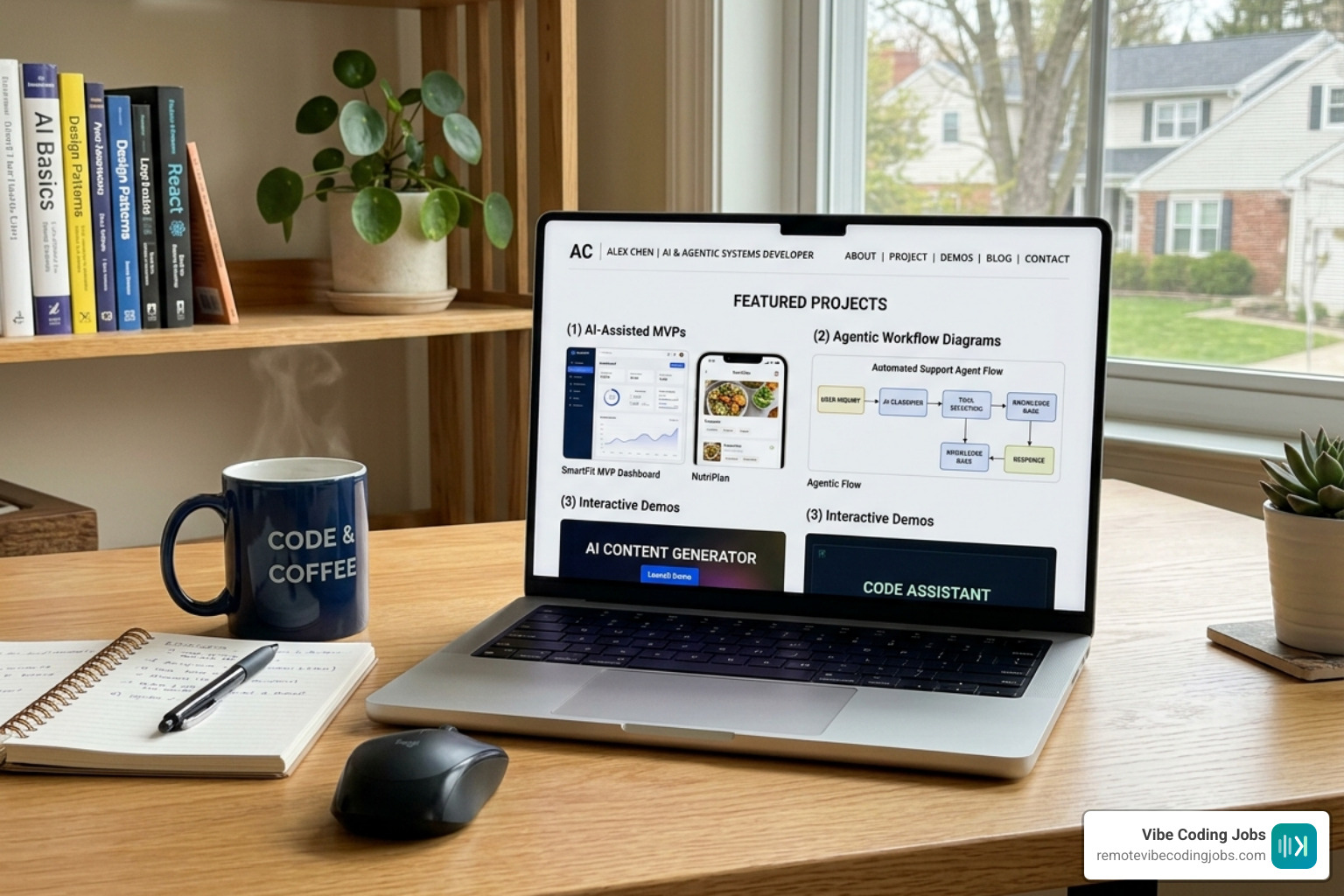
Your portfolio shouldn’t just be a list of links; it should be a gallery of experimental MVPs. Include:
- Prompt Libraries: Show the complex prompts you used to generate specific architectures.
- Rapid Prototypes: Projects built in under 24 hours that solve a specific problem.
- AI-Enhanced UI/UX: Demonstrate how you use tools like v0 or Lovable to create polished interfaces.
If you’re just starting, our Learn Vibe Coding Tutorial provides a step-by-step path to building these portfolio pieces.
Negotiating Contracts and Setting Rates
Because you are 2-5x more productive, you should avoid “trading hours for dollars” whenever possible. Instead, aim for:
- Bounty-based projects: Getting paid $2,000 for a feature that takes you 4 hours to vibe code.
- Milestone payments: Tying pay to functional deliverables.
- Value-based pricing: Pricing based on the business impact, not the time spent typing.
For current benchmarks, see our analysis of Vibe Coding Salary Remote.
Navigating the Market: Salary, Rates, and Top Platforms
The market for AI-fluent developers is exploding. As of April 2026, there are 1,696 verified positions available across 270+ companies. These aren’t just “startup” roles; even established enterprises are hiring “AI Pilots” to lead their development teams.
Freelance vibe coders are currently charging between $100 and $300 per hour. This premium is justified because a vibe coder can often replace a small team of traditional developers by leveraging agentic frameworks to handle backend, frontend, and deployment simultaneously.
Check our Vibe Coding Salary Guide for a detailed breakdown, and see which Companies Hiring Vibe Coders are currently looking for talent.
Expected Rates for a Remote Freelance Vibe Coder in 2026
- Entry-Level (1-2 years exp): $70,000 – $100,000 (often starting as “Junior Agentic Engineers”).
- Mid-Level (AI Proficient): $100,000 – $150,000.
- Senior/Product Engineer: $150,000 – $250,000+.
The “productivity multiplier” is the key here. Senior vibe coders aren’t just faster; they are more accurate because they use AI to validate their logic and catch security vulnerabilities in real-time. You can find these high-paying roles on our Vibe Coding Jobs page.
Top Platforms for Finding Work
While generic job boards are full of noise, specialized platforms like RemoteVibeCodingJobs.com filter for “async-first, no-BS” companies. These are organizations that value deep work and autonomy, making them perfect for the remote freelance vibe coder.
Don’t forget to check Who’s Hiring daily, as the best gigs—especially high-paying freelance contracts—are often snapped up within 48 hours.
Frequently Asked Questions about Vibe Coding
How can I start vibe coding with no prior experience?
While AI tools lower the barrier, you still need a foundation. We recommend a 3-6 month transition period where you learn the basics of HTML/CSS/JS and Python while simultaneously mastering tools like Cursor. Your goal is to understand what the code is doing so you can debug it when the AI hallucinates. Our Learn Vibe Coding Tutorial is the perfect starting point.
What are the biggest challenges for remote vibe coders?
- AI Hallucinations: Sometimes the AI writes code that looks right but doesn’t work. You need “coding instincts” to spot these.
- Context Window Limits: Managing large codebases requires knowing how to feed the right files to the AI.
- Security Compliance: You must ensure the AI isn’t introducing vulnerabilities or using insecure libraries.
How does vibe coding enable true location independence?
Traditional coding often requires long hours of synchronous collaboration. Vibe coding, by contrast, is built on an async-first culture. Because you can build so much faster, you can work in short, focused bursts (1-4 hours) and spend the rest of your day exploring. With 144 “work from anywhere” roles currently tagged on our platform, the dream of being a remote freelance vibe coder is more accessible than ever.
Conclusion
The “agent economy” is here, and software development has changed forever. The ladder to success is no longer built on how many lines of code you can write, but on how effectively you can “vibe” with AI to create value.
Whether you are a seasoned engineer looking to 10x your output or a newcomer aiming for a high-paying remote career, the tools and opportunities are ready for you. We invite you to join the 3,000+ AI-fluent developers in our community and start your journey today.
Apply for the latest remote freelance vibe coder roles and secure your place in the future of tech.