
Why the NYC Vibe Developer Remote Market Is Exploding Right Now
Finding an nyc vibe developer remote role has never been more viable — or more competitive. Here’s a quick snapshot of where the market stands right now:
Top remote vibe coding opportunities connected to NYC (June 2026):
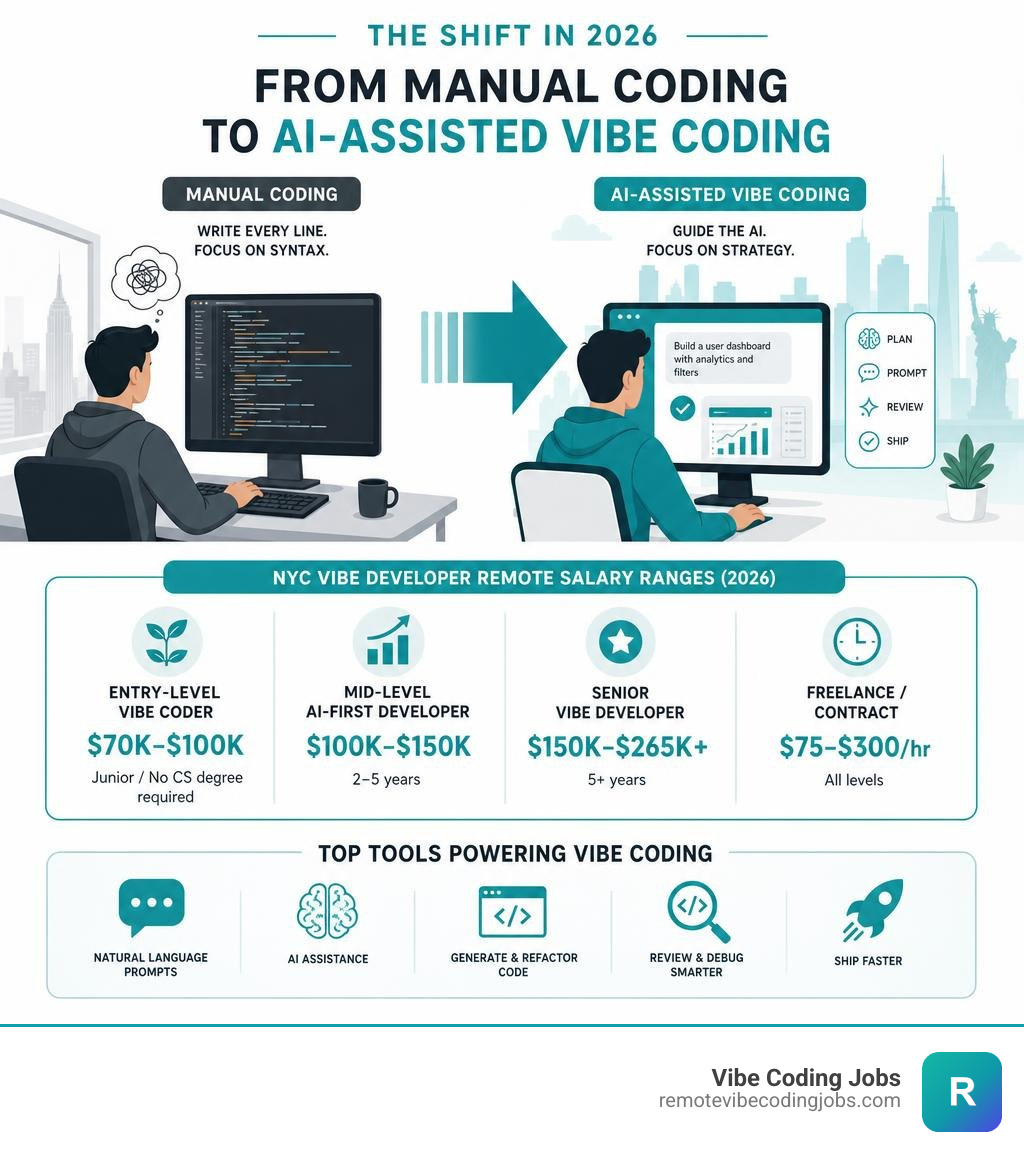
| Role Type | Salary Range | Experience Level |
|---|---|---|
| Entry-level vibe coder | $70K–$100K | Junior / No CS degree required |
| Mid-level AI-first developer | $100K–$150K | 2–5 years |
| Senior vibe developer | $150K–$265K+ | 5+ years |
| Freelance / contract | $75–$300/hr | All levels |
There are currently 153 remote coding jobs listed in the Manhattan area, with 127 of those being full-time positions and 95 targeting mid-to-senior talent. Over 100 new roles were posted in the last month alone.
So what is a vibe developer, exactly? In short: it’s a developer who uses AI tools — like Cursor, Claude Code, or Bolt.new — to build software through natural language prompts instead of writing every line by hand. The role shifts focus from syntax to strategy: architecture, prompt engineering, and knowing when to steer the AI back on track.
This guide covers everything you need to find and land one of these roles — from the tools you’ll need to the salaries you can expect.
As RVCJ Editorial, we track remote AI-assisted developer hiring across the full NYC tech ecosystem daily, covering the exact tools, workflows, and compensation benchmarks that define the nyc vibe developer remote market in 2026. Our team has reviewed hundreds of job postings and spoken with hiring managers at async-first companies, so the guidance here is grounded in what’s actually happening right now.
Demystifying the NYC Vibe Developer Remote Phenomenon
The tech landscape has shifted dramatically over the past twelve months. We have officially entered the era of the “vibe developer.”
In the past, software engineering was defined by manual code implementation—staring at a screen, wrestling with semicolons, and spending hours writing boilerplate code. Today, AI-assisted development has turned that model on its head.
Vibe coding is not about slacking off; it is about working at a higher level of abstraction. Instead of writing every individual line of code, you use natural language prompts to guide powerful AI models. Your primary job is to act as the director or architect. You outline the “vibe” of the feature, system, or application, and the AI handles the heavy lifting of raw code generation.

This shift requires a deep understanding of software architecture and system design. While the AI can write code in seconds, it needs a human expert to structure the database, integrate APIs, maintain security, and ensure the entire system scales. You are no longer just a typist; you are a system architect steering an automated development engine.
The Rise of the NYC Vibe Developer Remote Role in 2026
The New York City tech ecosystem has always been known for its high-energy, startup agility. In June 2026, that agility relies entirely on rapid prototyping and lightning-fast iteration cycles. Startups in Manhattan and Brooklyn cannot afford to spend six months building a basic Minimum Viable Product (MVP) when they can launch one in a few weeks using AI-native workflows.
Because of this, we are seeing an unprecedented surge in companies hiring specifically for AI-fluent professionals. This evolution is clearly documented in our vibe coding jobs remote career path job market analysis, which highlights how traditional software roles are morphing into product engineering positions.
Educational institutions are already adapting to this new reality. For example, Vibe Coding 101 Course Developer – Campus – Built In NYC highlights how academic programs are partnering with modern development platforms to teach AI-native software engineering. These programs focus on helping students blend programming fundamentals with advanced AI orchestration.
For developers who master this workflow, the financial rewards are substantial. According to our vibe coding salary guide 2026, mid-to-senior vibe coding professionals regularly command top-tier salaries while working from the comfort of their homes.
Why NYC Companies are Hiring Remotely
Historically, NYC tech firms insisted on having warm bodies in expensive physical offices in Flatiron or SoHo. But in 2026, the math has changed.
First, the local Manhattan job market is incredibly tight and expensive. By expanding their search to a remote talent pool, NYC companies can access world-class developers across different time zones without paying the premium for physical office space.
Second, vibe coding has made small teams incredibly powerful. When a single remote developer leveraging AI can match the output of a traditional three-person engineering team, the cost efficiency becomes undeniable.
Many of these forward-thinking companies have transitioned to an async first remote developer jobs flexible hours model. They prioritize clear documentation, deep work blocks, and measurable output over synchronous meetings.
If you want to bypass the daily subway commute and tap into this lucrative market, you can explore curated listings directly through our hub to Find remote NYC vibe developer jobs.
The Vibe Coding Tech Stack: Tools and Workflows in 2026
To succeed as an nyc vibe developer remote, you must be fluent in the modern AI-native development stack. This is not just about using ChatGPT to write a quick script; it is about integrating highly specialized development environments into your daily workflow.

To put this transition in perspective, let’s look at how daily workflows compare:
| Workflow Phase | Traditional Software Engineering | Vibe Coding Workflow |
|---|---|---|
| Scaffolding | Writing boilerplate, configuring Webpack, setting up directories manually. | Describing the app structure in plain English; AI scaffolds the entire project. |
| Debugging | Reading stack traces, inserting console logs, searching StackOverflow. | Auto-debug loops iterate internally to fix errors before you even see them. |
| API Integration | Reading endless docs, writing custom wrappers, manual testing. | Feeding API documentation to the AI and letting it generate clean, typed integrations. |
| Version Control | Manual git commits, resolving complex merge conflicts line-by-line. | Shadow git checkpoints and visual rollbacks that track prompt-driven changes. |
Essential AI IDEs and Code Generators
The tools of the trade have evolved far beyond standard text editors. Leading the charge is Vibe — The AI IDE Built for Vibe Coders, Where Developers Feel at Home , an IDE built from scratch specifically for prompt-driven development. Unlike traditional editors that simply append AI extensions, these modern platforms offer native features like:
- Zero Data Retention (ZDR) by default, ensuring your company’s proprietary code is never used to train external models.
- Shadow git checkpoints that automatically track AI-generated changes behind the scenes, allowing you to roll back to any prompt state instantly.
- Built-in auto-debug loops where the IDE runs the code, catches its own compilation errors, and corrects them autonomously.
- Model-agnostic credit pools, allowing you to switch between Anthropic’s Claude, OpenAI’s GPT, or Google’s Gemini depending on the task.
In addition to these IDEs, developers are using command-line tools and release distribution systems like ymzuiku/vibe-remote to manage remote environments and execute prompt-driven commands directly on cloud servers.
For businesses looking to build products without hiring massive teams, specialized service providers like Vibe Coding Company – Build Software & SaaS 70% Cheaper, 5x Faster have emerged, proving that AI-assisted workflows can deliver production-grade applications in a fraction of the traditional time and cost.
Programming Languages and Frameworks to Master
While AI handles the syntax, you still need to understand the underlying languages to review, debug, and optimize the generated code. In 2026, the most in-demand languages for vibe coding are TypeScript and Python.
TypeScript is the undisputed king of the modern web. If you are targeting front-end or full-stack roles, check out our remote typescript developer jobs guide to landing your next role as well as the broader remote javascript developer jobs your 2026 career guide.
For back-end engineering, data pipelines, and AI agent integration, Python remains essential. You can dive deep into compensation trends and technical expectations in our remote developer salary trends 2026 python a deep dive.
Compensation, Salaries, and Career Paths for Remote Developers
Working as a remote developer for an NYC-based company offers some of the best financial opportunities in the global tech industry. NYC companies are backed by substantial venture capital and enterprise budgets, allowing them to pay premium rates even for fully remote roles.
According to our comprehensive vibe coding salary guide 2026, full-time remote roles for AI-fluent developers typically range from $100,000 to $265,000+ depending on experience and the complexity of the systems you manage.
We can see these competitive salary trends in real-world job postings. For instance, the role of Backend Engineer, Integrations – Vibe.co | Built In NYC offers an impressive salary range of $196,000 to $265,000 annually. This position emphasizes the daily use of AI-augmented development workflows to build public APIs and scale data pipelines.
Similarly, the GTM Engineer – RevOps Careers position highlights the growing demand for developers who combine full-stack technical skills with AI tool fluency to build high-impact business infrastructure.
To navigate this landscape and secure top-tier pay, we highly recommend reading our remote developer salary guide 2026 to understand how companies structure their remote compensation packages.
How to Land an NYC Vibe Developer Remote Position Without LeetCode
The traditional software engineering interview process is notorious for its reliance on arbitrary LeetCode puzzle-solving. Fortunately, the vibe coding movement is actively dismantling this practice.
Hiring managers in 2026 want to see what you can actually build. They care about your ability to deliver functional, secure, and well-architected applications quickly.
Instead of memorizing sorting algorithms, focus on building a robust portfolio of real-world projects. Show off applications where you have successfully integrated complex APIs (like Stripe, Twilio, or database solutions like Supabase).
You can find a detailed breakdown of how to prepare for these practical interviews in our guide on remote coding jobs no leetcode alternative assessments.
Additionally, we recommend highlighting your design sensibility and remote collaboration skills. Agencies like Nyce Mood – UX/UI Designer & Web Developer demonstrate how modern digital professionals combine clean design with rapid development to deliver high-converting web applications.
Once you land the interview, make sure you are prepared to negotiate your worth. Use our remote developer salary negotiation tips get paid what you re worth to secure the best possible compensation and equity package.
Navigating Async Collaboration Across Time Zones
While working remotely for an NYC startup is highly rewarding, it does come with collaboration challenges. NYC teams move incredibly fast, and if you are working from a different time zone, you must master the art of asynchronous communication.
To succeed in an async-first culture, you must:
- Over-communicate through documentation: Write clear, detailed pull request descriptions, project updates, and prompt logs so your team knows exactly what you built and why.
- Leverage modern collaboration tools: Master GitHub, Slack, and project management boards to keep work flowing without needing live meetings.
- Set healthy boundaries: Working across time zones can easily lead to burnout.
For practical strategies on maintaining a healthy work-life balance while staying highly productive, explore our remote work productivity tips.
Frequently Asked Questions about Vibe Coding
What is the difference between a vibe developer and a traditional software engineer?
A traditional software engineer focuses heavily on manual code implementation, syntax optimization, and writing boilerplate code. A vibe developer leverages AI-powered IDEs and LLMs to handle code generation, shifting their focus to system architecture, product strategy, prompt engineering, and high-level debugging. You can explore how these roles are evolving by reading our guide to the vibe coding jobs remote career path job market.
Do I need a computer science degree to get hired as a vibe coder?
No. While computer science fundamentals (like databases, networking, and security) are incredibly helpful, many companies care more about your practical portfolio, AI tool fluency, and ability to ship functional products quickly. A strong portfolio of AI-assisted projects can easily replace a traditional degree in the eyes of modern hiring managers.
What are the typical salary ranges for remote vibe developers working with NYC companies?
Salaries range from $70,000–$100,000 for entry-level positions, $100,000–$150,000 for mid-level roles, and $150,000 to $265,000+ for senior professionals. Contract and freelance rates typically span $75 to $300 per hour. For a complete breakdown of these figures, check out our remote developer salary guide 2026.
Conclusion
The future of software development belongs to AI-fluent professionals who know how to build, iterate, and ship applications at unprecedented speeds. As the NYC tech ecosystem continues to embrace remote, async-first workflows, the demand for skilled vibe developers will only grow.
At RemoteVibeCodingJobs, we are dedicated to helping you navigate this exciting career path. We aggregate the best remote vibe coding roles, filtering them by culture, tech stack, and the exact AI tools you love using.
Ready to land your next high-paying, flexible role? Visit our platform to Find remote NYC vibe developer jobs and start your application journey today!