
Why Top Talent Choice Is Shifting to Remote NYC Startups
The choice for top engineering and tech talent is no longer strictly between local tech hubs and remote flexibility. Joining remote NYC startups lets developers tap into the aggressive growth, high-velocity capital, and elite founder networks of New York City without dealing with severe summer heat, subway delays, or traffic gridlock.
Commuting in New York presents daily friction. By eliminating hours spent in transit, distributed workers reclaim focus time for deep work.
At the same time, founders running remote NYC startups realize that limiting hiring to commuters within the five boroughs severely restricts their talent pool. Opening roles nationally or globally allows high-growth teams to hire specialized engineers, data scientists, and product leaders who prefer operating outside traditional office hubs.
To make this transition successfully, professionals must adjust their workflow habits. Take a look at our comprehensive guide on Transitioning to Remote Software Engineering to learn more about shifting your daily habits from on-site to distributed setups.
Key Advantages of Remote NYC Startups
Working for early-stage or high-growth tech firms headquartered in New York offers unique career tailwinds:
- Tier-1 NYC Base Compensation: New York startups offer top-of-market compensation packages to remain competitive against Wall Street finance firms and Big Tech satellite offices.
- Meaningful Equity Options: Founding and early engineering hires often receive substantial early-stage equity grants (ranging from 0.02% to over 1% depending on company stage), providing immense financial upside.
- Location Freedom and Focus Time: Developers can reside in lower-cost living areas while delivering high-value output during structured focus hours.
- High-Impact Product Engineering: Early-stage New York startups give software engineers direct access to core architecture decisions, client integration loops, and business strategy.
Common Challenges in Distributed NYC Workflows
While working remotely for New York tech firms carries massive perks, distributed workflows come with operational challenges.
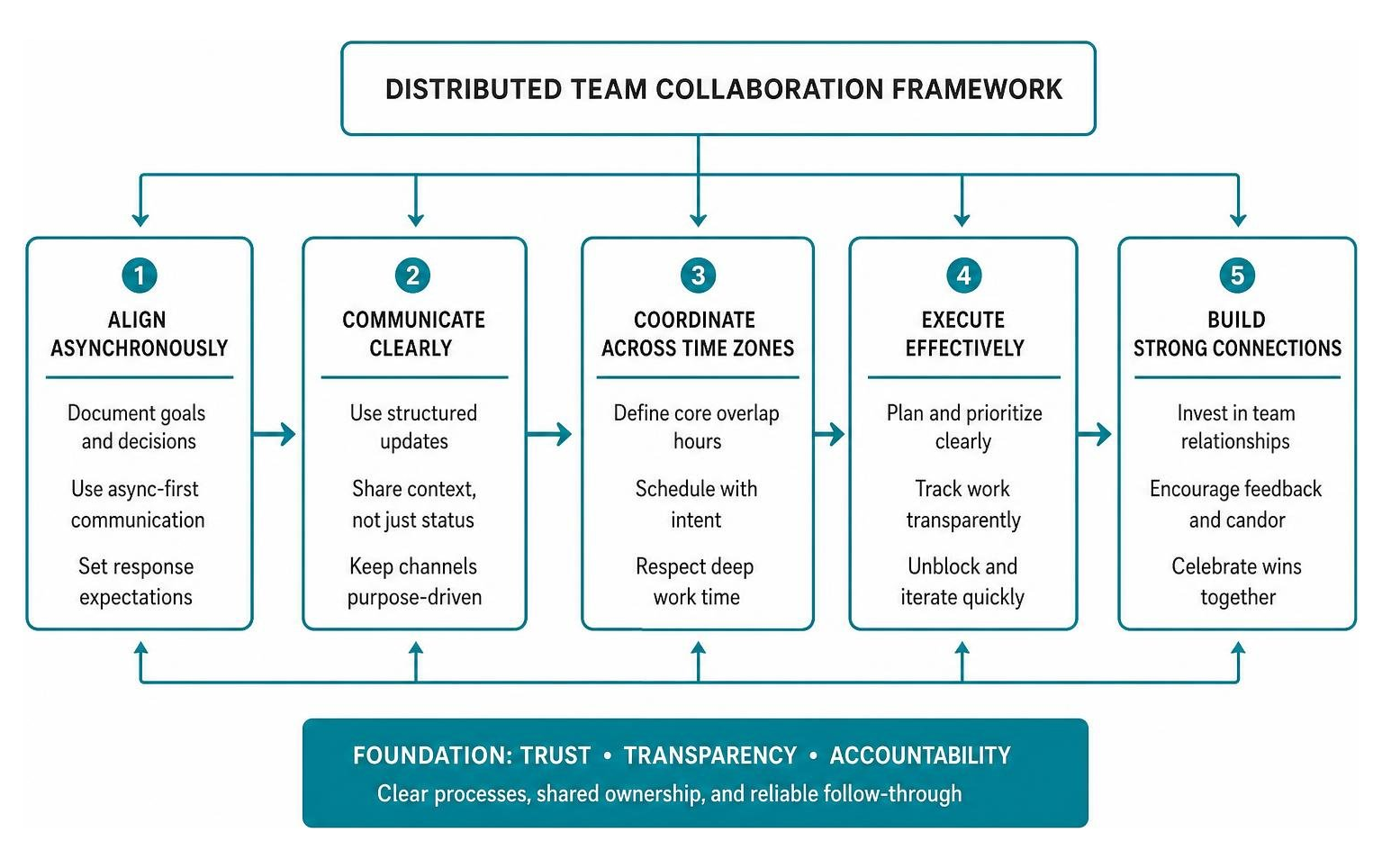
NYC startups are notorious for fast execution. When team members span multiple time zones, asynchronous communication friction can emerge if processes aren’t explicitly documented.
Main friction points include:
- Time Zone Overlap: Coordinating real-time discussions across Eastern Time (ET) and Western hours requires tight alignment on core collaboration windows.
- Communication Silos: Without informal hallway chat, vital product context can get trapped inside private Slack DMs or unrecorded calls.
- Burnout Risks: Fast-paced startup cultures can blur the lines between work and home, leading to continuous connectivity.
To keep remote teams aligned without endless Zoom meetings, modern tech companies rely heavily on tool ecosystems. Learn how top distributed organizations manage async communication in our guide on the Best Async Communication Tools for Dev Teams in 2026.
Top High-Growth Sectors and Roles at Remote NYC Startups
New York City hosts a dense concentration of specialized tech sectors. Startups operating in AI infrastructure, fintech, healthtech, proptech, and enterprise SaaS are expanding their distributed teams rapidly.
| Work Model | In-Person Expectation | Compensation & Equity Focus | Ideal Candidate Profile |
|---|---|---|---|
| Fully Remote | 0% in-office; optional annual or bi-annual company retreats | Standard national or NYC-benchmarked salary bands | Self-directed engineers with strong async communication skills |
| Hybrid NYC | 1–3 days per week in NYC offices (e.g., Soho, Flatiron, Williamsburg) | Full local NYC salary, commute stipends, local perks | Candidates living near NYC who value face-to-face team collaboration |
| Remote-First (US Regional) | Periodic quarterly on-sites in NYC (e.g., 2–4 times per year) | NYC-competitive base pay + tax-free health stipends (QSEHRA) | Engineers living within reasonable travel distance (e.g., East Coast, Midwest) |
Engineering and AI Roles at Remote NYC Startups
Engineering demand across New York’s remote job listings centers heavily around full-stack mastery, AI system implementation, and specialized backend architecture.

- Founding Software Engineers: Early-stage startups regularly seek founding full-stack engineers to build core MVP products from scratch. Common tech stacks include TypeScript, React, Next.js, FastAPI/Python, Node.js, and Postgres. Salary bands for these foundational roles typically range from $150,000 to $200,000+ alongside substantial equity packages.
- Forward-Deployed Engineers (FDE): High-growth AI startups frequently hire Forward-Deployed Engineers. Serving as a hybrid between core product developers and technical consultants, FDEs deploy client-facing integrations, manage API connectors, and convert operational needs into core codebase infrastructure. Base compensation for FDE roles ranges between $120,000 and $200,000 per year.
- AI Developers & Infrastructure Engineers: As agentic workflows take off, companies rely heavily on AI engineers to build custom LLM pipelines, vector search engines, and evaluation frameworks. Base salaries for specialized AI engineering roles in NYC stretch from $150,000 to over $300,000 annually.
If you are curious about the modern toolsets driving modern software creation, check out our breakdown of Remote AI Developer Jobs Tools & Salary.
Product, Operations, and Customer Success Roles
High-growth remote NYC startups hire extensively across product management, solutions architecture, and revenue operations:
- Product Management: Product Managers guide feature prioritization, coordinate cross-functional engineering sprints, and maintain roadmap alignment across distributed teams.
- Solutions Architecture & Technical Customer Success: As enterprise SaaS platforms scale, technical solutions consultants configure workflows, handle customer onboarding, and ensure platform health. Base salaries for these mid-to-senior customer success roles often range between $75,000 and $170,000 depending on enterprise complexity.
How Remote NYC Startups Handle Compensation, Benefits, and Equity
New York State salary transparency regulations require employers to post accurate base salary ranges on job postings. This gives remote candidates a transparent view into real-time market rates.
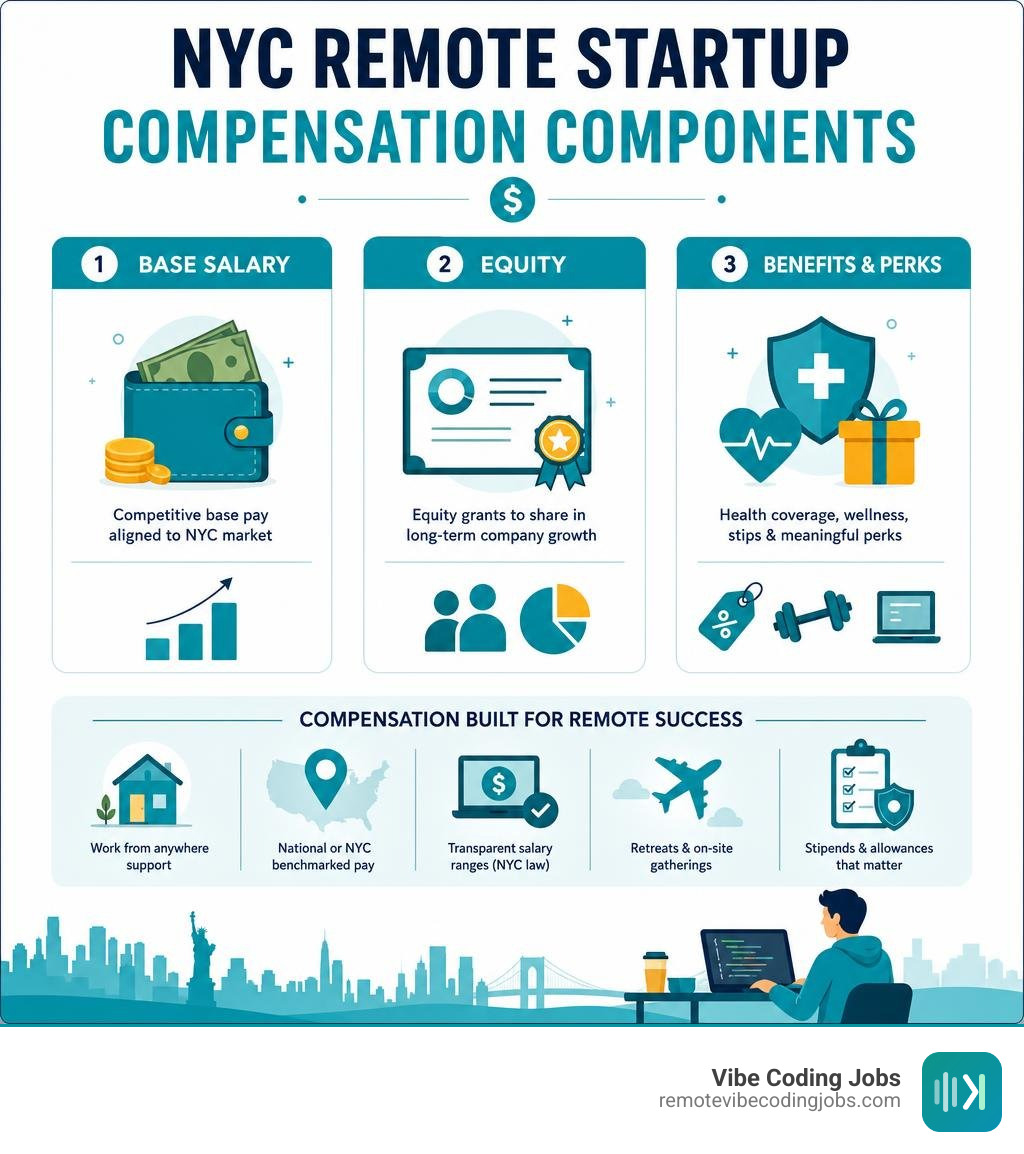
Base salaries for remote software roles generally fall into defined tiers based on responsibility:
- Mid-to-Senior Software Engineers: $120,000 – $170,000 annually.
- Founding Engineers / Senior AI Specialists: $150,000 – $300,000+ annually plus early-stage equity grants.
- Director & Lead AI Engineers: $173,000 – $410,000 annually for high-leverage architectural oversight.
Beyond base pay, early-stage NYC tech firms stand out through comprehensive benefits packages:
- Remote Setup & Internet Stipends: Home office setup stipends (typically $500–$1,000) alongside monthly internet reimbursements ($50–$100/month).
- Tax-Free Health Benefits: Flexible healthcare structures such as QSEHRA health reimbursement plans, comprehensive medical coverage, and student loan repayment perks.
- Equity Offerings: Early options packages designed to align team performance with long-term company liquidity events.
For an exhaustive analysis of standard market packages, read our complete breakdown on Remote Developer Salaries in 2026. When you are ready to evaluate an offer, reference our step-by-step guide on How to Negotiate Remote Salary.
How Distributed NYC Startups Build Culture and Maintain High Productivity
Operating a remote team out of New York requires deliberate choices around documentation, tooling, and team culture. Companies that succeed in maintaining high velocity rely on structured async workflows rather than non-stop video meetings.

Top strategies include:
- Async-First Communication Protocols: Successful teams standardize clear documentation habits, using ticket trackers (like Linear or GitHub Issues) and written RFCs (Request for Comments) so developers work autonomously without waiting for live approvals.
- AI-Assisted Development Workflows: High-growth startups encourage developers to use AI code-generation tools like Cursor and Claude. Embracing “vibe coding” allows small, focused engineering teams to bypass repetitive boilerplate syntax, prototype rapidly, and ship enterprise features into production.
- Dedicated Deep Work Blocks: Reserving uninterrupted time blocks allows engineers to enter focus states without interruption from incoming Slack notifications.
Explore how leading tech startups structure their distributed developer workflows by reading our insights on Async First Remote Developer Jobs and exploring our guide on Deep Work Culture Developer Jobs.
Best Resources and Strategies for Landing a Remote NYC Role
Finding the right remote opportunity at an NYC-headquartered company requires looking beyond generic, noisy job boards.
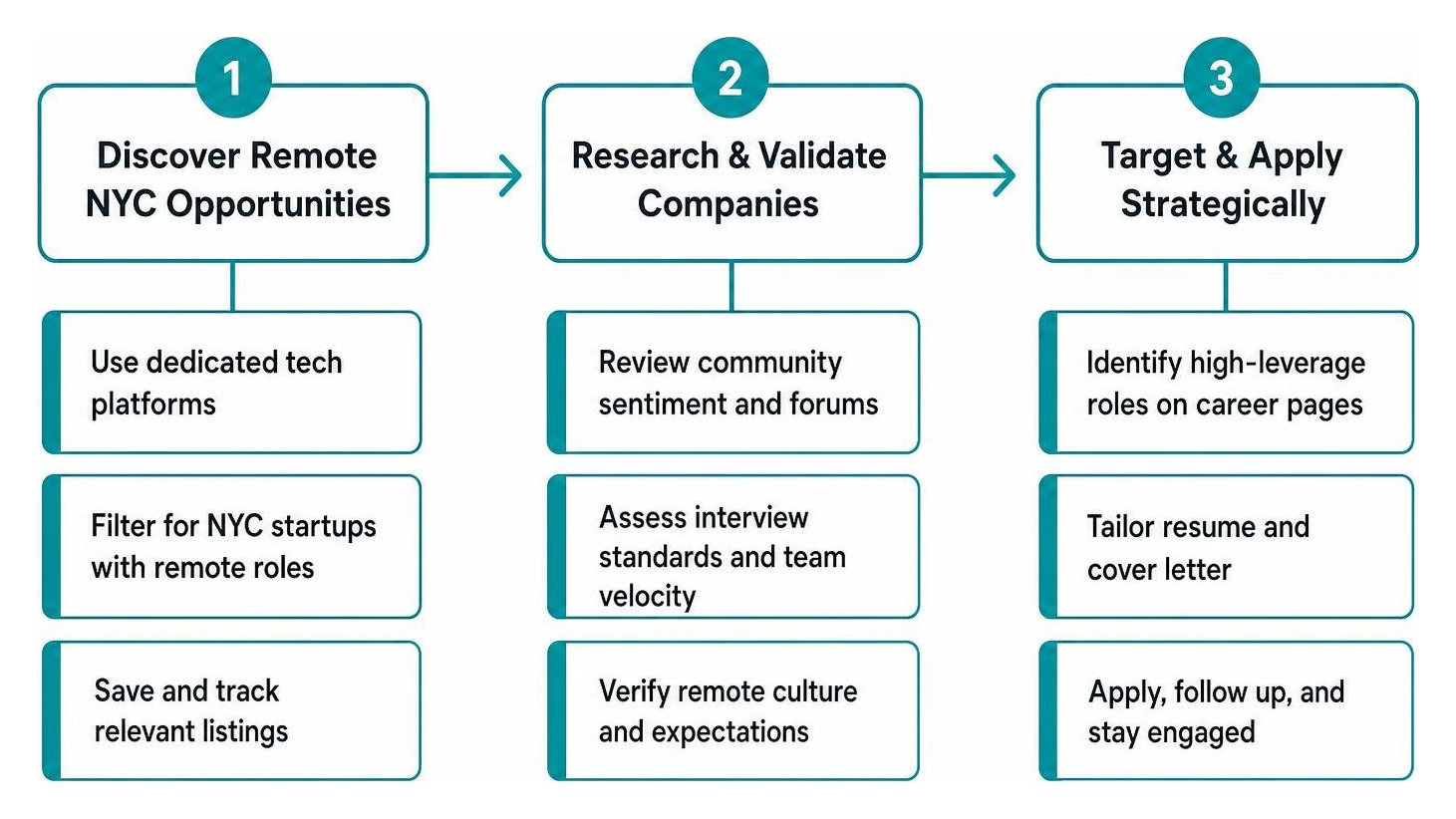
Here are key strategies to land your target role:
- Leverage Curated Platforms and Direct Portals: Filter directly for New York tech firms that explicitly permit work-from-home setups and maintain transparent remote hiring standards.
- Review High-Growth Community Sentiment: Candidate communities and peer forums (such as Blind) offer candid, unfiltered employee sentiment regarding interview standards, team velocity, and actual remote practices at fast-growing startups like Ramp, Merge API, and Metronome.
- Target Specific Startup Positions: Look directly at active career pages for high-leverage roles. Prominent remote-friendly listings in the New York market include:
- Showcase Practical Projects: Early-stage NYC startups value portfolio output and shipping velocity over abstract academic resume lines. Demonstrating working prototypes, open-source commits, or live web applications speeds up interview loops significantly.
To optimize your portfolio and skip outdated hiring hurdles, check out our resource on Remote Coding Jobs Practical Skills Guide.
Frequently Asked Questions About Remote NYC Startups
How do NYC startups evaluate remote engineering talent during interviews?
NYC startups are moving away from traditional theoretical algorithmic whiteboard challenges. Instead, tech teams evaluate remote engineering candidates using practical coding assessments, system architecture discussions, and short paid async take-home projects.
Hiring managers want to see how candidates structure clean code, leverage modern AI tools like Cursor or Claude, design resilient system APIs, and communicate technical decisions asynchronously. Learn more about practical evaluation trends in our Alternative Developer Assessments Guide.
What are the top emerging remote tech trends in New York?
The defining tech trend across remote NYC startups is the rapid integration of AI-assisted software development, commonly referred to as “vibe coding.” Startup engineering teams actively prioritize candidates proficient in AI-enabled workflows, agentic frameworks, and LLM tooling (such as LangChain and LlamaIndex).
Rather than hand-writing routine boilerplate, engineers act as software architects orchestrating autonomous agents, vector databases, and API pipelines. Discover how this shift is reshaping the job market in our analysis of Remote Vibe Coding Market Growth.
Do remote NYC startup roles offer equal pay compared to in-office positions?
In most cases, yes. Because of New York State’s compensation transparency mandates, posted salary bands apply equally to remote candidates across the United States.
While some large corporations scale base pay based on local cost-of-living indices, high-growth NYC startups increasingly adopt location-agnostic compensation structures. This policy ensures distributed team members receive competitive base pay and equity grants equal to their local NYC peers.
Conclusion
Finding the right role at remote NYC startups allows software developers, product managers, and AI specialists to work alongside high-velocity teams while retaining total location flexibility. As New York’s tech ecosystem continues embracing distributed workforces, modern tools and async workflows ensure remote employees stay fully integrated into company growth.
At Vibe Coding Jobs, we track daily hand-curated engineering roles, AI developer positions, and async-first opportunities across high-growth startups. If you are ready to accelerate your tech career with top distributed teams, explore our latest open roles and find your next position on our platform today!
Explore Remote NYC Startup Jobs on Vibe Coding Jobs