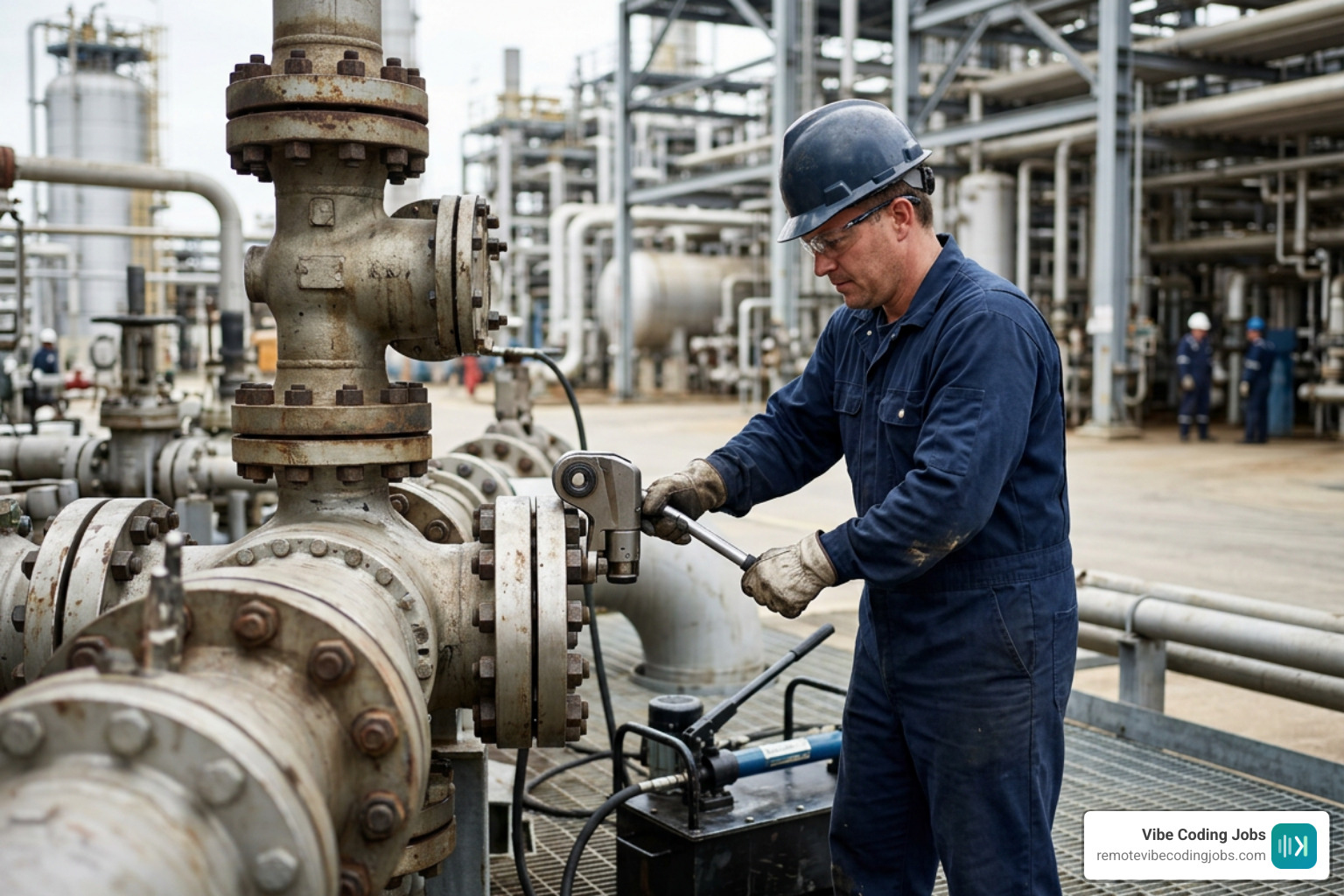
Bolt Technician Jobs: A Fast Overview
Bolt technician jobs can mean two very different things depending on where you search. In heavy industry, they involve installing, tightening, inspecting, and documenting critical bolted connections in equipment and structures. In tech job searches, especially on a site like Vibe Coding Jobs, the word “Bolt” may also point to AI-assisted development tools, software platforms, mobility companies, or field engineering roles.
This guide is designed to help job seekers separate those meanings quickly. If you are looking for a hands-on industrial trade, the sections below explain controlled bolting duties, certifications, work conditions, and pay. If you are looking for remote AI-assisted development jobs that mention Bolt-related tools or stacks, use this as a search-intent filter so you do not apply to the wrong type of role.
| Search result type | What the work usually involves |
|---|---|
| Industrial bolting technician | Torqueing and tensioning bolts to exact specifications on-site |
| Mechanical or joint integrity technician | Inspecting flanges, fasteners, gaskets, and mechanical assemblies |
| Field service technician | Traveling to plants, construction sites, wind farms, or customer facilities |
| Remote tech role mentioning Bolt | Building, testing, or supporting software with AI-assisted tools and modern web stacks |
Industrial bolting work is hands-on and usually cannot be remote. The equipment, safety checks, and physical inspections must happen at the job site. By contrast, Vibe Coding Jobs focuses on remote and async-first technical roles, so a search for “Bolt” on the platform is more likely to be useful when you mean software tooling, AI-assisted development, or tech roles that list Bolt-related workflows.
I am Hansjan Kamerling, cofounder of Adaptify SEO, with more than a decade in technology and product design. While my background is in tech rather than field mechanics, I research career paths and job-search signals to help readers understand specialized roles such as bolt technician jobs and avoid confusing industrial trade listings with remote software opportunities.
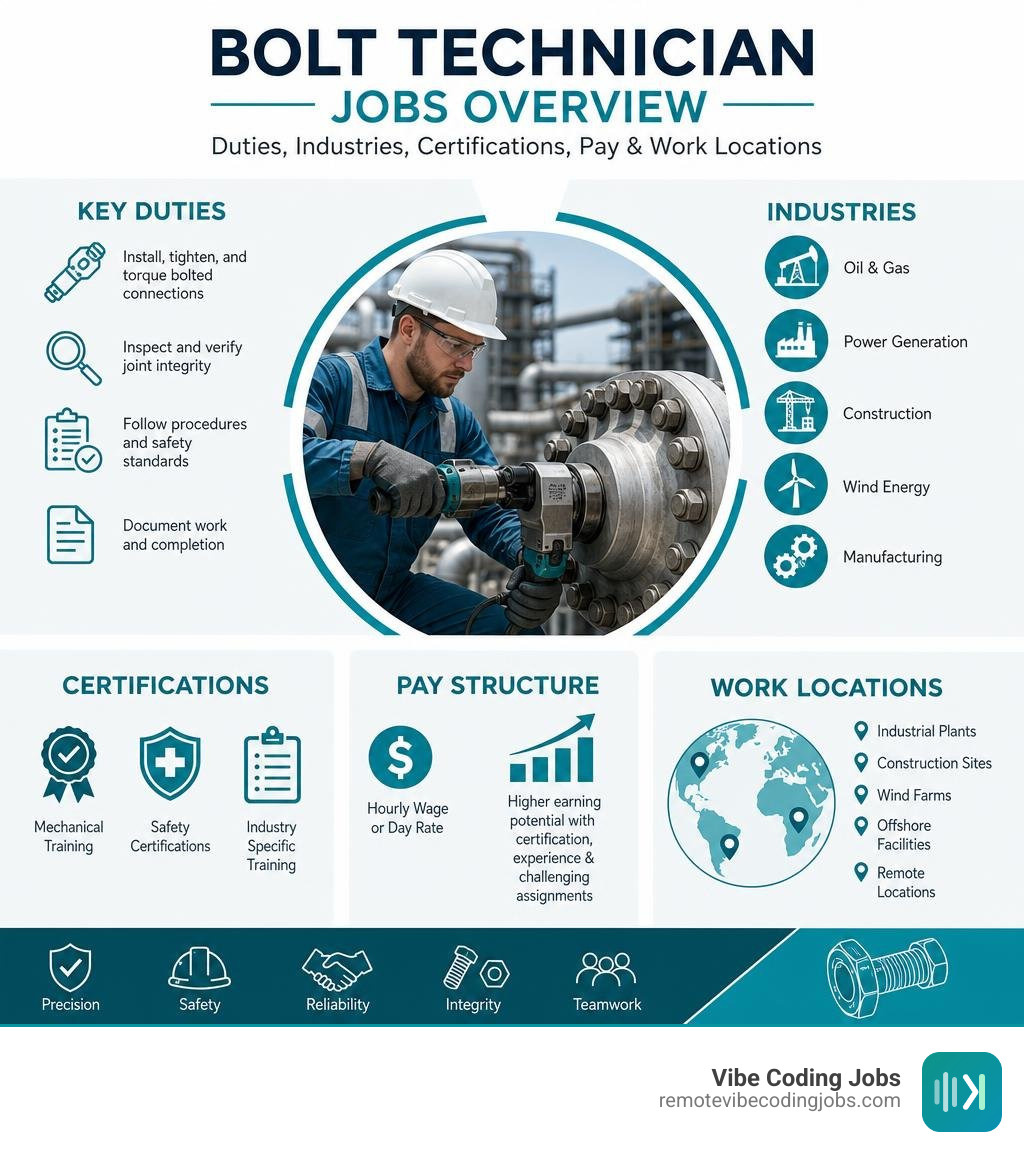
Understanding Bolt Technician Jobs: Roles, Responsibilities, and Technical Scope
When high-pressure pipelines, heavy industrial machinery, or offshore wind turbines are assembled, thousands of bolts hold everything together under immense strain. A single loose or improperly tightened bolt can trigger catastrophic fluid leaks, structural failures, or expensive emergency shutdowns. That is where specialized industrial bolting technicians step in.

At its core, an industrial bolt technician’s responsibility is joint integrity. They do not simply turn a hand wrench until a nut feels snug; they apply calculated hydraulic torque or direct tensioning force to stretch fasteners to exact engineering tolerances. This helps flanges, pressure vessels, and turbine foundations maintain a tight seal under operating pressure, vibration, and temperature changes.
For Vibe Coding Jobs readers, the key distinction is that this is not a remote software role. It is a precision mechanical trade. If you want remote work involving AI coding assistants, frontend frameworks, backend systems, or product engineering, you should filter for software titles rather than industrial bolting titles.
Key Differences Between Bolt Technician Jobs and Tech or Maintenance Roles
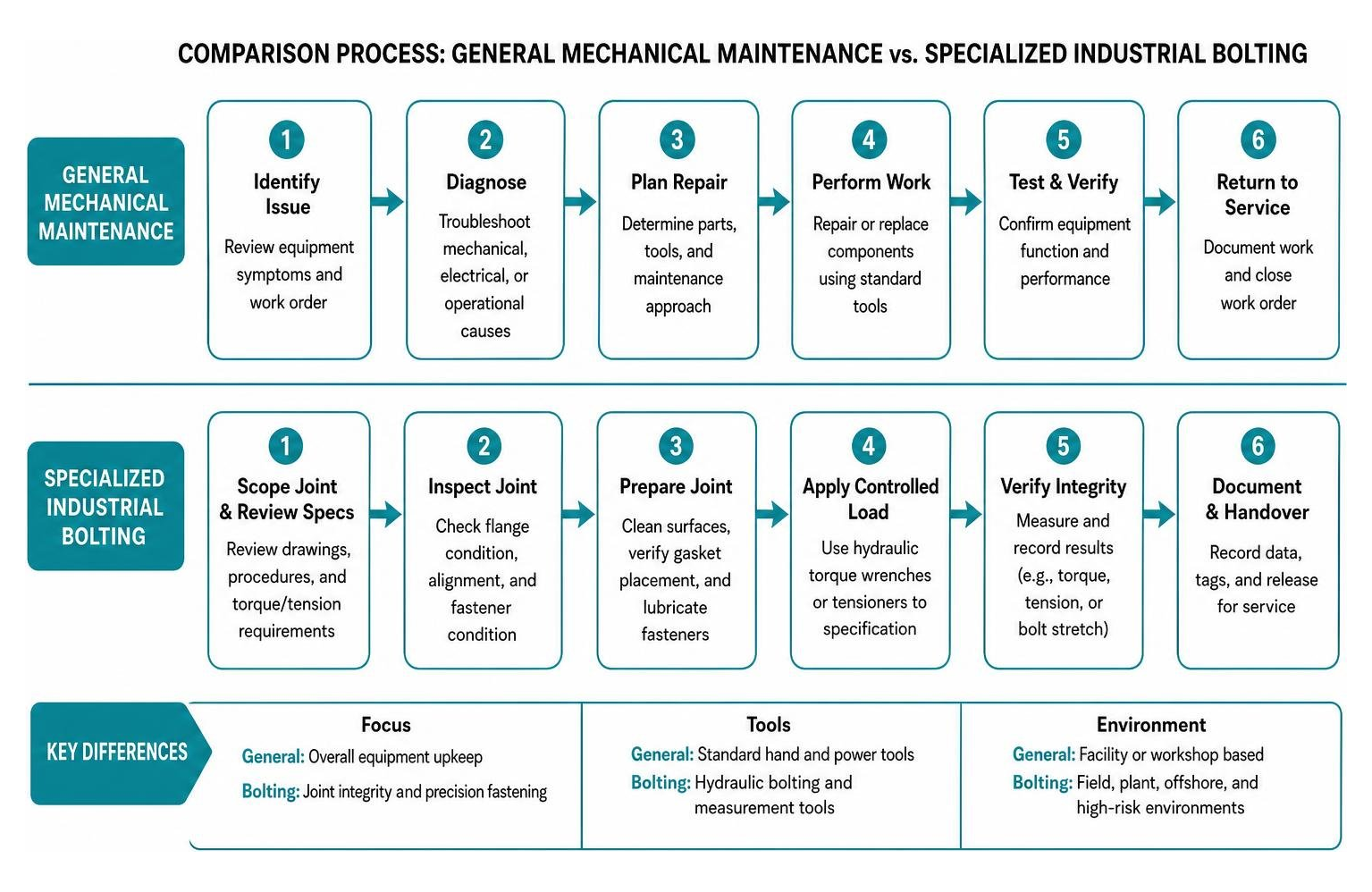
It is common for job seekers to confuse a general mechanical maintenance role, a dedicated industrial bolting role, and a tech role that happens to mention “Bolt.” The daily focus and tooling are very different.
General maintenance technicians handle broad tasks such as lubrication, replacing worn gears, repairing pumps, or troubleshooting electrical controls. A specialized bolt technician focuses on mechanical joint integrity, flange alignment, gasket sealing, and non-destructive joint verification. A remote tech role mentioning Bolt is usually about software delivery, AI-assisted coding workflows, or product engineering rather than physical fasteners.
| Role Aspect | General Maintenance Technician | Specialized Bolt Technician | Remote Tech Role Mentioning Bolt |
|---|---|---|---|
| Primary Focus | Equipment upkeep and mechanical troubleshooting | Controlled bolting, joint integrity, and flange alignment | Software development, support, automation, or AI-assisted building |
| Tooling Used | Standard wrenches, impact guns, multi-meters, basic hand tools | Hydraulic torque wrenches, bolt tensioners, ultrasonic stretch meters | IDEs, code repositories, AI coding tools, issue trackers, cloud platforms |
| Working Environment | Fixed facility, factory floor, or local workshop | Project-based field deployments, plants, wind sites, or offshore platforms | Remote, hybrid, or office-based technical teams |
| Certification Focus | General mechanical NVQ/BTEC, millwright, or electrical basics | ECITB Mechanical Joint Integrity (MJI), GWO, torque and tension credentials | Portfolio, coding experience, stack knowledge, AI-tool fluency |
| Risk Profile | General mechanical hazards and lockout-tagout | High-pressure hydraulic hazards, stored energy, chemical flange leaks | Security, reliability, production incidents, and delivery quality |
Daily Duties and Technical Tooling Expertise
A typical day for an industrial bolting specialist balances physical labor with exact measurement and strict safety record-keeping. The daily workflow usually includes:
- Inspecting Flanges and Fasteners: Checking bolt threads, nuts, structural steel, and flange sealing surfaces for corrosion, micro-cracks, or damage before assembly.
- Calculating Clamp Load: Verifying engineering datasheets to select the correct torque values or hydraulic pressure calculations.
- Operating Hydraulic Torque Wrenches: Using square-drive or low-profile hydraulic tools to apply uniform torque across complex bolt patterns.
- Executing Hydraulic Bolt Tensioning: Deploying hydraulic tensioner heads to physically stretch large-diameter bolts before relieving hydraulic pressure.
- Ultrasonic Load Verification: Using ultrasonic bolt elongation measuring devices to confirm clamp load without relying only on friction estimates.
- Flange Alignment and Spreading: Operating mechanical and hydraulic flange spreaders and alignment tools to safely align misaligned pipework.
- Site Documentation and QA Reporting: Logging calibration figures, pass/fail joint inspections, and sign-offs for QA auditing.
Technicians also maintain, calibrate, and repair heavy hydraulic power units and high-pressure hoses on site. Companies like VF Bolts demonstrate how industrial precision fasteners demand quality control from manufacturing through final field assembly.
Key Industries, Working Conditions, and Global Demand
Industrial demand for skilled bolting specialists is substantial, especially in energy, construction, manufacturing, and infrastructure. Industry reports list tens of thousands of technician positions across the United States, with most roles categorized as on-site work. Energy sector listings also regularly show active bolting positions across North America, Europe, Asia, and South America.
For remote tech job seekers, that on-site pattern matters. A listing for an industrial bolting technician is not usually a fit for someone seeking async-first software work. On Vibe Coding Jobs, a “Bolt” search is more relevant when it connects to coding tools, product engineering, AI-assisted development, or technical teams rather than controlled mechanical bolting.
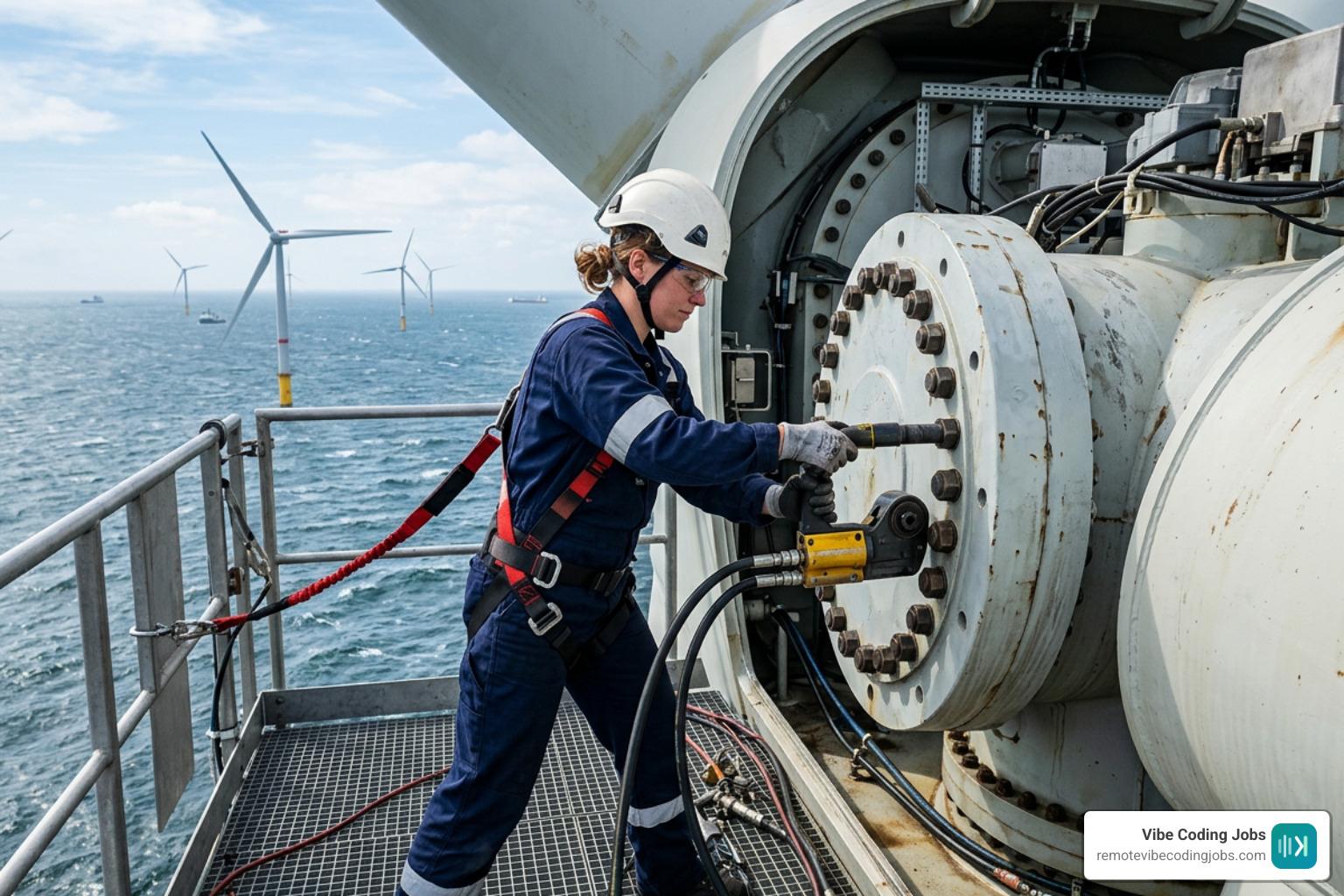
Key industries employing industrial bolting technicians include:
- Oil, Gas, and Petrochemicals: Refineries, offshore drilling rigs, processing plants, and transmission pipelines rely on bolting specialists during construction and seasonal turnarounds.
- Renewable Wind Energy: Onshore and offshore wind farms require large bolting campaigns during turbine installation and scheduled blade or tower maintenance.
- Power Generation and Nuclear: Steam turbines, pressure vessels, and generator casings require exact thermal and mechanical joint sealing.
- Heavy Construction and Infrastructure: Bridges, structural steel frameworks, and heavy mining machinery require certified torque and tensioning experts.
Sector-Specific Roles in Mobility, Electronics, and Field Engineering
When searching for bolt technician jobs on job boards, you may notice that the keyword “Bolt” catches roles outside traditional heavy industrial bolting. Categorizing these openings helps you target the correct career track:
- Industrial Bolting and Joint Integrity: Hands-on roles using torqueing, tensioning, flange alignment, and QA documentation. These are normally on-site.
- Micro-Mobility Fleet Mechanics: Mobility platforms may hire mechanics to maintain e-scooter and e-bike fleets. These roles can involve battery checks, warehouse repairs, and mechanical servicing rather than industrial joint integrity.
- Electronics Field Service Engineering: Some firms recruit engineers to install, troubleshoot, and service electronics manufacturing equipment, fire and security systems, or customer-site hardware. These roles may combine electrical fault-finding with mechanical support.
- Software, AI, and Product Engineering: Remote-friendly listings that mention Bolt may involve web development, AI coding workflows, automation, or platform engineering. These are the kinds of roles Vibe Coding Jobs is built to help candidates find.
Understanding these title overlaps prevents misdirected applications and helps you decide whether you are pursuing a physical trade, a customer-site engineering path, or a remote software career.
Field Service Conditions, Travel Requirements, and Perks
Industrial bolting is rarely a standard desk job. Technicians often work in field conditions that require physical stamina, adaptability, and frequent travel.
Key field service conditions include:
- Rotational Shifts: Positions, especially offshore or on remote wind farms, often run on 2-week-on/2-week-off or 4-week-on/4-week-off shift patterns. Daily shifts during active projects frequently span 10 to 12 hours.
- Travel and Mobility Allowances: Employers may provide company vehicles, fuel cards, per diems, and door-to-door transit compensation, depending on region and role.
- Challenging Environments: Technicians work at heights, inside confined spaces, or under difficult weather conditions on offshore and industrial installations.
By contrast, remote technical roles are usually evaluated around communication habits, delivery cadence, stack fit, AI-tool fluency, and the ability to work asynchronously with distributed teams.
Qualifications, Certifications, and Training Requirements
Because controlled industrial bolting involves immense hydraulic pressures and critical structural safety, employers prioritize certified candidates who demonstrate verified competence. Remote technical roles that mention Bolt require a completely different qualification profile, so job seekers should read requirements carefully before applying.
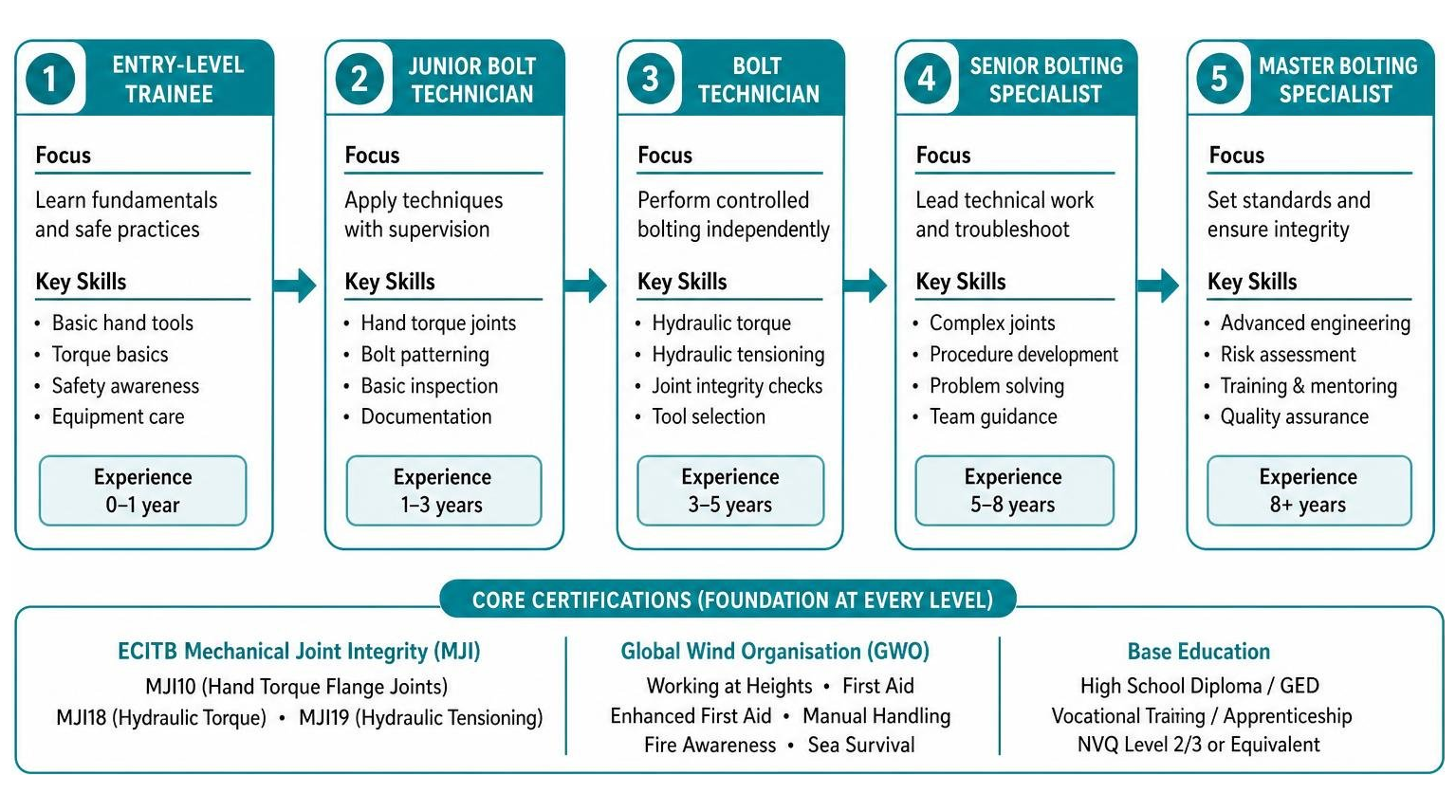
The primary educational and technical certifications for industrial bolting include:
- Base Education: A high school diploma or GED is the baseline. Vocational courses, mechanical apprenticeships, or an NVQ Level 2/3, BTEC, or HNC in Mechanical Engineering can provide an advantage.
- ECITB Mechanical Joint Integrity (MJI): In the UK and internationally, Engineering Construction Industry Training Board modules such as MJI10 for hand torque flange joints, MJI18 for hydraulic torque, and MJI19 for hydraulic tensioning are widely recognized credentials.
- Global Wind Organisation (GWO) Certification: Often required for offshore and onshore wind energy project work. Training may include Working at Heights, First Aid, Enhanced First Aid, Manual Handling, Fire Awareness, and Sea Survival.
- Medical Fitness Assessments: Offshore and wind energy technicians may need physical assessments and an up-to-date offshore medical clearance.
For remote software roles found through Vibe Coding Jobs, employers are more likely to look for:
- Software Portfolio: Shipped projects, GitHub activity, product demos, or examples of production work.
- Stack Fit: Experience with the languages, frameworks, databases, and cloud tools listed in the job description.
- AI-Assisted Development Fluency: Practical use of coding assistants and workflows for prototyping, debugging, testing, and documentation.
- Async Communication: Clear written updates, issue tracking discipline, and the ability to collaborate across time zones.
Essential Safety Protocols and Mechanical Attributes
Working with high-pressure hydraulics, often operating up to 10,000 psi or 700 bar, leaves little margin for safety shortcuts. A sudden hose burst or improper tool seating can cause severe injuries.
Key attributes for success as an industrial bolting technician include:
- Pressure Hazard Management: Inspecting hydraulic hoses, couplings, safety whip-checks, and pressure gauges before pressurization.
- Rigorous Attention to Detail: Following precise star-pattern or criss-cross tightening sequences to avoid pinch points, uneven gasket compression, or flange damage.
- Physical Stamina and Manual Dexterity: Handling heavy steel tooling, maneuvering in cramped quarters, and standing for long periods in industrial environments.
- Problem-Solving Skills: Diagnosing binding threads, flange misalignment, or hydraulic pump pressure drops under tight project deadlines.
The equivalent for remote tech candidates is disciplined engineering judgment: testing carefully, documenting assumptions, reviewing AI-generated code, and communicating risk before it becomes a production problem.
Salary Ranges, Day Rates, and Career Advancement
Compensation for industrial bolting technicians is usually structured around hourly wages, day rates, or fixed annual salaries, often augmented by overtime pay, site allowances, and travel perks. Remote technical roles that mention Bolt or AI-assisted development are usually paid as salaried software, product, engineering, or technical support positions, with compensation varying by company, seniority, region, and contract type.
Across US industrial job markets, entry-level technician roles can start around $40,000 to $55,000 annually, while experienced specialists working heavy overtime, shutdowns, remote projects, or offshore deployments may earn over $80,000 to $100,000+ per year.
In Europe and the UK, specialized field service engineers in mechanical or technical fields can command base salaries between £35,000 and £50,000 per year, often supplemented by car allowances, bonuses, travel pay, or site-specific benefits. Actual pay depends on certification, location, industry, overtime, and employer demand.
Salary Structures and Career Progression in Bolt Technician Jobs
The career trajectory for an industrial bolting specialist offers clear steps for professional and financial growth:
- Bolting Trainee / Apprentice: Assists senior crew members, manages basic hand tools, prepares flange surfaces, and maintains safety perimeters.
- Certified Bolt Technician: Independently operates hydraulic torque and tensioning equipment, logs joint data, reads engineering specs, and executes multi-bolt torque patterns.
- Senior / Lead Bolting Specialist: Leads field operations, oversees complex multi-flange turnarounds, troubleshoots non-standard joint alignment issues, and validates client QA/QC documentation.
- Bolting / Mechanical Field Supervisor: Coordinates site teams, manages equipment staging, interfaces with plant engineering managers, and supports environmental and safety compliance.
- Quality Control Lead or Plant Manager: Moves toward office-based or permanent facility management, overseeing joint integrity programs, procedure authoring, and site safety audits.
For remote tech candidates, the progression is different. A role that mentions Bolt in a software context may lead from junior developer or support engineer to product engineer, AI tooling specialist, staff engineer, engineering manager, or founder-track product builder. That is why it is important to confirm whether a listing is describing industrial bolting or remote software work before comparing salaries.
Frequently Asked Questions About Bolting Technician Careers
What qualifications are required to become a bolt technician?
To become an industrial bolt technician, you generally need a high school diploma or equivalent, paired with a mechanical background, apprenticeship, or vocational training. Industry-recognized credentials like ECITB Mechanical Joint Integrity training or specialized bolt torque and tension certifications are highly desirable. For wind energy roles, Global Wind Organisation safety modules and offshore medical clearances may be required.
How much do bolt technicians earn annually?
Earnings vary based on experience, location, and industry sector. Entry-level industrial technicians may start between $40,000 and $55,000 per year, while experienced senior technicians, field supervisors, or offshore specialists can exceed $80,000 to $100,000+ annually when factoring in day rates, overtime pay, and travel per diems.
Are bolt technician jobs strictly on-site or are remote options available?
Industrial bolting technician positions are overwhelmingly on-site because installing, tensioning, and testing mechanical joint hardware is physical work. Related software, systems integration, technical support, or AI-assisted development roles may be remote or hybrid, but those are different roles and should be evaluated separately.
Why would a remote tech job seeker search for bolt technician jobs?
Some candidates use broad keywords and discover that “Bolt” can refer to industrial fasteners, mobility companies, electronics field service, or software tools. If your goal is remote vibe coding work, focus on listings that mention software stacks, AI tools, async culture, and product engineering rather than hydraulic torqueing, flange alignment, or offshore site work.
Conclusion
Industrial bolt technician jobs remain important across energy, manufacturing, construction, and infrastructure because controlled torqueing, hydraulic tensioning, and joint integrity are essential to safe operations. These roles can offer strong pay and advancement, but they are usually hands-on, travel-heavy, and on-site.
For Vibe Coding Jobs readers, the main takeaway is search clarity. If you want a mechanical trade, industrial bolting may be the right path. If you want remote AI-assisted development work, look for software roles that match your stack, tooling, communication style, and async preferences instead of applying to field-service bolting jobs by mistake.
Whether you are comparing physical technician careers or narrowing your search to remote software work, having the right job-search platform matters. Explore technical opportunities on Vibe Coding Jobs to find curated roles filtered by culture, tech stack, and AI tools.