
The Rise of the AI Vibe Coder: From Zero Code to Live App
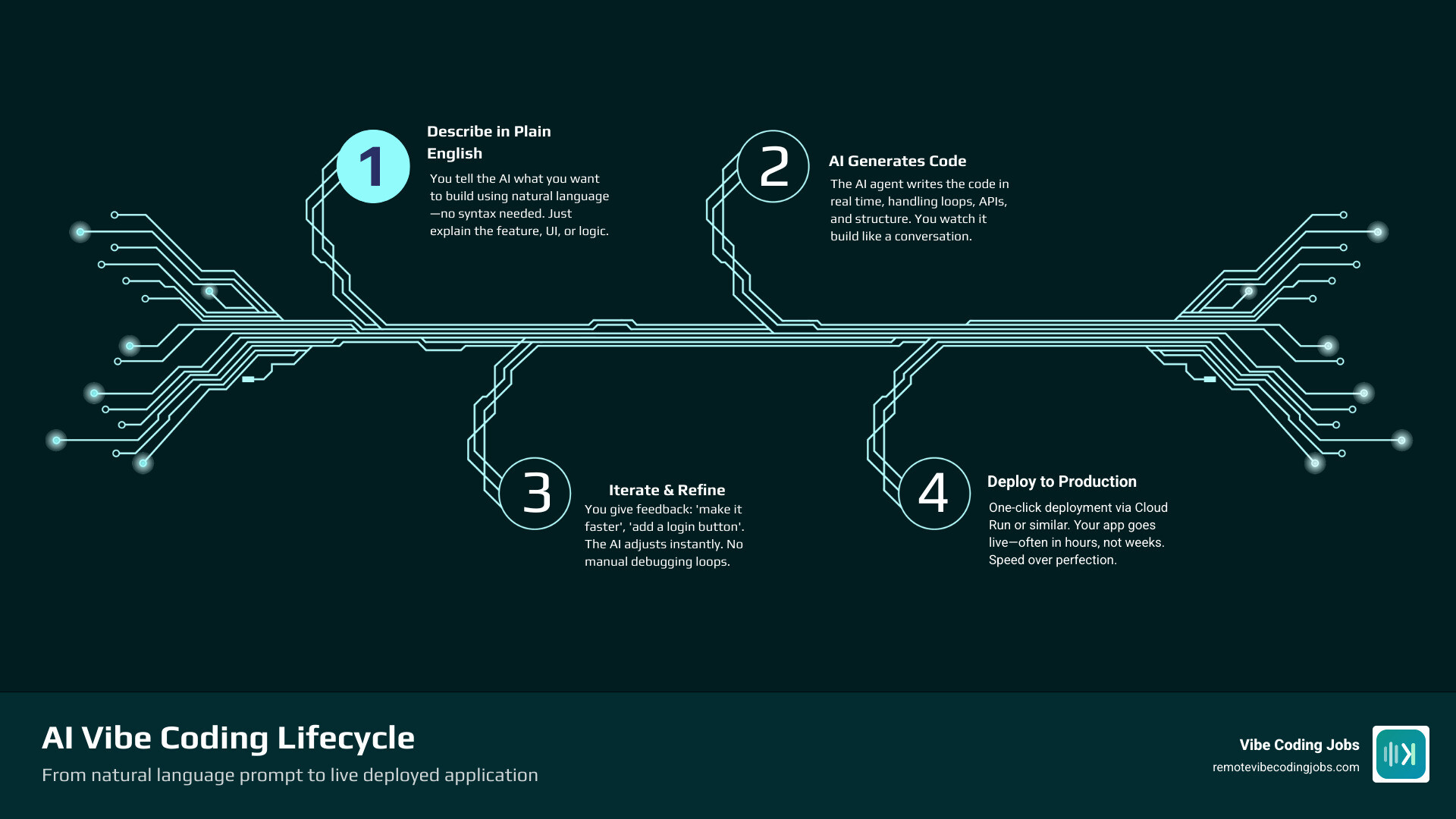
An AI vibe coder is a developer — or non-developer — who builds software by describing what they want in plain English and letting an AI agent handle the actual code. No syntax memorization. No manual debugging loops. Just prompts, iteration, and a working app.
Here’s what that means at a glance:
| Concept | Quick Answer |
|---|---|
| What is an AI vibe coder? | Someone who builds apps using natural language prompts instead of writing code manually |
| Who is it for? | Beginners, founders, and experienced developers who want to move faster |
| What tools do they use? | Google AI Studio, Claude Code, Cursor, Vibe IDE, and similar AI platforms |
| Is it real development? | Yes — but it ranges from quick prototyping to disciplined AI-assisted engineering |
| What are the risks? | Security flaws, unmaintainable code, and production failures without proper oversight |
The term “vibe coding” was coined by AI researcher Andrej Karpathy in early 2025. It describes the practice of fully giving in to the creative flow with an AI — describing what you want, watching it build, and iterating in conversation rather than in a code editor.
Since then, it has exploded. Founders are shipping micro-SaaS products in a single day. Non-developers are deploying full-stack apps without writing a single line of code. And major platforms like Google have officially adopted “vibe coding” as a supported product feature.
But it is not all smooth sailing. In an August 2025 survey, 16 out of 18 CTOs reported experiencing production disasters directly caused by AI-generated code. The gap between building fast and building well is real — and understanding it matters.
I’m Dominic Zijlstra, co-founder of Adaptify.ai and a former data scientist and DevOps engineer, and my hands-on experience with automated systems and AI tooling gives me a practical lens on where AI vibe coding genuinely accelerates work versus where it quietly creates risk. In this guide, I’ll walk you through everything you need to know — from tools and workflows to the pitfalls that trip up even experienced teams.
What is an AI Vibe Coder?
At its core, an ai vibe coder is someone who shifts the primary act of software development from writing code line-by-line to directing autonomous models. Instead of typing out loops, debugging memory leaks, or configuring build pipelines, the vibe coder focuses on high-level logic, design, and user experience.
When Andrej Karpathy introduced the term, he pointed out that programming was shifting from manual syntax construction to a conversation. We are no longer required to be translators who turn human ideas into rigid machine code. Instead, we act as directors.
To understand this shift, it is helpful to look at the transition from traditional programming. In our guide on What is Vibe Coding?, we explore how natural language has become the ultimate programming language. Rather than spending weeks mastering a specific framework, developers can now rely on AI agents to translate their creative vision into functional applications. This doesn’t mean the role of the developer is disappearing; rather, it is evolving. By understanding the fundamentals of Vibe Coding vs Traditional Development, we can see that the modern builder’s value lies in their ability to orchestrate, refine, and guide AI tools toward a finished product.
How the AI Vibe Coder Differs from Traditional Programmers
The differences between an ai vibe coder and a traditional software engineer come down to where the abstraction layer sits. Traditional programmers spend years mastering syntax, learning memory management, and understanding how to structure complex databases manually. They write every line of code, execute manual testing, and handle their own deployments.
An AI vibe coder, on the other hand, operates at a much higher level of abstraction. They use natural language to describe features, UI layouts, and business logic. The AI acts as the compiler, the developer, and often the QA tester all at once.
For a detailed breakdown of these structural changes, you can read about the Vibe Coding vs Traditional Software Engineering Key Differences. Many traditionalists wonder: is this approach a shortcut, or does it represent the natural evolution of the industry? We dive deep into this debate in our article, Is Vibe Coding Cheating? The Truth About AI Development. Just as compilers replaced assembly language, AI is replacing manual syntax generation—allowing builders to focus on what to build rather than how to write it.
The Ideal Persona of an AI Vibe Coder
Who is vibe coding actually for? The answer is surprising: it serves two completely different audiences in unique ways.
For beginners and non-technical founders, vibe coding is an absolute superpower. It lowers the barrier to entry to zero. If you can describe your idea, you can build it. We have seen founders create and deploy a functional micro-SaaS web app in a single day with zero prior coding experience. This rapid feedback loop allows creators to validate ideas with real users before investing thousands of dollars in traditional development teams.
For experienced developers, vibe coding is a massive accelerator. Instead of spending hours writing boilerplate code, configuring routers, or setting up database schemas, they can use AI to scaffold entire systems in minutes. A senior developer might use Claude to convert Docker Compose configurations to run on Terraform in just an hour or two—a task that would have easily taken a week of manual writing and testing in the past.
Whether you are looking to build your Vibe Coding First SaaS Weekend project or trying to optimize an existing enterprise workflow, the ideal persona is someone who is highly iterative, creative, and comfortable directing autonomous agents.
The AI Vibe Coder Tooling Ecosystem
To vibe code effectively, you need the right environment. The landscape of AI-assisted development has moved far beyond simple chat boxes. Today, we have dedicated IDEs, command-line interfaces, and web-based builders designed specifically to support natural language development.
When setting up your workflow, choosing the right environment is crucial. You can explore the Essential AI Tools for Vibe Coding to understand how different applications fit together. From browser-based sandboxes to terminal-integrated agents, having a curated set of Must-Have Vibe Coding Tools ensures you do not get stuck when building complex features. For a broader look at the software driving this movement, check out our comprehensive list of AI Coding Tools for Vibe Coding.
One of the most exciting developments in this space is Vibe — The AI IDE Built for Vibe Coders, which is designed from the ground up for AI-first workflows. Unlike traditional editors that simply bolt on AI extensions, these modern platforms offer native features like shadow git checkpoints, built-in model routing, and direct browser actions.
Web-Based Builders and CLI Agents
The tooling ecosystem generally splits into two categories: visual web-based builders and terminal-based CLI agents.
Web-based builders are perfect for rapid prototyping and visual development. Platforms like VibeCoder | AI-Powered Coding and Vibe Coder — Build Anything with AI allow you to describe what you want and watch the application build in real-time inside a sandboxed preview. These platforms often use smart AI routing, dynamically selecting the best model for the job—such as Claude for creative UI layouts or GPT models for complex mathematical logic.
For developers who prefer working in their local environment, terminal-based agents like Claude Code and Codex CLI offer incredible flexibility. These agents run directly inside your terminal, allowing them to read files, run tests, install dependencies, and execute git commands. By using structured frameworks, such as those found in the popular vibe-coding/README.md at main · EnzeD/vibe-coding · GitHub repository, developers can maintain a clean codebase while letting the AI do the heavy lifting. To understand how these terminal agents stack up against traditional autocomplete extensions, read our analysis on Claude Code vs Copilot for Developers in 2026.
Full-Stack App Generation and Vibe Deploying
The ultimate goal of vibe coding is “vibe deploying”—the ability to take an application from a natural language prompt to a live, production-grade environment with a single click.
Modern builders like AI App Builder for Full-Stack Web Apps | CoderVibe excel at this. They do not just generate HTML and CSS; they build fully connected full-stack applications, including databases, backend APIs, and user authentication.
Once your application is ready, platforms like VibeCoder – Ship Your Vibe Code in Real Time allow you to deploy your project globally to cloud environments (like Google Cloud Run) in minutes. This completely removes the traditional DevOps bottleneck, allowing anyone to share their creation with the world instantly.
Pure Vibe Coding vs. AI-Assisted Engineering
As vibe coding transitions from a hobbyist trend into professional environments, we must draw a clear line between “pure” vibe coding and disciplined AI-assisted engineering.
Pure vibe coding is about speed, exploration, and creative flow. You write a prompt, the AI generates the code, and if it works, you move on. You rarely look at the underlying files, let alone write unit tests or perform manual code reviews. While this is fantastic for building prototypes or validating a new idea over a weekend, it quickly falls apart when applied to complex, long-term software systems.
AI-assisted engineering, on the other hand, is the methodical integration of AI into a mature software development lifecycle. Here, the human engineer remains firmly in control of the architecture, security guidelines, and code quality. The AI is treated as an incredibly fast junior developer whose work must be constantly reviewed, tested, and verified.
For those looking to build a long-term career in this space, understanding this distinction is key to professional growth. You can explore how these roles are evolving in our guide on AI Assisted Development Career Growth.
| Feature | Pure Vibe Coding | AI-Assisted Engineering |
|---|---|---|
| Primary Goal | Speed and rapid exploration | Long-term stability and maintainability |
| Code Ownership | Fully delegated to the AI agent | Owned and thoroughly understood by the human |
| Testing | Visual verification (“if it looks right, it is right”) | Automated unit, integration, and security testing |
| Architecture | Ad-hoc, often leading to monolithic files | Planned modular design with strict coding standards |
| Risk Profile | High “trust debt” and potential security flaws | Controlled risk with continuous human oversight |
The Risks of Unchecked AI Code in Production
Why is this distinction so critical? Because relying blindly on AI-generated code in production environments is incredibly dangerous.
AI models are designed to please the user. If you ask for a login screen, they will write one that looks beautiful and functions perfectly on the surface. However, under the hood, the AI might omit crucial security checks, write inefficient database queries that fall over under scale, or introduce subtle logic bugs.
A junior developer might vibe an authentication module and accidentally invert a check, leaving deactivated accounts with admin access. Or an AI-generated database query might work perfectly in a local test environment with ten users, but bring a production database to its knees when queried by thousands of active customers.
This is why industry leaders are sounding the alarm. In our analysis of Is AI Replacing Developers? The Future of Coding in 2026, we look at how the role of the developer is shifting from a writer of code to a “code janitor” or auditor. Without human oversight, unchecked AI code quickly builds up “comprehension debt”—a state where no one on the team actually understands how the application works, making it impossible to debug or extend.
Spec-Driven Development: The Antidote to Prompt Chaos
To solve the chaos of pure vibe coding, professional teams are adopting spec-driven development. Instead of letting the AI write code immediately, you first collaborate with the model to build a highly detailed technical specification.
This process is structured, deliberate, and highly effective. Here is how it works:
- The Product Specification: You describe the feature, and the AI helps you draft a clean Markdown document detailing the requirements, edge cases, and user flows.
- The Implementation Plan: Before writing a single line of code, the AI generates a step-by-step technical plan. You review this plan to ensure the architecture is modular and secure.
- The Memory Bank: You maintain a set of core documentation files (like an architecture guide or system rules) that the AI agent must read before making any changes. This prevents the model from introducing conflicting patterns or bloated code.
- Incremental Execution: The AI executes the plan one small step at a time, running automated tests after each change to verify correctness.
By adopting these disciplined practices, teams can achieve the massive speed benefits of AI without sacrificing code quality. To learn more about setting up these agentic frameworks, read our guide on Agentic Engineering What It Is How to Thrive in 2024 and discover How to Build an Agent-Friendly Codebase Guide.
Frequently Asked Questions about Vibe Coding
What is the difference between pure vibe coding and responsible AI-assisted development?
The key difference lies in code ownership and review. In pure vibe coding, the developer fully trusts the AI’s output without looking at the code, prioritizing speed and instant deployment. In responsible AI-assisted development, the developer treats the AI as a collaborator. Every line of generated code is subjected to human review, automated testing, and security checks before being merged into production. To build a sustainable workflow, developers should leverage the right AI Assisted Development Career Growth Tools to automate testing and code quality checks.
Can you use vibe coding for production-grade applications?
Yes, but only if you transition from pure vibes to a structured engineering process. While you can vibe-code a prototype to validate an idea, deploying that exact code directly to production without human audit introduces massive risks. To ensure your production apps remain stable, performant, and secure, you must actively manage technical debt and use professional debugging practices. For tips on maintaining high output without sacrificing quality, check out our Remote Developer Productivity Tips Tools Boost Your Output guide.
How do I transition a vibe-coded prototype to a stable app?
To transition a prototype into a stable, production-ready application, you should follow a systematic refactoring process:
- Write Unit Tests: Ensure all core business logic is covered by automated tests to catch regressions.
- Audit for Security: Review authentication, database queries, and API endpoints for common vulnerabilities.
- Modularize the Codebase: Break down large, AI-generated monolithic files into clean, reusable modules.
- Establish a Spec-Driven Workflow: Move away from conversational prompting and start using structured implementation plans for all future updates.
Mastering this transition is one of the most valuable skills for modern builders. You can read more about the core competencies required in our analysis of Remote Developer Skills in Demand 2026 Future-Proof Your Career.
Conclusion
The era of the ai vibe coder is here, and it is fundamentally changing how software is built, deployed, and maintained. By lowering the barrier to entry, AI has empowered a new wave of creators to bring their ideas to life in record time. At the same time, it has given experienced engineers an unprecedented speed boost, allowing them to focus on high-level architecture and creative problem-solving.
However, as the industry matures, the developers who thrive will be those who can bridge the gap between rapid prototyping and disciplined software engineering. Moving fast is incredible, but building applications that are secure, scalable, and maintainable is what truly defines a professional.
At RemoteVibeCodingJobs, we help developers navigate this exciting new landscape. We curate daily, high-quality remote opportunities at forward-thinking, async-first companies that actively encourage the use of modern AI tools like Cursor, Windsurf, and Claude. Whether you are an experienced engineer looking to leverage AI to its fullest potential or an aspiring builder entering the market, we are here to support your journey.
Ready to take the next step in your career? Explore our curated listings and Find Remote AI Engineer Jobs today!