
Is Rust Worth Learning for Remote Data Engineering?
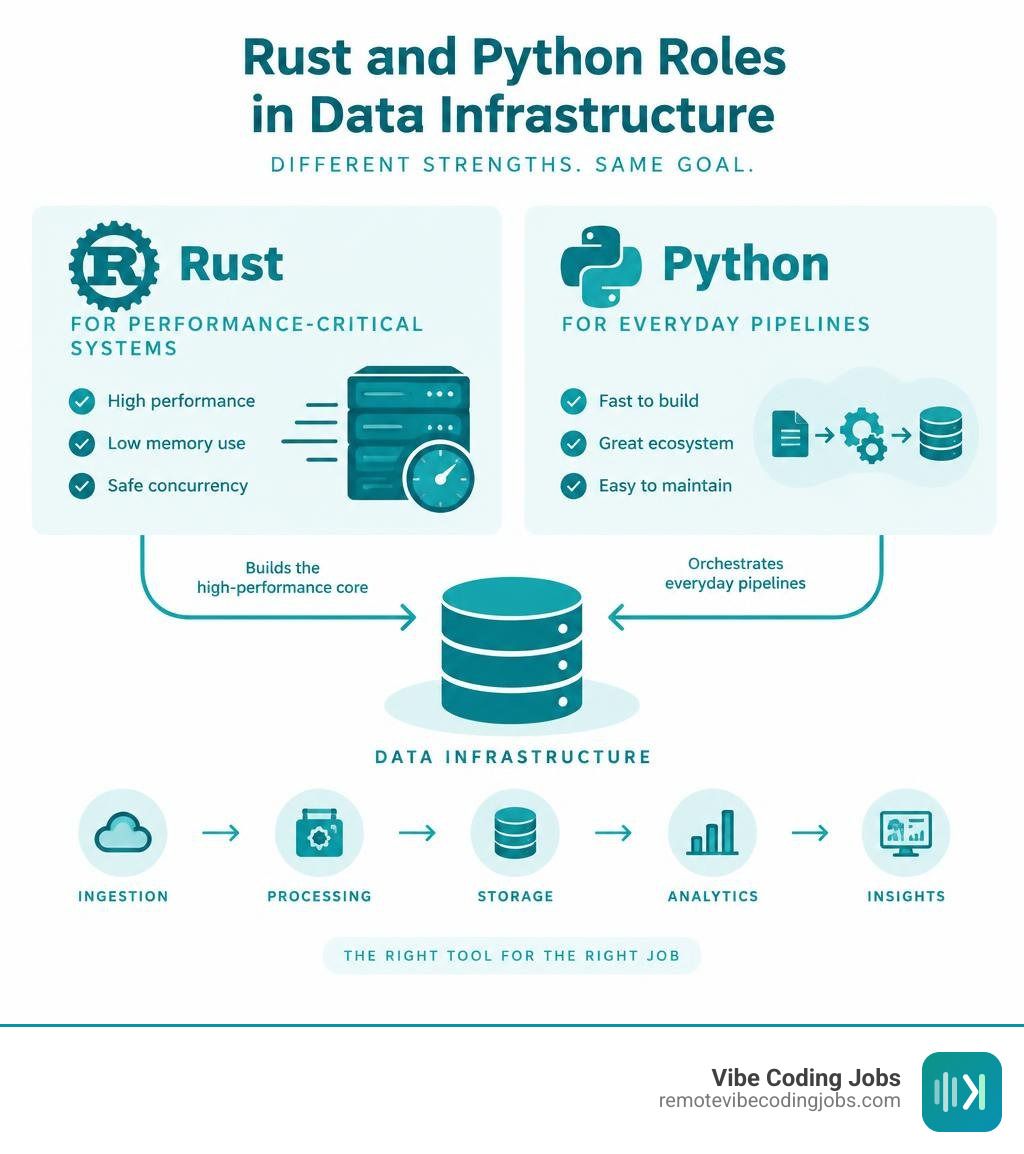
Rust remote data engineering is a niche, not a replacement for Python data engineering. Remote roles exist, but they are more often senior jobs building fast, reliable data infrastructure than jobs writing everyday ETL scripts. If you want to pursue them, keep your Python and SQL skills, then learn Rust for the parts of a system where speed, memory use, or safe concurrency matter most.
That might mean building an ingestion service or a data tool that Python teams use. The trade-off is time: Rust can make demanding systems easier to run reliably, but its learning curve and slower development pace are not worth it for every pipeline.
I’m Dominic Zijlstra. My background in data science, DevOps, and automated systems shapes this practical look at rust remote data engineering: where it helps, where it does not, and what to learn next.
The article editor does not render LaTeX. Do not write LaTeX commands or math delimiters in article copy. Explain calculations in plain language, or use an ordinary-text formula when useful, such as watts = volts × amps. Write units as readable text, such as ft³/hour or gallons/kWh. When asked to remove formulas or confusing mathematical notation, replace them with prose; do not substitute different equations or hide the notation in code.
The Reality of Rust Remote Data Engineering in 2026
If you open standard job boards looking for a standard pipeline builder role, you will find a curious paradox. Across thousands of remote data engineering listings across mainstream tech job boards, virtually none explicitly list Rust as a primary requirement for traditional ETL jobs. Instead, the landscape remains dominated by SQL, Python, Java, and Scala.
However, when you shift your focus to high-performance data systems, distributed streaming infrastructure, and database internals, the narrative flips entirely. We see a specialized talent market where 100% of analyzed Rust-focused infrastructure postings strictly require deep language mastery, 83% demand distributed systems experience, and 57% mandate Kubernetes expertise.
These are not entry-level jobs where you write simple cron jobs to move JSON from an API into a data warehouse. The market overwhelmingly targets senior, staff, and principal engineers with 5 to 10 years of software engineering experience. Companies hiring for senior remote Rust opportunities are investing in systems engineers who understand memory layouts, thread synchronization, low-level network protocols, and storage engine mechanics.
Industry leaders often highlight this reality: the hype surrounding Rust in the data ecosystem is immense, but the language serves a different purpose than general glue code. It is essential to separate enthusiasm from practical hiring demand. Rust is not taking over business reporting pipelines; it is quietly becoming the standard foundation beneath the modern data stack.
Why Teams Choose Rust Remote Data Engineering for Core Infrastructure
Why are infrastructure engineering teams replacing battle-tested C++ or JVM-based stacks with Rust? The answer comes down to memory safety without garbage collection overhead, deterministic execution, and fearless concurrency.
Modern data engines process gigabytes or terabytes per second per node. In garbage-collected runtimes like Java or Go, massive heap sizes cause unpredictable “stop-the-world” garbage collection pauses that ruin latency guarantees in real-time streaming. C++ avoids this but introduces memory corruption risks, dangling pointers, and data races that can silently invalidate analytic results. Rust provides zero-cost abstractions and compile-time memory verification, ensuring multi-threaded data pipelines run at bare-metal speeds without segfaults.
This power has fueled the creation of game-changing open-source data systems:
- Polars: A blazing-fast DataFrame library built on Apache Arrow memory structures that routinely executes analytical queries faster than Pandas and Spark single-node instances.
- Apache DataFusion: An extensible, vectorized SQL query engine written in Rust that powers modern lakehouses, custom databases, and analytical tools.
- Delta-rs: The native Rust implementation of Delta Lake, allowing streaming workers to read and write directly to transactional object stores without running a JVM.
- Ruff: An extremely fast Python linter and formatter written in Rust that transformed developer tooling speed across data teams worldwide.
| Feature / Dimension | Rust | Python | Go | Scala / Spark |
|---|---|---|---|---|
| Primary Sweet Spot | Engine internals, high-throughput ingest, core tooling | End-to-end ETL, orchestration, analytics, data science | Microservices, API gateways, lightweight stream processors | Big Data distributed computing, massive MapReduce jobs |
| Execution Speed | Native machine code (fastest) | Interpreted / bytecode (slow without C/Rust bindings) | Compiled (fast, slight GC latency) | JVM bytecode (fast after JIT, GC overhead) |
| Memory Management | Compile-time ownership (deterministic, zero GC) | Dynamic allocation with reference counting and GC | Concurrent garbage collection | JVM garbage collection with large heap footprint |
| Concurrency Safety | Compile-time guarantees (no data races) | Global Interpreter Lock (GIL) constraints | Goroutines & channels (runtime race detector) | Actor model / JVM threads (runtime concurrency control) |
| Ecosystem Maturity | Rapidly emerging in modern engines | Unmatched breadth for analytics and machine learning | Mature for networking and microservices | Highly mature for enterprise batch processing |
| Developer Velocity | Slower initial development, high cognitive load | Rapid iteration and flexible prototyping | Fast compilation, simple syntax | Moderate development speed, complex type system |
Remote Hiring Niches: AI Platforms, Crypto, and Hardware Telemetry
Remote data engineering roles utilizing Rust cluster around specific domains where throughput, latency, and hardware efficiency translate directly into business survival.
- AI Infrastructure and Agent Memory Engines: Modern agentic platforms require low-latency indexing, vector routing, and context retrieval. AI firms recruit Rust developers to build the underlying ingestion pipelines that turn petabytes of interaction history into searchable vector representations.
- GPU Optimization and Telemetry: Infrastructure companies profile deep learning workloads from high-level frameworks down to individual GPU instructions using eBPF and native Rust services. These engines funnel hardware observability metrics into analytical backbones like ClickHouse, saving millions in compute waste.
- Quantitative Trading and Crypto Platforms: Low-latency market data pipelines ingest WebSocket and REST feeds across financial venues. Data engineers use Tokio-based asynchronous pipelines to normalize order books and execute high-throughput analytics, writing clean columnar datasets into Parquet and time-series databases like QuestDB.
- Physical AI and Robotics: Teams managing multimodal robot telemetry process massive 2D, 3D, and time-series logs. Handling out-of-core visualization and petabyte-scale archives requires dedicated custom data engines that render high-volume data streams smoothly across distributed teams.
Rust vs Python, Go, and Scala: Evaluating the Trade-Offs
When choosing the right technology for data engineering, every language presents architectural and operational trade-offs.
Python remains the unmatched king of daily pipeline orchestration, exploratory data analysis, and rapid prototyping. Its massive collection of libraries makes connecting cloud sources straightforward. However, Python struggles when processing compute-bound tasks directly on CPU cores due to its dynamic nature and the Global Interpreter Lock. To understand broader market dynamics, you can review current Python data engineering workflows to see where standard script orchestration shines.
Go shines at network services, microservices, and simple background workers. It compiles quickly and offers simple concurrency with goroutines. However, Go lacks the expressive zero-cost abstractions, rich type system, and native vectorized SIMD memory layouts required for writing modern analytical query engines. You can compare these patterns against Golang infrastructure roles.
Scala powered the big data revolution through Apache Spark and Apache Flink. While expressive, the JVM carries substantial operational overhead, slow startup times, and complex memory tuning.
Rust introduces a steep initial cost: the borrow checker, strict lifetime annotations, explicit error handling with Result and Option types, and longer compilation times. Yet, once a Rust service compiles, runtime exceptions virtually vanish. It delivers predictable sub-millisecond execution times and minimal memory footprints that slash cloud infrastructure bills. For a comprehensive overview of how these two language ecosystems connect, explore the EuroPython session on Rust for Python data engineers.
Tooling and Infrastructure vs Everyday ETL Pipelines
A common pitfall for engineering teams is using Rust for every standard pipeline task. Writing custom Rust binaries simply to pull a daily 50-row CSV file from SFTP and load it into Postgres introduces unnecessary cognitive overhead and slows team velocity.
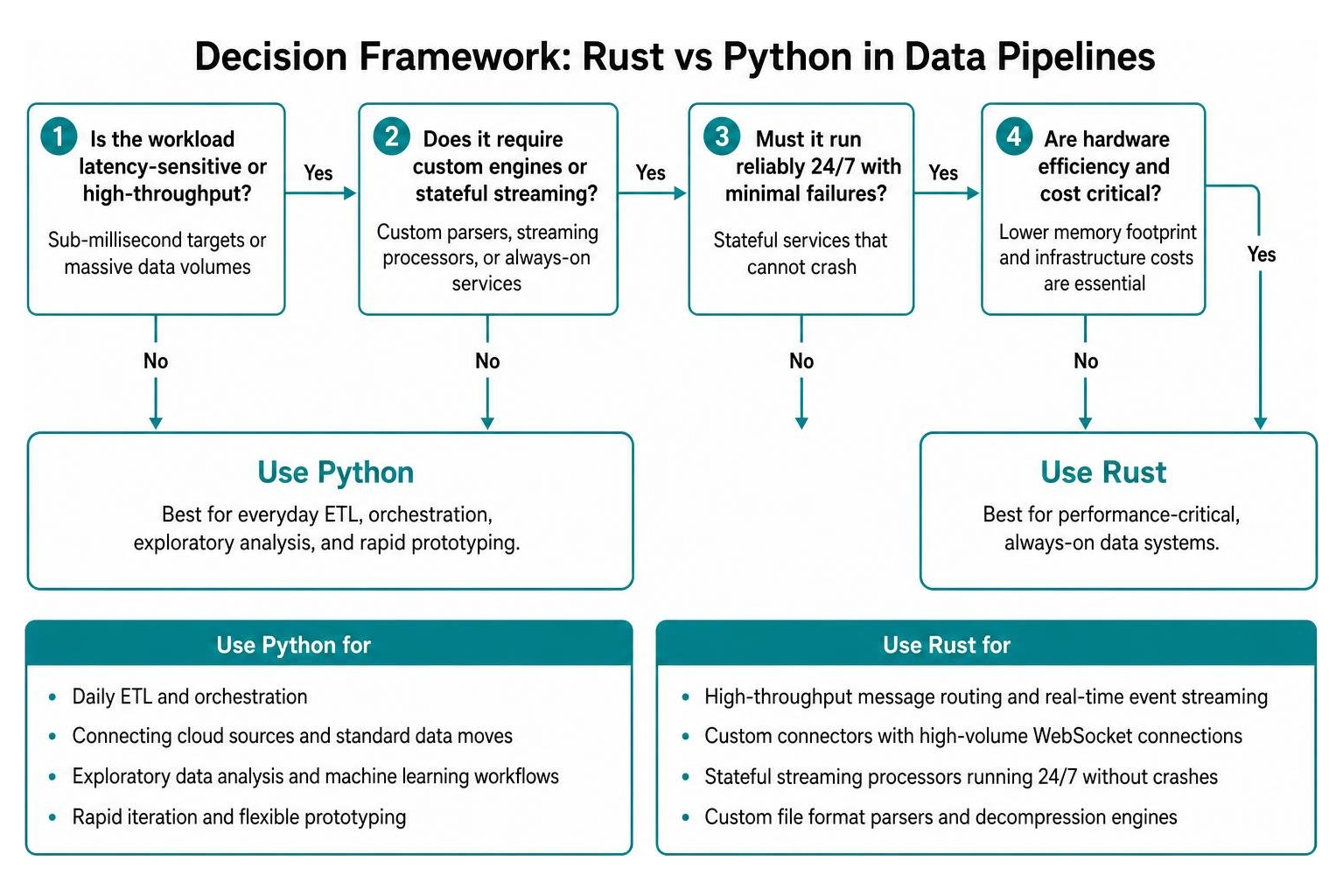
Reserve pure Rust systems for:
- High-throughput message routing and real-time event streaming.
- Custom connectors dealing with high-volume WebSocket connections.
- Stateful streaming processors running round-the-clock without crashes.
- Custom file format parsers and decompression engines.
- Native compute components within modern backend architecture.
For standard business logic that changes weekly, Python combined with high-performance engines remains the pragmatic choice.
Practical Hybrid Architectures: Rust Core with Python APIs
The most productive modern data engineering pattern does not force an all-or-nothing choice. Instead, teams adopt a hybrid approach: build the high-performance core engine in Rust, and expose a clean, user-friendly Python API using PyO3 and Maturin.
By leveraging pyo3 and the maturin build system, data engineers can package compute-intensive Rust crates into standard Python wheels. Downstream data analysts and analytics engineers can simply run pip install your-custom-engine and call high-speed functions directly inside standard Jupyter notebooks or Airflow tasks without ever knowing Rust is running under the hood.
This approach gives organizations the best of both worlds: bare-metal execution speed for heavy data manipulation and rapid, flexible scripting for workflow orchestration.
Remote Work Dynamics, Salaries, and Production Workflows
Because remote Rust data engineering sits at the crossroads of systems programming, cloud architecture, and data platforms, compensation reflects the high barrier to entry.
In the global remote market, senior-level base salaries typically range from $150,000 to $250,000+, with Staff and Principal positions at AI platform companies reaching $200,000 to $300,000 plus equity. Contract and international rates frequently range between $6,000 to $9,000+ per month for seasoned infrastructure contributors. You can analyze full market distributions in our 2026 developer compensation trends.
Working remotely on high-throughput Rust systems requires disciplined asynchronous engineering practices. Because Rust projects involve strict compile-time invariants and detailed architectural designs, teams thrive in documentation-heavy, low-meeting environments. Distributed teams coordinate via asynchronous pull request reviews, detailed Request for Comments (RFC) design docs, and continuous integration pipelines. For deeper insights into high-functioning remote workflows, review our guide on async-first team practices.
Transitioning to Rust Remote Data Engineering from Python
If you are a Python data engineer looking to add Rust to your skill set, avoid getting bogged down in abstract systems theory. Focus on hands-on, task-driven implementation:
- Start with Serialization and Parsing: Replace a slow Python script that parses complex JSON or malformed CSV files with a Rust CLI tool using the
serde,serde_json, andcsvcrates. - Master Memory Ownership through Data Frames: Work with the
polarsandarrowcrates in Rust. Constructing DataFrames in native Rust will teach you how memory layout, borrowing, and chunked arrays operate under the hood. - Build Asynchronous Ingestion Services: Use
tokio,reqwest, andaxumto create a lightweight microservice that consumes public market data or streaming telemetry, transforms the records, and writes them to local Parquet files. - Publish a Hybrid Python Package: Write a performance-critical data transformation function in Rust, wrap it using
pyo3, compile it withmaturin, and call it from a Python script.
Demonstrating real-world projects that solve concrete data bottlenecks is the single most effective way to stand out to hiring managers. You can follow our actionable steps on building a technical engineering portfolio to showcase these systems effectively.
AI-Assisted Workflows and Agentic Data Engineering
The development velocity equation for Rust has changed dramatically with modern AI programming tools like Cursor and Claude. Historically, Rust’s strict compiler created a steep ramp for beginners who spent hours debugging complex borrow checker errors and lifetime mismatches.
Today, AI-assisted development platforms excel at interpreting Rust’s detailed compiler diagnostics. When the rustc compiler flags an ownership conflict or missing trait implementation, AI coding agents can instantly pinpoint the issue, suggest correct lifetime annotations, or rewrite code to leverage appropriate smart pointers like Arc and Mutex.
This synergy allows engineers to write safe systems code at speeds approaching interpreted languages, accelerating the deployment of self-healing data pipelines and distributed connectors. You can discover how modern engineering teams structure these workflows in our deep dive on AI coding infrastructure.
Frequently Asked Questions about Rust in Data Engineering
Will Rust replace Python for day-to-day data engineering?
No. Python will remain the primary language for general data engineering, analytics orchestration, and ETL scripts for the foreseeable future. Python’s concise syntax, vast collection of database drivers, and interactive notebook ecosystem make it the optimal glue language for business logic. Rust will continue to expand its footprint as the engine room beneath Python libraries, powering query engines, data parsers, and stream processors.
How steep is the learning curve for Python data engineers moving to Rust?
The learning curve is significant primarily because Python abstracts away memory management, pointers, and CPU-level execution models. Moving to Rust requires understanding heap versus stack allocation, explicit variable ownership, borrowing semantics, and static typing. However, using task-focused data projects and pairing with modern AI coding assistants significantly flattens the learning curve.
What types of companies hire remote data engineers writing Rust?
Remote Rust data engineers are typically hired by:
- AI and Machine Learning Platforms: Building low-latency feature stores, agent vector caches, and real-time telemetry parsers.
- Quantitative Finance and Web3 Trading Firms: Constructing high-frequency market data connectors, order-book normalizers, and algorithmic execution infrastructure.
- Database and Data Lakehouse Vendors: Developing query optimization engines, storage format readers, and analytical backends.
- Observability and Cloud Infrastructure Providers: Ingesting and analyzing billions of distributed logs, traces, and metrics per second.
Conclusion
Remote data engineering in Rust represents one of the most intellectually rewarding and lucrative career paths in modern software engineering. It bridges the gap between low-level systems programming and high-level analytical platforms. Rather than viewing Rust as a competitor to Python, successful data engineers treat it as a superpower: they leverage Python for rapid exploration and pipeline glue, while deploying Rust to build robust, blazing-fast, and memory-safe infrastructure that never crashes at 3 AM.
If you are ready to explore your next high-impact career move in modern infrastructure, browse remote Rust developer jobs on RemoteVibeCodingJobs to find curated roles at async-first companies building the future of data systems.