Most In-Demand Specialist Stacks for Tech Stack Remote Coders
When selecting a technology stack for remote work in 2026, understanding market data is essential. Distributed teams heavily favor mature ecosystems with strong tooling, automated testing suites, and straightforward CI/CD deployment pipelines.
While enterprise on-premise environments sometimes rely on legacy setups, remote-first companies prioritize tools that enable quick iteration and rapid feature delivery.
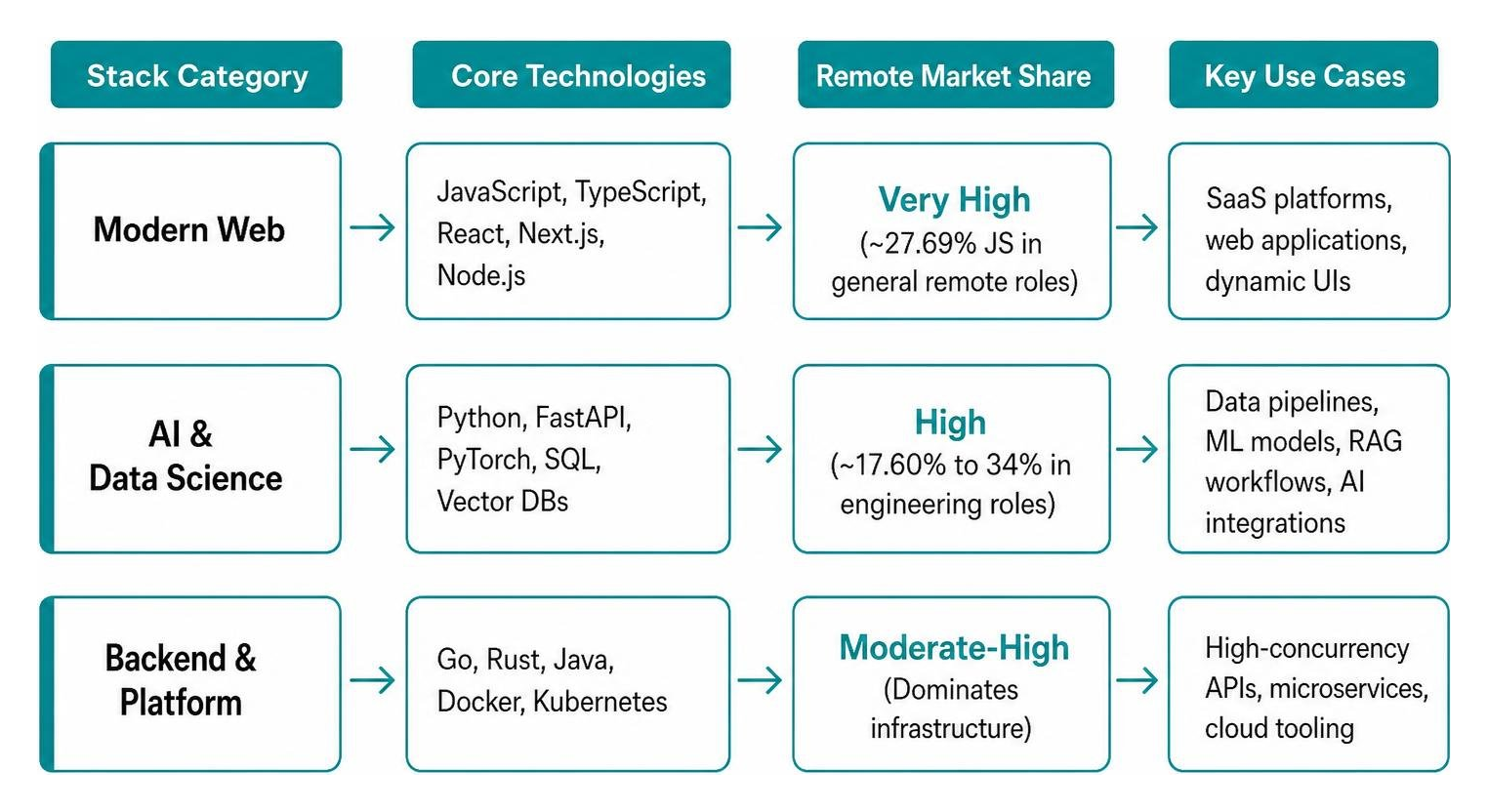
| Stack Category | Core Technologies | Remote Market Share | Key Use Cases |
|---|---|---|---|
| Modern Web | JavaScript, TypeScript, React, Next.js, Node.js | Very High (~27.69% JS in general remote roles) | SaaS platforms, web applications, dynamic UIs |
| AI & Data Science | Python, FastAPI, PyTorch, SQL, Vector DBs | High (~17.60% to 34% in engineering roles) | Data pipelines, ML models, RAG workflows, AI integrations |
| Backend & Platform | Go, Rust, Java, Docker, Kubernetes | Moderate-High (Dominates infrastructure) | High-concurrency APIs, microservices, cloud tooling |
| Legacy & Niche | Ruby on Rails, PHP, Elixir, Scala | Specialized (Rails ~13.83% in remote posts) | Startup MVPs, high-margin maintainer contracts |
Understanding the demand distribution across these distinct stack categories enables tech stack remote coders to target open positions effectively.
The Full-Stack TypeScript Ecosystem
JavaScript and TypeScript dominate remote software engineering postings. JavaScript appears in approximately 27.69% of all remote job listings and is actively used by over 60% of developers worldwide.
The modern standard for web product engineering centers on end-to-end TypeScript. A standard full-stack setup includes:
- Frontend: React (found in roughly 10.46% of remote listings) alongside frameworks like Next.js for server-side rendering, static site generation, and optimized SEO.
- Styling: Tailwind CSS for utility-first styling and component consistency.
- Backend API: Node.js with Express, Hono, or tRPC to enforce type safety from database to browser.
- Database & ORM: Relational databases like PostgreSQL managed via modern ORMs like Prisma or Drizzle.
TypeScript provides strict compile-time checks, reducing entire classes of runtime errors across distributed engineering teams. Developers seeking stable remote job volume can explore curated Remote TypeScript Jobs to see real-world skill expectations.
Python, AI Engineering, and Data Stacks
Python is the fastest-growing technology segment for remote developers. It appears in roughly 17.60% of broad remote listings, over 22% of specialized tech postings, and up to 34% of data-focused engineering roles.
The rise of artificial intelligence has converted Python from an internal scripting language into a core backend driver. Remote AI product engineers utilize Python to build context-aware applications, custom RAG (Retrieval-Augmented Generation) architectures, and agentic workflows.
Key components of the modern Python stack include:
- Web Frameworks: FastAPI (preferred over Django for asynchronous microservices due to automatic OpenAPI generation and higher performance) or Flask.
- Data & Storage: PostgreSQL, Redis for caching, and vector databases like Pinecone, Qdrant, or
pgvectorfor embedding searches. - AI Tooling: LangChain, LlamaIndex, PyTorch, and direct SDK integrations with OpenAI, Anthropic, and open-source Hugging Face models.
Companies hiring for these roles prioritize candidates who can construct deterministic data validation pipelines around non-deterministic LLM outputs.
High-Performance Backend Stacks: Go, Rust, and Enterprise Java
For system infrastructure, cloud tooling, and high-concurrency workloads, compiled backend languages offer strong remote employment prospects.
- Go (Golang): Standard language for cloud-native infrastructure, DevOps automation, and microservices. Used extensively by companies building containerized services, Kubernetes extensions, and network platforms.
- Rust: Rapidly growing choice for high-performance systems, memory-safe infrastructure components, and WebAssembly tooling. While absolute job numbers are lower than JavaScript, remote willingness among Rust-using companies is exceptionally high due to specialized talent distribution.
- Java & C# (.NET): Dominant across enterprise systems. Java and .NET maintain steady remote volume within financial services, logistics, and large-scale SaaS companies requiring strict object-oriented patterns and long-term stability.
How To Choose and Master Your Specialist Tech Stack
Choosing a technology stack requires balancing personal experience against market demand. A common mistake candidates make is positioning themselves as generic multi-language coders without clear depth in any single ecosystem.
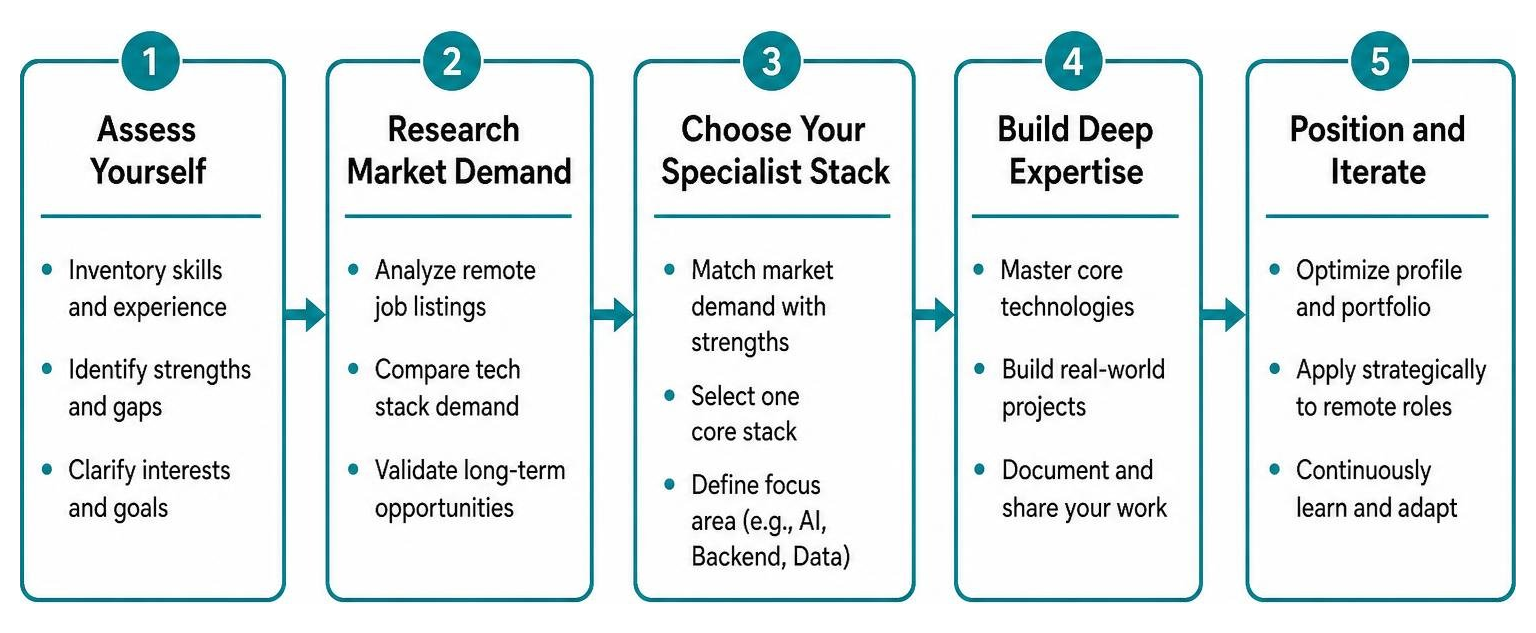
Developers can use our interactive Tech Stack Analyzer Tool to evaluate their existing skills against current remote hiring listings.
Choosing the Right Tech Stack Remote Coders Need for Global Roles
To build an attractive profile for international remote engineering roles:
- Analyze Target Job Descriptions: Review 20 to 30 active remote job postings for your desired role title (e.g., Senior Full-Stack Engineer, AI Product Developer).
- Identify Core Tool Clusters: Note recurring technologies across frontend, backend, database, testing, and deployment layers.
- Select a Specialist Foundation: Pick one primary ecosystem (such as TypeScript/Next.js or Python/FastAPI) and build deep technical competence.
- Study Production Agent Patterns: Understand how modern engineering teams structure full-stack repositories. You can review reference open-source standards such as this cli-tool Agent Spec to see how production-ready full-stack roles structure agentic responsibilities.
The 80% Skill Overlap Strategy and Categorization
Hiring managers dedicate between 1 and 5 minutes to initial resume and portfolio screening. If your profile appears fragmented, readers may skip to the next applicant.
To maximize your interview callback rate, target positions where your profile has at least an 80% direct skill overlap with the explicit job requirements. Organize your resume skills cleanly into standardized operational categories:
- Languages: TypeScript, JavaScript (ESNext), Python, SQL
- Frameworks & Libraries: Next.js, React, Node.js, FastAPI, Tailwind CSS
- Data Layer & ORMs: PostgreSQL, Redis, Drizzle ORM, Prisma, Vector Search
- Testing & Quality Assurance: Jest, React Testing Library, Playwright, Cypress
- Infrastructure & Deployment: Docker, Vercel, AWS (S3, Lambda), GitHub Actions CI/CD
- Development Tooling: Git, Prettier, ESLint, Cursor, Claude Code
Categorizing your stack this way allows engineering managers to verify technical compatibility immediately.
Portfolio Strategy and Remote Technical Interview Prep
For remote positions, abstract claims on a resume hold less weight than verified production code. Because remote teams rely on asynchronous trust, your portfolio must prove you can build, test, and ship complete features independently.
Portfolio Pitfalls That Stop Tech Stack Remote Coders From Getting Hired
Many qualified developers fail to land remote interviews due to basic presentation flaws in their portfolio projects:
- Un-deployed Repositories: Remote hiring teams rarely clone and run repositories locally. Every portfolio project must have a working live deployment URL hosted on platforms like Vercel, Netlify, or AWS.
- Missing or Incomplete README Files: A production repository requires a clear
README.mddetailing system architecture, tech stack decisions, environment configuration, setup instructions, and trade-offs. - Zero Test Coverage: Professional remote teams rely on automated testing to prevent code regressions. Projects missing unit tests (Jest) or end-to-end tests (Playwright/Cypress) send a signal that code quality may be secondary.
- Overengineering Simple Concepts: Building microservice architectures with complex queue brokers for a basic contact form raises concerns about practical decision-making. Focus on clean code, domain logic, and responsiveness.
How Async and AI-Native Remote Interviews Work
Remote technical evaluations have evolved past simple algorithmic whiteboarding quizzes. Today’s remote interviews mirror daily production tasks through:
- Async Take-Home Assignments: Building a small, working feature within a 48-hour window. Evaluators score candidates on clean architecture, comprehensive README explanations, boundary handling, and test coverage.
- Pair-Programming & Live Code Reviews: Working alongside an engineer to refactor legacy code, add an endpoint, or debug an existing application. Candidates are expected to speak through their architectural decisions out loud.
- System Design & Architecture: Designing scalable distributed systems (e.g., rate-limiters, notification engines, streaming pipelines) with an emphasis on data models, caching strategies, and security.
- AI-Assisted Workflow Evaluation: Employers increasingly assess how effectively candidates leverage modern AI tooling like Cursor, GitHub Copilot, or Claude Code to solve complex tasks quickly while auditing the output for correctness. You can read our detailed breakdown on Cursor vs Copilot Comparison to understand how these tools differ in production settings.
The Shift to AI-Assisted “Vibe Coding” Tools in Modern Stacks
The concept of “vibe coding”—using natural language prompts paired with AI developer environments like Cursor, Claude Code, Windsurf, Lovable, and v0—has shifted software development practices.
Instead of writing repetitive boilerplate syntax by hand, modern developers guide AI models using structured project context files like SKILL.md and ARCHITECTURE.md.

This evolution does not remove the need for engineering fundamentals. Rather, it increases the importance of architectural design, system safety, database design, and code auditing skills:
- Accelerated Velocity: Engineering teams using AI-native workflows report feature delivery speed increases of 3x to 10x over traditional workflows.
- Shift to Product Ownership: Developers can focus on high-level domain mechanics, edge cases, and user experience rather than configuration setup.
- Expanding Developer Toolkits: Modern coders evaluate specialized tools to maximize efficiency. To explore the top AI development setups, review our guides on Vibe Coding Tools: AI-Powered Arsenal, discover alternatives in Best Cursor Alternatives for Remote Developers in 2026, and browse services detailed in the Vibe Coder Toolkit and Services.
Frequently Asked Questions About Tech Stacks for Remote Roles
What is the most demanded programming language for remote coders?
JavaScript remains the most requested language in remote development, appearing in over 27% of general remote software engineering job postings and used by more than 60% of developers globally. TypeScript extends JavaScript across modern full-stack workflows.
Python follows closely, driven by artificial intelligence, data pipelines, backend APIs, and automation roles.
Should remote developers be generalists or stack specialists?
Specializing in a defined stack (such as modern TypeScript/Next.js or Python/FastAPI) yields better hiring results for early- to mid-career remote developers than being a broad generalist.
Remote employers hire to fill specific project needs. Demonstrating deep competence and live portfolio projects in an exact technology stack reduces employer hiring risk.
Once hired, senior engineers naturally expand their scope into polyglot system architecture.
How do AI coding tools impact technical interviews for remote developers?
Modern remote technical interviews place less weight on memorized syntax and greater focus on system architecture, problem decomposition, code review, and output verification.
Many remote-first employers encourage using AI tools like Cursor or Copilot during live pair-programming sessions to observe how candidates validate edge cases, manage context windows, and refactor AI-generated code safely.
Conclusion
Succeeding as a tech stack remote coder requires aligning your technical toolset with current hiring market realities.
Whether you focus on modern full-stack TypeScript, scalable Python AI infrastructure, or high-performance Go microservices, concentrate on building clean applications, maintaining clear code documentation, and publishing live, test-backed deployments.
At RemoteVibeCodingJobs, we aggregate remote engineering roles built around modern stack expectations, async culture, and AI-assisted developer workflows.
Ready to position your engineering skills for high-velocity remote teams? Learn how AI-first workflows are redefining development careers by exploring our guide to Discover AI-First Roles at Vibe Coding Jobs.