
The Best Sites for AI Coding Jobs Remote
Remote AI Coding Jobs Are Growing Fast — Here’s Where to Find Them in 2026
AI coding jobs remote are one of the fastest-growing categories in tech hiring right now. If you want the short answer on where to find them, here it is:
Best sites for remote AI coding jobs in 2026:
| Platform | Best For | Pay Range |
|---|---|---|
| vibecoding.work | AI-native & vibe coding roles | $60k–$230k/yr |
| GitLab Careers | Fullstack AI engineering | $112k–$180k/yr |
| Turing | LLM evaluation contracts | $50–$150/hr |
| Stellar AI | Data annotation & AI training | $25/hr base |
| RWS TrainAI | Entry-level AI data tasks | Per task |
| xAI Careers | Model training & ML infra | Competitive |
| Coder | AI developer tooling (US/CA) | Not listed |
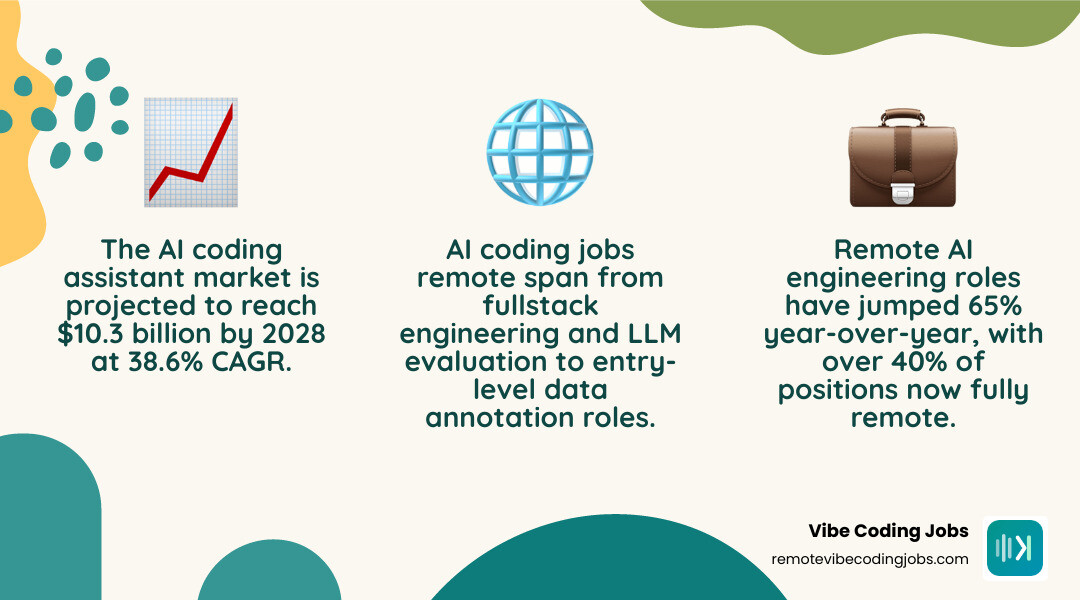
The market behind these roles is enormous and still expanding. The AI coding assistant market is projected to hit $10.3 billion by 2028, growing at a 38.6% CAGR according to industry reports. Remote AI engineering roles specifically have jumped 65% year-over-year, with over 40% of all AI developer positions now fully remote.
This isn’t a niche anymore. It’s where software development is heading.
Whether you’re a senior fullstack engineer wanting to build AI-powered developer tools, or a domain expert looking to train and evaluate large language models on the side — there are real, paying opportunities out there right now.
I’m RVCJ Editorial, the team behind Remote Vibe Coding Jobs — we cover the async-first, AI-native hiring landscape and have curated hundreds of AI coding jobs remote across every experience level and tech stack. Read on for the full breakdown of where to apply and what to expect.
Top Platforms and Companies for AI Coding Jobs Remote
In 2026, the landscape for ai coding jobs remote has branched into three distinct territories: the nimble AI-first startups, the massive enterprise leaders, and the specialized research labs. Each offers a different flavor of remote work, from high-intensity model training to “vibe coding” roles that focus on rapid prototyping with AI assistants.
If you are looking for a comprehensive Remote AI Developer Job Description, you’ll find that these roles are no longer just about writing code; they are about orchestrating AI agents to do the heavy lifting.
AI-First Startups and Job Boards
Startups are currently the most aggressive recruiters for “vibe coders”—developers who use tools like Cursor and Claude to build at 10x speed. These companies usually operate with an async-first culture, meaning they don’t care when you work, as long as the product moves forward.
For those hunting for the latest openings, we recommend checking curated boards. You can find a list of current opportunities at Remote AI Developer Jobs Boards Openings and explore broader AI Coding Jobs Remote Opportunities that cater to both full-time and contract seekers.
Enterprise Tech Leaders
Companies like GitLab and Coder are leading the charge in building the infrastructure that other developers use. These aren’t just companies using AI; they are companies building the AI-powered DevSecOps platforms of the future.
- GitLab: Known for its “all-remote” philosophy, GitLab hires engineers to build tools like GitLab Duo. They focus heavily on integrating AI into the daily developer workflow across IDEs and terminals.
- Coder: This team focuses on self-hosted cloud development environments. They look for engineers to build secure workspaces where autonomous coding agents can operate safely.
Specialized AI Research Labs
If you want to be at the bleeding edge, labs like xAI are looking for specialists in high-speed interconnect ML infrastructure and model training. These roles are often more academic and technical, focusing on the “how” of the AI itself rather than just the application of it.
Engineering the Future of AI Coding Jobs Remote
The technical requirements for ai coding jobs remote have shifted. While the “vibe coding” movement allows for more rapid development, the underlying engineering needs to be more robust than ever.
To land these roles, you often need a mix of traditional and modern skills:
- Languages: TypeScript and Python remain king, but Go is essential for distributed systems (like those at Coder), and Kotlin is becoming a requirement for those building JetBrains IDE plugins (like at GitLab).
- Protocols: Understanding the Language Server Protocol (LSP) is a massive advantage. It’s the “secret sauce” that allows AI tools to work consistently across different code editors.
- Frameworks: Proficiency with Vue 3, Tailwind, and Node.js is standard for the “Fullstack AI” roles that dominate the current market.
For a deeper dive into the specific qualifications companies are looking for, check out our guide on Remote AI Developer Jobs Requirements.
Data Annotation and AI Training Roles
Not every ai coding jobs remote position requires you to build a full application. A massive portion of the market is dedicated to “Human-in-the-Loop” (HITL) work. This involves training Large Language Models (LLMs) to be better at coding.
- LLM Evaluation: Companies like Turing hire senior engineers to review AI-generated code. You might rank 30 different AI responses for correctness, readability, and performance. It’s essentially “code review as a service” to help the models learn.
- Data Labeling & Prompt Engineering: Platforms like Stellar AI and RWS TrainAI offer flexible, project-based work. You might create prompts for general AI agents or convert GitHub Pull Requests into training tasks for coding models.
- RLHF (Reinforcement Learning from Human Feedback): This is where you help the AI understand “why” a piece of code is good or bad. It requires high-level reasoning and the ability to explain complex technical decisions clearly.
Many of these roles are great for those looking for AI Coding Jobs Entry Level Remote Growth, as they provide a foot in the door to the AI ecosystem without requiring five years of machine learning experience.
Compensation and Flexibility in Remote AI Engineering
One of the biggest draws of ai coding jobs remote is the pay. Because the demand for AI expertise is currently outstripping the supply, companies are willing to pay a premium.
Pay Scales for 2026
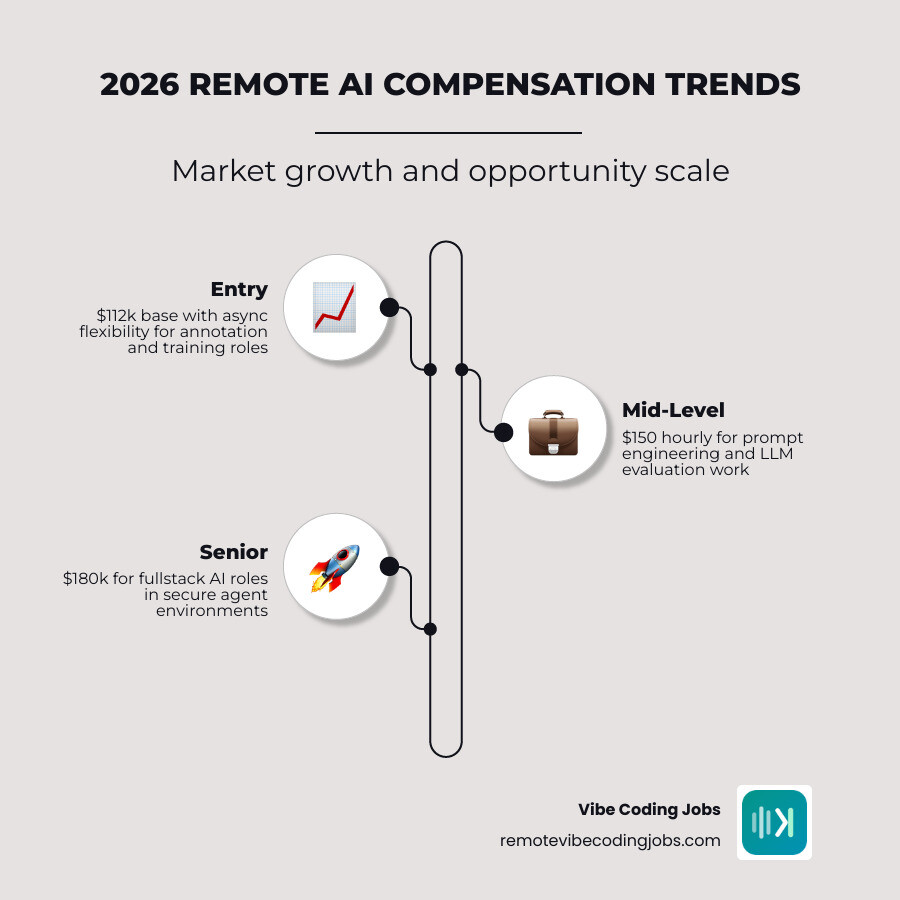
Compensation varies wildly based on whether you are a full-time employee or a specialized contractor. Here is what we are seeing in the market today:
| Role Type | Compensation Structure | Typical Range |
|---|---|---|
| Senior AI Engineer (Full-time) | Annual Salary + Equity | $112,000 – $180,000+ |
| LLM Training Specialist (Contract) | Hourly Rate | $50 – $150 per hour |
| Data Annotator / AI Trainer | Project-based or Hourly | $25 – $90 per hour |
| Junior Agentic Engineer | Annual Salary | $60,000 – $80,000 |
The Flexibility Factor
Beyond the paycheck, the AI Coding Jobs Future Remote Benefits are significant. Most of these companies are “async-first.” This means:
- No “Core Hours”: You can code when your brain is most active, whether that’s 2 AM or 10 AM.
- Location Independence: Many companies hire globally, though some (like Coder) may have specific requirements for being based in the US or Canada for security reasons.
- Contract Choice: You can choose between high-stakes full-time roles or flexible “open-ended contracts” where you work as much or as little as you want.
Application and Onboarding for AI Coding Jobs Remote
Applying for ai coding jobs remote is a bit different from your standard software engineering application. Because these roles are often AI-assisted, the interview process has evolved to match.

The New Interview Stack
When you apply for a role through a platform like Stellar AI or GitLab, expect a multi-stage process:
- Skill-Match Tests: These are often automated assessments that check your ability to debug code or evaluate model responses.
- AI-Assisted Take-Homes: Some companies, like Coder, actually allow you to use AI tools for your take-home assessments, provided you disclose it. They want to see how you collaborate with the AI, not just if you can memorize syntax.
- The “Human” Interview: While you might use AI to build the project, conversational interviews are still human-led. Companies want to see your reasoning and cultural fit.
For a step-by-step breakdown of how to prepare your portfolio, read our article on Remote AI Developer Jobs AI Tools Description Qualifications Application.
Navigating the Interview for AI Coding Jobs Remote
To stand out in a sea of applicants, you need to demonstrate that you are an “AI-native” developer. This means more than just having a ChatGPT tab open.
Best Practices for AI Interviews:
- Be Transparent: If you used an AI agent to help architect a solution, explain why you chose that prompt and how you verified the output.
- Focus on Design: When AI can write the boilerplate, your value lies in system design and identifying edge cases.
- Async Communication: Since these roles are remote, your ability to write clear, concise documentation is just as important as your ability to code. Show off your “written-first” mentality.
- Portfolio Reviews: Include links to GitHub repos where you’ve used AI to build something complex. Show the “diffs” where you had to intervene and fix an AI’s mistake.
Future Trends in AI-Assisted Development
As we move further into 2026, the concept of “coding” is being replaced by “vibe coding” and “agentic engineering.” This isn’t just a change in terminology; it’s a fundamental shift in the job market.
Vibe Coding and Agentic Engineering
“Vibe coding” refers to the high-level orchestration of software. Instead of writing every line, you set the “vibe” or the direction, and the AI (like Claude or Cursor) handles the implementation. “Agentic engineering” takes this a step further, where you manage a fleet of AI agents that can browse the web, fix bugs, and deploy code autonomously.
Tools to Master
If you want to stay relevant in the ai coding jobs remote market, you need to be proficient in:
- Cursor: The current gold standard for AI-integrated IDEs.
- Claude Code: Advanced reasoning for complex refactoring.
- GitHub Copilot / Windsurf: Essential for enterprise-level collaboration.
We expect to see a surge in AI Coding Jobs Future Trends Entry Level positions that focus specifically on managing these agents. The developer of the future looks more like a Product Manager who can also read code.
Frequently Asked Questions about AI Coding Jobs
What are the typical pay ranges for remote AI coding roles in 2026?
As of May 2026, full-time remote AI engineers typically earn between $112,000 and $180,000 per year. Specialized contract roles for LLM evaluation pay between $50 and $150 per hour, depending on your expertise and the complexity of the domain (e.g., medical or financial AI training pays more).
Do I need a PhD to work in remote AI engineering?
Absolutely not. While about 70% of high-level AI trainers hold advanced degrees, the majority of ai coding jobs remote focus on engineering and application. If you can build robust software using AI tools and understand the fundamentals of LLMs, you are qualified for most roles.
How flexible are the hours for AI data annotation and training jobs?
Extremely flexible. Platforms like Stellar AI and RWS TrainAI offer “open-ended contracts” with no fixed schedule. You can work while traveling, during your child’s nap time, or as a side hustle to your main job. Most projects only require a reliable internet connection and a high-speed browser.
Conclusion
The era of the “manual coder” is transitioning into the era of the “AI-native developer.” Whether you are looking for a high-paying staff engineer role at a company like GitLab or a flexible freelance gig training the next generation of LLMs at Turing, the opportunities for ai coding jobs remote have never been more accessible.
At Remote Vibe Coding Jobs, we believe the future of work is asynchronous, AI-assisted, and location-independent. Don’t get left behind in the old way of building software. Start mastering the tools of the “vibe coding” movement today.