
Why AI Tools Culture Remote Teams Can’t Afford to Ignore
The fastest way to kill a remote team’s culture is to ignore it — and right now, most companies are doing exactly that while rushing to adopt AI.
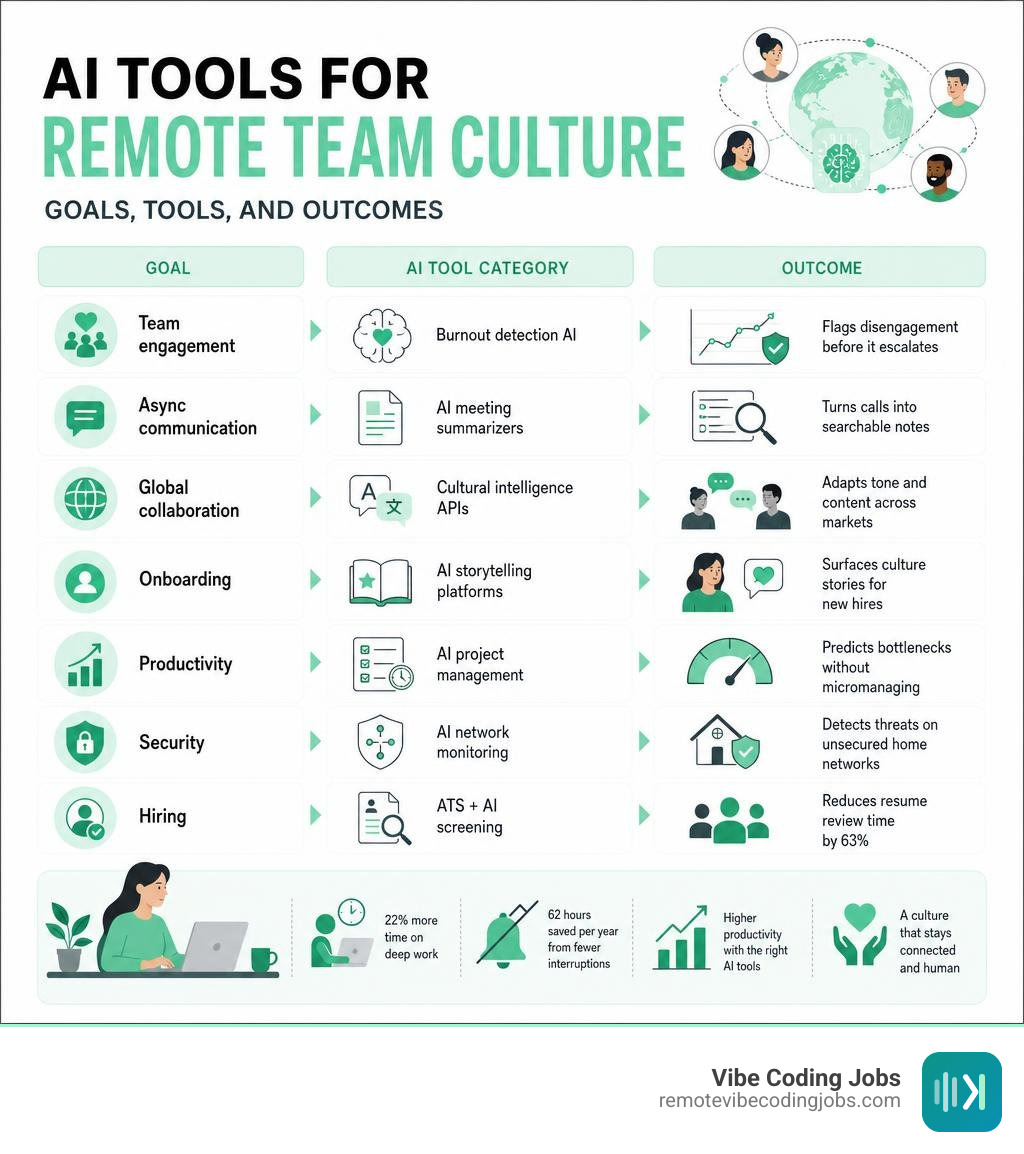
Here are the best AI tools helping remote teams stay connected, productive, and human:
| Goal | AI Tool Category | What It Does |
|---|---|---|
| Team engagement | Burnout detection AI | Flags disengagement before it escalates |
| Async communication | AI meeting summarizers | Turns calls into searchable notes |
| Global collaboration | Cultural intelligence APIs | Adapts tone and content across markets |
| Onboarding | AI storytelling platforms | Surfaces culture stories for new hires |
| Productivity | AI project management | Predicts bottlenecks without micromanaging |
| Security | AI network monitoring | Detects threats on unsecured home networks |
| Hiring | ATS + AI screening | Reduces resume review time by 63% |
The stakes are real. Remote workers already use more AI in their day-to-day work than their in-office peers — which means they’re also more exposed to automation risk. Research shows that remote job postings in AI-susceptible roles like coding and routine writing dropped roughly 19% after ChatGPT launched in late 2022. At the same time, companies that built strong remote infrastructure during COVID-19 are now adopting generative AI faster than competitors — and leaning on new remote hires less.
That’s a paradox worth paying attention to: the same tools that make remote work better are quietly shrinking the pool of remote jobs available.
But here’s the flip side. Remote teams that get AI right don’t just survive — they thrive. Remote workers already spend 22% more time on deep work than office-based colleagues, and remote teams save nearly 62 hours per year from fewer interruptions. Add the right AI tools into that environment, and you get a compounding productivity and culture advantage that’s hard to beat.
The challenge is knowing which AI tools actually strengthen your remote culture — and which ones hollow it out.
I’m the RVCJ Editorial team at Remote Vibe Coding Jobs, and we cover the intersection of AI tools, culture, and remote work daily — from burnout-detection platforms to vibe coding workflows and async-first hiring trends. We’ve tracked hundreds of remote AI-native companies and the tools they use to keep distributed teams aligned, and we’ll walk you through exactly what’s working right now.
Ai tools culture remote terms simplified:
- What are the best daily-updated job boards for remote developers who prefer working with LLMs?
- claude ai vibe dev
The Evolution of AI Tools Culture Remote and Team Dynamics
The rapid integration of artificial intelligence is fundamentally rewriting the playbook for distributed teams. We are no longer just using technology to bridge the physical distance between home offices; we are climbing an “organizational technology ladder” where early investments in remote work infrastructure make it significantly easier to deploy generative AI.
However, this transition introduces serious questions about job security and role evolution. According to the UCLA Anderson Review, early remote adopters are utilizing AI to automate routine tasks faster than in-office organizations, which has led to a decline in traditional remote postings. If a job can be done entirely from a computer without physical presence, it is highly susceptible to AI augmentation or direct automation. You can read more about this shift in the study Your Remote Job May Help AI Replace You.
To prevent this automation shift from hollowing out your team’s spirit, leaders must intentionally design a digital workspace where technology elevates human potential rather than replacing it. Rather than letting culture happen by accident, progressive companies use AI to make culture systematic. This shift is explored in detail in the guide on How to Build a Strong Corporate Culture in Remote Work with AI.
By automating administrative tasks, we give our teams the breathing room to focus on high-impact, creative, and collaborative efforts. For developers, this means transitioning from manual syntax writing to high-level system architecture and “vibe coding.” Keeping up with these changes is essential for maintaining career growth and competitive compensation, as detailed in our analysis of Remote Developer Jobs AI Tools Trends Salary.
Overcoming Cultural Blindspots in Global Teams with AI Tools Culture Remote
When your team spans dozens of countries, communication isn’t just about translating words; it’s about translating context. A simple thumbs-up emoji or an direct piece of feedback can be perfectly normal in one country and highly offensive or demotivating in another.
To bridge these gaps, we are seeing the rise of dedicated cultural intelligence systems designed specifically for distributed workspaces.
- Global Cultural Intelligence Layers: Developers can now integrate cultural context directly into their communication stacks. For example, kultur.dev — The World’s Cultural Intelligence Layer provides specialized APIs and tools like the kultur-dev/mcp-server to connect models like Claude and GPT-4 directly to cultural databases. This prevents teams from making costly communication errors before they happen.
- Contextual Operating Systems: Platforms like Cultural Context AI model for any interface allow organizations to decode local idioms, humor, and taboos in real time, ensuring that internal messaging resonates with every demographic.
- Cultural Intelligence Platforms: Tools like kontenta | Cultural Intelligence Platform analyze platform signals to help creative and brand teams produce content that feels truly native to every market.
- Real-Time Negotiation & Communication Coaching: For client-facing remote teams, platforms like AI Negotiation Coach for International Sales VPs | GoKulturely map team profiles across Hofstede’s cultural dimensions to run simulated negotiations, helping global teams close deals without hitting cultural roadblocks.

Balancing AI Tools Culture Remote with Authentic Human Connection
While AI-driven translation and context tools keep us from stepping on cultural toes, they cannot replace authentic human connection. If every message, Slack post, and email is perfectly polished by an LLM, our communication risks becoming sterile and synthetic.
To maintain a healthy workspace, we must use AI to facilitate—not replace—genuine human storytelling.
A great example of this balance is CultureHQ — The most intelligent storytelling engine ever built. Instead of generating fake corporate updates, CultureHQ uses smart AI prompts to collect real, unscripted video stories from employees, automatically editing out filler words and formatting them for internal channels and careers pages. This allows remote workers to share their authentic experiences, which is a hallmark of the Amazing Remote Developer Culture Top Companies in 2024.
Boosting Productivity and Well-Being Without Micromanagement
One of the greatest dangers of remote leadership is the temptation to micromanage. When managers can’t see their employees, they often resort to invasive tracking software that monitors keystrokes and screen activity. This destroys trust and tanks morale.
AI offers a much healthier alternative: predictive productivity and engagement analytics that focus on outcomes and well-being rather than active hours.
| Traditional Micromanagement | AI-Driven Support & Outcome Focus |
|---|---|
| Monitors active keystrokes and mouse movements | Analyzes communication trends to detect burnout risks |
| Demands rigid “green status” on Slack | Encourages asynchronous, flexible schedules |
| Measures success by hours logged at the desk | Focuses on completed sprint goals and code quality |
| Interrupts focus time with frequent status check-ins | Summarizes async updates to protect deep work |
By focusing on trends rather than individual minutes, leaders can protect employee mental health while keeping projects on track. For practical strategies on maximizing output without burning out, check out our guide on Remote Developer Productivity Tips Tools Boost Your Output as well as our general Remote Work Productivity Tips.
Fostering Deep Work and Asynchronous Communication
Remote workers spend 22% more time on deep work than in-office workers, but that focus is incredibly fragile. Constant notifications and unnecessary Zoom meetings break momentum.
AI-powered meeting summarizers and documentation assistants are saving remote cultures by allowing teams to adopt an async-first mindset. Instead of forcing everyone onto a live call across multiple time zones, one developer can run the meeting, and AI can generate structured, searchable action items for the rest of the team.
This approach gives developers the freedom to work when they are most creative and focused. To learn more about how async-first companies structure their workflows, read our breakdown of Async First Remote Developer Jobs Benefits Communication Teamwork.
Protecting this focus time is the foundation of a healthy technical organization. For more on building a culture that respects the flow state, explore Deep Work Culture Developer Jobs Finding Focus Flow. You can also look into how modern firms manage scheduling and async expectations in Async First Remote Developer Jobs Flexible Hours, Async First Remote Developer Jobs Flexible Culture, and Async First Remote Developer Jobs Roles Teams Companies.
AI in Remote Hiring, Onboarding, and Performance Management
Hiring and onboarding in a remote-first company is notoriously difficult. Without face-to-face interviews, recruiters struggle to assess culture fit, and candidates struggle to get a real feel for the team.
Today, both sides of the hiring equation are using AI to streamline this process. On the candidate side, job seekers are leveraging specialized AI tools to optimize their resumes for applicant tracking systems (ATS) and practice technical interviews. If you are currently looking for a new role, you can explore these platforms in the curated list of 15 AI tools that can help you find a remote job in 2025.

For employers, the key is using AI to make the application process more humane, not less. Instead of using generic keyword filters that reject qualified candidates, modern companies use AI to match actual work samples and portfolio projects to open positions. This ensures that qualifications are assessed fairly, as outlined in our guide to Remote Developer Jobs AI Tools Description Qualifications Application.
Mitigating Bias and Securing Data in Remote HR Workflows
While AI tools bring incredible efficiency, they also introduce risks around data privacy, algorithmic bias, and cybersecurity.
If an AI screening tool is trained on historical hiring data from a non-diverse team, it will inevitably replicate those same biases in its recommendations. Furthermore, with remote workers accessing sensitive company data from home networks, security is a major concern—nearly half of all Chief Information Security Officers (CISOs) agree that hybrid and remote work is a primary source of security risk.
To protect both our people and our code, remote-first organizations must implement strict data governance policies, multi-factor authentication, and zero-trust frameworks. Learn more about securing your distributed engineering environment in Remote Developer Jobs AI Tools Security Automation.
Upskilling Remote Workers for Vibe Coding and Agentic Workflows
As AI agents become more capable, the day-to-day role of the software developer is shifting. We are moving away from manual syntax writing and toward “vibe coding”—a workflow where developers use natural language prompts to guide AI tools like Cursor and Claude to write, test, and deploy code.
This shift doesn’t make developers obsolete; it supercharges them. However, it requires a new set of skills: prompt engineering, system architecture, and agentic workflow design.
To help our teams transition, we must invest heavily in upskilling. Understanding this shift in engineering roles is vital for career longevity; you can read about these emerging paths in Remote Developer Jobs AI Tools Roles Careers. If you’re looking to understand the financial return on these training investments, check out Remote Developer Jobs AI Tools Benefits ROI, and explore how these tools improve daily teamwork in Remote Developer Jobs AI Tools Productivity Collaboration.
Frequently Asked Questions About AI and Remote Culture
How do AI tools affect employee engagement in remote teams?
When implemented correctly, AI tools boost engagement by removing repetitive, administrative tasks from an employee’s plate, allowing them to focus on creative and strategic work. AI-driven sentiment analysis can also help managers detect early signs of burnout and disengagement by highlighting communication bottlenecks or sudden drops in collaboration activity before they lead to turnover.
What are the biggest security risks of using AI in remote work?
The primary risks include data leakage (such as employees pasting proprietary source code or sensitive customer data into public LLMs), unsecured home networks being targeted by attackers, and a lack of clear data governance. Remote organizations must use enterprise-grade AI subscriptions that guarantee data privacy and enforce strict zero-trust security policies.
Can AI tools replace the need for human-centric remote culture?
Absolutely not. AI should be viewed as an assistant that enhances human capabilities and handles administrative friction, not as a replacement for empathy, trust, and authentic human connection. The most successful remote cultures use AI to handle the “work about work” so that teammates have more time and energy to build real relationships with one another.
Conclusion
The intersection of AI and remote work is a double-edged sword. If we use these tools purely to cut costs and automate jobs, we risk destroying the trust, diversity, and connection that make remote teams great.
But if we use AI to eliminate administrative friction, bridge global cultural gaps, and protect our deep focus time, we unlock a healthier, more productive way of working.
At Remote Vibe Coding Jobs, we believe the future belongs to developers and teams who embrace this human-machine partnership. We curate daily listings of remote “vibe coding” roles at forward-thinking, async-first companies that value balance, modern tech stacks, and cutting-edge AI workflows.
Ready to find a team that values your flow state and your AI-assisted development skills? Explore open roles today on Remote Vibe Coding Jobs.