
Find Entry-Level Remote Software Engineer Jobs Without Experience
You can qualify for remote software engineer jobs entry level no experience by showing proof that you can build, test, and explain software. Start with junior developer, software engineer I, QA engineer, internship, and associate developer searches. Then apply early with a focused resume, a clean GitHub profile, and one or two deployed projects that match the job’s stack.
Prioritize roles asking for 0-2 years of experience, especially those that accept coursework, bootcamp work, personal projects, research, or internships. SQL, JavaScript, Python, Git, REST APIs, and basic database skills appear often in entry-level listings. For remote teams, clear written communication and comfort with async work matter almost as much as code.
The market is competitive, but it is not closed to beginners. Aggregated remote-job data puts the average entry-level remote engineering salary near $65,500, while real postings range far wider based on location, specialty, and company. AI-assisted workflows are also becoming normal: knowing how to use tools such as Cursor, Claude, or Copilot and verify their output can strengthen your application.
I am Di Su, a software engineer with more than 10 years of experience in web development, scalable products, and growth-focused technical work, including remote-friendly workflows with Svelte and Python. In this guide, I will show how candidates seeking remote software engineer jobs entry level no experience can turn project work into credible evidence for hiring teams.
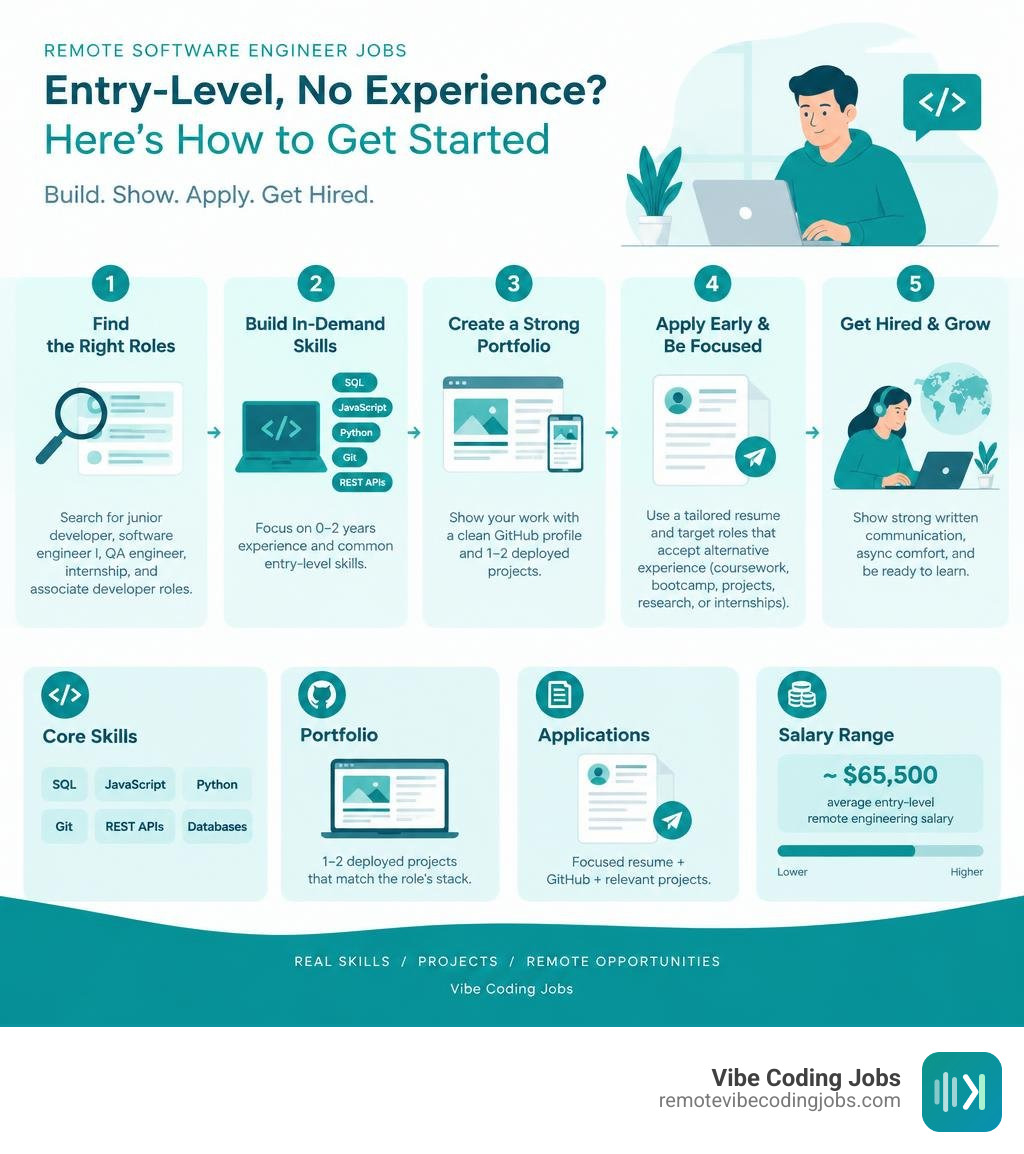
Remote software engineer jobs entry level no experience word guide:
Understanding the Market for Remote Software Engineer Jobs Entry Level No Experience
Breaking into tech without formal corporate credentials can feel daunting, but the market data shows substantial opportunity. Over 11,000 entry-level software engineering openings with zero prior commercial experience listed routinely appear across national job networks in the United States. Furthermore, specialized remote databases track dozens of dedicated work-from-home entry roles each week, with approximately 13% of fresh listings never even appearing on conventional job boards.
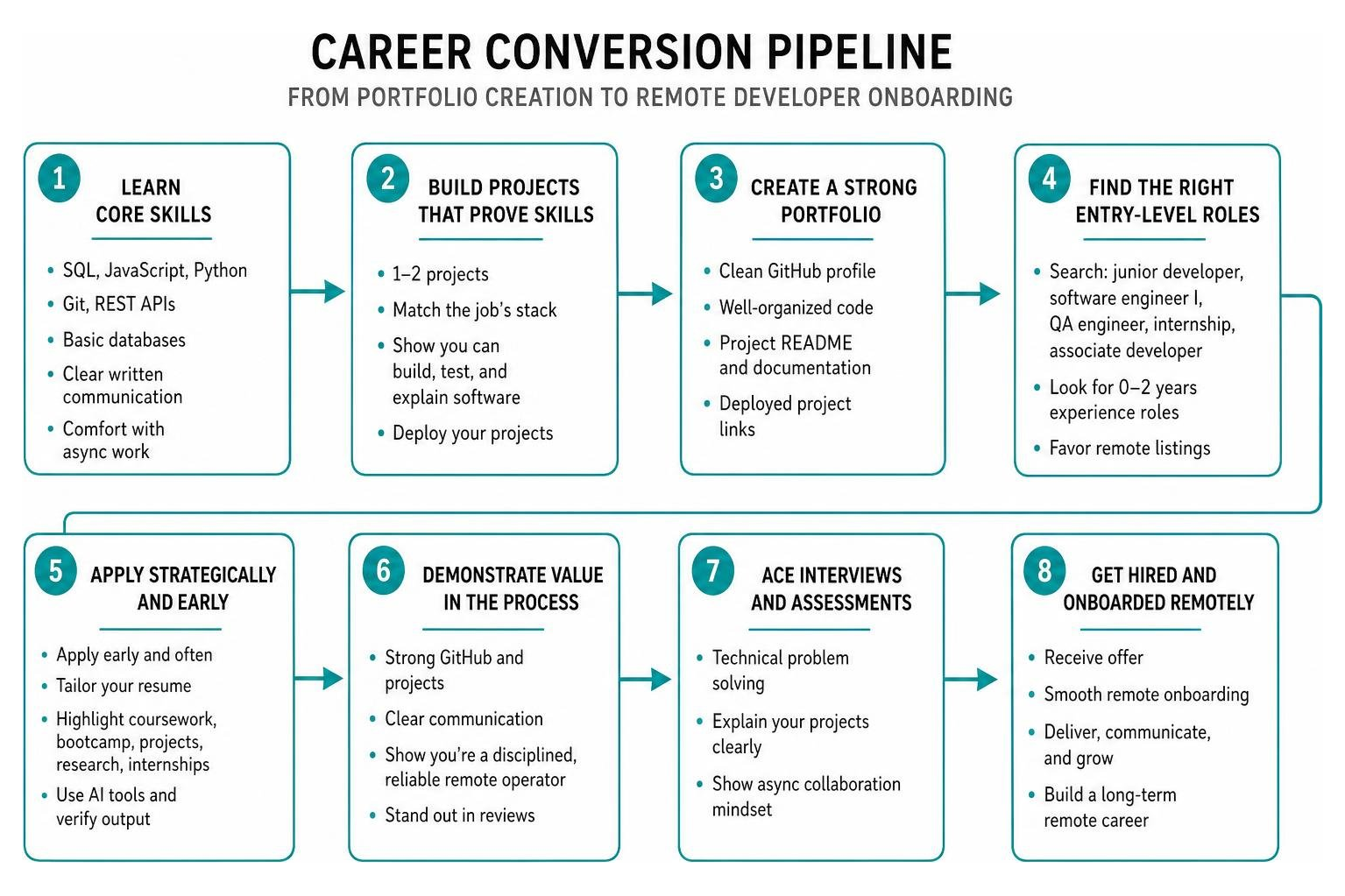
The modern hiring process moves fast once an application enters review. Employers take roughly 43 days on average to close an entry-level software engineer opening. Teams spend significant time filtering through raw applicants to find candidates who understand modern development dynamics. Anyone transitioning to remote software engineering must recognize that companies are not just assessing syntax knowledge—they are looking for disciplined remote operators.
Weighing the remote work pros and cons in 2026 highlights both immense freedom and clear challenges. Working from home spares you the commute and opens access to nationwide salary benchmarks, but it also demands personal accountability, deliberate communication habits, and a self-guided learning mindset from day one.
Where to Find Remote Software Engineer Jobs Entry Level No Experience
Generic platforms often get inundated with thousands of submissions within hours. To get your resume seen, diversify your sourcing strategy across specialized avenues:
- Dedicated Remote Aggregators: Target platforms featuring unlisted and verified positions that monitor non-indexed roles and track hiring velocity.
- Search Filter Mastery: Use targeted boolean searches on major job platforms and explore niche aggregations for flexible entry-level no-experience remote developer opportunities.
- Direct Company Portals: Review specific opportunities such as entry-level software developer roles posted directly by employers and defense contractor roles such as Entry Level Software Engineer | Remote (SBOR-DP7NJ6).
- Async-First Listings: Distributed teams prioritizing documentation over endless meetings share openings aligned with our async-first remote work guide.
Automating alerts with specific filters (“entry level”, “associate”, “0-2 years experience”, “junior”) ensures you submit applications within the first 48 hours of a job going live, dramatically boosting callback rates.
New Grad vs. Entry-Level vs. Junior: Defining the Tiers
Job titles in tech are frequently used interchangeably, but understanding their subtle differences helps you target the right openings:
- New Grad Roles: Designed exclusively for candidates graduating from an accredited university within the past 12 months. These hiring tracks evaluate academic coursework, algorithmic fundamentals, and campus internships.
- Entry-Level Roles: Open to self-taught coders, bootcamp graduates, and degree holders alike. They require demonstrable competence in practical application building rather than formal enterprise tenure.
- Junior Developer Roles: Often look for 0 to 2 years of practical experience. These teams expect you to pick up starter tickets, navigate an established codebase, and ship pull requests during your initial weeks.
- Apprenticeships and Associate Tracks: Paid rotational programs where companies provide structured mentorship, pairing you with senior staff while you contribute to production systems.
Roles, Career Paths, and Salary Benchmarks for Beginner Engineers
Compensation for remote beginners varies significantly based on engineering discipline, tech stack complexity, and team structure.

While the aggregated national average for entry-level remote software engineers sits at $65,576, entry-level compensation packages span across a broad spectrum:
| Job Title / Specialty | Typical Requirements | 2026 Salary Range | Key Focus Areas |
|---|---|---|---|
| Junior Software Developer | HTML/CSS, JS, Python/Node, Git | $56,000 – $95,000 | Feature tickets, UI fixes, API consumption |
| Fullstack Engineer I | React/Vue, Node/Django, SQL | $80,000 – $130,000 | End-to-end features, database modeling |
| Software Quality / QA Engineer | Test scripting, Jira, CI/CD basics | $60,000 – $85,000 | Build verification, automated test suites |
| AI Training & Integration Dev | Python, prompt pipelines, LLM APIs | $70,000 – $115,000 | Model evaluation, AI agent workflows |
| Data Streaming / Cloud Engineer I | SQL, Python, Kafka/Azure/AWS | $90,000 – $114,500 | Pipeline maintenance, cloud deployments |
| Specialized Defense / High-Growth | US Clearance eligible or Go/Rust | $75,000 – $160,000 | Security-critical systems, distributed scale |
You can explore detailed compensation data across our developer salary benchmarks to check specific backend engineer salary ranges before entering salary negotiations.
Common Job Titles for Entry-Level Candidates
When scouring listings, look beyond the standard “Software Engineer” title. Search for these common alternatives:
- Junior Software Developer — Remote
- Junior Software Developer — Remote
- Software Developer– Full Stack (Entry Level)
- Junior Software Engineer (Entry level – Remote US) – Reston, Virginia
- Associate Technical Consultant / Integration Specialist
- AI Training Generalist / Annotation Engineer
Active Hiring Sectors and Startup Commitment Models
A variety of industries actively recruit entry-level remote engineers:
- Funded Startups: Early-stage companies frequently hire junior engineers through flexible arrangements, offering full-time, fractional, or side-gig models with equity options and direct mentorship.
- Enterprise Consultancies & IT Providers: Large agencies deploy junior talent across enterprise data fabric platforms, migration tasks, and client maintenance projects.
- Defense and Infrastructure: Organizations working on mission-critical applications often offer strong initial compensation for engineers willing to obtain security clearances.
- Async-First SaaS Companies: Fully distributed software teams regularly open junior pipelines. Discover who is actively hiring by checking async-first companies hiring developers.
Core Technical Skills, Languages, and AI Workflows in Demand
Data from thousands of job postings reveals clear trends in entry-level skill requirements:
- SQL (20.7% of listings): Relational database modeling, query optimization, joins, and data schemas remain foundational.
- JavaScript / TypeScript (16.5% of listings): The web standard for frontend and backend logic. Check available Remote React Developer Openings to see frontend expectations in practice.
- Python (13.5% of listings): Highly prized for versatility across web backends, automation scripts, and data engineering. Explore our breakdown of Remote Python Developer Jobs in 2026.
- Version Control & Tooling: Flawless Git hygiene (branching, rebasing, meaningful commit histories) and container fundamentals (Docker, basic Kubernetes).
The Rise of AI-Assisted and Vibe Coding Workflows
The software landscape has shifted: modern remote engineering teams prioritize developer velocity over manual syntax memorization. Companies increasingly evaluate candidates on their ability to build using next-generation AI workflows.

Understanding what is vibe coding—directing AI agents, architecting systems through natural language prompts, and reviewing AI output—is quickly becoming a massive advantage for junior developers. Incorporating must-have AI tools for coding like Cursor, Claude Code, and GitHub Copilot into your day-to-day workflow allows you to build full-scale applications faster.
Employers look for candidates who master best GitHub Copilot practices for remote developers by using AI to generate unit tests, explain complex code, and accelerate debugging without blindly committing unverified code.
Async Communication and Self-Management Skills
On a remote team, your communication is your presence. In async organizations, developers must operate autonomously:
- Written Precision: Writing clear pull request descriptions, filing detailed bug reports, and updating tickets without requiring live check-ins.
- Proactive Block Identification: Knowing how to research a technical blocker independently, document what you attempted, and ask concise questions when stuck.
- Task Management: Navigating tools like Jira, Linear, and Confluence to track sprint commitments reliably.
- Deep Work Habits: Organizing your day to maintain focused coding blocks across different time zones. Explore open roles built around this autonomy in async-first remote developer jobs.
Blueprint to Break In: Portfolios, Projects, and Application Strategies
When you have zero commercial software experience, your portfolio is your primary credential. Hiring managers want practical proof of execution over theoretical knowledge.
- Build Fullstack, Deployed Web Applications: Avoid boilerplate tutorial clones (like standard to-do lists or weather apps). Build multi-tenant tools, automated dashboards, or niche workflow utilities backed by live databases.
- Provide Live Demos and Clean GitHub Repos: Every project on your resume must have an active URL and a public repository containing clean code, automated tests, and an informative
README.mdexplaining architecture choices. - Document Architecture Decisions: Write brief summaries detailing why you selected a specific database, how you handled authentication, and how you integrated CI/CD pipelines.
For an end-to-end framework on packaging your work, study how to build a killer remote developer portfolio. If high-stress live whiteboarding makes you nervous, you can also target remote coding jobs without LeetCode assessments that rely on take-home practical projects and repository walkthroughs.
How to Stand Out for Remote Software Engineer Jobs Entry Level No Experience Without a Degree
You do not need a four-year computer science degree to secure an entry-level remote software role. Hiring managers prioritize demonstrated skill and problem-solving ability:
- Highlight AI Tooling Fluency: Showcase experience building with modern AI developer tools. Roles in entry level AI coding jobs value developers who can leverage LLM APIs and prompt-engineering pipelines.
- Showcase Self-Directed Career Evolution: If you are transitioning from another field, make your journey a strength. Our guide on making a career change into vibe coding illustrates how domain expertise combined with AI-assisted software skills can help you stand out.
- Contribute to Open-Source Projects: Submitting accepted pull requests to established open-source tools demonstrates your ability to navigate unfamiliar codebases, adhere to style guidelines, and collaborate with other developers.
Common Application Mistakes to Avoid
Avoid these pitfalls when applying for remote positions:
- Submitting Generic Resumes: Tailor every resume to match the primary languages, frameworks, and tools listed in the target job posting.
- Neglecting Async Readiness: Failing to showcase your written communication skills in your portfolio documentation, cover notes, and email correspondence.
- Applying to “Ghost” Jobs: Check posting dates and company activity. Prioritize listings posted within the last 7 to 14 days to maximize callback rates.
- Ignoring Basic Cloud & Containerization Basics: Demonstrating basic familiarity with Docker containers and cloud platforms (AWS, Azure, Vercel) puts you ahead of applicants who only know local development.
Frequently Asked Questions
Can I get a remote software engineering job with zero professional experience?
Yes. Remote employers routinely hire candidates with no commercial work history if they present strong proof of work. Personal full-stack projects, bootcamp deliverables, open-source pull requests, and technical blog posts serve as direct evidence of your abilities.
What is the average starting salary for remote entry-level software developers in 2026?
Aggregated market data indicates an average baseline of approximately $65,576 per year across the United States. Depending on company size, funding stage, geographic tiers, and tech stack complexity (such as cloud infrastructure or AI integration), entry-level compensation ranges from $56,000 to over $130,000 annually.
How do AI coding tools impact entry-level hiring expectations?
Modern engineering teams view AI tools as productivity multipliers rather than shortcuts. Junior developers who know how to use AI coding assistants to write code faster, generate automated tests, and debug errors—while understanding the underlying logic—hold a distinct advantage in today’s remote hiring market.
Conclusion
Landing your first remote software engineering position without prior experience requires clear strategy: target the right entry-level job titles, master core technologies like SQL, JavaScript, and Python, leverage modern AI coding tools, and build a portfolio that proves you can ship production-ready code.
Set up daily job alerts, tailor your applications, and continuously refine your deployed projects. To fast-track your search with pre-vetted, async-first positions tailored to modern developers, explore curated remote AI developer openings and take the next step in your software engineering career today.