
Finding the Best Remote Software Development Jobs in 2026
Landing the best remote software development jobs in July 2026 does not have to feel like a grueling, full-time chore. The remote job market has shifted rapidly, moving away from generic job boards toward highly specialized, AI-assisted development roles that value output over traditional hours.
If you want a quick answer on where the best opportunities are right now, here is a snapshot of the current remote landscape:
- AI-Native Engineering (Vibe Coding): Forward-thinking startups and enterprise companies are actively hiring developers who use tools like Cursor, Windsurf, and Copilot to build faster. These roles pay anywhere from $114,000 to $225,000+ per year.
- Flexible AI Training: Companies are hiring developers to train AI chatbots on flexible, on-demand schedules, offering competitive hourly rates of up to $100 per hour.
- Modern Tech Stacks: Traditional full-stack and backend roles remain highly popular, with a massive surge in demand for TypeScript, React, Node.js, and lightweight tools like Bun, Hono, and Drizzle.
- The Best Strategy: Avoid massive, outdated job boards and focus on daily curated lists that specifically target async-first, modern engineering cultures.
I am Dominic Zijlstra, a technologist, cofounder of Adaptify.ai, and founder of Traverse.link, with over a decade of experience building automated platforms and working in remote software development jobs across data science and DevOps. I wrote this guide to help you cut through the corporate noise, skip the grueling LeetCode puzzles, and target the absolute best remote workplaces hiring today.
High-Demand Remote Software Development Jobs in July 2026

The remote software hiring landscape has evolved dramatically. We are no longer in an era where companies simply copy-paste their on-premise requirements into a remote job description. In July 2026, the demand for remote software development jobs is highly concentrated in industries that have fully adapted to asynchronous collaboration and high-velocity shipping.
SaaS startups, defense contractors, and enterprise retail giants are leading the charge. However, their approaches differ wildly:
- SaaS Startups: These organizations prioritize sheer execution speed, modern developer tools, and product intuition. They are the primary drivers of the “vibe coding” revolution.
- Enterprise Retail: Large-scale retailers focus on robust, highly scalable systems to handle massive consumer transactions.
- Defense and Aerospace: Government contractors are offering competitive telework environments but require strict adherence to compliance and security protocols.
AI-Enhanced Roles: The New Frontier of Remote Software Development Jobs
We are witnessing the rise of a completely new category of software engineering: AI-enhanced development. Companies are no longer looking for developers who write every line of syntax manually. Instead, they want engineers who can leverage artificial intelligence as a force multiplier.
A fascinating sub-sector of this space is AI training. Platforms like DataAnnotation are hiring developers as AI Trainers to evaluate, refine, and write code to train advanced LLM chatbots. These roles offer incredible flexibility, allowing you to work on an on-demand schedule from anywhere in the world while earning up to $100 an hour.
Additionally, established consulting and technology providers are hiring full-time AI-enhanced engineers. For instance, roles like the Full-Stack Software Engineer (AI-Enhanced Development) at World Wide Technology—which commands a salary range of $114,800 to $172,200 annually—explicitly require proficiency in using AI code assistants to rapidly prototype and deploy systems.
Full-Stack, Backend, and Frontend Engineering
Despite the growth of specialized AI roles, core engineering disciplines remain the backbone of the remote job market. However, the expectations for these roles have shifted toward modern, lightweight, and highly performant tech stacks.
- Full-Stack: Companies are heavily favoring TypeScript-first architectures. The combination of React on the frontend and Node.js on the backend is still dominant, but cutting-edge startups are rapidly adopting next-generation runtimes and ORMs.
- Backend: Traditional heavy frameworks are being replaced by high-performance tools like Bun, Hono, and Drizzle ORM paired with PostgreSQL.
- Frontend: Next.js and Tailwind CSS remain the gold standards for building responsive, fast B2B and B2C interfaces.
If you are looking for active, vetted positions in this space, we recommend targeting roles such as:
- Fullstack Software Developer – High-velocity, stealth-mode B2B marketplaces utilizing Next.js, Bun, and Drizzle.
- Node.js Engineer – Backend-focused roles building scalable SaaS infrastructure.
- Sr Lead Node.js & React Full Stack Engineer – Leadership roles offering $150,000 to $175,000+ per year for engineers comfortable with monorepos and AI-assisted workflows.
- Software Developer – Consulting-focused full-stack JavaScript roles that blend application development with client-facing strategy.
Specialized Enterprise and Low-Code Positions
Beyond standard full-stack development, there is a booming niche for specialized enterprise developers. Many large corporations rely on proprietary database platforms or workflows. For example, remote Artiva Software Developer roles (such as those at FH Cann & Associates starting at $90,000 a year) focus on managing complex database configurations and scripting within specialized financial or healthcare systems.
Similarly, low-code and no-code platforms like Unqork are gaining enterprise traction. These roles do not require traditional syntax writing; instead, they require deep logical thinking, system integration expertise, and the ability to design complex agentic workflows. Even research giants like Gartner are hiring leadership roles in this space, such as their Sr. Director, Analyst AI-Native, Agentic and Low-Code Software Development, which pays between $172,000 and $203,000 annually.
Essential Skills and AI Tools for Modern Developers
To stand out in the competitive pool of remote software development jobs, your skill set must reflect the realities of engineering in 2026.
| Skill Category | Traditional Developer | AI-Assisted Developer (“Vibe Coder”) |
|---|---|---|
| Writing Code | Manual syntax, boilerplate writing, heavy reliance on StackOverflow | Natural language prompting, rapid prototyping, AI-guided generation |
| Debugging | Manual console logs, reading stack traces line-by-line | Prompting AI to identify logic flaws, automated test generation |
| Architecture | Manual design patterns, repetitive system setup | High-level system design, leveraging AI to spin up microservices |
| Focus Area | Syntax accuracy and language-specific quirks | System reliability, code quality reviews, and product user experience |
The Shift to AI-Native Workflows in Remote Software Development Jobs
The industry is rapidly transitioning from traditional manual coding to “vibe coding”-a workflow where developers act as directors, using natural language to guide autonomous AI agents. Tools like Cursor, Windsurf, GitHub Copilot, and Claude are no longer considered “cheating”; they are now actively listed as preferred or required qualifications in modern job posts.
For a deeper dive into how this shift is reshaping the job market, read our guide on Remote Developer Skills in Demand 2026. Knowing when to let the AI write the boilerplate and when to step in with human engineering judgment is the ultimate career cheat code. You can see this philosophy in action in roles like a Full-Stack Software Engineer (AI-Enhanced Development), where prompt engineering and AI code reviews are core daily responsibilities.
Core Programming Languages and Modern Tech Stacks
While AI tools handle the bulk of syntax generation, you still need a rock-solid foundation in core programming languages to validate, debug, and secure your applications. The most in-demand languages for remote roles include:
- TypeScript & JavaScript: Essential for modern full-stack development, especially within the Node.js, React, and Next.js ecosystems.
- Python: The undisputed king of AI integrations, LLM prompt engineering, and data pipeline development.
- C# and Java: Heavily utilized by enterprise systems, cloud platforms (AWS, Azure), and legacy desktop or mobile integrations.
- SQL (PostgreSQL, MSSQL): Crucial for managing relational databases and structuring complex data workflows.
Compensation, Benefits, and Home Office Requirements

Working from home offers immense freedom, but it also comes with concrete expectations regarding your physical setup and digital infrastructure.
Remote Developer Salary Benchmarks
Salary ranges for remote software development jobs vary based on specialization, company size, and your level of experience. However, 2026 has brought incredible salary transparency:
- Entry-to-Mid Level: Roles at larger retail enterprises, like Home Depot, typically offer remote software engineering salaries ranging from $50,000 to $130,000 per year.
- Senior / Lead Engineers: Senior Lead Full-Stack and Backend roles regularly command between $150,000 and $175,000+. For example, the Senior Software Engineer (Backend / Platform) role at Everforth offers a salary range of $150,000 to $225,000.
- Staff and Principal Engineers: Highly specialized roles, such as the Staff Frontend Developer position at Lockheed Martin, offer salaries ranging from $113,900 to $200,905 per year.
For a comprehensive breakdown of what you should be earning based on your tech stack and location, consult our Remote Developer Salary Guide 2026.
Work-From-Home Infrastructure and Security Clearances
To secure a premium remote role, your home office must meet strict corporate telecommuting standards. Many enterprise employers now explicitly require:
- A dedicated, distraction-free workspace.
- A minimum internet speed of 25 Mbps upload and download.
- A strictly hardwired ethernet connection (Wi-Fi is often barred for security and stability reasons).
Furthermore, working for defense contractors or government-adjacent firms introduces security clearance hurdles. Roles at aerospace giants often require active federal security clearances or the ability to obtain one post-hire, which typically mandates US citizenship and a clean background check.
If you prefer to avoid rigid corporate setups and security clearances, focusing on async-first startups is your best bet. Learn more about how these flexible environments operate in our guide to Async-First Remote Developer Jobs: Productivity & Benefits.
Navigating the Remote Application and Interview Process
The application process for remote roles has streamlined significantly. Because remote teams span multiple timezones, they rely heavily on asynchronous signals to evaluate your capabilities before hopping on a call.
Your GitHub profile is your modern resume. When applying to forward-thinking teams, submit a clean, active GitHub profile showing full-stack projects, clear documentation, and evidence of AI-assisted workflows.
Streamlined Technical Interviews and No-LeetCode Trends
Thankfully, the tech industry is slowly moving away from abstract, high-stress whiteboard puzzles. Modern startups and AI-first companies prefer practical assessments. For example, a standard hiring loop might consist of a brief 20-minute introductory cultural conversation followed by a single 60-minute practical technical interview focusing on real-world system design, code reviews, or collaborative debugging.
To find companies that respect your time and skip the academic algorithms, check out our curated directory of Remote Coding Jobs with No LeetCode.
Career Growth, Mentorship, and Leadership in Remote Teams
A common concern among remote developers is career stagnation. However, remote-first companies have built incredible frameworks for digital mentorship and upward mobility.
In an async-first culture, leadership is defined by your documentation, your ability to unblock others through clear communication, and your ownership of end-to-end product features. For strategies on climbing the remote engineering ladder, read our resources on Remote Developer Jobs, AI Tools & Career Growth and Land Your Dream Job: Global-Friendly Remote Developer Jobs.
Frequently Asked Questions
What are the typical home office requirements for remote software developer jobs?
Most remote employers require a private, quiet workspace, a reliable computer capable of handling local development runtimes, and a hardwired ethernet connection with minimum internet speeds of 25 Mbps upload and download to support video conferencing and large codebase syncs.
Can software developers find flexible, hourly remote work?
Yes. There is a rapidly growing market for AI training roles. Companies hire developers on highly flexible, on-demand schedules to write, review, and debug code to train conversational AI models, with compensation reaching up to $100 an hour.
Do remote software jobs require security clearances?
Only if you are working for defense contractors, government agencies, or highly regulated financial institutions. Standard commercial SaaS startups and retail enterprises do not require security clearances.
Conclusion
The market for remote software development jobs in July 2026 is highly competitive but incredibly rewarding for those who adapt. By shifting your focus toward AI-native engineering, mastering modern tech stacks, and targeting async-first companies, you can bypass the traditional job search grind entirely.
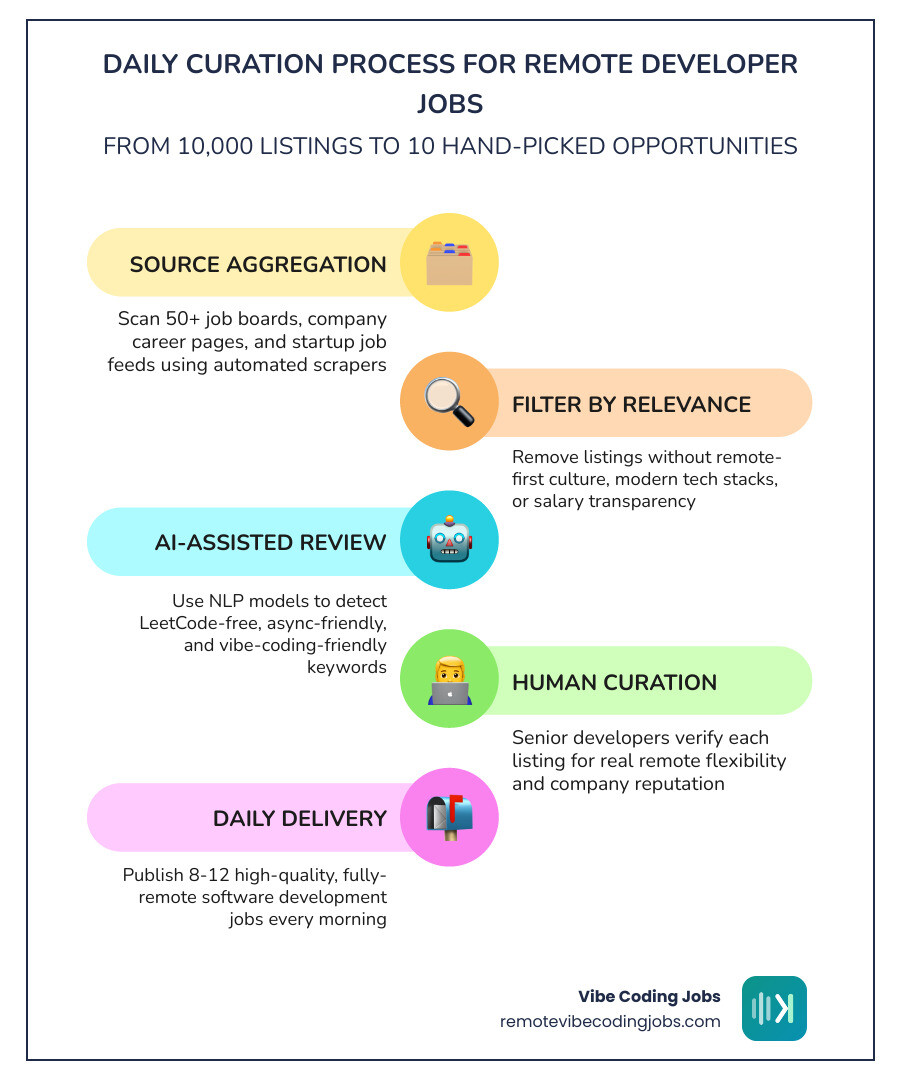
At RemoteVibeCodingJobs, we do the heavy lifting for you. We aggregate and curate daily listings of remote “vibe coding” jobs, filtering them by culture, tech stack, and modern AI tool integration.
Ready to transition to the future of software engineering? Check out our comparison of vibe coding vs traditional development and claim your free playbook today!