
Remote NYC Applications: Your Guide to Working in Your Pajamas with New York Views
The NYC Remote Job Market Is Bigger Than You Think
NYC remote applications are one of the fastest-growing segments of the 2026 job market — and the numbers back that up.
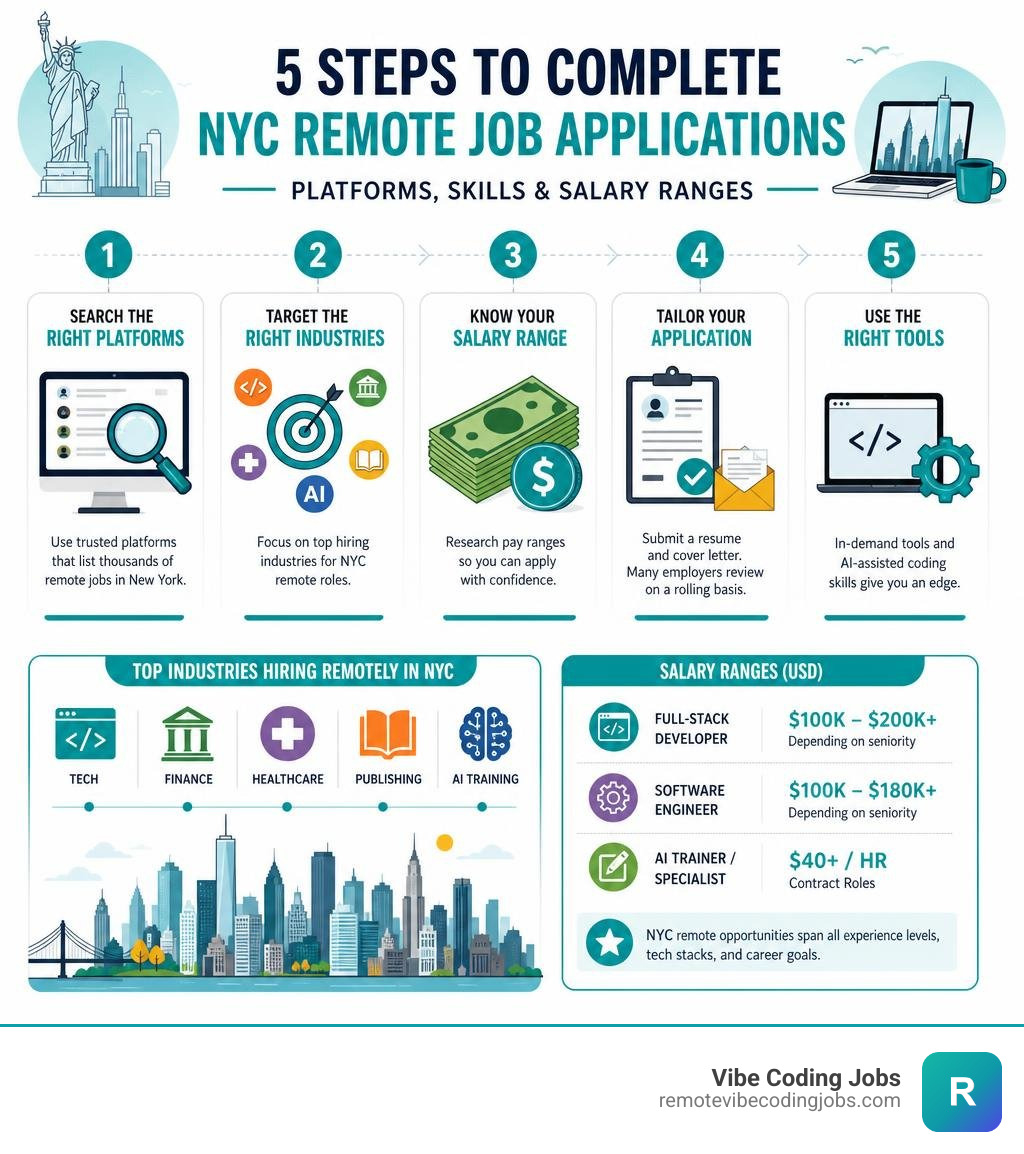
Quick answer: How to find and apply to NYC remote jobs
- Search the right platforms — LinkedIn lists 15,000+ remote jobs in New York; Remote.co adds 2,000+ new remote listings every day
- Target the right industries — Tech, finance, healthcare, publishing, and AI training are the heaviest NYC remote hirers right now
- Know your salary range — Full-stack developer roles start around $100K and go past $200K depending on seniority
- Tailor your application — Submit a resume and cover letter; many NYC employers review on a rolling basis
- Use the right tools — Vibe coding skills (Cursor, Claude Code, GitHub Copilot) are increasingly listed as a plus — or a requirement
New York’s remote job market isn’t just big. It’s diverse. From AI training contracts paying $40+/hr to senior engineering roles at publishers like Penguin Random House offering $100K–$115K, there’s a wide range of opportunities — for all experience levels and tech stacks.
The catch? The market moves fast, competition is high, and standing out requires more than just submitting a generic resume.
At RVCJ Editorial, we cover remote developer hiring, async-first work culture, and AI-assisted development for job seekers navigating exactly this space — including the latest trends in NYC remote applications across vibe coding and modern engineering roles. In the sections below, we break down everything you need to land the right role.
Learn more about nyc remote applications:
How to Navigate NYC Remote Applications in 2026
The landscape of remote work in New York City is highly competitive but incredibly rewarding. Successfully navigating nyc remote applications requires a strategy that goes beyond clicking “Easy Apply” on major job boards. With over 15,000 remote jobs listed in New York on LinkedIn alone and 2,000+ new remote jobs posted every day on Remote.co, your application must stand out from a global pool of talent.
To start, you need a highly targeted application strategy. NYC-based companies value speed, clarity, and direct alignment with their operational needs. If you are applying for software engineering or developer roles, your portfolio should be clean, up-to-date, and explicitly highlight your experience with distributed environments.
Tailoring your resume is non-negotiable. Many NYC employers review applications on a rolling basis, meaning early applicants have a massive advantage. When submitting your application:
- Always include a tailored cover letter explaining why you excel in an asynchronous environment.
- Highlight specific metrics—such as reducing page load times, scaling API integrations, or managing remote deployments.
- Emphasize your familiarity with async communication tools and modern development workflows.
If you are transitioning into this space for the first time, check out our guide on How to Land Your First Remote Job as a Developer: 2024 Guide to build a solid foundation. For a localized perspective on finding remote roles specifically tied to the Empire State, our Remote NYC Job Search Guide details the exact steps needed to capture the attention of local hiring managers.
Top Industries Hiring via NYC Remote Applications
While technology remains the dominant force in the remote job market, several other major NYC industries have fully embraced distributed teams.
- Technology & SaaS: NYC is home to thousands of tech startups and established scale-ups. These companies are constantly seeking frontend, backend, and full-stack engineers.
- Publishing & Media: Traditional media giants, such as Penguin Random House, regularly hire remote developers to support and modernize their web applications. Roles like Developer, Full Stack (Open to Remote) | Zenvok or Developer, Full Stack (Open to Remote) | Hirevector demonstrate how even legacy media brands are building remote-first teams.
- Healthcare & Telehealth: Healthtech is booming in NYC. Startups and clinics are hiring developers to build secure, patient-facing applications. For instance, companies are actively recruiting for specialized roles like this React Native Developer, 100% Remote | Wfh to develop cutting-edge pediatric telehealth products.
- AI Training & Annotation: A massive influx of remote contract work has emerged around AI model evaluation. Platforms like DataAnnotation hire developers starting at $40+ per hour to write code and train AI models, offering extreme schedule flexibility (5 to 20 hours per week).
- Finance & FinTech: From high-growth creator marketplaces to institutional trading platforms, finance companies are hiring full-stack engineers to build scalable transaction engines.
To explore the latest open positions across these dynamic industries, you can Browse Remote NYC Tech Jobs on Vibe Coding Jobs to find curated listings that match your exact skillset.
Salary Trends and Compensation Packages
One of the most appealing aspects of submitting nyc remote applications is the competitive compensation. NYC-based companies must compete with global tech giants, which keeps remote salaries remarkably high.
For mid-level developers, salary ranges typically span from $100,000 to $150,000. For senior developers and specialized engineers, salaries frequently reach $150,000 to $230,000+ annually, often accompanied by equity, home office stipends, and comprehensive health benefits.
Even specialized contract roles offer strong returns. For example, senior full-stack consulting developers can earn a flat rate of $50/hour for consistent 40-hour workweeks, while AI training roles pay upwards of $40/hour for part-time, fully flexible schedules.
To see how your target salary aligns with current market standards, explore our comprehensive Remote Developer Salary Guide 2026. If you specialize in specific languages, our Remote Developer Salary Trends 2026 Python: A Deep Dive provides a granular look at compensation trends for backend and data engineering specialists.
Essential Skills and Tools for Remote NYC Roles

To succeed in securing a remote role with an NYC employer, you need more than just general coding knowledge. NYC companies operate in , high-stakes environments where self-direction and technical proficiency are critical.
When reviewing nyc remote applications, hiring managers look for a combination of strong software fundamentals and modern development toolkits. Specifically, you should be proficient in:
- Frontend Frameworks: React, TypeScript, Next.js, and Vue.
- Backend Languages: Python, Node.js, Java, and Go.
- Databases & Cloud: SQL (PostgreSQL), AWS, and modern DevOps/CI/CD pipelines.
Beyond pure coding, soft skills like written communication, proactive updates, and independent problem-solving are highly valued. For a deep dive into building these competencies, read our guide on Transitioning to Remote Software Engineering: A Complete Guide.
The Rise of Vibe Coding and AI-Assisted Development
A major trend defining the 2026 NYC remote job market is the rise of vibe coding—a development approach where engineers leverage advanced AI tools to generate, prototype, and iterate on code using natural language prompts.
Many forward-thinking NYC companies now list experience with AI-assisted coding tools as a highly desirable “plus” or even a core requirement. Tools like Cursor, Claude Code, GitHub Copilot, and Windsurf allow developers to compress development cycles and focus on architecture and product design rather than boilerplate code.
This shift is changing how product teams build software. Product managers and designers are using AI tools to construct working prototypes before handoff, while engineers use them to transition legacy systems to modern architectures rapidly.
To understand how these tools are redefining productivity, check out our resource on Remote Developer Jobs: AI Tools & Productivity. To learn how you can position yourself for these cutting-edge roles, explore Vibe Coding: The Future of Remote Development.
Security Protocols for NYC Remote Applications
Because remote workers access sensitive corporate networks from home, NYC employers place an incredibly high premium on security. This is especially true for companies operating in finance, healthcare, and government-adjacent sectors.
According to the New York State Office of Information Technology Services, over 90 percent of breaches involve compromised usernames and passwords. Because of this, security is a major focus during the onboarding process.
When working remotely for an NYC-based organization, you will likely be required to use:
- Multi-Factor Authentication (MFA): Utilizing soft tokens or apps to verify your identity.
- Virtual Private Networks (VPN) & Virtual Desktop Infrastructure (VDI): Encrypting your connection to prevent data interception.
- Host Checkers: Software that scans your personal computer to verify your operating system is patched and running active antivirus software before granting network access.
To maintain professional data hygiene, remote employees should clear saved passwords, delete locally cached files, and strictly avoid discussing sensitive corporate data in unverified virtual meetings. You can review the official security guidelines on the Remote Work | Office of Information Technology Services page to understand the exact protocols required by state and enterprise employers.
NYC vs. Other Tech Hubs: Compensation and Work-Life Balance
How does working remotely for an NYC-based company compare to roles in other major tech hubs like San Francisco or Austin? While all three cities offer incredible opportunities, NYC stands out for its high compensation ceiling and robust benefits packages, balanced by the unique pace of East Coast business.
| Feature / Metric | New York City (NYC) | San Francisco (SF) | Austin (ATX) |
|---|---|---|---|
| Average Mid-Senior Salary | $150,000 – $230,000 | $160,000 – $240,000 | $130,000 – $180,000 |
| Equity & Stock Options | High (focused on SaaS & FinTech) | Very High (focused on venture-backed startups) | Moderate |
| Typical Work Culture | Fast-paced, hybrid-friendly, highly professional | Tech-centric, rapid scale, high-pressure | Balanced, lifestyle-oriented, flexible |
| Home Office Stipends | Common ($1,500 – $2,000 setup) | Common ($1,000 – $1,500 setup) | Occasional ($500 – $1,000 setup) |
While West Coast roles sometimes offer slightly higher pure equity packages, NYC remote roles excel in providing stable, high-base compensation paired with comprehensive benefits (such as student loan repayment assistance and generous parental leave).
However, remote work isn’t without its trade-offs. Working for an NYC company means aligning with Eastern Time hours, which can require early starts or late finishes depending on where you are located. To weigh these factors, read our analysis on Remote Work: Pros & Cons 2026. For a broader breakdown of how remote compensation models vary by location and work style, check out our Remote Developer Salary Guide: Compensation Trends & Benefits.
Frequently Asked Questions about NYC Remote Jobs
Do NYC remote jobs pay the same as in-office roles?
In many cases, yes. While some traditional corporations implement geographic pay adjustments based on your local cost of living, many NYC tech startups and modern companies offer standardized compensation packages to secure top-tier talent regardless of location. This is especially true for senior roles and specialized developer positions where talent scarcity drives up wages.
What security tools do I need to work remotely for an NYC company?
Typically, your employer will provide or mandate the necessary security suite. This usually includes enterprise VPN clients, Virtual Desktop Infrastructure (VDI) like VMware Horizon, and multi-factor authentication (MFA) tools such as RSA SecurID. You do not need to purchase these tools yourself, but you must have a personal computer capable of running them securely.
Can I work for an NYC company if I live in another state?
Yes! Most remote-first NYC companies are set up to hire employees across the United States. However, some companies restrict hiring to specific states due to local tax registrations and labor laws. Always check the job description to ensure your state of residence is eligible, and be prepared to work on Eastern Time (ET) hours.
Conclusion: Landing Your Dream Remote NYC Role

Securing a remote job with a New York City company is an incredible way to advance your career, enjoy premium East Coast compensation, and maintain the flexibility of working from home.
By targeting the right industries, keeping your modern development skills sharp, and embracing AI-assisted “vibe coding” workflows, you can make your nyc remote applications completely irresistible to hiring managers.
At RemoteVibeCodingJobs, we aggregate remote “vibe coding” (AI-assisted development) jobs at async-first companies. We filter daily listings by culture, tech stack, and modern AI tools like Cursor and Claude, providing a free playbook and fast applications to help you land your next role.
Ready to make your move? Skip the generic job boards and find your next opportunity today by visiting our curated listings of Remote NYC Jobs on Vibe Coding Jobs.