
The Remote AI Job Market in 2026 Is Bigger Than You Think
Curated remote ai roles are now available across thousands of companies — from early-stage startups offering equity to established firms paying $400K+.
Here’s a quick snapshot of what’s out there right now:
| Role Type | Example Titles | Salary Range (USD) |
|---|---|---|
| AI Engineering | Agentic AI Engineer, Applied AI Engineer, Founding AI Engineer | $160K – $445K |
| AI Orchestration | AI Orchestration Specialist, Forward Deployed AI Engineer | $190K – $265K |
| Vibe Coding / AI-Assisted Dev | AI-Native Full-Stack, Principal Data Engineer | $112K – $465K |
| Non-Engineering AI | AI Product Marketing, Customer Success, GTM | $140K – $160K |
| Entry-Level / Contract | AI Agent Developer, Vibe Coding Intern | $60K – $100K ($100–$400/hr contract) |
The numbers are hard to ignore. Over 7,500 remote AI engineering roles are currently listed on Wellfound alone. Specialized contract roles for MCP and agent workflow experts are hitting $400/hr. And “vibe coding” — once a Twitter buzzword — is now a formal job requirement at companies like UnitedHealth Group and ServiceNow.
The problem isn’t that the jobs don’t exist. It’s that finding the right ones — matched to your stack, experience level, and async-first culture preferences — takes real work.
That’s exactly what this guide is for.
I’m RVCJ Editorial, the team behind Remote Vibe Coding Jobs, where we track and curate remote AI roles for developers building with tools like Cursor, Claude Code, Copilot, and Replit. Our focus on curated remote ai roles means we cut through the noise so you can spend less time searching and more time building.
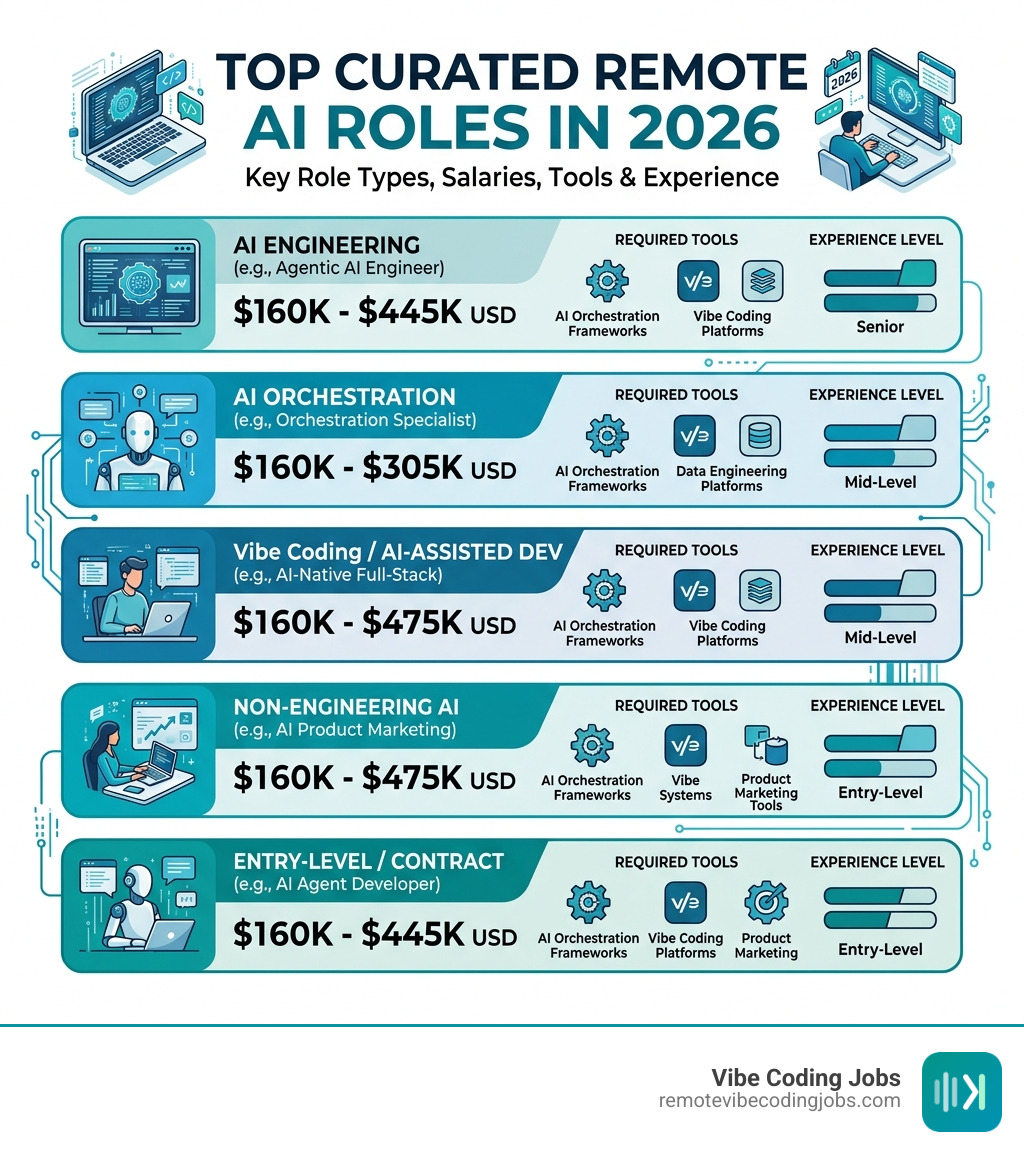
Top Curated Remote AI Roles in 2026
As we move through May 2026, the landscape of remote work has shifted from “remote-friendly” to “AI-native.” Companies are no longer just looking for developers who can write Python; they are hunting for architects who can pilot autonomous systems.

Agentic AI Engineers
The hottest title in 2026 is the Agentic AI Engineer. These professionals don’t just build chatbots; they design “agentic workflows”—systems capable of autonomous reasoning, multi-step execution, and persistent memory management. Unlike traditional ML roles, these positions focus on the orchestration of LLMs (Large Language Models) and SLMs (Small Language Models) to perform complex tasks without constant human intervention.
AI Orchestration Specialists
Emerging as a critical infrastructure role, AI Orchestration Specialists focus on the “plumbing” of AI. They master tools like Claude Code to build production-ready orchestrators that bridge the gap between raw model outputs and enterprise systems like SAP or Salesforce. If you are interested in these cutting-edge positions, check out our Curated AI Agent Developer opportunities and other AI Engineer Jobs.
High-Demand Curated Remote AI Roles for Engineers
The engineering sector has split into several specialized niches. We are seeing a massive surge in Applied AI Engineers—developers who focus on pragmatically shipping user-facing features rather than theoretical research.
Another rising star is the Forward Deployed AI Engineer. This role is a hybrid of client-facing strategy and deep technical implementation, often found in high-growth startups that need to embed AI directly into a customer’s existing tech stack. For a deeper dive into what these companies expect, you can read our Remote AI Developer Job Description guide. You can also explore specialized listings at Vibe Coding Jobs — Curated AI-Assisted Roles.
Non-Engineering Curated Remote AI Roles
You don’t need to be a “code typist” to thrive in this market. Non-technical curated remote ai roles are exploding as companies realize they need people to sell, market, and support these complex products.
- AI Product Marketing: These roles focus on translating technical agentic capabilities into clear customer value. Salaries often range from $140,000 to $160,000.
- Customer Success for AI: This involves helping enterprise users adopt AI workflows and ensuring they don’t get stuck in the “planning phase” of their transformation.
- GTM (Go-To-Market) Strategy: Specialists who understand the “AI-first” sales cycle are in high demand.
To see how these roles fit into the broader career path, take a look at our article on AI Coding Jobs – Future Trends & Entry-Level.
Leading Companies Hiring for Remote AI Positions
The “Big Four” of the AI world—OpenAI, xAI, Snorkel AI, and Cohere—continue to lead the charge, but the most interesting curated remote ai roles are often found in the mid-tier “scale-up” companies and async-first startups.
- OpenAI: Known for high-profile roles, they offer massive salary ranges. For example, a Customer Marketing Manager can earn up to $252k, while a Silicon Implementation Engineer can reach $445k.
- Snorkel AI: They focus on “expert data development,” hiring for roles across research, engineering, and professional services. They are famous for their “supportive whiteboard culture” and unlimited PTO.
- Zapier: A pioneer in remote work, Zapier is currently hiring for leadership roles like Sr. Director of Engineering – Applied AI. They explicitly encourage candidates to use AI tools during the application process.
For a comprehensive list of who is currently looking for talent, visit our page on the Best Companies Hiring AI Developers or Browse Curated Remote AI Roles directly.
Compensation and Benefits at Top AI Firms
The compensation for curated remote ai roles in 2026 is, frankly, staggering. We are seeing “vibe coding” roles at companies like ServiceNow paying up to $465,000 per year. Even at the startup level, Pair Team is hiring Senior AI Engineers at $190k–$260k.
Beyond the base salary, equity remains a major draw. Founding engineers at early-stage startups can expect between 1% and 4% equity. Benefits have also evolved; leading companies now offer:
- Wellness stipends and comprehensive health plans.
- Global offsites (think Thailand, Colombia, or Ireland).
- Async-first workflows that prioritize output over hours spent at a desk.
Check out our detailed breakdown of Remote AI Developer Jobs – Benefits for more.
Regional Availability and Hybrid Requirements
While “fully remote” is the goal for many, the reality is often regional. Many “remote” roles at companies like OpenAI or Zapier are restricted to specific time zones (like EMEA) or countries for legal and tax reasons.
However, the “Bay Area” remains the spiritual home of AI. Many companies offer hybrid roles that allow for remote work but require occasional visits to hubs like San Francisco or New York. For those seeking true geographic freedom, focusing on “async-first” companies is the best bet. Read more about Best Companies Hiring AI Developers – Remote Career Paths to find your match.
Essential Skills and Tools for Modern AI Developers
In 2026, the tools you use define your productivity. The “vibe coding” stack has standardized around a few key players:
- Cursor: The AI-native code editor that has become a non-negotiable requirement for many startups.
- Claude Code: Used for deep experimentation and building orchestration patterns.
- GitHub Copilot & Windsurf: Essential for maintaining velocity in large codebases.
Mastering these tools is no longer optional. Some job postings even state that if you don’t use Cursor daily, the role isn’t for you. For a full list of what to learn, see Remote AI Developer Jobs – Tools & Salary. You can find AI-First Remote Full-Time Jobs that specifically list these tools in their requirements.
Mastering Agentic Workflows and RAG
To land a senior role, you must go beyond simple prompt engineering. You need to understand:
- RAG (Retrieval-Augmented Generation): Implementing embeddings, chunking, and vector search to give LLMs context.
- Semantic Search: Building systems that understand intent, not just keywords.
- Memory Management: Designing short-term and long-term memory systems for autonomous agents.
Explore these specialized paths through our LLM Engineer Jobs and NLP Engineer Jobs pages.
Specialized Curated Remote AI Roles in Orchestration
Companies like 1Sphere are looking for “Founding AI Orchestration Specialists.” This role involves mastering Claude Code features—like skills, subagents, and hooks—to create reusable patterns for Fortune 500 companies. These roles are about setting the industry standards for how AI is embedded into legacy systems. Find your place in this niche at AI Orchestration Specialist Roles or see which Companies Hiring AI Developers – Vibe Coders are leading the pack.
How to Stand Out in the 2026 AI Job Market
Standing out requires more than a polished CV. You need a “builder” portfolio.
- Show, Don’t Just Tell: Build and deploy 3-5 production-ready AI orchestrators.
- Use AI to Apply: Companies like Zapier love it when you use AI tools responsibly during the application process.
- Master the PRD-to-App Pipeline: Demonstrate that you can take a Product Requirements Document and turn it into a functional app in days, not weeks.
Review our Remote AI Developer Jobs – Requirements for a checklist of what to prepare, especially if you are looking for Entry-Level Remote AI Coding Jobs.
Transitioning from Traditional Dev to Vibe Coding
If you are a traditional dev, the transition to “vibe coding” is a shift in mindset. You are moving from being a “code typist” to a “software architect.”
- Focus on System Design: Let the AI handle the boilerplate; you focus on the architecture and business logic.
- Develop “AI Debugging” Skills: Learn to spot AI hallucinations and security flaws in generated code.
- Adopt an Async-First Mentality: Documentation is your best friend in a remote, AI-driven world.
Learn more about this evolution at AI Coding Jobs – Remote Career Growth.
Frequently Asked Questions about Curated Remote AI Roles
What is the difference between an AI Engineer and an Applied AI Engineer?
An AI Engineer often works on the “guts” of the system—fine-tuning models, managing infrastructure, and researching new architectures. An Applied AI Engineer focuses on the “last mile”—integrating those models into user-facing products, building RAG pipelines, and ensuring the AI solves a specific business problem.
Can I use AI tools like ChatGPT or Claude during the application process?
In 2026, the answer is increasingly “Yes!” Many AI-forward companies view the use of AI tools as a sign of proficiency. However, always be transparent and ensure the final output is something you can explain and defend.
What are the highest paying remote AI roles in 2026?
The highest salaries are currently found in Principal Data Engineering and Staff Applied AI roles, with some total compensation packages (including equity) exceeding $465,000. Contract rates for specialized AI Agent developers are also peaking at $400/hr.
Conclusion
The era of curated remote ai roles has arrived. Whether you are a “vibe coder” shipping MVPs at light speed or an architect building complex agentic systems, the opportunities in May 2026 are unprecedented. At Remote Vibe Coding Jobs, we believe that the developer of the future is an AI pilot—someone who uses technology to amplify their creativity and impact.
By focusing on async-first cultures and the latest AI-assisted tools, you can find a role that offers not just a high salary, but the freedom to build from anywhere in the world.
Ready to make your next move? Check out More info about async-first remote developer jobs benefits and start your application today.