
Why Finding Filtered Remote Coder Jobs Is Harder Than It Looks
Filtered remote coder jobs are easier to find when you know where to look — here’s a quick breakdown of the best starting points:
| Platform | Jobs Available | Best For |
|---|---|---|
| 207 in California alone | Broad search with filters | |
| CommonSpirit Health | 16 remote coding roles | Direct employer listings |
| AHIMA Career Assist | 18 verified listings | Credential-specific roles |
| Kaiser Permanente | 4 HIM roles | Inpatient/compliance focus |
| Virtual Vocations | 75 healthcare jobs | Entry to experienced levels |
The demand for remote medical coders is real — and growing. Major health systems like CommonSpirit Health, Kaiser Permanente, and Providence are actively posting remote roles across specializations like inpatient coding, clinic coding, and compliance auditing.
But here’s the problem: most job seekers are applying blind. Research shows 75% of applications never even reach a recruiter. The listings are out there, but getting through the filters takes more than just submitting a resume.
This guide cuts through the noise. Whether you hold a CCS, CPC, RHIA, or RHIT credential — or you’re working toward one — you’ll find exactly what you need to land a legitimate remote coding role.
I’m RVCJ Editorial, the editorial team behind Remote Vibe Coding Jobs, where we track remote developer and coder hiring trends across healthcare and AI-native industries — including the full landscape of filtered remote coder jobs. We’ve put together this guide using current job market data so you can skip the guesswork and apply smarter.
Understanding the Landscape of Filtered Remote Coder Jobs
The world of health information management (HIM) has undergone a massive digital transformation. As of June 2026, the days of flipping through massive physical codebooks in a sterile hospital basement are largely behind us. Today, medical coders review electronic health records (EHR) from the comfort of their home offices, translating complex clinical documentation into standardized codes.
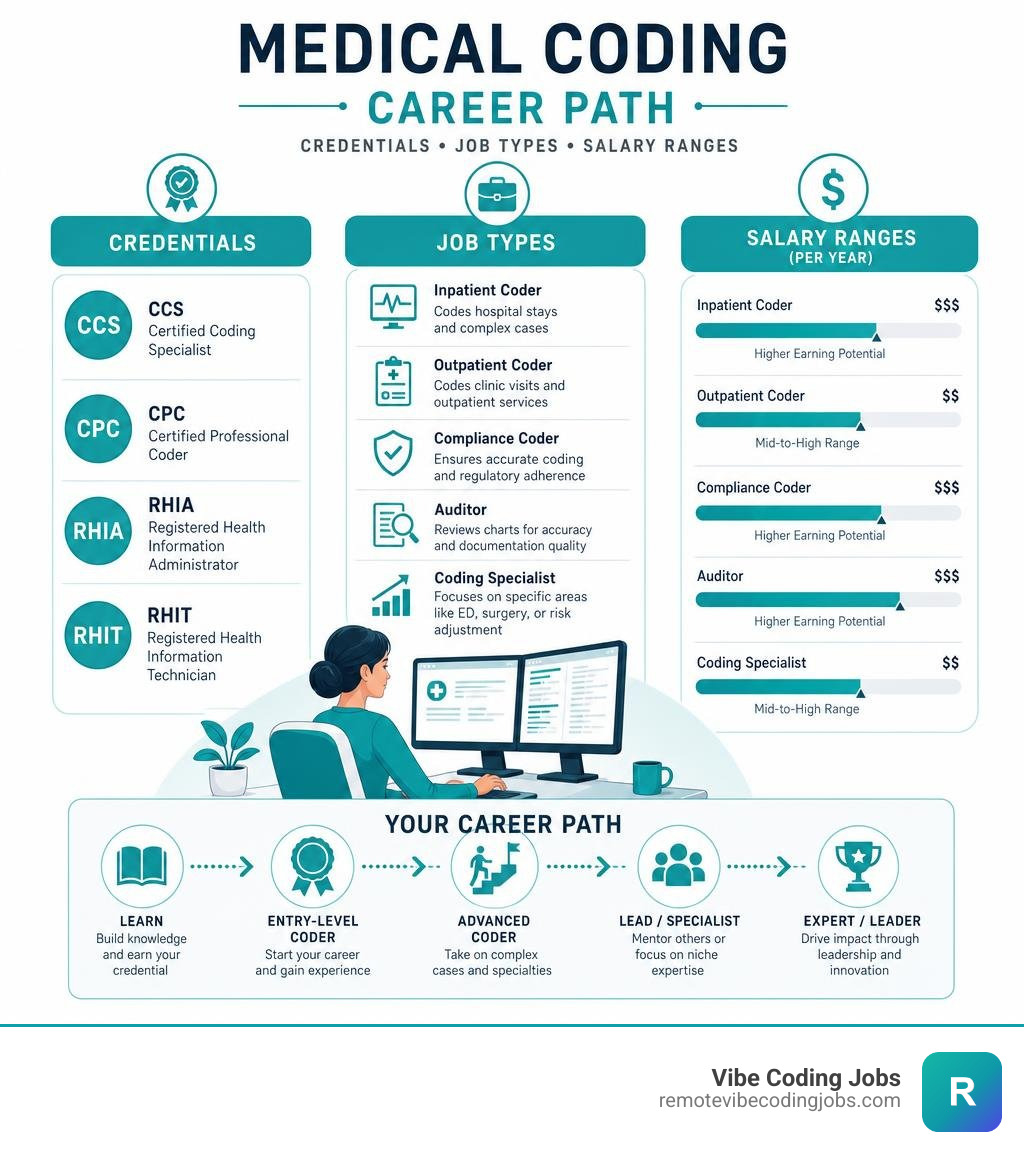
However, finding these roles requires navigating a highly structured job market. When searching for filtered remote coder jobs, you will quickly notice that employers categorize positions using highly specific titles and specializations:
- Clinic Coder II / Physician Coder: These professionals focus on outpatient services, clinic visits, and professional fee coding.
- Inpatient Facility Coder: Highly specialized roles that analyze complex multi-day hospital stays, assigning diagnostic and procedural codes that determine major reimbursement rates.
- Coding Auditor / Compliance Analyst: Senior-level professionals who review completed charts to ensure accuracy, prevent fraud, and optimize billing cycles.
- ED Coder (Emergency Department): Fast-paced coding roles requiring rapid classification of emergency procedures, diagnostic tests, and evaluation and management (E/M) levels.
Demand Drivers and Job Flexibility
Why is the demand for remote medical coders continuing to climb in June 2026? The drivers are clear: an aging global population requiring more medical care, constantly shifting regulatory guidelines (such as annual updates to ICD-10-CM and CPT systems), and a industry-wide push to reduce administrative overhead.
For professionals, the benefits of these roles are substantial. Remote medical coding offers incredible geographical flexibility, allowing you to work from almost anywhere, provided you meet state-specific tax and compliance guidelines. Many employers offer flexible scheduling, allowing coders to complete their production quotas during non-traditional hours.
To help you visualize how these different roles stack up, we have compiled a quick comparison of standard remote medical coding pathways:
| Job Title | Average Experience Required | Key Coding Systems | Typical Schedule Flexibility |
|---|---|---|---|
| Clinic Coder II | 1–3 Years | ICD-10-CM, CPT, HCPCS | High (Often asynchronous) |
| Inpatient Facility Coder | 3–5+ Years | ICD-10-CM, ICD-10-PCS, MS-DRGs | Medium (Typically business hours) |
| Coding Auditor | 5+ Years | All Systems + Audit Guidelines | High (Independent project-based) |
| ED Professional Fee Coder | 2–4 Years | ICD-10-CM, CPT (E/M Levels) | High (Weekend/swing shifts available) |
Whether you are looking for a stable full-time salaried position with comprehensive medical benefits or a flexible PRN (pro re nata / as-needed) contract role to supplement your income, the remote coding landscape has options. For instance, major healthcare employers like CommonSpirit Health frequently list diverse opportunities on their portal for Medical Coding Jobs in Remote at CommonSpirit Health, where you can filter by employment status, location, and specific coding levels.

Navigating Filtered Remote Coder Jobs for Career Growth
Developing a career in remote medical coding is not a dead-end path; it is a ladder with extensive professional development opportunities. Most successful remote coders start in outpatient or clinic roles before moving into high-paying inpatient coding, auditing, or management positions.
Continuous education is the lifeblood of this profession. Organizations like the American Health Information Management Association (AHIMA) and the American Academy of Professional Coders (AAPC) mandate annual continuing education units (CEUs) to maintain active credentials.
For those who value ultimate flexibility, some progressive healthcare systems and tech-forward administrative partners are beginning to offer alternative work models. Just as software developers have embraced Four-Day Work Week Developer Jobs to combat burnout, some innovative medical administrative groups are experimenting with compressed schedules. You can explore similar highly flexible, modern job structures by looking through 4-Day Week Remote Jobs to see how remote work is shifting across multiple technical and analytical sectors.
Key Differences: Inpatient vs. Outpatient vs. Specialty Coding
To successfully navigate filtered remote coder jobs, you must understand the fundamental differences in daily workflows, required knowledge bases, and software tools across the three primary coding categories.
1. Inpatient Coding
Inpatient coding is widely considered the most complex and intellectually challenging branch of medical coding. When a patient is admitted to a hospital, their entire stay—which may span days, weeks, or even months—must be synthesized into a single billing claim.
- Coding Systems: Inpatient coders rely heavily on ICD-10-CM (for clinical diagnoses) and ICD-10-PCS (Procedure Coding System), which is used exclusively in U.S. inpatient hospital settings.
- Reimbursement Impact: Inpatient codes are grouped into Diagnosis-Related Groups (DRGs). A single code variation can alter a hospital’s reimbursement by thousands of dollars, which is why inpatient coders face high accuracy standards.
- Software: Coders typically work with robust electronic health record (EHR) systems like Epic integrated with advanced computer-assisted coding (CAC) software like 3M 360 Encompass.
2. Outpatient Coding
Outpatient coding deals with patients who visit a clinic, emergency room, or outpatient surgery center and go home the same day.
- Coding Systems: Outpatient coders utilize ICD-10-CM for diagnoses, but they swap out ICD-10-PCS for CPT (Current Procedural Terminology) and HCPCS Level II codes for procedures, injections, and medical equipment.
- Focus: The focus is on verifying medical necessity and ensuring that the documented procedure matches the diagnosis code exactly. Outpatient charts are generally shorter, allowing for a much higher daily chart production volume.
3. Specialty Coding
Specialty coding focuses on a singular medical field, such as cardiology, oncology, orthopedics, or interventional radiology.
- Complexity: Because medical specialties have unique procedures and billing rules, specialty coders must possess deep anatomical knowledge of their chosen field.
- Job Outlook: Specialty coders are highly sought after by private clinics and specialized billing agencies. For example, if you are looking for localized or specialty-focused listings, checking out Certified medical coder jobs in Phoenix, AZ | Healthcare Careers can reveal how regional healthcare markets price these specialized skills.
Top Healthcare Employers and Job Requirements
If you want to secure a high-quality remote role, targeting the right employers is half the battle. Several major healthcare systems are known for their robust remote work infrastructures:
- CommonSpirit Health: This massive non-profit healthcare system regularly hires remote Clinic Coders, Senior Coders, and Coding Auditors. They frequently have dozens of active remote opportunities across multiple states.
- Kaiser Permanente: Known for excellent compensation and comprehensive benefits, Kaiser Permanente frequently posts Health Information Management (HIM) and Inpatient Coding roles, particularly supporting their operations in California and Hawaii.
- Providence: Operating across the Western United States, Providence actively hires remote Coding Quality Educators and Physician Billing Specialists, offering remote work options to candidates living in most eligible states.
Certifications That Open Doors
To get your application past automated filters, you must hold a recognized credential. The most respected certifications in the industry include:
- Certified Coding Specialist (CCS): Offered by AHIMA, this is the gold standard for inpatient hospital coding.
- Certified Professional Coder (CPC): Offered by AAPC, this is the premier credential for outpatient physician office coding.
- RHIA & RHIT (Registered Health Information Administrator/Technician): Degree-level credentials that prepare professionals for leadership, auditing, and advanced data analysis roles within HIM departments.
Experience, Location, and Time Zone Restrictions
While the work itself is performed on a computer, “remote” does not always mean “work from anywhere.” Most healthcare employers restrict remote hiring to specific states due to tax laws, licensing requirements, and corporate insurance policies.
Additionally, you may be required to work within a specific time zone to align with clinical staff hours for physician queries. For example, if you look at the 422 Medical Coder jobs in Phoenix – LinkedIn, you will find that while many of these roles are remote, they frequently require candidates to live in Arizona or neighboring Mountain/Pacific time zone states.
How to Find Filtered Remote Coder Jobs in Healthcare
With 75% of applications falling into the “black hole” of Applicant Tracking Systems (ATS), you need a targeted strategy to find and secure legitimate opportunities.
- Use Niche Job Banks: Skip the generic job boards that are flooded with thousands of unqualified applicants. Instead, focus on the AHIMA Career Assist Job Bank, the AAPC Job Board, or direct health system career portals.
- Optimize Your Resume for ATS: Ensure your resume explicitly lists the coding systems you know (e.g., ICD-10-CM, CPT), the EHR platforms you have used (e.g., Epic, Cerner), and your exact credential acronyms (e.g., CCS, CPC).
- Leverage Global and Tech-Forward Platforms: Sometimes, the best remote opportunities are found on platforms that specialize in global remote work. If you are open to broader technical or analytical roles that utilize your structured logic and data processing skills, you can research Land Your Dream Job: Global-Friendly Remote Developer Jobs or browse curated listings on Global-Friendly Remote Jobs to see how modern remote-first companies structure their hiring processes.
Frequently Asked Questions about Remote Medical Coding
What credentials are most in-demand for remote medical coders?
The most in-demand credentials for remote coding are the CCS (Certified Coding Specialist) from AHIMA for inpatient hospital roles, and the CPC (Certified Professional Coder) from AAPC for outpatient and physician clinic roles. Holding one of these, combined with a couple of years of experience, will make you highly competitive in the remote job market.
Can you work as a remote medical coder with no experience?
While it is more challenging, it is entirely possible. Many entry-level coders start by taking on contract or PRN roles, participating in an employer-sponsored coding practicum, or working in medical billing or clinical scheduling first to gain familiarity with health systems before transitioning directly into full-time remote coding.
How do geographic location and state restrictions affect remote coding jobs?
Due to state-specific payroll taxes, healthcare compliance regulations, and corporate licensing, many remote medical coding positions are restricted to residents of specific states. Always read the fine print of a remote job posting to ensure your home state is on their list of approved hiring locations.
Conclusion
Finding filtered remote coder jobs in healthcare requires a blend of the right credentials, targeted job search strategies, and an understanding of employer-specific requirements. By focusing on major systems like CommonSpirit Health, Kaiser Permanente, and Providence, and ensuring your resume is optimized for ATS filters, you can successfully land a flexible, rewarding remote role.
The Broader Future of Coding: What Lies Beyond Healthcare?
As we look at remote work trends in June 2026, the definition of “coding” is expanding rapidly. While medical coding remains a stable and vital career, a parallel revolution is happening in the software development space.
Today, a new wave of remote work called vibe coding (or AI-assisted development) is taking over. Vibe coding allows builders to design software, build web applications, and manage databases using cutting-edge AI tools like Cursor, Claude, and GitHub Copilot without needing a traditional computer science degree or mastering complex Leetcode algorithms.
If you have a knack for logical thinking, data organization, and structured systems—skills you already use daily in medical coding—you might find AI-assisted development incredibly exciting.
At Remote Vibe Coding Jobs, we daily curate the best remote, async-first positions for builders who want to work with these AI tools. If you are curious about how AI is changing the landscape of remote work, check out our guide on What Are Vibe Coding Jobs? A Guide to the Future of Remote Work or explore open roles that bypass traditional technical barriers by reading about Remote Coding Jobs with No Leetcode.
For those ready to dive into the future of asynchronous, remote-first work, browse our active listings at Async-First Remote Developer Jobs or learn the fundamentals of this new movement directly at https://remotevibecodingjobs.com/blog/what-is-vibe-coding.
Whether you choose to specialize in the vital field of healthcare data or step into the fast-growing world of AI-assisted software building, the future of remote work belongs to those who know how to navigate the digital landscape. Happy job hunting!
External References for Global Remote Opportunities
If you are looking for international technical roles or want to see how remote work operates globally, you can check out these additional resources:
- Explore development roles abroad: Python Developer – Remote in Vietnam | FlexPilot
- Review European remote engineering opportunities: Account Suspended