
No Office, No Problem: Where to Find Top Remote Web Developer Jobs Today
Remote Web Developer Jobs Are Everywhere — Here’s How to Find the Best Ones
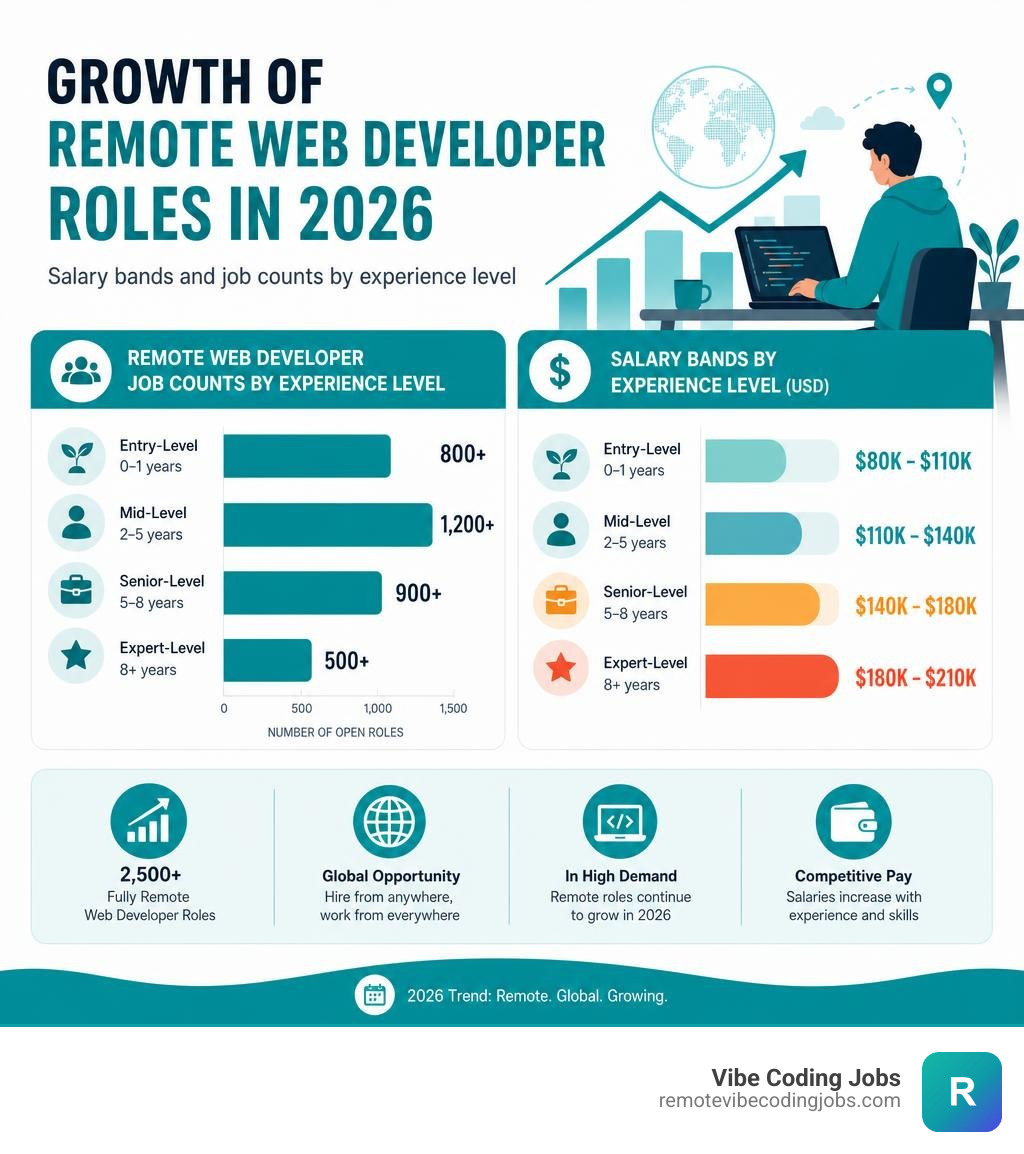
Remote jobs for web developers have never been more plentiful. Right now, over 3,400 open positions are listed across major job platforms in the US alone — and more than 2,500 of those are fully remote roles.
If you want a quick answer, here’s where the market stands today:
| What You Want to Know | The Quick Answer |
|---|---|
| How many remote web dev jobs exist? | 3,400+ in the US, 2,500+ fully remote |
| What roles are most common? | Frontend, full-stack, and back-end engineers |
| What’s the salary range? | $80,000–$210,000/year depending on experience |
| Top skills employers want | React, TypeScript, Next.js, Node.js, Python |
| Best experience levels hiring now | Entry-level and mid-senior (nearly equal demand) |
| Are AI tools required? | Increasingly yes — vibe coding skills are in demand |
| Where to find jobs fast | Vibe Coding Jobs, LinkedIn, Indeed, Glassdoor |
The market has shifted fast. Fully remote positions now outnumber on-site roles by more than 5 to 1. Companies aren’t just tolerating remote work — they’re building around it.
And there’s a new layer on top of all this: AI-assisted development, sometimes called vibe coding, is becoming a core skill that employers actively seek. Tools like Cursor, Claude Code, and GitHub Copilot are showing up in job descriptions right alongside React and TypeScript.
That’s exactly the intersection we cover at RVCJ Editorial — we’re the team behind Vibe Coding Jobs, and we track remote jobs for web developers daily, from entry-level roles to senior AI-first engineering positions. In this guide, we’ll walk you through where the best opportunities are, what pays well, and how to land one.
Learn more about remote jobs for web developers:
The State of Remote Jobs for Web Developers in 2026
As we navigate through June 2026, the tech landscape has completely reorganized itself around distributed teams. The numbers speak for themselves. In the United States alone, there are over 3,000 active listings for remote web developers. When you break down the hiring trends, you see a massive preference for location-independent talent: 2,573 fully remote web developer positions are currently available compared to just 515 on-site and 392 hybrid roles. This means that nearly 75% of all web development opportunities are now designed to be performed from the comfort of your home office or a co-working space.
Furthermore, the velocity of the market is staggering. On any given day, more than 110 new remote web developer jobs are posted across major career networks. Platforms like Glassdoor actively list hundreds of remote positions, while aggregators and specialized job boards are constantly flooded with fresh opportunities.

This shift is not just about convenience; it is a fundamental restructuring of how software is built. Companies have realized that limiting their talent search to a 30-mile radius of a physical office is a losing strategy. By looking globally or nationally, they can find developers who are not only technically proficient but also highly productive in asynchronous environments.
If you are ready to explore these listings, you can browse the Remote Web Developer Jobs on Vibe Coding Jobs to find curated positions that align with your lifestyle, tech stack, and favorite development workflows.
High-Paying Remote Jobs for Web Developers by Experience Level
One of the most encouraging trends in June 2026 is that the financial rewards for remote developers remain exceptionally strong. Employers are willing to pay competitive salaries to secure top-tier talent, regardless of where those developers choose to log in.
Salaries generally range from $80,000 to over $210,000 annually, depending heavily on your specialized skills, system architecture knowledge, and experience level. Surprisingly, the demand is almost equally split between early-career developers and seasoned pros. Entry-level positions and mid-to-senior level roles have nearly identical job counts in recent market surveys (roughly 1,543 entry-level openings compared to 1,516 mid-senior listings).
To help you visualize where you fit in the current market, here is a breakdown of typical salary bands:
| Experience Level | Annual Salary Range (USD) | Key Focus Areas |
|---|---|---|
| Entry-Level / Junior | $70,000 – $100,000 | Implementing UI components, writing basic API endpoints, code debugging, and learning AI-assisted tools. |
| Mid-Level | $100,000 – $150,000 | Designing features, managing state, database optimization, and collaborating on API contracts. |
| Senior | $150,000 – $250,000+ | System architecture, security compliance, performance tuning, and leading AI-native development workflows. |
| Freelance / Contract | $40 – $300 / hour | Rapid MVP prototyping, specialized integrations, custom web scraping, and short-term migrations. |
Whether you are just starting out or are a veteran engineer looking to future-proof your career, understanding these bands is essential for salary negotiations. For a deeper look at how to position yourself for the highest-paying roles this year, check out our guide on the Best Remote Developer Jobs 2026.
Common Work Arrangements and Time Zone Flexibility
While “remote” means you do not have to commute, it does not always mean “work whenever you want from anywhere in the universe.” Companies structure their remote work agreements in several distinct ways:
- Fully Remote (Global or National): These roles allow you to work from literally anywhere, provided you have a reliable internet connection. Some companies, particularly those building Web3 experiences or distributed SaaS platforms, embrace a global, async-first philosophy.
- Fully Remote with Time Zone Constraints: Many US-based companies require their remote developers to reside within specific boundaries (such as EST or CST) or have at least a 4-hour overlap with core business hours. This ensures that team meetings, pair programming sessions, and incident responses can happen without anyone waking up at 3:00 AM.
- Hybrid Arrangements: Some organizations still prefer a hybrid model, requiring you to be within commuting distance of an office for weekly or monthly syncs, while working from home the rest of the time.
- Async-First with Core Hours: This is the sweet spot for many developers. Companies set a small window of “core hours” (e.g., 10:00 AM to 2:00 PM EST) for synchronous communication, leaving the rest of the day completely flexible for deep, uninterrupted focus.
In-Demand Roles and Tech Stacks in the Remote Market
The technical requirements for remote web development have evolved. It is no longer enough to just know basic HTML and CSS. Modern web applications are complex, data-heavy systems that require a deep understanding of state management, performance, and API integrations.
The most common types of remote web developer roles fall into three main buckets:
- Frontend Developers: Responsible for everything the user sees, touches, and experiences. They focus heavily on performance, accessibility, and smooth state transitions.
- Backend Developers: The architects of the server, databases, and APIs. They ensure that data flows securely, quickly, and reliably behind the scenes.
- Full-Stack Developers: The generalists who can jump from database migrations to CSS styling without breaking a sweat. Because of their versatility, full-stack engineers are highly sought after by startups and fast-growing remote teams. If you enjoy working across the entire lifecycle of an application, you can check out the latest Remote Fullstack Developer Jobs to see what modern teams are building.
Frontend Development and Modern Frameworks
In the frontend arena, React continues to reign supreme. However, the ecosystem around React has matured significantly. Modern frontend roles frequently require experience with Next.js (utilizing the App Router patterns), TypeScript (in strict mode), and advanced state management tools like TanStack Query (React Query) for efficient data fetching, caching, and optimistic UI updates.
For instance, senior frontend contracts often involve building massive, green-field Single Page Applications (SPAs) that handle complex enterprise workflows or high-volume data entry. In these environments, tools like React Hook Form and Zod are standard for managing dozens of dynamic fields without introducing input lag.
If you specialize in these modern user interfaces, explore our dedicated listings for Remote React Developer Jobs or, if you prefer alternative modern frameworks, the growing market for Remote Vue Developer Jobs.
Backend and Full-Stack Engineering
On the backend, the remote market is highly diverse. Node.js (TypeScript) and Python remain incredibly dominant, particularly as companies rush to integrate artificial intelligence and Large Language Models (LLMs) into their existing web applications.
Modern backend developers are expected to connect LLMs to enterprise databases (such as PostgreSQL, SQL Server, and MongoDB) using Retrieval-Augmented Generation (RAG) and vector search. Understanding containerization (Docker) and cloud infrastructure (AWS or Azure) is also a massive advantage, as remote teams rely on cloud-native pipelines to deploy software rapidly and securely.
The Rise of AI-Assisted Vibe Coding
We cannot talk about the 2026 job market without addressing the elephant in the room: vibe coding.
Vibe coding is the practice of using highly advanced AI-agentic tools—like Cursor, Claude Code, Windsurf, and v0—to handle the heavy lifting of manual coding, boilerplate generation, and syntax debugging. Instead of spending hours writing repetitive CSS or setting up standard API routes, developers use natural language prompts to guide AI agents through complex codebases.
This has shifted the developer’s role from a “code typist” to a “software architect.” The modern remote developer “vibes” with the AI, directing the technical architecture, reviewing the generated output for security, and stepping in to write custom logic only when the AI reaches its limits. Far from replacing developers, vibe coding has supercharged productivity, allowing small, remote teams to build enterprise-grade software in a fraction of the time.
Key Skills and Qualifications Employers Look For
To land a premium remote web developer job today, you need a balanced mix of deep technical expertise and highly polished soft skills. In a remote environment, your code speaks volumes, but how you communicate about your code is what keeps you employed.
Technical Expertise and System Architecture
When companies hire remote developers, they want self-starters who do not need hand-holding. This means employers look for:
- Strong System Design: Knowing how to structure a monorepo, set up shared component libraries, and design clean APIs using OpenAPI/Swagger specifications.
- Security and Performance: Understanding secure authentication flows (like OIDC/OAuth2 with PKCE), managing JWTs safely in the browser, and optimizing web applications to maintain zero input lag even when handling massive datasets.
- CI/CD and Automation: Familiarity with GitHub Actions, automated testing frameworks (like Jest and React Testing Library), and continuous deployment pipelines.
Soft Skills and Async Communication
Because you won’t be sitting next to your teammates, your soft skills are just as critical as your tech stack:
- Proactive Written Communication: In an async-first company, writing clear, concise pull request descriptions, documentation, and Slack/Discord updates is your primary way of showing impact.
- Self-Discipline and Time Management: You must be able to independently manage your work queue, prioritize tasks, and meet deadlines without a manager hovering over your shoulder.
- The Ability to Ask for Help: In a remote setting, it is easy to get stuck and disappear for days. Successful remote developers know how to articulate their roadblocks clearly and seek help early.
How to Stand Out When Applying for Remote Jobs for Web Developers
The remote job application process is highly competitive. To stand out, you need to show, not just tell.
First, ensure your GitHub profile is active and clean. Instead of just hosting basic tutorial projects, showcase real, production-ready applications. If you have built projects using AI-assisted tools, document your prompts, your architectural decisions, and how you validated the AI’s code. This demonstrates that you know how to leverage modern developer tooling responsibly.
If you are transitioning to this setup for the first time, read our step-by-step guide on How to Land Your First Remote Job as a Developer. For intermediate and senior engineers looking to optimize their application strategy, our resource on How to Get a Remote Developer Job offers excellent tactical advice on passing technical assessments and remote interviews.
Best Platforms to Find Remote Web Developer Roles
When searching for remote jobs for web developers, using the right platform can save you dozens of hours of fruitless scrolling. While general job boards have their place, they are often cluttered with outdated listings or hybrid roles disguised as fully remote.
Here are the best platforms to focus your search on today:
- Vibe Coding Jobs: Our platform is specifically curated for modern developers who embrace AI-assisted workflows and want to work for forward-thinking, async-first companies. We filter listings by tech stack, remote culture, and the specific AI tools (like Cursor or Claude Code) that the team uses.
- LinkedIn: A fantastic resource for finding enterprise-level roles. You can explore 1,000+ Remote Web Developer jobs in United States – LinkedIn to see real-time postings from major corporations and fast-growing startups.
- Indeed: Excellent for finding a wide variety of contract, full-time, and part-time developer roles. Check out Flexible Remote Web Developer Jobs – Indeed to filter by specific salary ranges, from hourly contract work to high-paying executive engineering positions.
Frequently Asked Questions about Remote Web Development
What are the most common types of remote web developer jobs?
The most common roles are full-stack, frontend, and backend developers. Full-stack roles are particularly popular in smaller remote startups where versatility is highly valued. Frontend roles focus on building highly interactive user interfaces using frameworks like React and Next.js, while backend roles focus on databases, APIs, and cloud infrastructure.
What are the typical salary ranges for remote web developers?
In 2026, typical salaries for remote web developers range from $80,000 to $210,000 per year. Entry-level developers generally start around $70,000 to $100,000, mid-level developers earn between $100,000 and $150,000, and senior engineers or system architects can easily command $150,000 to $250,000+ plus equity and benefits.
Do I need to know AI tools to get a remote developer job in 2026?
While not every company explicitly requires it yet, proficiency with AI-assisted development tools (vibe coding) is becoming a massive competitive advantage. Companies are actively seeking developers who can use tools like Cursor, Claude Code, and Copilot to ship features 2x to 5x faster than traditional manual coders. Knowing how to write prompts, validate AI output, and architect systems with AI assistance will make you highly attractive to modern remote employers.
Conclusion
Finding the right remote jobs for web developers doesn’t have to be an exhausting, endless search. The remote job market of 2026 belongs to developers who are not only technically skilled but also adaptable, highly communicative, and ready to embrace the future of AI-assisted development.
By focusing on in-demand frameworks like React and Next.js, mastering async communication, and learning to vibe-code with modern AI tools, you can position yourself at the very top of any hiring manager’s list.
When you are ready to take the next step in your career and find a company that values your modern developer workflow, visit Vibe Coding Jobs to browse our daily curated listings, or explore specialized roles like Remote AI Engineer Jobs to future-proof your career today. Your next great work-from-home adventure is just an application away!