Defining Async Remote Tech Roles vs. Standard Remote Work
Understanding async remote tech roles requires looking past the basic concept of “working from home.” In standard remote work, you might be out of the office, but you are still tethered to rigid working hours, frequent Zoom calls, and constant Slack notifications requiring instant replies.
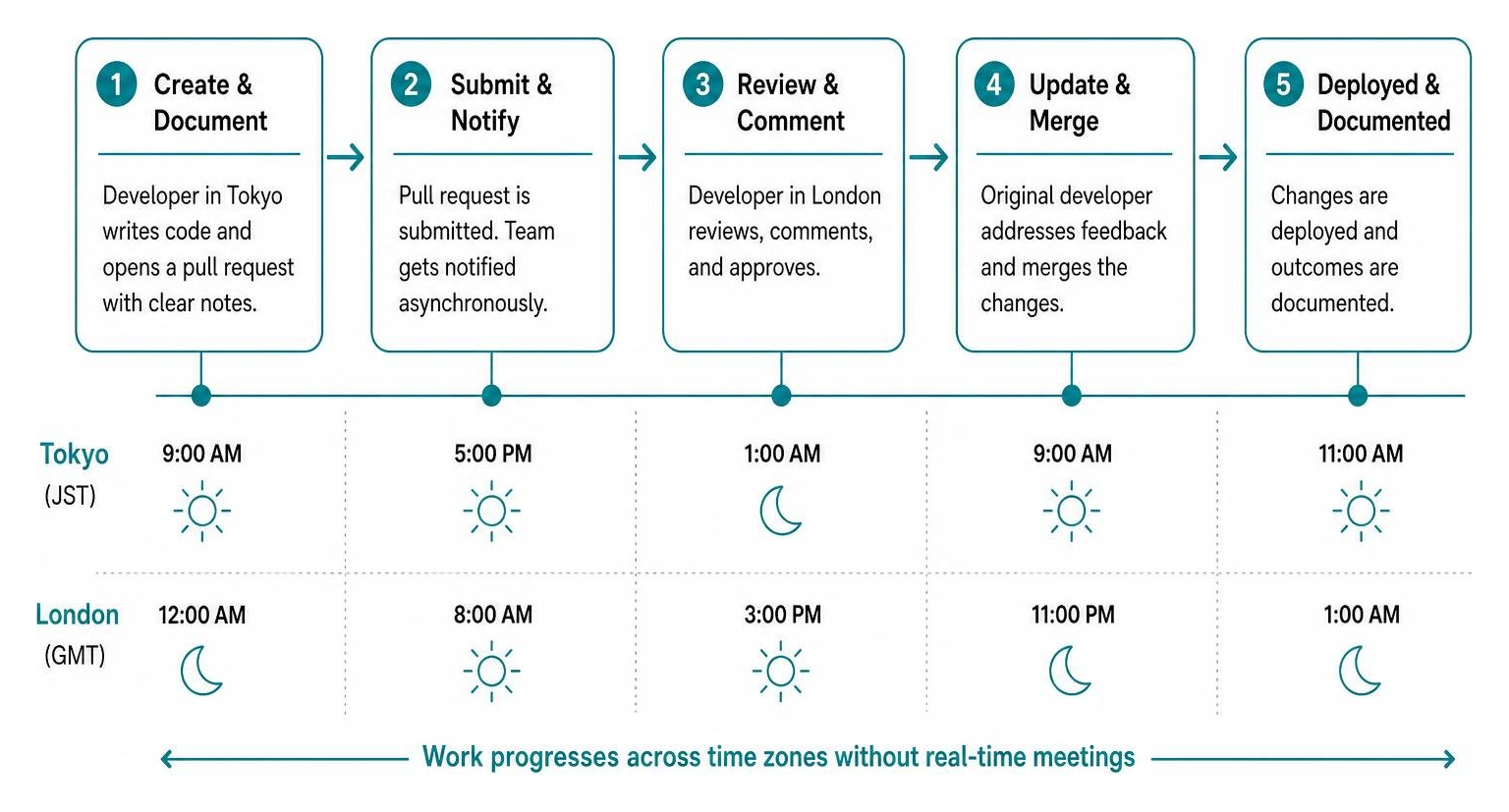
Asynchronous remote work shifts the focus entirely toward autonomy, written documentation, and output metrics. Instead of measuring your value by hours spent active on green status indicators, companies evaluate you on the quality and impact of your output. Teams set expectations asynchronously, meaning a developer in Tokyo can submit a pull request, go to sleep, and have it reviewed by a colleague in London without ever sitting together in a live meeting.
This operational paradigm relies on a complete shift in communication habits. Instead of calling quick alignment meetings, asynchronous teams default to detailed written specs, pre-recorded video walkthroughs, and clear task assignments. To master these practices, read our detailed guide on Async-First Communication Guide.
Difference Between Synchronous and Asynchronous Work
The contrast between real-time, synchronous setups and asynchronous execution fundamentally changes a developer’s daily workflow.
| Work Dimension | Synchronous Remote Work | Asynchronous Remote Work |
|---|---|---|
| Communication Mode | Real-time (Zoom, active Slack channels) | Written-first (Notion, GitHub PRs, Loom) |
| Schedule Control | Fixed hours matching company headquarters | Flexible schedule dictated by personal preference |
| Focus Time | Interrupted by periodic daily meetings | Continuous deep focus blocks |
| Geographic Range | Restricted to matching time zones | Broad global availability across 90+ countries |
| Performance Metric | Hours logged and real-time responsiveness | Shipped features, code quality, output |
While standard remote work forces developers to juggle constant calendar interruptions, async workflows grant total schedule freedom. Engineers can spend four straight hours in deep flow state, write an comprehensive progress report, and take time off during the day without asking permission.
Why Tech Companies Are Transitioning to Async Culture
Global hiring is a primary driver behind the modern async migration. Global platforms and Employer of Record (EoR) models allow startups and enterprises to recruit elite talent anywhere in the world. However, hiring developers across 90+ nationalities and 50+ languages makes synchronous meetings mathematically impossible.
Companies adopt an async-first culture to unlock key operational advantages:
- Uninterrupted Deep Work: Engineers build software faster when they aren’t context-switching between meetings.
- Higher Talent Retention: Giving developers control over their time drastically cuts burnout.
- Robust Documentation Culture: When every feature, bug, and architectural decision is documented in public handbooks, onboardings are faster and knowledge loss drops.
To explore the top engineering cultures making this shift, check out our guide on Async-First Remote Developer Jobs.
High-Demand Engineering and AI Positions in the Async Market
Asynchronous roles span many tech specializations, but high demand is currently concentrated in backend engineering, full-stack development, and AI training infrastructure.

AI Evaluation and Data Infrastructure Positions
The rise of AI and large language models (LLMs) has created a boom in specialized async remote tech roles. Leading AI labs rely on external engineering talent to evaluate models, build training infrastructure, and curate complex datasets.
These roles often feature micro-contracts or flexible commitments (ranging from 5–20 hours per week up to full-time 40-hour positions):
- AI Output Evaluator & Prompt Engineer: Reviewing model outputs for technical accuracy, logic errors, and domain-specific edge cases. Compensation ranges from $23/hr for generalists to $60–$130/hr for subject-matter experts.
- Telemetry & Pipeline Engineer: Building high-throughput data processing engines using Python to handle real-time AI telemetry.
- Data Annotation Infrastructure Developer: Creating web tools to streamline automated data quality checks and human-in-the-loop review systems.
Core Backend and Full-Stack Engineering Roles
Beyond AI data ops, traditional software engineering positions are heavily async-first.
Backend roles frequently revolve around event-driven architectures, microservices, and asynchronous frameworks. For instance, Senior Python Developers utilizing asyncio, FastAPI, and message brokers like RabbitMQ or Kafka build systems that handle high-load real-time streaming asynchronously. Compensation for senior backend roles regularly reaches $1,500–$2,500/month for junior/mid-level contracts, up to $160,000–$240,000/year for enterprise staff positions.
Full-stack engineers building with TypeScript, Node.js, Next.js, and React are also heavily recruited by distributed startups. If you’re looking to scale your career in Python backends, review our comprehensive Remote Python Developer Jobs 2026.
Workflows, Tooling, and Culture in Async Tech Environments
Succeeding in async remote tech roles requires mastering specialized tools and adapting your habits to decentralized execution.

Essential Skills for Async Remote Tech Roles
To thrive without a manager standing over your shoulder, you need a specific set of personal traits and technical competencies:
- Concise Written Communication: Your docs, pull request descriptions, and Slack updates serve as your primary professional footprint.
- Self-Discipline & Autonomy: You must prioritize your backlog, unblock yourself, and hit deadlines without daily hand-holding.
- AI Fluency: Modern async engineers use AI coding tools like Claude and Cursor to generate boilerplate, refactor code, and write tests independently. Read more about integrating these workflows in our Remote Developer AI Tools Guide.
Overcoming Communication Delays and Isolation
While async work offers freedom, waiting hours for pull request reviews or specs can slow you down if unmanaged.
To prevent bottlenecks, teams establish optional synchronous overlap windows (e.g., 4 hours daily PST overlap) for fast design reviews. On an individual level, working in isolation requires deliberate self-care. Without natural office transitions, tech professionals face higher risks of overworking.
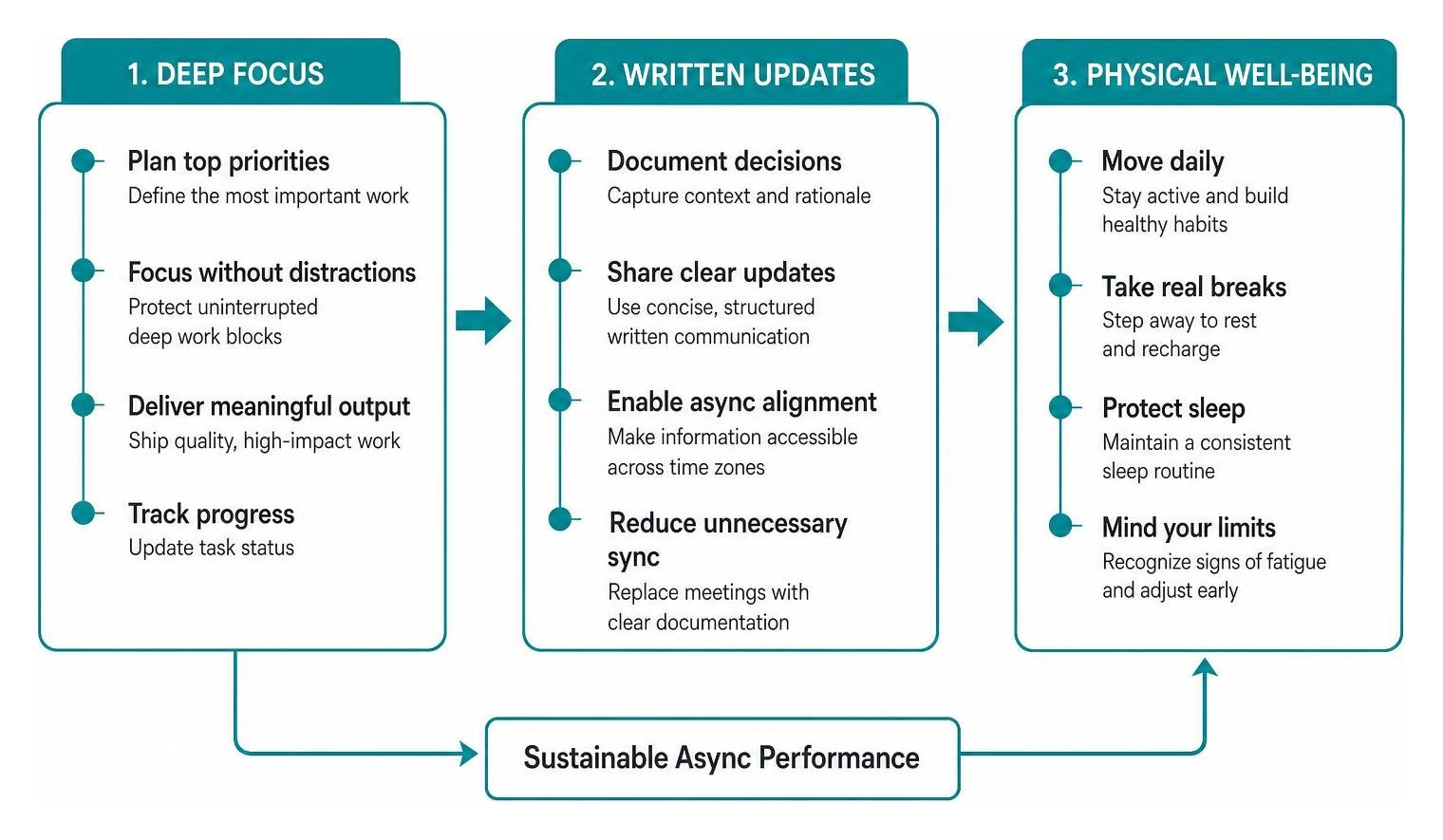
Prioritizing mental health, stepping away from screens, and staying active are vital to avoid exhaustion. Learn how to maintain balance with our tips on Staying Active as a Remote Developer and avoiding burnout through structured rest.
Key Tools Driving Asynchronous Development
Async culture relies on a modern software stack designed to replace live conversations with permanent records:
- Documentation Hubs: Tools like Notion house engineering specs, brand guidelines, and public company handbooks.
- Asynchronous Video & Messaging: Platforms like Loom allow engineers to share screen recordings walking through code changes, while Slack is used with notification boundaries.
- AI-Assisted Development Environments: Editors like Cursor and models like Claude allow developers to prototype fast, run self-evaluations, and solve bugs independently before requesting human code reviews. Explore our top software picks in the Best Async Communication Tools breakdown.
Compensation Structures and Job Search Strategies
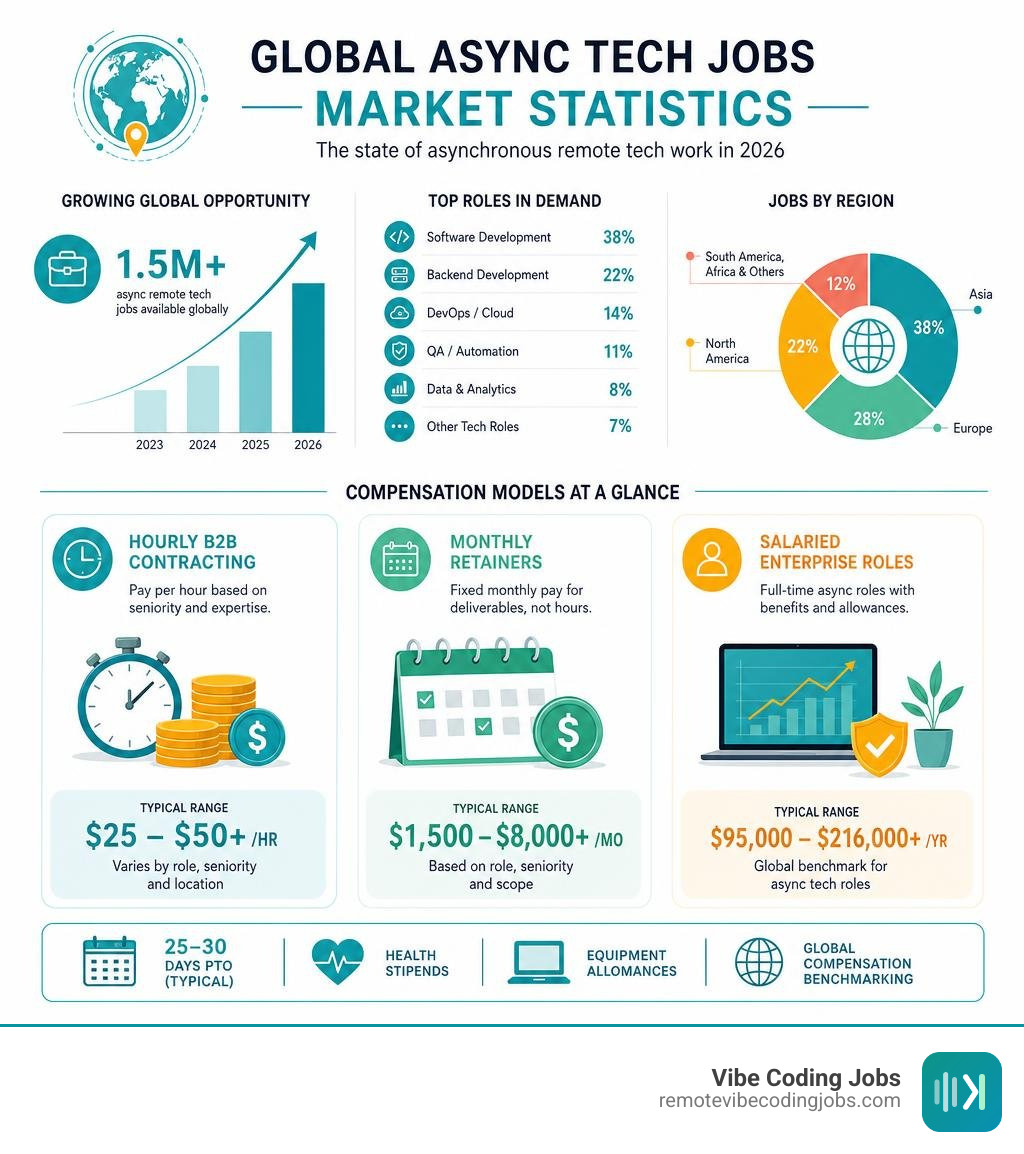
Asynchronous positions span various employment models, from micro-task freelancing to salaried B2B engineering contracts.
Compensation Models for Async Remote Tech Roles
- Hourly B2B Contracting: Common for specialized roles. Hourly rates vary widely based on seniority and domain expertise—for example, $25–$33/hr for general content reviewers up to 160–200 PLN/hr ($40–$50/hr USD equivalent) for Senior Python Developers in Eastern Europe.
- Monthly Retainers: Many full-stack and backend contract positions pay fixed monthly amounts (e.g., $1,500–$2,500/month for part-time/mid-level, up to $8,000+/month for senior engineers) for target deliverables regardless of exact hours worked.
- Salaried Enterprise Roles: Async-first global SaaS platforms offer full global salary benchmarking ($95,000–$216,000+ USD), complete with flexible PTO targets (25–30 days per year), health stipends, and equipment allowances via Employer of Record platforms like Deel.
Identifying Legitimate Positions and Avoiding Scams
With thousands of remote listings published daily, filtering out exploitative arrangements or scams is crucial:
- Check for Public Documentation: Reputable async companies maintain public handbooks detailing their operational values and pay tiers.
- Transparent Specs: Legitimate postings clearly state salary ranges, hourly commitments, and time-zone overlap expectations.
- Fair Interview Assessments: Avoid companies demanding days of unpaid labor. Look for paid trial tasks or portfolio-based hiring. For alternative technical evaluations, check our resource on finding Remote Coding Jobs without LeetCode.
Frequently Asked Questions About Asynchronous Tech Work
What is the typical weekly hour commitment for async AI evaluation roles?
Most entry-to-mid-level contributor programs offer flexible workloads of approximately 5 to 20 hours per week. Senior full-stack or backend AI data infrastructure roles generally require 20 to 40 hours per week.
Do async remote positions require fixed daily working hours?
Generally, no. Most async setups let you structure your work hours around your personal peak productivity times. However, some companies ask for a light synchronous overlap window (e.g., 4 hours daily) to conduct architectural design reviews or team check-ins.
Which industries hire the most asynchronous remote tech workers?
AI model training platforms, developer tooling startups, specialized SaaS vendors, and global HR/EOR enterprises lead the market in adopting fully asynchronous workflows.
Conclusion
Asynchronous remote tech roles represent a fundamental shift in how global software development operates. By removing constant meetings and localized schedule constraints, async work gives tech professionals unparalleled daily flexibility, deep focus time, and access to international engineering teams.
Whether you’re building high-load Python telemetry backends, leveraging Cursor and Claude for vibe coding, or evaluating LLM outputs, success comes down to strong self-discipline and clear written communication.
Ready to find your next flexible development role? Browse Swift Remote Coding Jobs on our curated board today to connect with async-first teams hiring worldwide!