
Why Remote SSIS Developer Jobs Still Offer Strong Data Careers
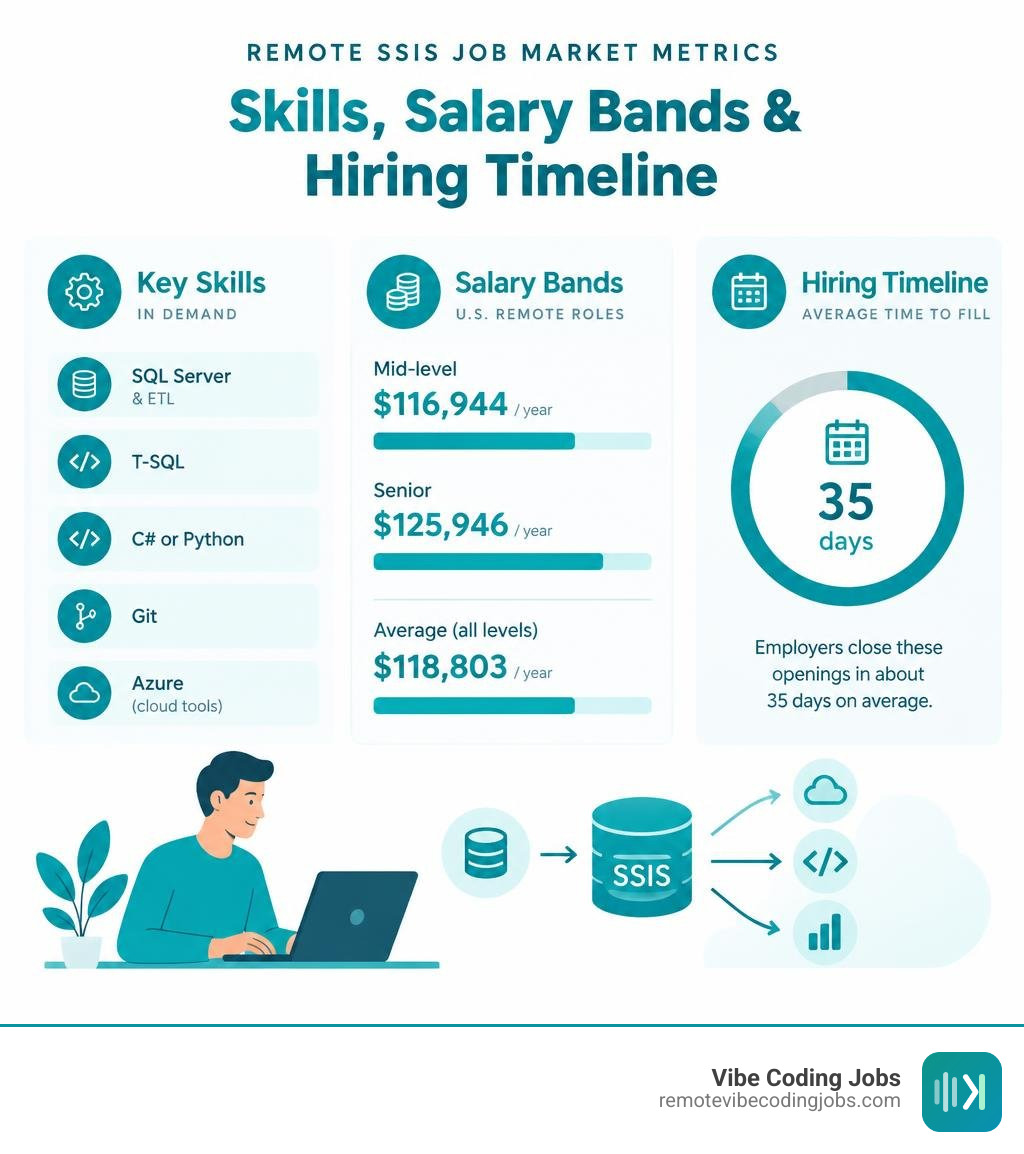
Remote SSIS developer jobs remain a practical path into enterprise data engineering. Start by targeting roles that match your SQL Server and ETL experience, then strengthen your profile with T-SQL, C# or Python, Git, and cloud tools such as Azure. Look for titles like ETL Developer, SQL Developer, Database Developer, MSBI Developer, and Data Warehouse Specialist.
The market is shifting, not disappearing. SSIS is still central to many large data warehouses, especially in healthcare, finance, insurance, and public-sector work. But employers increasingly want developers who can maintain reliable SSIS packages and connect them to modern cloud, API, scripting, and monitoring workflows.
Current U.S. listing data puts average remote SSIS pay at $118,803 per year. Mid-level roles average $116,944, while senior roles average $125,946. Hiring moves fairly quickly too: employers close these openings in about 35 days on average.
I’m Di Su, a software engineer with 10+ years of experience building scalable web and Python-based workflows, plus a background in conversion and product growth. In this guide, I’ll help you assess remote SSIS developer jobs with the same practical lens: clear skills, real work proof, and roles that fit how you want to work.
Remote ssis developer jobs definitions:
Key Market Insights and Compensation for Remote SSIS Developer Jobs
Enterprise data infrastructure depends heavily on reliable extract, transform, and load workflows. Because companies maintain decades of mission-critical data within SQL Server ecosystems, demand for professionals who understand integration architecture remains steady. Reviewing real-world listings demonstrates that companies prioritize seasoned practitioners who keep data pipelines running smoothly while bridging the gap to cloud data warehouses.
Compensation varies depending on your depth of experience, your ability to handle complex pipeline optimization, and the contract structure of the position. Exploring compensation benchmarks across technical tiers reveals that remote ETL and database roles reward cross-functional problem solvers.
| Experience Level / Role Type | Average Annual Salary / Hourly Rate | Typical Years of Experience | Core Competency Focus |
|---|---|---|---|
| Junior / Associate Developer | $85,150 / year | 0–2 years | Basic SSIS maintenance, T-SQL scripting, bug fixes |
| Mid-Level SSIS Developer | $116,944 / year | 2–4 years | Package design, data warehousing, performance tuning |
| Senior SSIS / Data Engineer | $125,946 – $155,000 / year | 5–9 years | Architecture, hybrid pipelines, C#/Python scripting, root-cause resolution |
| Lead / Enterprise Data Architect | Up to $180,000 / year | 10+ years | Modernization strategy, Azure Synapse, enterprise data governance |
| Contract / 1099 Specialist | $64 – $90 / hour | 3–7+ years | Pipeline migrations, emergency support, API integrations |
The average hiring window of 35 days reflects deliberate technical screening. Hiring managers test your ability to debug complex stored procedures, implement resilient error logging, and communicate asynchronously across distributed environments.
Top Hiring Sectors and Industries for Remote SSIS Developer Jobs
SSIS remains the backbone of structured data operations across sectors that handle massive transaction volumes and strict regulatory standards:
- Healthcare Systems and Insurance: Hospital networks, population health managers, and payer platforms rely on SSIS to process patient billing, EHR migrations, and claims analytics. Roles in this space often support systems handling Medicare Advantage or revenue cycle data.
- Financial Services and Banking: Loan origination platforms, retail banks, and wealth management firms use SSIS to unify customer transactions, balance ledger records, and interface with backend systems. Many financial platforms integrate SSIS with backend APIs to support real-time reporting and reconciliation.
- Supply Chain and Retail: E-commerce companies and logistics providers run nightly ETL batches to align inventory levels, reconcile supplier invoices, and populate reporting dashboards.
- Government and Public Sector: Federal agencies and defense contractors require database specialists for data modernization. These positions frequently require candidates to possess or qualify for Public Trust clearance.
Essential Technical Skills and Modern Tooling Stack
The technical stack expected from candidates has expanded beyond basic drag-and-drop Visual Studio workflows. Analysis of current job requisitions reveals clear priorities:
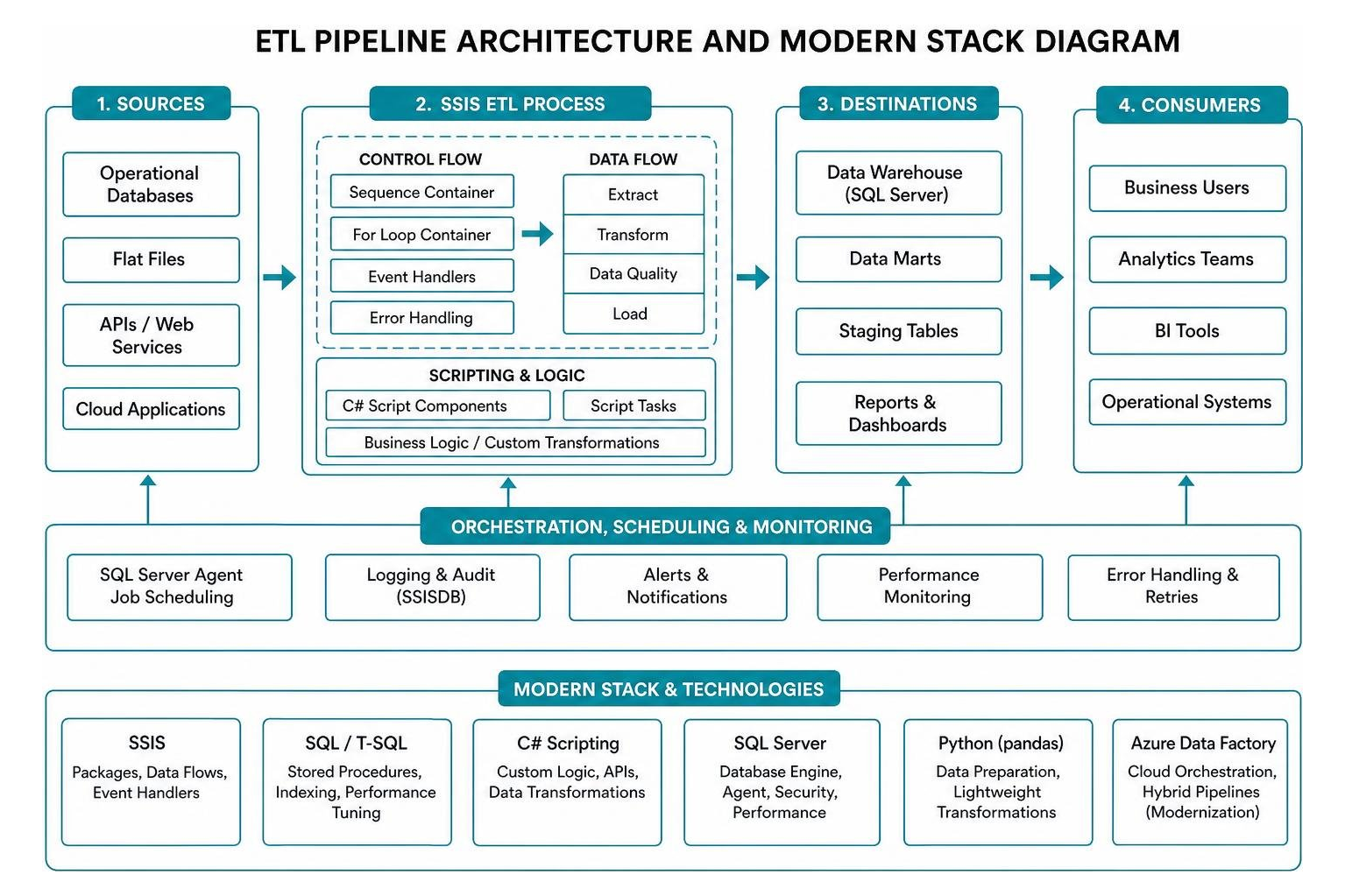
- SSIS (61.1% of postings): Building modular control flows, data flow transformations, incremental loads, and event handlers with SQL Server Integration Services.
- SQL / T-SQL (58.3% of postings): Writing complex stored procedures, indexing strategies, CTEs, window functions, and query plan optimization.
- ETL Pipeline Architecture (38.9% of postings): Data staging strategies, slowly changing dimensions (SCD Types 1, 2, and 3), and audit logging frameworks.
- C# Scripting (31.9% of postings): Script Components and Script Tasks within SSIS for custom parsing, regex processing, and REST API calls.
- SQL Server & Database Administration (29.2% of postings): SQL Agent job scheduling, transaction logs, and server performance monitoring.
Modern engineering teams increasingly look for candidates who complement their foundational SQL knowledge with in-demand data development capabilities, such as Python with pandas for lightweight data preparation and Azure Data Factory (ADF) for cloud orchestration.
Core Roles, Work Models, and Daily Responsibilities
Working remotely as an SSIS developer involves a balanced mix of system maintenance, pipeline construction, and cross-team communication. You ensure that business stakeholders receive clean, accurate data every morning.
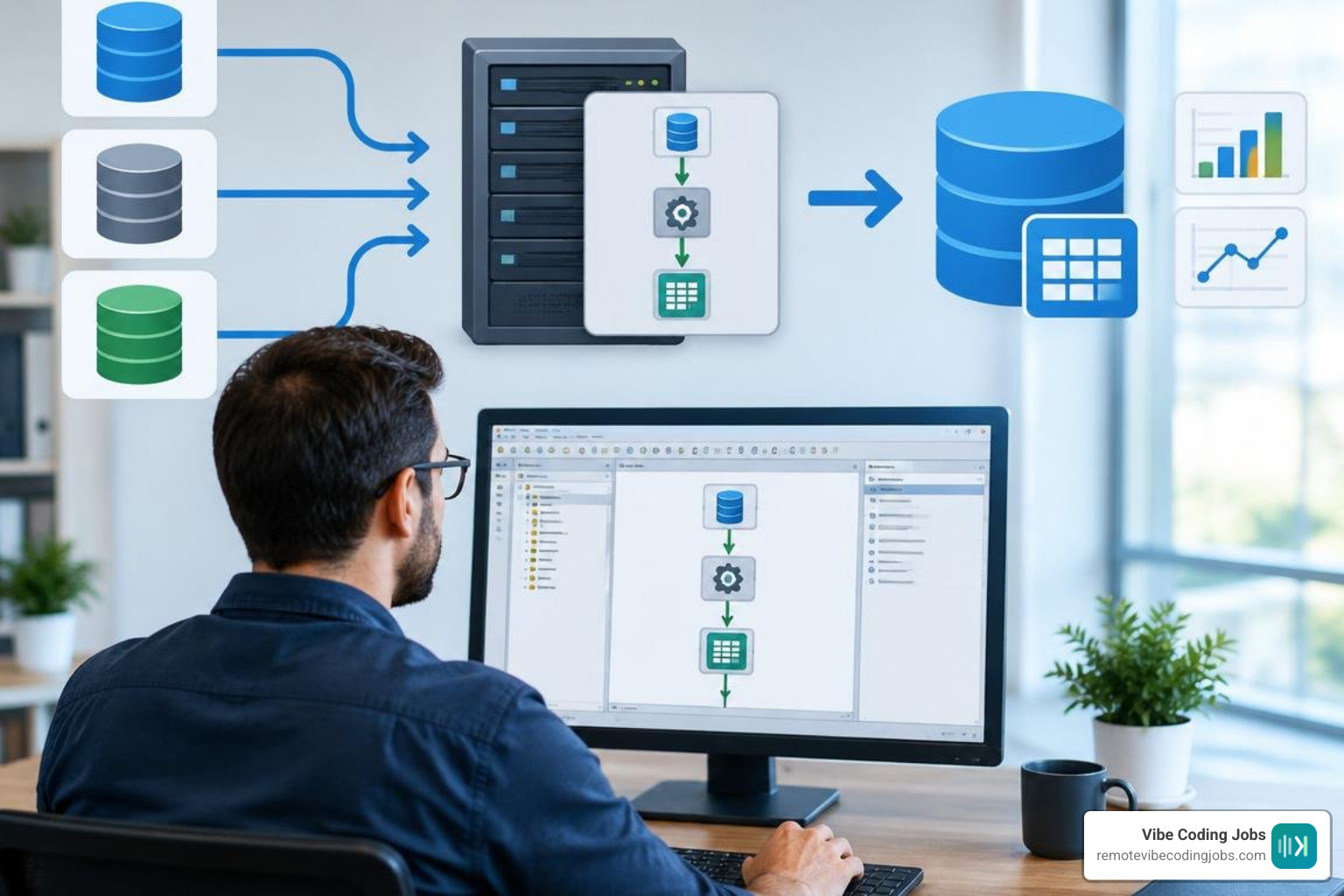
A typical day includes:
- Pipeline Health Monitoring: Inspecting overnight execution logs, resolving failed SQL Agent jobs, and addressing data anomalies before business hours begin.
- Package Construction & Refactoring: Developing new data integration packages or updating existing mappings to accommodate changing source schemas.
- Database Performance Tuning: Analyzing query execution plans, refactoring expensive joins, rebuilding indexes, and partitioning large database tables.
- Data Validation & Testing: Writing automated verification scripts to ensure row counts, checksums, and business logic align across staging and production tables.
- Technical Documentation: Maintaining metadata dictionaries, mapping documents, and architecture runbooks so async team members can troubleshoot issues seamlessly.
Many remote SQL developer and data warehouse specialist roles emphasize that roughly 80% of routine workload involves safeguarding data integrity, optimizing queries, and modernizing existing packages.
Remote vs Hybrid vs Onsite SSIS Work Dynamics
While onsite positions often pull developers into physical server room maintenance and ad-hoc desk interruptions, remote positions emphasize disciplined self-service operations:
- Timezone Scheduling: Many U.S. remote teams require core alignment with Eastern Standard Time (EST) or Central Standard Time (CST) to support real-time data syncs and business review sessions.
- Asynchronous Collaboration: Rather than whiteboarding in person, remote engineers communicate through pull request reviews, detailed Jira/Azure DevOps tickets, and recorded video walkthroughs.
- Production Support & Alerting: Remote teams depend on automated alerting tools such as Azure Monitor, Grafana, and Slack webhooks to surface pipeline exceptions immediately, enabling swift root-cause analysis without physical proximity.
Common Job Titles and Experience Expectations
Job listings reflect diverse functional focus areas:
- ETL Developer / Data Mapper: Concentrates on data ingestion, field mapping rules, and schema transformation. These roles often bridge business logic with database development.
- SSIS / SSRS Developer: Combines backend ETL workflows with reporting visualizations and automated dashboard exports.
- Data Warehouse Specialist: Architectures star and snowflake schemas, optimizes data marts, and manages staging storage.
- Hybrid Cloud Data Engineer: Builds bridge pipelines connecting on-premise SQL databases with cloud resources, including serverless functions and managed integration services.
Senior roles generally mandate 5 to 7+ years of hands-on SQL Server experience, while mid-tier positions require 2 to 4 years of proven package design.
How to Stand Out and Land Top Remote Roles
Because remote engineering managers evaluate candidates without in-person interactions, demonstrating clean code habits and proactive communication is critical to landing offers.

- Demonstrate Version Control Discipline: Traditional SSIS development suffered from poor source control practices. Show that you manage
.dtsxpackages, environment parameters, and deployment scripts inside Git repositories. - Showcase Modern Scripting: Highlight practical C# script tasks and Python scripts that interact with REST endpoints or parse nested JSON payloads.
- Emphasize Performance Tuning Metrics: Frame resume achievements around quantifiable business impact. Instead of writing “Optimized stored procedures,” write “Refactored 12 core ETL stored procedures, reducing nightly batch window from 4.5 hours to 1 hour and 40 minutes.”
- Leverage Practical Portfolios: Many remote companies favor practical project portfolios over algorithm tests when evaluating experienced data developers. Building a complete end-to-end pipeline project showcasing data ingestion, error logging tables, and automated alerting demonstrates ready-to-deploy proficiency.
Best Sourcing Strategies to Find Remote SSIS Developer Jobs and Avoid Scams
Navigating the remote job market requires filtering out stale listings and fraudulent recruitment schemes:
- Check Job Posting Freshness: Data indicates high response rates occur when applying to roles posted within the last 10 to 14 days. Listings that sit untouched for months often represent talent-pool collection rather than active openings.
- Verify Direct Employment Types: Clarify whether the role is a direct W2 Full-Time Equivalent (FTE) position, a W2 hourly contract, or a 1099/C2C engagement before completing lengthy interview rounds.
- Watch for Scam Red Flags: Legitimate employers never ask for payment for home office equipment or conduct comprehensive hiring processes entirely via unverified direct message apps. Always check company domains and cross-reference recruiter profiles.
Future Trends and Career Growth Paths
The SSIS developer role is evolving into modern data engineering. Enterprises are actively executing hybrid cloud migrations, integrating legacy SQL Server setups with platforms like Azure Data Factory, Snowflake, and Databricks.
Developers who combine SSIS expertise with cloud services, serverless triggers (like AWS Lambda or Azure Functions), and modern scripting can chart a robust long-term engineering career trajectory. As AI-assisted tools streamline routine T-SQL scripting, the high-value engineering skill remains designing resilient, self-healing data architectures.
Frequently Asked Questions about Remote SSIS Development
What is the average salary for remote SSIS developers in 2026?
The national average salary for remote SSIS developers in the United States is $118,803 per year. Junior positions start around $85,150, mid-level roles average $116,944, senior developers earn between $125,946 and $155,000, and lead architects command upwards of $180,000. Hourly contracting rates typically range from $64 to $90 per hour depending on project urgency and specialization.
Is SSIS still in demand given the rise of cloud ETL tools?
Yes. While modern cloud tools like Azure Data Factory and dbt have grown rapidly, thousands of large enterprises maintain complex on-premise SQL Server ecosystems that cannot be rewritten overnight. SSIS remains heavily utilized in healthcare, banking, and manufacturing due to its cost efficiency, robust transaction control, and deep integration with the Microsoft Business Intelligence stack.
How can SSIS developers transition into broader cloud data engineering?
SSIS developers already understand foundational data principles: schema design, dimensional modeling, incremental loading, and error handling. You can transition smoothly by learning:
- Azure Data Factory (ADF): Understand how to migrate SSIS packages into Azure-SSIS Integration Runtimes and build native ADF pipelines.
- Python for Data Engineering: Learn pandas, PySpark, and REST API consumption.
- Cloud Data Warehouses: Gain practical experience with Snowflake, Google BigQuery, or Azure Synapse.
- CI/CD for Data: Automate deployments using Azure DevOps or GitHub Actions.
Conclusion
Remote SSIS development continues to provide dependable, high-compensating career opportunities for data professionals who combine core SQL mastery with modern development practices. By focusing on measurable pipeline performance, expanding your scripting toolbox with C# and Python, and adopting cloud-ready workflows, you position yourself as an essential asset to enterprise engineering teams.
Explore curated remote engineering opportunities and accelerate your career path at RemoteVibeCodingJobs.