Master the Vibe with These Top Online Coding Courses
The Best Vibe Coding Course Online in 2026: A Quick Guide
If you’re looking for a vibe coding course online, here are the top options available right now:
| Course | Platform | Level | Cost | Duration |
|---|---|---|---|---|
| Vibe Coding Essentials – Build Apps with AI | Coursera | Beginner | Free to audit | ~4 weeks |
| Intro to Vibe Coding | Codecademy | Beginner | Free | 1 hour |
| Vibe Coding Fundamentals | Coursera | Beginner | Free to audit | 6 hours |
| Vibe Coding 101 with Replit | DeepLearning.AI | Beginner | Free (beta) | 1h 44m |
| Introduction to Vibe Coding | Microsoft Learn | Beginner | Free | 1h 20m |
| AI Agents Vibe Coding Course | Google/Kaggle | Intermediate | Free | 5 days |
| Cursor Course: FullStack Development | Udemy | Intermediate | Paid | Self-paced |
Something big is happening in software development. vibe coding course online searches have exploded in 2026 — and for good reason. Andrej Karpathy coined the term “vibe coding” in early 2025, describing a workflow where you write in plain English and let AI handle the actual code. Since then, over 1 million apps have been built this way.
This isn’t a niche experiment. It’s a real shift in how software gets made.
Developers are reporting 5-10x speed increases. Non-technical founders are shipping MVPs in days instead of months. And platforms like Coursera, Codecademy, and Google’s Kaggle have all launched dedicated courses — with Coursera’s vibe coding specialization already pulling in over 15,000 enrolled learners.
Whether you’ve never written a line of code or you’re a senior engineer wanting to move faster, there’s a course built for your level.
We’ve rounded up the best options below — organized by platform, skill level, cost, and what you’ll actually build.
About the author: This guide was put together by the RVCJ Editorial team at Remote Vibe Coding Jobs — we track AI-assisted development trends, tools like Cursor, Claude, Copilot, and Replit, and the remote job market for vibe coders, making us well-placed to cut through the noise on every vibe coding course online. Read on for our full breakdown of the top programs in 2026.
What is Vibe Coding and Why is it the Future of Development?
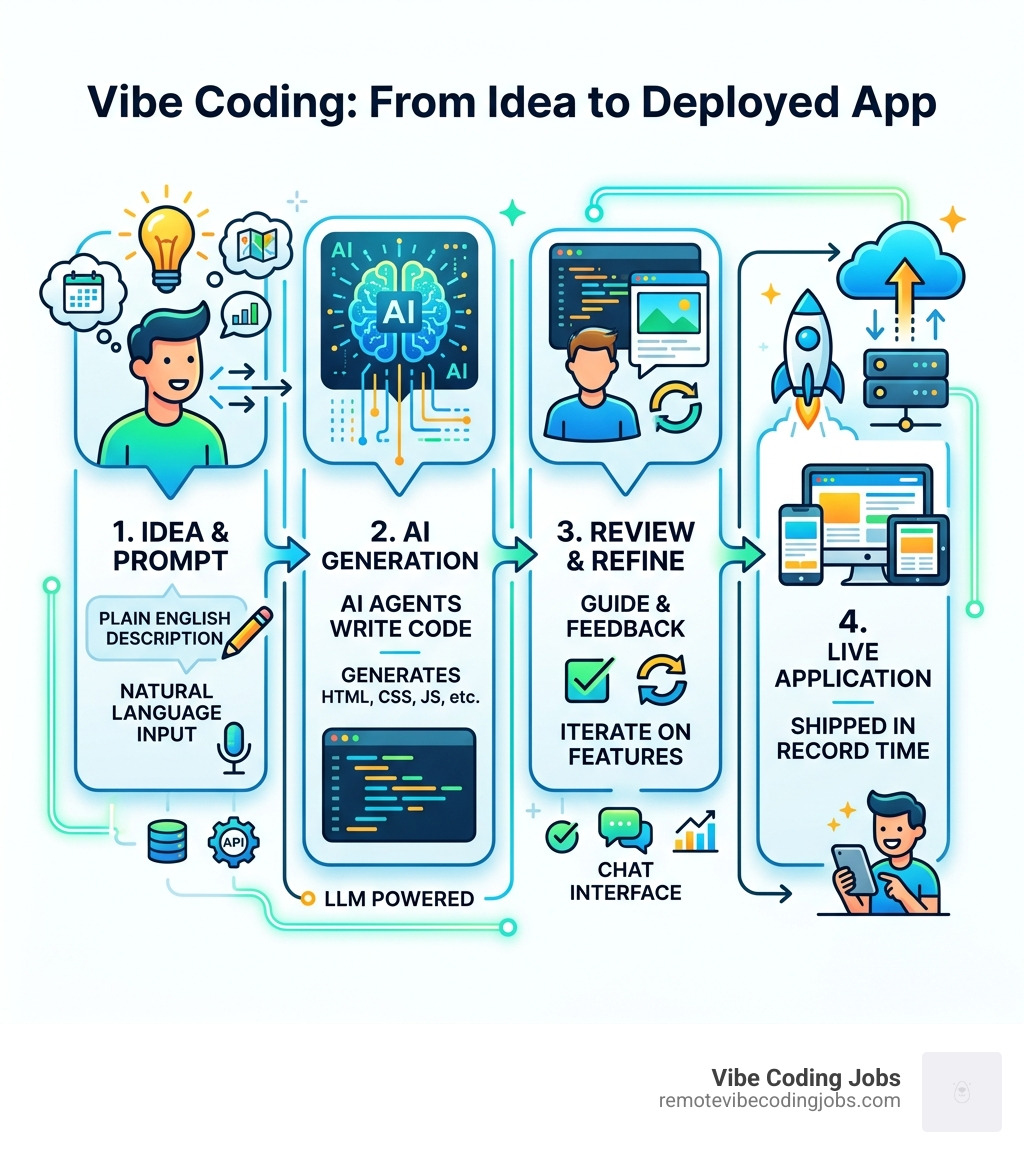
To understand why everyone is looking for a vibe coding course online, we first have to define What is Vibe Coding?. At its core, vibe coding is a fundamental shift in how we interact with computers. Instead of manually typing out every bracket and semicolon (traditional coding), you act as an architect or director. You describe the “vibe,” the logic, and the features in natural language, and AI agents handle the implementation.
Abstraction Levels and Natural Language
Traditional coding requires you to learn the specific syntax of languages like Python or JavaScript. Vibe coding operates at a higher abstraction level. You use English to describe a product, and tools like Cursor or Claude Code generate the functional code. This allows you to focus on software architecture and user experience rather than debugging a missing comma.
Productivity Gains: The 10x Developer
The statistics are staggering. Since the term was coined in early 2025, developers using these methods have seen productivity spikes of 2x to 5x within their first month of practice. Some indie hackers report being 10x faster, turning what used to be a two-week project into a two-hour task. This efficiency is why 62% of founders in recent startup batches used vibe coding to build their MVPs.
Context Engineering and AI Agents
The modern vibe coder doesn’t just “prompt” an LLM; they engage in context engineering. This involves providing the AI with the right project structure, naming conventions, and documentation so the AI agents can work autonomously. It’s the difference between asking for a “to-do list app” and orchestrating a multi-agent workflow that builds a production-ready system with a database and user authentication.
Top Platforms to Find a Vibe Coding Course Online
The educational landscape has caught up with the “vibe” era. In 2026, several major platforms have emerged as leaders in providing structured learning paths for this new discipline.
Coursera
Coursera is currently the heavyweight champion of vibe coding education. Their Vibe Coding Fundamentals | Coursera course has already seen over 5,000 enrollments. They partner with industry leaders like DeepLearning.AI to offer specializations that bridge the gap between “no-code” and “pro-code.”
Udemy
If you prefer a wide variety of specific tool-based tutorials, Udemy is the place to go. With over 20+ specialized courses, you can find everything from deep dives into Cursor AI to beginner-to-pro guides for GitHub Copilot. For example, the “FullStack Development with Cursor” course has already trained over 9,500 students.
Codecademy
For those who want to jump in immediately, Codecademy offers interactive environments where you can test your “vibes” in real-time. Their introductory course is a favorite for those who want a quick, hands-on experience without a massive time commitment.
Microsoft Learn and Google Kaggle
The tech giants are also in the game. Microsoft Learn provides modules specifically for vibe coding with GitHub Copilot, while Google and Kaggle’s “AI Agents Intensive” reached a massive 1.5 million learners in its first run. These courses focus heavily on production-ready systems and tool integration.
Beginner-Friendly Vibe Coding Course Online Options
If you have zero prior coding experience, don’t worry. Vibe coding is specifically designed to lower the barrier to entry. Many people are using it as a bridge for a Career Change Vibe Coding.
- Intro to Vibe Coding | Codecademy: This is a 1-hour “vibe” check. It covers the history of the movement and teaches you how to use the Cursor IDE to build your first web app.
- How to Vibe Coding AI Tools Beginner: This guide helps you understand the initial setup—from installing a terminal to writing your first effective prompt.
- Vibe Coding 101 with Replit: This 104-minute course from DeepLearning.AI focuses on a “five-skill framework”: thinking, using frameworks, checkpoints, debugging, and providing context. It’s perfect for non-technical founders who want to build a website performance analyzer or a simple voting app.
Advanced Vibe Coding Course Online for Production Apps
For those looking to build more than just prototypes, advanced courses focus on agentic workflows and deployment.
- Vibe Coding – AI Development Course: This intensive program focuses on going from idea to MVP in days. It covers user psychology, rapid prototyping, and how to scale a product to millions of users.
- Model Context Protocol (MCP): Advanced courses now teach MCP as a foundational skill. This protocol allows your AI agents to connect to local data and external tools, making them far more powerful than a standard chatbot.
- Multi-Agent Orchestration: Programs like the CodeLeap bootcamp teach you how to steer multiple AI agents simultaneously—one for the frontend, one for the backend, and one for testing—ensuring zero merge conflicts and production-quality code.
Essential Tools Taught in Modern Vibe Coding Programs
A vibe coding course online is only as good as the tools it teaches. In 2026, the ecosystem has solidified around a few key players.
- Cursor AI: Frequently cited as the #1 IDE for vibe coding. It features inline prompting and a deep understanding of your entire codebase.
- Claude Code: A powerful agentic tool that can execute terminal commands and write complex logic across multiple files.
- GitHub Copilot: The industry standard for enterprise teams, now featuring specialized “agents” for prototyping.
- Windsurf: An emerging “flow-state” IDE that emphasizes the intuitive rhythm of coding.
- Replit Agents: A cloud-based environment where you can describe an app and watch the agent build, debug, and deploy it for you.
- Vercel v0: A specialized tool for generating high-quality UI components using natural language.
The Vibe Coding Essentials – Build Apps with AI Specialization – Coursera is a great place to see all these tools in action. It teaches you how to manage “context windows” and use “slash commands” to guide the AI through complex refactoring.
Comparing Free vs. Paid Vibe Coding Education
Choosing between a free or paid vibe coding course online depends on your goals.
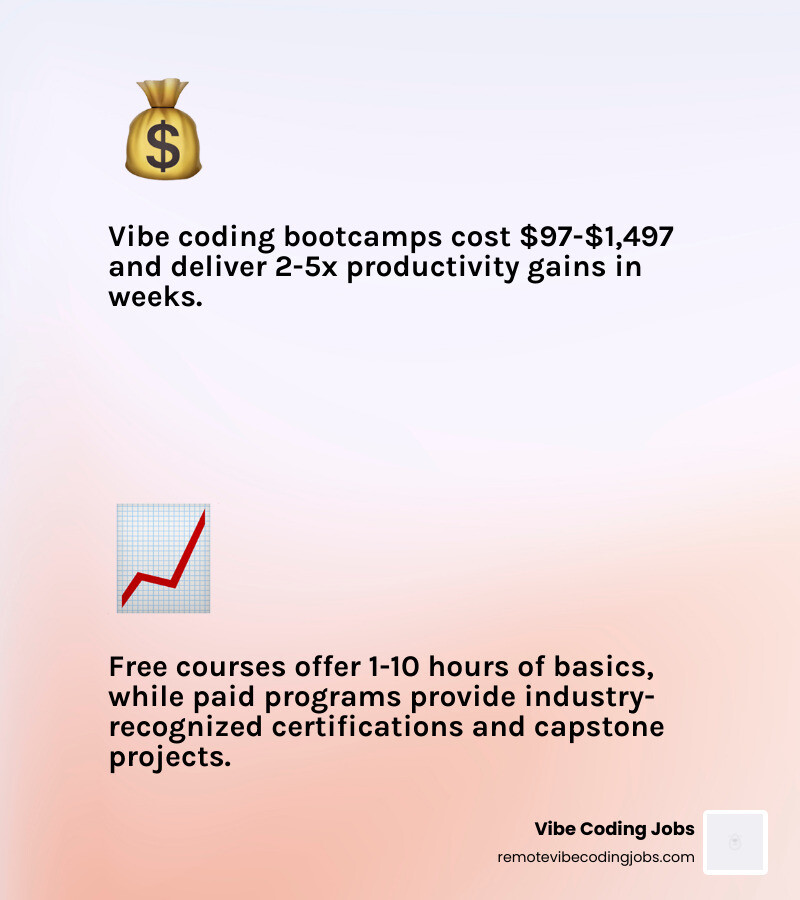
| Feature | Free Courses (Kaggle, Microsoft) | Paid Bootcamps (CodeLeap, Vibe Coders) |
|---|---|---|
| Cost | $0 | $97 – $1,497 |
| Duration | 1 – 10 hours | 5 hours – 8 weeks |
| Certification | Basic completion | Professional/Industry recognized |
| Support | Community forums | 1-on-1 Mentorship |
| Outcome | Conceptual knowledge | Production-ready Portfolio |
Paid courses often provide the best ROI for those seeking a Vibe Coding Salary Guide level income. For example, a $997 bootcamp might help a non-technical founder build an MVP that raises a pre-seed round, while a $20 Udemy course might be enough for a developer to double their daily output.
Frequently Asked Questions about Vibe Coding
Do I need prior experience for a vibe coding course online?
Not necessarily. While a basic understanding of logic and how web apps work is helpful, many courses are designed for complete beginners. You don’t need to know how to write a React hook, but you should know what a web browser is and how to follow instructions in a terminal. If you are looking for a Career Change Vibe Coding, these courses are the perfect entry point.
Are vibe coding certificates valuable in 2026?
Yes. Over 60% of recruiters now recognize certificates from platforms like Coursera and IBM as credible evidence of skill. More importantly, the portfolio you build during these courses serves as “proof of vibe.” Showing a functional, deployed app that you architected with AI is often more valuable than a traditional degree in the current Vibe Coding Careers Remote Job Market.
How long does it take to learn vibe coding?
You can learn the basics in as little as one hour with an intro course. However, becoming a “10x vibe coder” who can handle production-ready apps usually takes 4 to 8 weeks of consistent practice. Most students report a significant productivity boost (2-5x) within their first month of using tools like Cursor.
Conclusion
The era of struggling over syntax is ending. Whether you’re an indie hacker, a non-technical founder, or a senior dev, taking a vibe coding course online is the fastest way to future-proof your career. By shifting your focus from “how to write code” to “how to architect solutions,” you unlock a level of productivity that was impossible just two years ago.
At Remote Vibe Coding Jobs, we see the demand for these skills every day. Companies are no longer just looking for “coders”—they want AI-fluent professionals who can ship products at the speed of thought.
Ready to put your new skills to work? Master AI-native tools for your next remote role and browse our curated listings of async-first, AI-forward companies today. The future of work is a vibe—make sure you’re part of it.