
How to Land Your First Remote Software Job Without Leaving Your Couch
Remote Software Engineering Internships Are Easier to Land Than You Think
Quick answer: How to find a remote software engineer internship in 2026
- Search specialized boards – platforms like Vibe Coding Jobs list remote-only roles updated daily
- Build a GitHub portfolio – real projects beat a perfect GPA every time
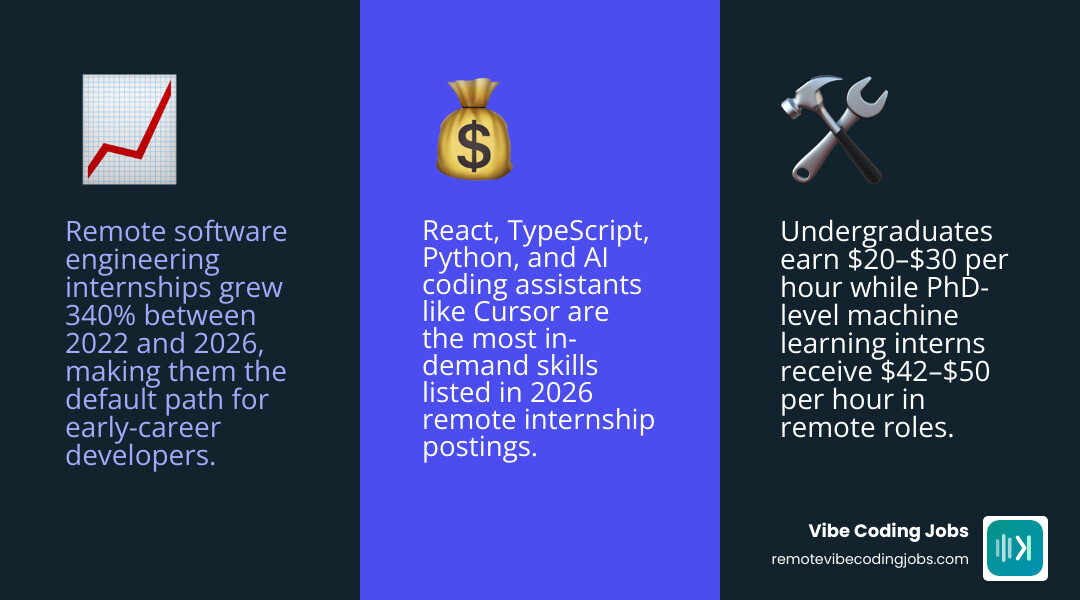
- Learn the right stack – React, TypeScript, Python, and AI tools like Cursor or Claude are most in-demand
- Apply directly – many roles (up to 59%) never appear on mainstream job boards
- Target the right companies – fintech, healthcare AI, SaaS startups, and developer tooling firms hire remote interns year-round
Landing a remote software engineer internship is no longer a long shot – it’s quickly becoming the default path for early-career developers in 2026. Right now, there are hundreds of open positions across the market, from structured 10-week programs at major financial institutions to fast-moving 8-week stints at startups where you ship real code to real users on day one.
The range is genuinely wide. Some roles pay $20/hour for undergrads building government SaaS platforms. Others offer $42-$50/hour for PhD-level machine learning work. A few early-stage startups offer equity plus a monthly stipend in exchange for high ownership and async independence.
The challenge isn’t that opportunities don’t exist – it’s knowing where to look and how to stand out.
I’m part of the RVCJ Editorial team at Vibe Coding Jobs, where we cover remote hiring trends, AI-assisted development workflows, and career-entry strategies for developers navigating the remote software engineer internship landscape. We’ve tracked hundreds of live roles and the patterns that separate candidates who land interviews from those who don’t.
Know your remote software engineer internship terms:
Essential Requirements for a remote software engineer internship
Landing a remote software engineer internship in 2026 requires a blend of traditional academic knowledge and modern, “vibe-forward” technical skills. While many programs still look for students currently pursuing a degree in Computer Science or a related Engineering field, the barrier to entry is shifting toward what you can actually build.
Most companies expect you to have completed at least two years of coursework, giving you a solid foundation in data structures and algorithms. However, we’ve seen a surge in “degree-optional” roles at startups that prioritize a robust GitHub portfolio over a diploma. If you can show a history of building and shipping end-to-end projects, you’re already ahead of 90% of the applicant pool.
Problem-solving remains the core requirement. In a remote setting, you won’t always have a senior dev leaning over your shoulder to help you debug a memory leak. You need to demonstrate that you can independently navigate documentation, leverage AI-assisted development tools, and communicate your technical hurdles clearly through async channels.
Technical Skills and Modern Tooling
The “must-have” tech stack for 2026 has solidified around a few key players. If you want to be competitive, you should be comfortable with:
- Frontend: React, Next.js, and TypeScript are the industry standards.
- Backend: Node.js, Python (especially for AI/ML roles), Go, and SQL for database management.
- AI Coding Assistants: Proficiency in tools like Cursor, Claude, and GitHub Copilot is no longer “cheating”—it’s a requirement. Companies like Softeta and Sealed Security explicitly look for interns who can use these tools to accelerate output while maintaining code quality.
- Version Control: You must be a Git wizard. Understanding branching, PR reviews, and merge conflict resolution is non-negotiable for remote teams.
- Cloud & CI/CD: Basic familiarity with AWS (EC2, Cognito), Azure, or Docker will make your resume pop.
Check out our guide on How to Get a Vibe Coding Job: Requirements & Qualifications for a deeper dive into these skills.
Soft Skills for Async Environments
In a remote internship, your “soft” skills are actually “hard” requirements. Since you aren’t in a physical office, your writing is your presence.
- Communication: You need to be a proactive communicator. This means writing clear, concise Slack updates and documenting your code so others can understand it without a Zoom call.
- Autonomy: You’ll often work in a “founder-led” environment where you’re expected to own a project from start to finish.
- Time Management: Working across time zones (like the common 9 AM – 2 PM PT “sync window”) requires discipline.
- Agile Workflows: Most remote teams use some form of Agile or Scrum. Being comfortable with Jira tickets and sprint planning is essential.
Where to Find Remote Internships in 2026

The search for a remote software engineer internship has changed. While general-purpose job boards are still widely used, they are often flooded with thousands of applicants within minutes. In 2026, specialized platforms, company career pages, and community-maintained lists are often where the highest-quality leads live.
Currently, there are hundreds of remote-specific software engineer intern roles circulating across niche boards, startup hiring pages, and curated developer communities. It also helps to understand the broader remote work ecosystem, since many internship postings use terms like “distributed,” “async-first,” or “work from anywhere” instead of simply saying “remote.”
Finding a remote software engineer internship on Job Boards
We recommend a multi-pronged approach to your search:
- Vibe Coding Jobs: We aggregate roles that specifically value AI-assisted development and async-first cultures.
- Company career pages: Many remote-first teams publish internships on their own sites before they appear anywhere else.
- Community GitHub lists: Student-run and developer-run repositories often track fresh internship openings and application deadlines.
- Email alerts and niche newsletters: Set up targeted alerts for remote internships, software engineering intern roles, and AI-assisted development teams.
- Direct outreach: If you find a company that matches your stack and working style, applying directly can help you bypass crowded mainstream feeds.
For those just starting out, our list of AI Coding Jobs for Beginners is a great place to begin.
Startup vs. Enterprise Opportunities
Your experience will differ wildly depending on the company size:
- Startups: Expect high ownership, fast feedback loops, and the chance to ship a feature to production in your first week. These roles often use the latest tools like Claude Code and Cursor.
- Enterprise: These offer more structured mentorship, defined 10-week schedules, and clearer pathways to full-time Associate Software Engineer roles. Many also provide formal onboarding and intern cohort programming.
Compensation and Benefits: What to Expect

The “unpaid intern” is largely a thing of the past in software engineering. In 2026, compensation for a remote software engineer internship is competitive and often includes perks that rival full-time roles.
Typical Salary Ranges in 2026
Compensation is usually calculated hourly or as a monthly stipend. Based on our research, here is what you can expect:
| Level | Hourly Rate / Monthly Pay | Special Perks |
|---|---|---|
| Undergraduate | $20 – $30 / hour | Health insurance options, home office stipend |
| Graduate (MS) | $30 – $40 / hour | Travel stipends to HQ, performance bonuses |
| PhD / Specialized | $42 – $50 / hour | Research autonomy, premium project scope |
| Startup | $5,000 – $10,000 / month | Potential equity or high-ownership project work |
Across the market, some remote internship programs start around $20/hour, while more specialized machine learning and research-heavy internships can exceed $40/hour. Startup offers may be structured as a monthly stipend and can sometimes include equity depending on the company stage.
Check our Remote Developer Salary Expectations by Experience Level 2026 for more details.
Non-Monetary Perks
Remote internships often come with unique benefits designed to support a work-from-home lifestyle:
- Home Office Stipend: Many companies provide $500-$1,000 to get your desk, chair, and monitor set up.
- Flexible Hours: Aside from core sync hours (e.g., 9 AM – 2 PM PT), you often control your schedule.
- Extra time off: Some teams offer company-wide recharge days or occasional long weekends.
- Networking: Virtual events, mentorship pairings, and sometimes paid trips to headquarters for offsite weeks.
How to Successfully Apply for a Remote Software Engineer Internship
Applying for a remote role requires a different strategy than an in-person one. You aren’t just selling your coding skills; you’re selling your ability to work independently.
Optimizing Your GitHub and Portfolio
Your GitHub is your real resume. For a remote software engineer internship, recruiters want to see:
- End-to-End Projects: Don’t just fork a tutorial. Build a tool that solves a real problem, like an AI-powered personal finance tracker or a custom editor extension.
- Clean Documentation: A README that explains how to run your code and why you made certain architectural decisions shows you can communicate async.
- AI Integration: Show that you know how to use LLM APIs or have built projects using vibe coding techniques. Companies hiring AI-native interns often look for this kind of practical experience.
Learn more about this in How to Get a Vibe Coding Job: The Complete Guide.
Mastering the Virtual Interview
The interview process for a remote software engineer internship usually follows this path:
- Recruiter Video Call: A vibe check to see if you are a culture fit for a remote team.
- Technical Assessment: Often a live coding session via screen share or a take-home project.
- Virtual Onsite: 1-2 rounds with senior engineers focusing on system design and behavioral questions.
Tip: During live coding, narrate your thought process. In a remote setting, your interviewer can’t see your face clearly, so your voice must carry your logic.
Remote vs. In-Person: Impact on Your Career Development
Is a remote software engineer internship as valuable as an in-person one? In 2026, the answer is a resounding yes, but the experience is different.
The Long-term Value of a remote software engineer internship
Remote internships are “career accelerators” for several reasons:
- Full-Time Conversion: Many programs are designed as pipelines for Associate Software Engineer roles.
- Global Networking: You aren’t just meeting people in your city; you’re collaborating with engineers across the globe.
- Mastery of Remote Tools: Learning how to be productive in an async-first culture is a skill that will keep you employable for the rest of your life.
For more on this, see AI-Assisted Development Career Growth & Remote Opportunities.
Overcoming Remote Challenges
It’s not all unlimited PTO and working in pajamas. Remote internships have hurdles:
- Isolation: It can be lonely. You have to be the one to schedule virtual coffees with your teammates.
- Time Zones: Coordinating with a mentor in a different time zone requires meticulous planning.
- Technical Hurdles: When your local environment breaks, you can’t just tap a neighbor on the shoulder. You need to become an expert at troubleshooting.
Frequently Asked Questions about Remote Internships
What is the average pay for a remote software engineer intern in 2026?
The average pay ranges from $25 to $35 per hour for undergraduate students. Startups often pay a monthly stipend between $5,000 and $10,000, sometimes including equity. For more specifics, check our Vibe Coding Salary Guide: Remote Entry Level.
Do I need a degree to land a remote software engineering internship?
While most large companies require you to be pursuing a CS degree, many startups are skills-first. If you have a portfolio that proves you can ship production-ready code using modern AI tools, you can land a role at many early-stage firms without a degree. See Remote Coding Jobs: No LeetCode, No Tests, Easy Hiring for more.
How do I find remote internships that use AI coding tools?
Look for job descriptions that mention “vibe coding,” “Cursor,” “Claude Code,” or “agentic workflows.” Platforms like Vibe Coding Jobs specialize in these roles. Companies building AI-native engineering workflows are currently leading the way in hiring interns with these skills.
Conclusion
The remote software engineer internship is the ultimate gateway to a flexible, high-paying career in tech. Whether you’re building AI-driven healthcare tools or optimizing CI/CD pipelines for a fintech startup, the opportunities in 2026 are limitless for those who embrace the “vibe coding” revolution.
By focusing on a strong GitHub portfolio, mastering AI-assisted tools, and targeting specialized job boards, you can launch your career from anywhere in the world. Ready to find your first role? Start your journey with us at remotevibecodingjobs.com.