
Why Python AI Jobs Are the Ultimate Career Move in 2026
Finding the best python ai jobs in July 2026 has never been more exciting, but the market is moving incredibly fast.
With over 1,000 active listings in the US alone, companies are desperate for developers who can bridge the gap between clean backend code and intelligent models. But you do not need to spend hours scrolling through messy job boards to find the right fit.
Here is a quick snapshot of the Python AI job market today to help you start your search:
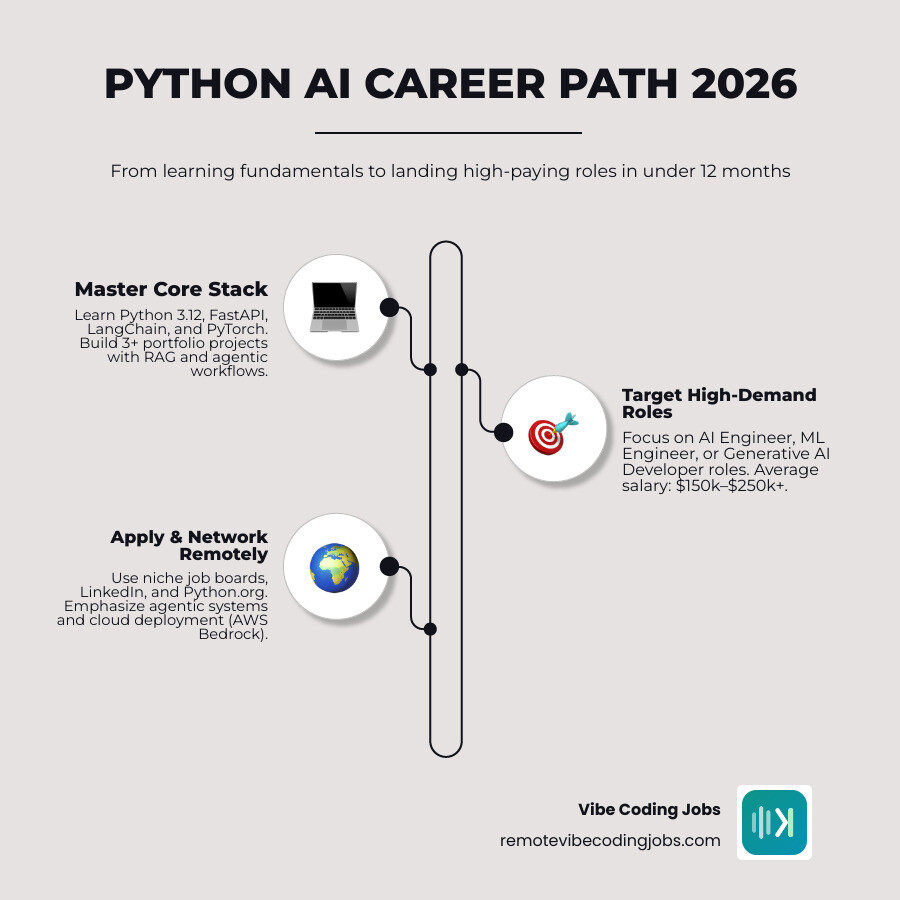
- Average Salaries: Full-time roles pay $150,000 to $250,000+ per year, while flexible AI training roles offer $50 to $100+ per hour.
- Top Tech Stack: Employers look for Python 3.12, FastAPI, LangChain, and AWS (Bedrock/SageMaker).
- The Big Shift: Companies are moving away from simple prompt engineering and hiring for agentic systems and vibe coding (AI-assisted workflows).
- Work Style: While major tech hubs like New York and San Francisco offer top dollar, fully remote and hybrid roles are highly prevalent.
I am Dominic Zijlstra. As the cofounder of Adaptify.ai and a former data scientist at iwoca, I have spent over a decade building automated systems and tracking the rise of python ai jobs. In this guide, I will share my insider knowledge to help you cut through the noise, master the right tools, and land a high-paying role.
The Landscape of Python AI Jobs in 2026
The market for python ai jobs has reached a fascinating tipping point. If we look at major platforms like LinkedIn, there are consistently over 1,000 active listings in the United States alone for roles combining Python, machine learning, and generative AI. Even the official Python Job Board regularly features active roles specifically tagged with Machine Learning or AI-Augmentation.
What makes 2026 different is who is hiring. It is no longer just venture-backed Silicon Valley startups. Traditional sectors like healthcare, corporate banking, and global media are aggressively recruiting Python AI talent to build proprietary tools, automate due diligence, and construct secure enterprise platforms.
To help you navigate these options, we have compiled a comparison of the primary career paths you will encounter during your job search:
| Job Title | Primary Focus | Core Python Stack | Infrastructure & Tools |
|---|---|---|---|
| AI Engineer | Integrating LLMs, building agentic systems, and deploying RAG pipelines. | FastAPI, LangChain, Pydantic-Ai, Milvus | AWS Bedrock, Docker, OpenTelemetry |
| Machine Learning Engineer | Training, fine-tuning, and deploying custom predictive models. | PyTorch, TensorFlow, Scikit-learn, Pandas | SageMaker, Kubernetes, MLflow |
| Data Scientist | Statistical analysis, business intelligence, and model prototyping. | Pandas, NumPy, Scikit-learn, SQL | Jupyter, Tableau, Snowflake |
Key Differences in Python AI Jobs: AI Engineers vs. Data Scientists
We often see candidates confuse AI engineering with traditional data science. While both roles require strong Python skills, their daily workflows and goals are completely different.
Data scientists are primarily analytical. They spend their time cleaning data, running statistical tests, and prototyping models in Jupyter Notebooks to answer business questions.
AI Engineers, on the other hand, are builders. They take those models—or API-based foundation models from OpenAI and Anthropic—and integrate them into scalable, production-ready software. This requires robust software engineering practices, asynchronous programming, microservices design, and a deep understanding of model deployment. If your passion lies in writing clean backend code that powers intelligent features, you should focus your efforts on Remote AI Engineer Jobs.
Geographic Hotspots and Remote Work Trends
While the tech world continues to embrace remote work, geographic hotspots still influence where physical offices and hybrid roles are concentrated. Major metropolitan areas like New York City, San Francisco, Chicago, and Dallas/Austin host the highest density of enterprise AI roles.
For example, large financial institutions in New York regularly recruit senior talent for hybrid positions to build internal generative AI platforms. However, if you prefer working from home, fully remote arrangements remain incredibly popular for senior-level engineers. International companies frequently hire remote developers across various regions, often listing roles like the Senior Python Engineer (AI) (#4498148101) – Office/Remote | N-iX to attract top global talent.
Essential Technical Skills and Frameworks for Python AI Roles
To stand out in the competitive landscape of python ai jobs, you must master the modern tools that production teams use daily.
The baseline requirement is a deep command of Python itself. Modern codebases are rapidly adopting Python 3.12, taking full advantage of its performance improvements and advanced typing features. Furthermore, because AI workloads involve heavy network and API I/O, writing high-performance, non-blocking code using asynchronous programming is no longer optional.
Here are the key frameworks you should focus on:
- API Frameworks: While Django and Flask are still widely used, FastAPI and newer asynchronous frameworks like Litestar are the industry standards for building high-load AI pipelines.
- Machine Learning Libraries: PyTorch remains the dominant framework for deep learning and model training, closely followed by TensorFlow and Scikit-learn for traditional machine learning tasks.
- AI Orchestration: Frameworks like LangChain and LangGraph are essential for connecting models to external tools, databases, and APIs.
- Structured Data Validation: Pydantic and Pydantic-Ai are heavily utilized to force large language models to return strict, typed JSON outputs that backend systems can safely process.
The Shift to Generative AI and Agentic Systems in Python AI Jobs
The industry is moving rapidly from simple single-prompt LLM wrappers to complex, autonomous architectures. Today, employers want to hire engineers who understand how to design Retrieval-Augmented Generation (RAG) pipelines and multi-agent systems.
RAG architectures connect large language models to external data sources. Building a production-grade RAG pipeline requires a solid understanding of document chunking, embeddings, and vector databases like Milvus, Pinecone, or Weaviate.
Furthermore, companies are now building “agentic systems”—workflows where multiple AI agents collaborate, plan, use tools, and recover from errors autonomously. If you want to work on these cutting-edge systems, check out specialized listings like the Remote Senior Generative AI LLM Engineer (Python, SQL) or explore advanced roles such as the Senior Python AI Engineer (LLM & Multi-Agent Systems) | Flexgen.
Cloud Platforms and MLOps Infrastructure
An elegant AI model is useless if it cannot run reliably at scale. This is why cloud infrastructure and MLOps skills are highly valued by hiring managers.
Most enterprise AI systems are built on major cloud providers like AWS (utilizing Bedrock and SageMaker) or Azure ML. To manage these complex environments, you should understand Infrastructure as Code (IaC) tools like Terraform, alongside containerization using Docker and Kubernetes.
Once your system is live, you must monitor its performance and latency. Modern AI stacks rely heavily on observability tools like OpenTelemetry for distributed tracing and Sentry for real-time error tracking. Understanding how to handle streaming responses, manage backpressure, and set up dead-letter queues in event-driven architectures is what separates junior developers from senior engineers. You can see these production-grade requirements reflected in postings like the Senior AI Software Engineer, Python | The Booking Agency.
Salary Ranges and Compensation Structures
The compensation for python ai jobs reflects the incredibly high demand for skilled builders. Depending on your experience, location, and specialization, these roles offer some of the most lucrative packages in the software industry.

- Senior/VP-Level Roles: Large financial institutions and enterprise tech giants offer vice-president level engineering roles with base salaries ranging from $140,000 to $215,000+ per year, often accompanied by generous stock options and bonuses. You can explore these high-end corporate structures by viewing the Senior Python AI Engineer (Hands-On), VP | Citi Careers.
- Contract and Hourly Rates: If you prefer flexibility, the contract market is thriving. Specialized AI training and data quality roles frequently pay anywhere from $50 to $100+ per hour, while top-tier consulting roles can reach significantly higher rates.
Entry-Level vs. Senior AI Engineer Compensation
If you are just starting out, do not be discouraged by the senior-focused listings. The rapid growth of the AI sector has created a massive parallel gig economy for junior talent and career changers.
Entry-level positions and AI training roles are fantastic stepping stones. They allow you to gain hands-on experience working directly with LLMs, refining prompts, and validating training data. As you build your portfolio and transition into full-time engineering, your earning potential will scale rapidly from entry-level baselines to the standard $150,000 – $250,000 senior bracket. To find accessible starting points, take a look at our curated list of AI Coding Jobs for Beginners.
Frequently Asked Questions About Python AI Jobs
What are the most common job titles for Python AI professionals?
The most frequent job titles you will see on modern job boards include:
- AI Engineer (focused on LLM integration, APIs, and agentic workflows)
- Machine Learning Engineer (focused on training and deploying custom models)
- Generative AI Developer (focused on prompt engineering, RAG, and application building)
To see how these titles translate to real-world responsibilities, check out active postings like the Python AI Engineer (Prompt & Agentic Systems) | Taskium.
Do I need a PhD to get a high-paying Python AI job?
Absolutely not. While academic research roles at companies like OpenAI or Google DeepMind still value advanced degrees, the vast majority of commercial python ai jobs prioritize practical software engineering skills.
Employers want to see that you can write clean, asynchronous Python code, build scalable APIs, design reliable RAG pipelines, and deploy secure systems. A strong portfolio of real-world projects, contributions to open-source libraries, or a track record of deploying applications to production is far more valuable than a theoretical degree. You can find many of these practical, hands-on roles by browsing listings like the Remote AI Engineer (Python, LLM, Agentic AI).
How is “vibe coding” changing Python AI development?
“Vibe coding” is a modern, lighthearted term for AI-assisted development. Instead of spending hours writing repetitive boilerplate code or memorizing complex syntax, developers use advanced AI coding assistants like Cursor and Claude to generate, debug, and optimize their code.
This shift allows you to focus your energy on high-level system architecture, security, API design, and solid engineering principles (like SOLID and DRY). Far from making developers obsolete, vibe coding makes you incredibly fast and productive. In fact, forward-thinking employers are now explicitly listing AI-assisted workflows as a preferred skill. If you want to work with teams that embrace these modern, high-speed development methods, explore our curated list of Python Remote Jobs (No Leetcode).
Conclusion
The demand for Python AI talent is not slowing down. Whether you want to build complex multi-agent systems for financial institutions, deploy scalable RAG pipelines, or leverage AI coding assistants to build software at lightning speed, there is a perfect role waiting for you.
At RemoteVibeCodingJobs, we make your job search simple. We aggregate the best remote “vibe coding” and Python AI jobs at async-first companies that value architectural thinking over manual syntax. We curate our daily listings by culture, tech stack, and modern AI tools like Cursor and Claude, offering you a free playbook and fast applications to jumpstart your next career move.
Ready to find your dream role? Explore our curated listings on Remote AI Engineer Jobs today!