
Why unlimited pto dev remote Jobs Are the Gold Standard in 2026
unlimited pto dev remote roles are the most sought-after positions in tech right now — and for good reason. Here’s a quick summary of what you need to know:
- Top companies with unlimited PTO and verified high remote scores include Deel (95), Grafana Labs (92), and GitLab (91)
- Over 2,282 remote dev jobs are currently available at companies with unlimited PTO policies
- Minimum PTO floors to look for: Sourcegraph (30 days), PostHog (25 days), Zapier (2 weeks)
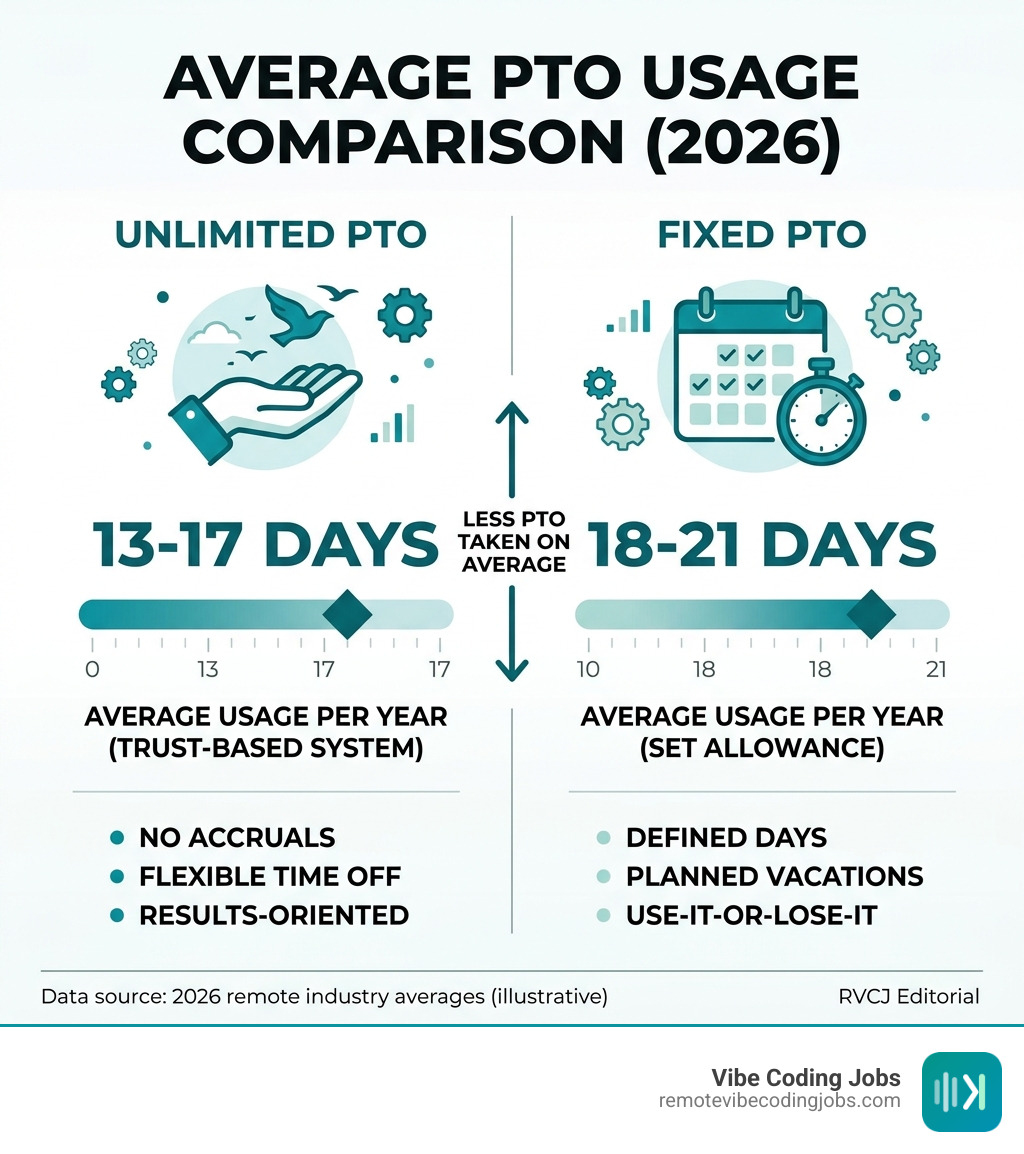
- Real usage with unlimited PTO averages 13-17 days/year — less than the 18-21 days taken under fixed policies
- Key signals of a healthy policy: published minimums, company-wide shutdowns, leaders who visibly take time off
The promise sounds great. But here’s the catch: unlimited doesn’t always mean more. Without a supportive culture behind it, unlimited PTO can quietly become less vacation than you’d get with a standard fixed allowance.
That gap matters a lot when you’re weighing job offers.
This guide cuts through the noise. It covers which remote dev companies actually back up their unlimited PTO policies, what to look for beyond the headline benefit, and how to find roles that fit your stack and your life.
I’m RVCJ Editorial from Remote Vibe Coding Jobs — our team tracks AI-assisted development trends, remote hiring, and developer career strategy, including the real-world nuances of unlimited PTO dev remote policies at async-first companies. We’ve reviewed hundreds of remote dev roles so you can quickly identify which perks are genuine and which are just marketing.
Understanding Unlimited PTO for Remote Software Developers
In April 2026, the traditional 9-to-5 is a relic. For software developers, the shift toward unlimited pto dev remote roles represents a transition from “time-in-seat” metrics to a results-oriented work environment. At its core, unlimited PTO means there is no set number of days you are “allowed” to take off. Instead, you are trusted to manage your workload and take the breaks you need to remain productive.
For remote developers, this is often paired with an async first remote developer jobs philosophy. When a company doesn’t care when you work, they usually don’t care if you’re working on a Tuesday afternoon—as long as your PRs are reviewed and your features ship on time. This trust-based management is the engine that makes unlimited PTO possible.

The Reality of unlimited pto dev remote Policies
While the term “unlimited” sounds like a dream, the data tells a more complicated story. Research indicates that employees under unlimited policies take an average of 13 to 17 vacation days per year. Compare that to the 18 to 21 days typically taken by those with fixed allowances, and you see the “unlimited trap.”
Why does this happen? Psychological barriers are the main culprit. Without a “use-it-or-lose-it” deadline at the end of December, many developers keep pushing, waiting for a “perfect time” to take a break that never comes. There is also the “guilt factor”—if there is no set number, how much is too much?
Healthy companies combat this by fostering a guilt-free culture. For example, the PostHog Time Off Handbook explicitly states that they expect team members to take at least 25 days off. This transparency removes the guesswork and gives developers “permission” to actually use the policy.
Why Fixed Allowances Often Result in More Days Off
Fixed PTO policies often act as a floor rather than a ceiling. When you have exactly 25 days in your “bank,” you view them as part of your hard-earned compensation—much like your salary. You are more likely to take them because you don’t want to “lose” that value.
In unlimited pto dev remote roles, peer pressure can inadvertently suppress vacation time. If your lead developer hasn’t taken a day off in six months, you might feel like you shouldn’t either. This is why we emphasize looking for remote developer jobs ai tools benefits roi that prioritize long-term sustainability over short-term grind. A company that encourages you to step away is a company that understands that a burnt-out developer is an expensive liability.
Top Companies Offering unlimited pto dev remote Roles in 2026
If you are looking for a role where “unlimited” isn’t just a buzzword, you need to look at companies with high REMOTE Scores. These scores evaluate companies based on work-life balance, compensation, and cultural transparency. Currently, there are 2,282 remote jobs available at companies with verified unlimited PTO policies.
| Company | REMOTE Score | Minimum PTO Expectation | Unique Perk |
|---|---|---|---|
| Deel | 95 | No specific minimum | 270+ open positions |
| GitLab | 91 | Encouraged usage | Public handbook transparency |
| Grafana Labs | 92 | 30 days + 3 shutdown days | Explicit leave days + unlimited |
| Zapier | 90+ | 2 weeks (minimum) | Most take 4-5 weeks |
| PostHog | 85+ | 25 days (minimum) | Permissionless time off |
Companies like Sourcegraph Jobs – Unlimited PTO and Netlify Jobs – Unlimited PTO have built reputations for being developer-first. Netlify, for instance, views its policy as a way to empower developers to “return inspired,” rather than just a way to avoid tracking hours.
Minimum Expectations at Leading Tech Firms
The best way to ensure you actually take time off is to join a company that mandates it.
- Sourcegraph: They enforce a 30-day minimum requirement. If you haven’t taken enough time, they will likely tap you on the shoulder and tell you to go away for a while.
- Zapier: They require a minimum of 2 weeks, though their internal data shows most employees take 4 to 5 weeks annually.
- PostHog: Their handbook sets an expectation of 25 days. They even mention that taking more than 40 days is fine, provided it doesn’t cause a massive strain on the team.
- Vercel: They recommend at least 4 weeks per year.
- Replit: As seen on Replit Jobs – Unlimited PTO, they prioritize output over hours worked, allowing for a highly flexible schedule.
High REMOTE Score Leaders for 2026
The leaders in the unlimited pto dev remote space are those that combine generous leave with high-impact work. Deel currently leads with a 95 REMOTE Score and hundreds of open positions. GitLab, a pioneer in the remote space, maintains a 91 score by documenting everything in their public handbook, ensuring no “shadow rules” govern your time off. Grafana Labs offers a unique hybrid: 30 days of annual leave plus 3 company shutdown days, all sitting alongside an unlimited policy. This ensures that even the most “workaholic” developers get at least 33 days of rest.
To find more of these, check out async first companies hiring developers to see who is currently scaling their engineering teams.
Evaluating unlimited pto dev remote Total Compensation
When you’re looking at a job offer, unlimited PTO can be tricky to value. A fixed 25-day policy has a clear dollar value (roughly 10% of your salary). Unlimited PTO has no “floor” unless the company specifies one.

To evaluate these offers properly, look at the full package:
- Equity: Is it meaningful?
- Health Coverage: Does it cover your region globally?
- Home Office Stipends: Companies like Vercel and Netlify provide generous budgets for your setup.
- Work-Life Balance: Check the remote javascript developer jobs career guide for tips on how to ask about “actual” days taken during the interview process.
Signals of a Healthy Unlimited PTO Culture
Don’t just take the recruiter’s word for it. Look for these “green flags”:
- Leadership Example: Do the VPs and Founders actually post vacation photos in Slack? If leadership doesn’t disconnect, the rest of the company won’t either.
- Company-Wide Shutdowns: Many healthy remote companies shut down for a week in July and a week in December. This is the ultimate “guilt-free” break because everyone is offline.
- Transparency: Does the company publish its time-off stats?
- 4-Day Standards: Some companies are moving toward 4-day work week developer jobs as a way to bake rest into the weekly schedule.
Perks Beyond the Vacation Policy
The best unlimited pto dev remote roles offer more than just “days off.” They invest in your growth and environment.
- Learning Budgets: Most top-tier companies offer $1,000–$5,000 annually for books, conferences, or courses.
- Annual Retreats: Since you’re remote, companies like Zapier and PostHog fly the whole team to a cool location once or twice a year.
- Mental Health Support: Access to apps like Calm or professional counseling services is becoming a standard.
- Language Stack Support: Whether you are looking for a remote typescript developer jobs guide or Go roles, the best companies provide the tools you need to excel in your specific niche.
How to Land High-Benefit Vibe Coding Roles
In 2026, the way we code has changed. “Vibe Coding”—the practice of using AI coding assistants like Cursor, Claude, and GitHub Copilot to handle the boilerplate while you focus on architecture and “vibes”—is the new standard. Companies offering unlimited pto dev remote roles are specifically looking for developers who can leverage these tools to ship faster.
If you’re a Next.js expert, for example, you should check out the remote next js developer jobs guide to see how AI is being integrated into the modern stack.
Mastering the Async-First Application
To land these roles, your application needs to prove you can thrive in an async-first environment.
- The Portfolio: Show projects where you used AI-native workflows. Mention how you used Cursor to refactor a legacy codebase or how Claude helped you architect a serverless backend.
- Communication: Your initial outreach and emails are your first “work samples.” Are they clear? Do they provide all the context needed?
- Culture Fit: Read the async first remote developer jobs culture workflow communication guide. Companies with unlimited PTO value autonomy and reliability above all else.
- Experience Level: Whether you’re looking for remote developer jobs ai tools junior senior roles, emphasize your ability to work without constant supervision.
Frequently Asked Questions about Unlimited PTO
Do developers actually take more time off with unlimited PTO?
Statistically, no. Research shows employees with unlimited PTO take an average of 13-17 days, which is slightly less than the 18-21 days taken by those with fixed allowances. This is why it is critical to join a company with a culture that actively encourages taking time off.
Which companies enforce a minimum number of days off?
Sourcegraph (30 days), PostHog (25 days), and Zapier (2 weeks) are leaders in enforcing minimum time off to prevent burnout. These “mandatory minimums” are the best way to ensure the policy actually benefits the employee.
Can I work from anywhere globally with these roles?
Many companies like Deel and Zapier allow work from anywhere, though some may have specific time zone requirements. For example, a company might be “fully remote” but require a 4-hour overlap with the US Eastern time zone for team syncs. Always check the specific “Work from Anywhere” status on the job board.
Conclusion
The April 2026 job market is heavily skewed toward developers who can combine technical excellence with AI-assisted productivity. Finding a unlimited pto dev remote role isn’t just about finding a job—it’s about finding a culture that respects your autonomy and trusts your output.
At Remote Vibe Coding Jobs, we specialize in curating these high-benefit roles. We focus on companies that embrace “vibe coding” and async-first principles, ensuring you don’t just get a paycheck, but a lifestyle that prevents burnout and rewards innovation.
Ready to find a role that actually lets you take that vacation?