
Why Your Tech Stack Dev Remote Job Search Starts Here
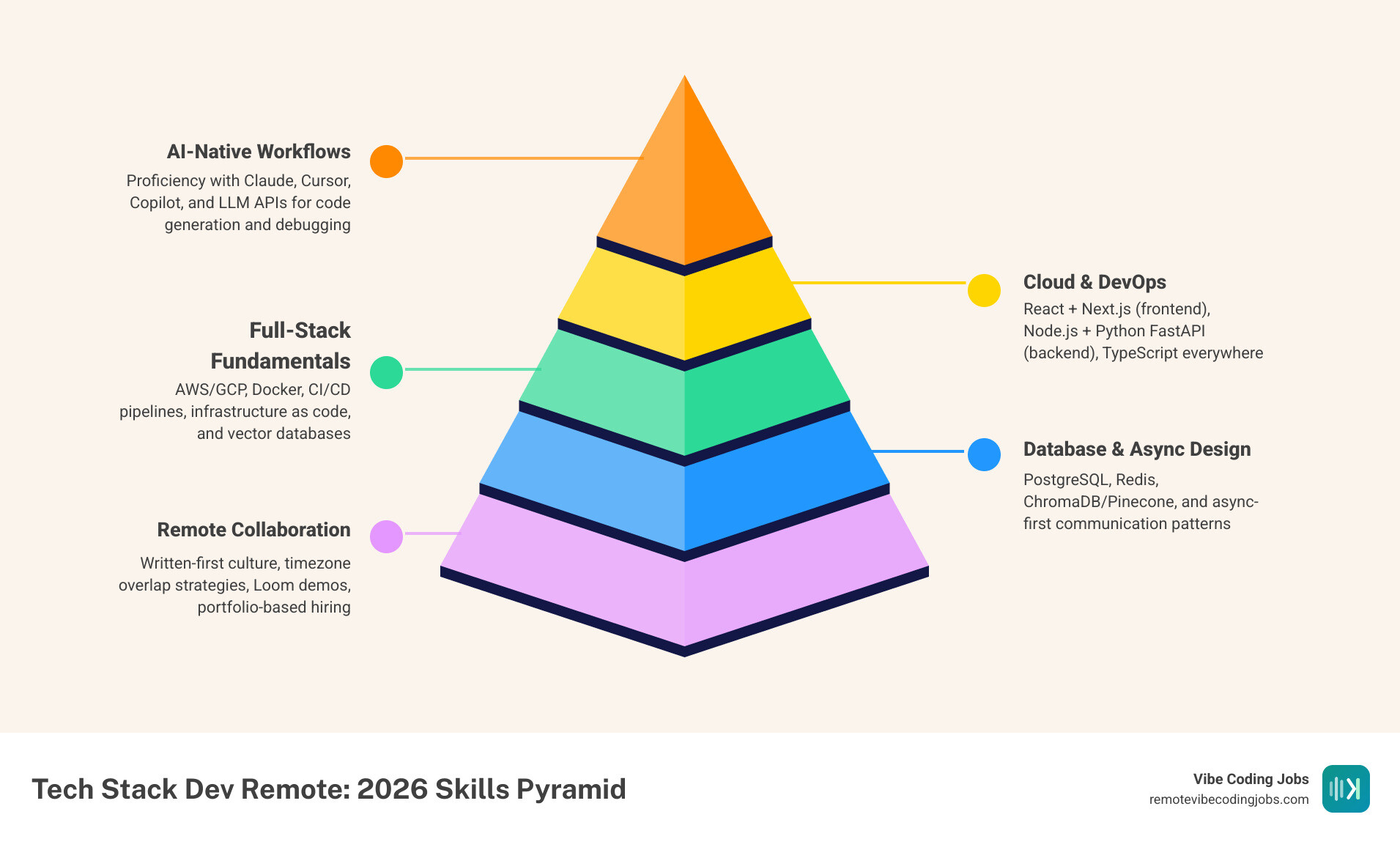
Finding the right remote dev role in 2026 comes down to one thing: stack match. Here are the most in-demand tech stacks appearing in remote full-stack job postings right now:
| Layer | Most In-Demand Technologies |
|---|---|
| Frontend | React, Next.js, TypeScript |
| Backend | Node.js, Python (FastAPI/Flask), TypeScript |
| Database | PostgreSQL, Redis, vector databases (ChromaDB, Pinecone) |
| Cloud & DevOps | AWS, GCP, Docker, GitHub Actions CI/CD |
| AI Tools | Claude, Cursor, GitHub Copilot, LLM APIs (OpenAI, Anthropic) |
The remote developer market has shifted fast. A tech stack dev remote job in 2026 rarely means just knowing React or Python anymore. AI-native workflows, cloud infrastructure, and async collaboration skills are now part of the package — and companies are explicitly hiring for them.
Roles like “Vibe Coder,” “AI-Native Full Stack Developer,” and “Senior Full Stack Developer – AI Infrastructure” are appearing on job boards alongside traditional full-stack listings. The tools on your resume (and how you use them) now matter just as much as your years of experience.
I’m Dominic Zijlstra, co-founder of Adaptify.ai and a former DevOps engineer and data scientist, and my hands-on experience building and deploying production systems gives me a grounded view of what actually matters in a tech stack dev remote job search. In this guide, I’ll cut through the noise so you can find roles that match your exact stack, experience level, and working style.
Tech stack dev remote terms to learn:
The Most In-Demand Tech Stack Dev Remote Frameworks in 2026
To target the right remote roles, you first need to understand how tech stack expectations diverge depending on the size and stage of the company. Startups require extreme agility and rapid feature delivery, which has led to a massive surge in modern, high-velocity JavaScript and TypeScript runtimes. Established companies, on the other hand, prioritize long-term stability, strict type safety, and massive cloud scalability.
The table below breaks down these stack divisions to help you align your personal skills with the right type of employer:
| Tech Stack Layer | Startup Profile (High-Velocity / Agile) | Established Enterprise Profile (Scale / Stability) |
|---|---|---|
| Primary Language | TypeScript, Python | TypeScript, Java, Go |
| Frontend Framework | Next.js, React, Tailwind CSS | React, Angular, Vue.js |
| Backend Runtime | Bun, Hono, Node.js, FastAPI | Node.js, Spring Boot, Go |
| ORMs & Databases | Drizzle ORM, PostgreSQL, Supabase | Prisma, Hibernate, PostgreSQL, MySQL, Oracle |
| AI Integration | Cursor, Claude, custom LLM agents, vector DBs | GitHub Copilot, secure internal LLM gateways |
| Infrastructure | Vercel, Supabase, Docker, GCP | AWS CDK, Kubernetes, Terraform, Multi-AZ setups |
We are seeing a major trend where modern startups completely bypass traditional Node.js setups. Instead, they are opting for a TypeScript-first architecture powered by the Bun runtime and the Hono framework. This combination delivers blisteringly fast execution and minimal cold-start times, which is perfect for serverless deployments.
For instance, several stealth-mode B2B marketplaces and scaling SaaS platforms are standardizing on Next.js, Hono, Drizzle ORM, PostgreSQL, and Bun. They combine this modern backend architecture with AI-native engineering workflows to build complex pricing engines and logistics systems with incredibly lean teams. If you want to work for a high-growth startup, having Bun, Hono, and Next.js on your resume will instantly make you stand out.
Frontend and Backend Standards for a Tech Stack Dev Remote Role
On the frontend, React remains the undisputed king of remote full-stack development, but it is almost universally paired with Next.js and TypeScript in 2026. Companies no longer want developers who write plain JavaScript or manage complex, custom Webpack configurations. They want engineers who can leverage Next.js to handle server-side rendering (SSR), static site generation, and server actions out of the box.
If you are looking to secure a frontend-heavy or full-stack remote position, mastering these server-side React patterns is essential. You can explore some of the top curated listings in this space on our Remote Jobs NextJS Developer page.
On the backend, Python continues to dominate any role that touches data science, machine learning, or AI orchestration. Runtimes like FastAPI and Flask are highly favored for building lightweight, high-performance APIs that connect frontend user interfaces with complex language models.
Python’s clean syntax and extensive ecosystem of mathematical and AI libraries make it the default language for modern backend services. To see how companies are hiring for these backend roles, check out our dedicated listings for Remote Jobs Python Developer positions.
Database and Cloud Infrastructure in a Tech Stack Dev Remote Environment
When it comes to databases, PostgreSQL remains the industry standard for relational data modeling due to its reliability, extensibility, and advanced feature set. Many modern SaaS platforms leverage PostgreSQL alongside specialized extensions like PostGIS for geographical queries, or combine it with Redis to handle caching and real-time state management.
However, the rise of artificial intelligence has introduced a new player to the database layer: vector databases. If you are applying for a modern full-stack role, having experience with vector databases like ChromaDB or Pinecone is a massive competitive advantage. These databases are critical for handling semantic search, retrieval-augmented generation (RAG), and storing high-dimensional embeddings generated by large language models.
Cloud infrastructure and DevOps skills are no longer optional additions to a full-stack resume—they are core requirements. Because remote teams must operate independently, companies expect full-stack engineers to understand how to containerize applications using Docker and deploy them to major cloud platforms like AWS, GCP, or Azure.
This trend is highly visible in modern job postings. For example, the Senior Full Stack Developer – AI Infrastructure role at Lean Layer requires deep hands-on experience with Python, React, TypeScript, PostgreSQL, Docker, GCP, and LLM APIs.
To bridge the gap between pure coding and system reliability, senior remote roles often blend platform engineering with traditional development. You can get a sense of how these dual responsibilities affect market value by viewing our Salaries DevOps Engineer guide.
How AI-Native Workflows and Vibe Coding Are Redefining Remote Roles

The day-to-day workflow of a remote developer has changed dramatically. We have entered the era of “vibe coding”—a term that describes an AI-first development workflow where natural language prompting, architectural design, and system validation replace manual syntax writing.
Tools like Cursor, Claude, and GitHub Copilot are no longer just optional autocomplete extensions; they are the primary environments where software is designed, written, and debugged.
In an AI-native engineering workflow, developers use Cursor paired with Claude to generate boilerplate code, write comprehensive unit tests, and scaffold entire features in minutes. This allows a single full-stack engineer to operate with the output capacity of a small team.
Instead of spending hours searching through documentation or debugging syntax errors, developers focus on high-level system architecture, security integration, and user experience.
If you want to stay ahead of this curve, it is vital to keep up with the Best AI Coding Tools 2026 and understand how platforms stack up in our head-to-head comparison of Cursor vs Windsurf for Developers in 2026 Which is Best.
The Shift from Writing Code to Managing AI Agents
This technological evolution is driving a fundamental shift in the very identity of a software engineer. We are moving away from being “code writers” and transitioning into “agent managers.”
In this new paradigm, your primary job is to orchestrate agentic AI workflows, write clear prompts, and audit the output of LLMs to ensure code quality and system security.
This transition requires a significant Builder Identity Shift. Developers must learn to treat prompting as a precise programming language of its own.
Codebase integrity becomes the ultimate goal. Because an AI can generate hundreds of lines of code in seconds, the human engineer must act as a rigorous auditor, verifying that the generated code is secure, free of OWASP vulnerabilities, and highly performant.
To understand how this shift is opening up new career paths, read our detailed guide on the journey From Writing Code to Managing Agents New Developer Career Path.
Real-World AI-Native Roles and Infrastructure
These AI-first methodologies are not just theoretical; they are actively shaping corporate recruitment strategies and team structures. Dev.Pro, for instance, explicitly hires for the official title of “Vibe Coder,” signaling a deep corporate commitment to AI-first workflows that allow smaller, highly efficient teams to outperform massive, traditional engineering departments.
Similarly, forward-thinking organizations are structuring their internal teams around these workflows. The Tech Foundations area at Alan, a prominent European digital health partner, specifically focuses on infrastructure enablement, security, developer productivity, and AI-assisted engineering.
They treat AI code assistants as first-class citizens, ensuring that everyone in the engineering organization has the tools and training to maximize their output.
Other companies are looking for developers who can build B2B SaaS tools that help businesses navigate AI-powered search. For example, Geeky Tech actively recruits for their AI-Native Full Stack Developer | Geeky Tech role, where Claude, Cursor, and Copilot are integrated directly into the daily engineering toolkit.
Startup vs. Established Company Requirements for Remote Developers
When you are looking for a tech stack dev remote job, it is important to realize that startups and established enterprises evaluate candidates through very different lenses.
Startups are typically lean, , and highly focused on shipping working software iteratively. They value generalists who can jump from frontend React components to backend database migrations without missing a beat.
In a startup environment, your ability to rapidly prototype features using AI-assisted tools and take complete ownership of a product is highly prized.
Established companies, by contrast, operate at a scale where system stability, observability, and compliance are paramount. They require rigorous adherence to security standards like SOC 2 and data privacy regulations like GDPR.
In these environments, a senior developer’s role involves setting up automated CI/CD pipelines, managing infrastructure-as-code using AWS CDK, and implementing Row Level Security (RLS) to prevent cross-tenant data leaks.
This focus on platform engineering is highly visible in roles like the Senior Full Stack Engineer – Platform & DevOps position at Smart Working Solutions. This full-time remote role requires over five years of experience, focusing on AWS cloud infrastructure, Docker, system observability, and strict compliance standards for digital health platforms.
To help companies fill these vital infrastructure roles, we connect top talent with employers through our portal to Hire DevOps Engineer specialists.
If you want to see what established companies look for in a platform-heavy role, you can view the Smart Working Solutions – Senior Full Stack Engineer – Platform & DevOps (Remote, Full-Time) [HR161] job posting.
Navigating Remote Collaboration and Time Zone Challenges
One of the biggest hurdles in any remote role is collaborating effectively across different time zones. To mitigate this, modern remote-first companies are moving away from constant, synchronous meetings and embracing an async-first, written-first culture.
In a written-first environment, radical transparency is the default. Every architectural decision, database schema change, and product requirement is documented in detail.
This ensures that developers can log on from any time zone, read the documentation, and immediately understand the context of their tasks without waiting for a synchronous hand-off.
To find companies that prioritize this healthy, meeting-free approach to software engineering, explore our resources on Async First Remote Developer Jobs Culture Tools Salary.
Operating asynchronously requires developers to protect their focus. Without the constant interruption of Slack pings and Zoom calls, engineers can enter a state of deep work, leading to higher-quality code and a much lower rate of burnout.
You can learn how to build these productive habits in our guide on Deep Work Culture Developer Jobs Finding Focus Flow.
Even in async-first companies, some level of timezone overlap is often required. Many job postings will specify a minimum overlap (such as a “minimum 5-hour working overlap with Eastern Time or Mexico City”) to facilitate code reviews and occasional team alignment sessions.
Always check these geographic and timezone constraints before submitting your application, as many remote roles are restricted to specific regions or countries due to legal and operational requirements.
Salary Ranges and Compensation for Remote Full-Stack Developers
Compensation for remote full-stack developers in 2026 varies widely based on your experience level, location, and the specific role structure.
For full-time, direct-hire positions, senior-level AI full-stack roles often start with a base salary of $90,000 to $150,000+, depending on the company’s funding and location. Many of these roles also feature scaled, performance-based bonus structures tied directly to measurable technical outcomes, platform performance improvements, and key engineering milestones.
For developers seeking ultimate flexibility, contract work and AI training platforms offer highly lucrative alternatives. For instance, platforms like DataAnnotation pay contract full-stack developers up to $100+ USD per hour to help train and evaluate advanced AI models.
This work involves writing complex coding problems, explaining solutions, and auditing AI-generated outputs. It has grown into a massive community of over 100,000 professionals, including front-end, back-end, and machine learning engineers, who enjoy the freedom of choosing their own hours and working from anywhere.
To get a comprehensive view of the current financial landscape for remote engineers, check out our Remote Senior Software Engineer Salary Guide 2026 What to Expect and compare standard rates on our Salaries Full Stack Developer page.
How Companies Evaluate Technical Skills and Cultural Fit
The remote hiring process in 2026 has largely moved away from traditional, stressful whiteboard interviews and algorithmic puzzle-solving. Because modern development relies heavily on AI assistance, companies want to see how you solve real-world problems using your actual daily toolkit.
Instead of testing your ability to memorize algorithms, forward-thinking employers use alternative assessments. A popular screening method is requiring a short (3-5 minute) Loom video with your application.
In this video, you are asked to walk through a project you built, explain your tech stack, and demonstrate how you integrate AI tools like Cursor and Claude into your development workflow. This immediately showcases your communication skills, technical thinking, and tool fluency.
Furthermore, companies are increasingly evaluating candidates based on practical tasks and portfolio reviews. They want to see functional GitHub repositories, clean code structure, and your ability to validate AI-generated outputs.
To prepare for this modern interview style, read our guide on Remote Coding Jobs No Leetcode Alternative Assessment.
You can also learn how to build an impressive, AI-accelerated project showcase by following our step-by-step manual on creating a Killer Remote Developer Portfolio How to Land Your Dream Job.
Frequently Asked Questions about Remote Tech Stacks
What is the most popular tech stack for remote developers in 2026?
The most popular and highly demanded tech stack for remote full-stack developers in 2026 is a TypeScript-first architecture. On the frontend, React and Next.js are the industry standards.
On the backend, Node.js (or modern runtimes like Bun and Hono) and Python (FastAPI/Flask) are dominant. PostgreSQL is the preferred database for relational data, often paired with Redis for caching and vector databases like ChromaDB for AI integrations.
Do remote developer jobs require Leetcode tests?
An increasing number of remote-first companies are abandoning Leetcode tests in favor of practical, real-world assessments. These alternative evaluations include portfolio reviews, take-home projects where you are encouraged to use AI tools, and recorded video walkthroughs of your code.
If you want to target companies that skip the algorithmic grilling, check out our curated list of Remote Coding Jobs No Leetcode opportunities.
How does vibe coding impact remote developer salaries?
Vibe coding and AI-native workflows allow developers to achieve significantly higher output and rapid prototyping speeds. This increased productivity makes highly skilled “agent managers” incredibly valuable to lean teams.
Developers who can successfully leverage AI to build secure, scalable products can command premium compensation. To see how these skills translate to financial rewards, read our analysis on Vibe Coding Salary Remote USA trends.
Conclusion
Securing a remote developer job in 2026 is all about adapting to the new reality of software engineering. Whether you are targeting a role at a stealth-mode startup using Bun and Hono, or a platform-focused position at an established company managing cloud infrastructure and SOC 2 compliance, your technical stack and your ability to work alongside AI are your greatest assets.
By mastering in-demand frameworks, embracing AI-native workflows, and showcasing your skills through real-world portfolios and video walkthroughs, you can future-proof your career and land a highly flexible, lucrative remote role.
At RemoteVibeCodingJobs, we make your job search simple. We curate and aggregate the best remote “vibe coding” and AI-assisted engineering roles at async-first companies, filtering them by culture, technology, and AI tool integration.
Don’t spend hours scrolling through generic job boards—find your next remote vibe coding job with us today and join a community of forward-thinking builders!