Why Finding the Right Async Coding Job Board Changes Everything
The best async coding job board doesn’t just list remote jobs — it filters for companies that actually respect deep work and written-first communication.
Quick answer: Top async coding job board features in May 2026
| Job Board Type | Best For | Market Availability |
|---|---|---|
| Remote Vibe Coding Jobs | AI-assisted & async-first roles | 1,823+ AI-assisted roles |
| Global Async Platforms | Engineering roles | 1,470+ remote listings |
| Curated Async Lists | Specialized roles | High-quality, vetted positions |
Most developers searching for async roles have the same problem: generic remote job boards flood you with listings from companies that say “remote-friendly” but still run daily standups and expect instant Slack replies.
The difference with async-first companies is real. Their default communication method is written — think docs, recorded Loom updates, and Linear threads — not live meetings. You get uninterrupted focus time and the freedom to work across time zones without your calendar running your life.
In May 2026, that shift is accelerating fast. AI-assisted development, agentic engineering, and tools like Cursor and Claude are reshaping what async developer roles even look like.
I’m RVCJ Editorial, the team behind Remote Vibe Coding Jobs — we’ve spent years covering AI-assisted development, async work culture, and remote hiring trends, and we curate the best async coding job board listings for developers who build with tools like Cursor, Claude, and Copilot. Read on for the full breakdown of where to search, what skills to highlight, and how to land a role that actually fits the way you work.
Understanding the Shift to Async-First Development
As we move through May 2026, the definition of a “great job” has shifted from the size of the office snacks to the quality of the company’s documentation. For developers, this shift is centered around the concept of async-first.
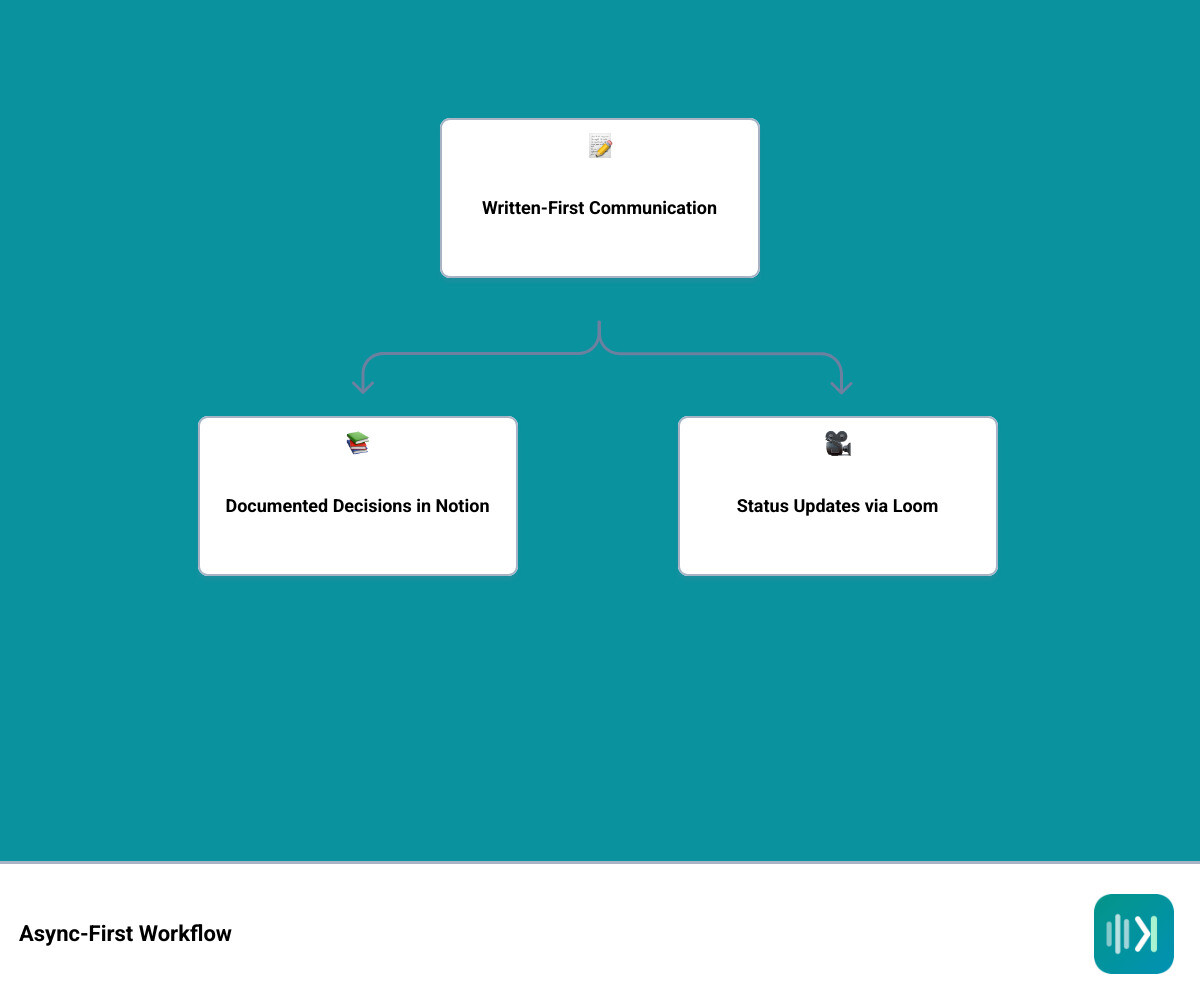
In a traditional synchronous environment, communication happens in real-time. If you have a question, you ping someone on Slack and wait for an immediate reply, or worse, you “jump on a quick call.” This constant context switching is the enemy of deep work. Async-first development flips this on its head. In these environments, the default is written communication. Decisions are documented in Notion, tasks are managed in Linear, and status updates are recorded via Loom.
The benefits of async-first remote developer jobs are profound. Beyond the obvious perks of timezone independence—allowing a developer in Tokyo to collaborate seamlessly with a teammate in Lisbon—it creates a culture of autonomy. When communication is documented, you don’t need permission to move forward; you just need to read the spec.

Working at an async-first company requires a specific mindset. It’s about separating problem definition from implementation. Because you aren’t tethered to a live meeting schedule, you can focus on high-level system architecture while delegating specific implementation details to AI agents or returning to them during your peak focus hours. For a deeper dive into how these teams operate, check out our guide on async-first remote developer jobs culture, tools, and salary.
The Rise of the Async Coding Job Board
Traditional job boards are often too broad. If you search for “remote developer” on a legacy site, you might find 10,000 roles, but 9,000 of them likely require you to be online from 9 AM to 5 PM EST for “team alignment.” This is why a dedicated async coding job board has become an essential tool for the modern engineer.
Specialized platforms focus on “vibe” and “culture” as much as they do on tech stacks. They look for markers of async maturity, such as companies that don’t have mandatory daily standups and those that prioritize long-form technical writing over verbal brainstorming.

When you are finding high-quality async remote jobs, you’ll notice a significant difference in listing quality. These roles often feature higher salary transparency and explicit mentions of the tools used to facilitate deep work.
| Feature | Traditional Remote Job Site | Async Coding Job Board |
|---|---|---|
| Communication | Assumed synchronous/Slack-heavy | Explicitly async-first/Doc-heavy |
| Meeting Culture | Frequent daily standups | Rare, high-value meetings only |
| Documentation | Often an afterthought | The primary source of truth |
| Tooling Focus | General (Jira, Zoom) | Modern (Linear, Notion, Loom, AI) |
| Trust Level | High monitoring/Presence-based | High autonomy/Output-based |
To see who is leading the pack, explore our list of async-first remote developer jobs roles, teams, and companies.
Navigating an Async Coding Job Board for High-Quality Roles
To make the most of an async coding job board, you need to use the right filters. It’s no longer just about “Backend” or “Frontend.” In 2026, developers are filtering by specific tech stacks and communication styles. For example, if you are a JavaScript specialist, you might look specifically for async-first JavaScript developer jobs or async-first React developer jobs.
Modern boards also allow you to create talent profiles that companies can browse. Instead of you chasing every lead, companies looking for specific “agentic” skills can find you. Currently, there are 36,601 active users browsing remote async engineering jobs, and 1,470 total remote engineering jobs listed with a specific focus on async collaboration.
Why Every Async Coding Job Board is Now an AI Job Board
You cannot talk about async work in 2026 without talking about AI. The two are inextricably linked. AI tools allow developers to maintain momentum even when their teammates are asleep. If you hit a roadblock at 2 AM, you don’t need a senior dev to unblock you; you have a fine-tuned LLM agent that understands your codebase.
We are seeing a massive surge in these roles. There are currently 1,823 remote vibe coding and AI-assisted developer roles available. These aren’t just “AI companies”—these are standard product companies that have realized that a developer using Cursor and Claude is 10x more effective in an async environment. Check out the top async-first roles in 2026 to see how agentic engineering is taking over the async-first remote developer jobs landscape.
Vibe Coding and the New Era of Agentic Engineering
“Vibe coding” might sound like a relaxed term, but it represents a sophisticated shift in how software is built. It’s the practice of using natural language and AI tools like Cursor, Claude, and GitHub Copilot to handle the heavy lifting of syntax and boilerplate, while the human developer focuses on the “vibe”—the architecture, the user experience, and the ultimate goal of the product.
In an async-first world, vibe coding is a superpower. It allows for rapid prototyping and feature delivery without the need for constant back-and-forth. As we explain in our remote vibe coding jobs guide, the role of the developer is evolving into that of an orchestrator. You aren’t just writing lines of code; you are defining problems so clearly that an AI agent can implement them.
This “agentic engineering” requires a high level of trust. Companies like those found on our list of top companies for async-first remote developer jobs value developers who can maintain a “human-in-the-loop” approach. This means you spend less time typing and more time on detailed code reviews and automated verification.
Essential Skills and Tools for Async Success
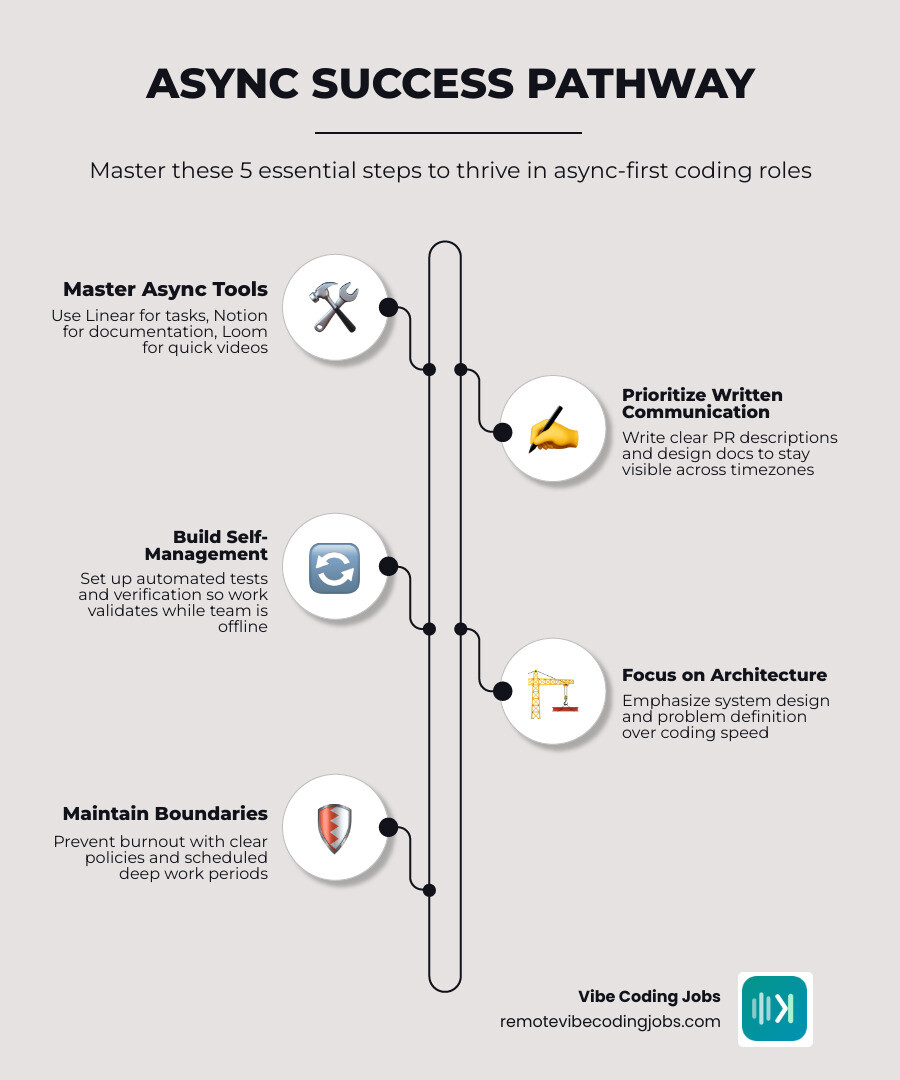
If you want to land a role from an async coding job board, you need to master the “Async Stack.” This isn’t just about Python or Rust; it’s about the tools that enable a team to function without being in the same room (or time zone).
- Linear: For task management that doesn’t feel like a chore.
- Notion: For creating the “Internal Brain” of the company.
- Loom: For replacing 30-minute meetings with 2-minute video walkthroughs.
- Technical Writing: This is perhaps the most underrated skill. In an async world, if you can’t write a clear PR description or a design doc, you are invisible.
Success in these roles also requires a high degree of self-management. You have to be your own project manager. This involves setting up automated verification systems—unit tests, type checking, and performance benchmarks—so that your work can be validated by the system while your team is offline. When you browse our async-first job board, look for roles that emphasize “system architecture” and “problem definition” over “typing speed.”
Frequently Asked Questions about Async Coding
What is the average salary for async coding roles in 2026?
Salary ranges for async coding positions are increasingly location-agnostic. In May 2026, we are seeing benchmarks ranging from $50K for junior roles to over $300K for staff-level engineering positions. Many async-first startups also offer significant equity or stock options, especially those in the AI and HR tech space. Because these companies save on office overhead, they often pass those savings on to their global talent pool.
How do I prepare for an async-first interview?
The “Loom video trick” is your best friend. When you apply, include a short video walking through a recent project or explaining how you solved a complex problem using AI tools. This demonstrates your communication skills and your “agentic” workflow immediately. You should also have a portfolio of projects that show you can build and ship independently. Agentic interviews often focus more on how you think and orchestrate rather than how fast you can solve a LeetCode problem.
What are the biggest challenges of working asynchronously?
It’s not all sunshine and deep work. Isolation can be a factor, which is why many async companies host annual or bi-annual retreats. There is also a higher documentation overhead; you have to be disciplined about writing things down. Finally, boundary setting is crucial. When you can work “anytime,” it’s easy to feel like you should work “all the time.” The best async-first companies have clear policies to prevent burnout.
Conclusion
The future of work isn’t just “remote”—it’s asynchronous and AI-assisted. As AI-native startups continue to outpace traditional enterprises, the demand for developers who can thrive in a deep-work-centric environment will only grow.
By using a dedicated async coding job board like RemoteVibeCodingJobs, you can skip the “remote-ish” noise and find a team that values your focus time as much as you do. Whether you’re a seasoned staff engineer or a “vibe coder” just starting your journey, the tools and roles are ready for you.
Ready to find your next role? Explore our current listings for Remote Vibe Coding Jobs — AI Engineer and join the community of developers who are building the future, one async doc at a time.