
What Is Your Software Engineer Market Value in 2026?
Your software engineer market value sits somewhere between “it depends” and a six-figure number — but here’s a fast answer before we dig in:
| Career Level | Median Base Salary (US, 2026) | Typical Total Compensation |
|---|---|---|
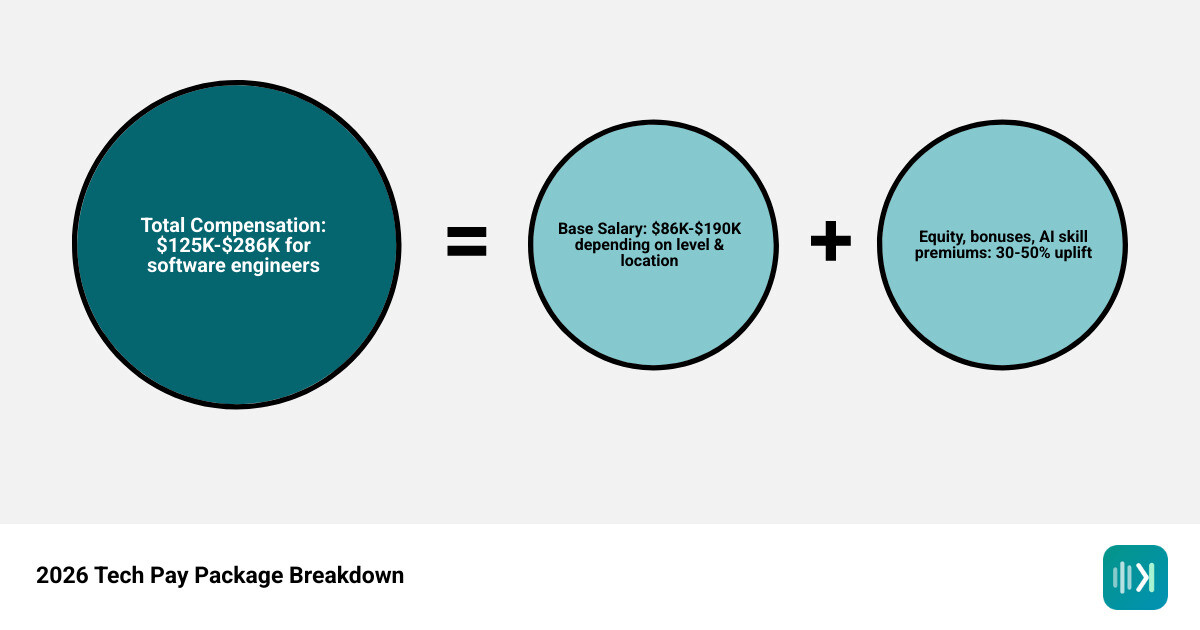
| Entry-Level (0-2 yrs) | $86,000 – $98,500 | $125,000 |
| Mid-Level (2-5 yrs) | $115,000 – $128,600 | $165,300 |
| Senior (5-10 yrs) | $145,000 – $158,900 | $215,400 |
| Staff / Principal (10+ yrs) | $176,000 – $190,200 | $285,600 |
Key factors that move your number:
- Location (San Francisco pays ~$170K median; Mississippi pays ~$86K)
- Specialization (AI/ML commands 28-42% premiums over general roles)
- Company type (big tech vs. startup vs. finance)
- Total comp vs. base (equity and bonuses can add 30-50% on top)
The gap between what you’re earning and what you could earn is often wider than you’d expect. One source in our research found that salary negotiation alone — with the right data behind it — can produce increases of $30,000 or more. Meanwhile, the same role at different companies can pay anywhere from $79,000 to well over $220,000, depending on who’s hiring and where.
The market isn’t broken. It’s just opaque. And opacity costs engineers real money every year.
The good news: calculating your market rate is a learnable skill, not a guessing game. The BLS pegs the median annual wage for software developers at $133,080 as of May 2024, with the highest 10% earning over $211,000. But raw medians only tell part of the story — your actual number depends on your level, your stack, your location, and yes, whether you know how to use AI tools like Cursor or Claude in production.
This guide walks you through exactly how to figure out where you stand — and what to do about it.
I’m part of the RVCJ Editorial team at Remote Vibe Coding Jobs, where we cover compensation data, remote hiring trends, and career strategy for engineers building with AI-native tools — all directly relevant to understanding your software engineer market value in today’s shifting market. We’ve analyzed salary data across dozens of sources so you don’t have to start from scratch.
Understanding Your Software Engineer Market Value in 2026
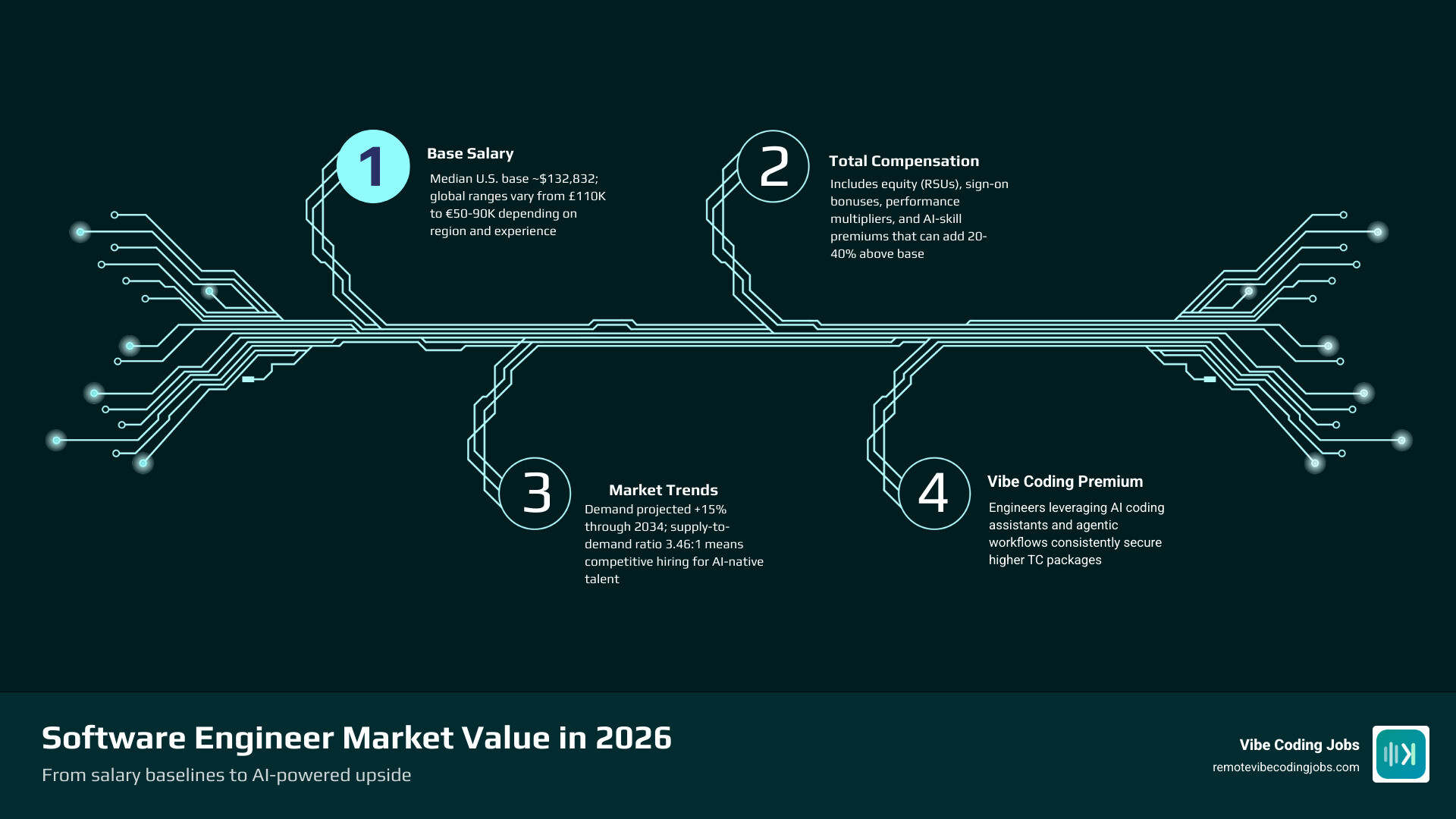
To understand your software engineer market value, we first have to look at the macro trends of 2026. The tech landscape has shifted from the “hiring at all costs” frenzy of the early 2020s into a more calculated, efficiency-driven era. While average salaries in the U.S. dipped about 18% between 2023 and 2025 due to market normalization, 2026 has seen a steady recovery, particularly for those who have adapted to the “vibe coding” revolution.
Salary transparency is no longer a luxury; it’s a standard. Platforms providing Real-time data on software engineer compensation show that while base salaries are stabilizing, total compensation (TC) is where the real variance lives. According to Official 2026 employment outlook and wage data, the demand for developers, QA analysts, and testers is projected to grow 15% through 2034, which is significantly faster than the average for all occupations.
However, the supply-to-demand ratio in the U.S. currently sits at approximately 3.46:1. This means the market is “Competitive.” To stand out, you can’t just be a “coder”; you need to be a problem solver who leverages high-leverage tools.
Global vs. US Software Engineer Market Value
The gap between U.S. and international salaries remains significant, but it is narrowing for top-tier remote talent. In the U.S., the average base salary is roughly $132,832, whereas in the UK, a senior role might average £110,200 (approx. $140,000 USD). Western Europe typically sees ranges between €50,000 and €90,000.
The real magic for many in 2026 is “geographic arbitrage.” This is the practice of securing a salary based on high-cost tech hub rates (like SF or NYC) while living in a region with a much lower cost of living. We see this frequently in our Remote Developer Salaries in 2026: What to Expect guide, where remote engineers often maintain 90-95% of the purchasing power of their office-based counterparts without the $4,000/month rent.
The Pillars of Compensation: Experience, Location, and Tech Stack
Your software engineer market value is built on three primary pillars. If you’re missing data on even one of these, your calculation will be off.
- Experience Level: In 2026, the jump from Junior to Mid-level is often the largest percentage increase (around 34%), as you move from “needs constant supervision” to “owns features end-to-end.”
- Location: Even in a remote-first world, your “home base” matters for taxes and regional pay bands. San Jose leads the pack with average salaries around $169,930, followed closely by New York at $167,998.
- Tech Stack: Not all languages are created equal. Mastering niche or high-demand ecosystems can add a “premium” to your base rate.
When evaluating your worth, check our Remote Senior Software Engineer Salary Guide 2026: What to Expect to see how seniority impacts total package structure. For example, Staff and Principal engineers often see their compensation heavily weighted toward equity (RSUs or options) rather than just base salary.
Specific language expertise also dictates your floor. We’ve tracked significant differences in Python Engineer Salaries versus TypeScript Developer Salaries, though the gap is closing as full-stack versatility becomes the expected baseline.
Calculating Software Engineer Market Value by Specialization
If you want to maximize your earnings, specialization is the fastest route. Generalists are great, but specialists solve expensive problems.
- AI/ML Engineering: This is the undisputed heavyweight of 2026. AI engineers command a 28-42% premium, with median total compensation reaching between $168,000 and $195,000.
- Cybersecurity: With the rise of AI-driven threats, security engineers are seeing average salaries between $140,000 and $220,000.
- Cloud Infrastructure/DevOps: As companies move toward agentic workflows, the people who build the “pipes” are more valuable than ever. Average salaries here hover around $132,000 to $156,200.
For a deeper dive into these numbers, our Vibe Coding Salary Guide: Data & Market Research breaks down how these specializations perform in async-first environments.
The “Vibe Coding” Premium: How AI Tools Impact Your Market Rate
The term “vibe coding” refers to the modern era of AI-assisted development. In 2026, the market value of an engineer who refuses to use AI is actually declining. Why? Because productivity expectations have shifted.

Research shows that AI-assisted development now accounts for roughly 30% of new code in high-performing teams. If you are proficient with tools like Cursor, Claude, and GitHub Copilot, you aren’t just “writing code”; you are orchestrating systems. This shift toward “Agentic Workflows” allows a single engineer to do the work that previously required a small team.
We’ve detailed this shift in our Vibe Coding Salary Guide 2026. Companies are increasingly looking for “AI-native” developers who can bridge the gap between business requirements and technical architecture using LLMs. This is particularly true for Vibe Coding Salary Remote AI Roles, where the ability to work independently and ship fast is rewarded with top-of-market pay.
Strategies to Maximize Your Total Compensation Package
Calculating your software engineer market value is only half the battle; the other half is capturing that value during a negotiation.
Most engineers make the mistake of focusing only on the base salary. In 2026, a “good” offer is a balanced one. Total Compensation (TC) includes:
- Base Salary: Your steady paycheck.
- Bonuses: Often 10-20% for senior roles, plus sign-on bonuses which currently median at $42,000 for top-tier talent.
- Equity (RSUs/Options): This is where wealth is built. In big tech, equity can represent 30-50% of your TC.
- Benefits: Don’t overlook 401k matching, health insurance (90% of engineers receive medical), and remote work stipends.
To get a baseline, use a Developer Market Value Tool to see where you land relative to your peers. When you enter a negotiation, use “anchoring.” Instead of giving a single number, provide a range where your desired salary is at the bottom or middle. For example, if you want $160,000, suggest a range of $165,000 to $180,000 based on the market data you’ve gathered.
Also, consider the “Remote vs. Office” trade-off. Our research on Vibe Coding Salary Compensation Growth: Remote vs Office shows that while office roles might offer slightly higher nominal base pay, remote roles often provide better “real” purchasing power when you factor in the lack of a commute and lower cost of living.
Frequently Asked Questions about Software Engineer Market Value
What is the difference between base salary and total compensation?
Base salary is the fixed amount you get paid every pay period. Total compensation (TC) is the sum of your base salary, annual bonuses, the yearly value of your equity (stock options or RSUs), and other measurable benefits like 401k matching. In 2026, your TC can easily be 50% higher than your base salary at a mid-to-large tech company.
How does remote work affect my market rate in 2026?
It depends on the company’s policy. Some companies use “location-based pay,” which adjusts your salary based on where you live. Others use “national medians” or “location-agnostic” pay. Interestingly, remote-first companies in 2026 often pay 12% higher than traditional companies because they are competing for a global talent pool rather than just local candidates.
Which programming languages command the highest market value today?
While “vibe coding” makes the specific language less of a barrier, Python remains king for AI/ML roles. Rust and Go command premiums for systems and infrastructure work. However, the highest value today isn’t in a language, but in a capability—specifically Cloud Architecture and AI Integration.
Conclusion
Determining your software engineer market value in 2026 requires looking past the “average” and into the specifics of your skill set, your location, and your ability to leverage AI. The market is currently rewarding “Vibe Coders”—engineers who combine deep architectural knowledge with the speed of AI-assisted tools.
At RemoteVibeCodingJobs, we specialize in connecting these high-value engineers with async-first companies that actually understand what a modern developer is worth. Whether you’re looking to benchmark your current role or find a new one that pays what you’re actually worth, we’re here to help.
Check out our Vibe Coding Salary Guide: Trends & Calculator to get a personalized estimate, or if you’re ready to see what the market is offering right now, Calculate your market value and find high-paying remote roles on our curated job board. Don’t leave money on the table in 2026—know your value and go get it.