Modern Backend Architecture: Choosing a Tech Stack for Async Devs
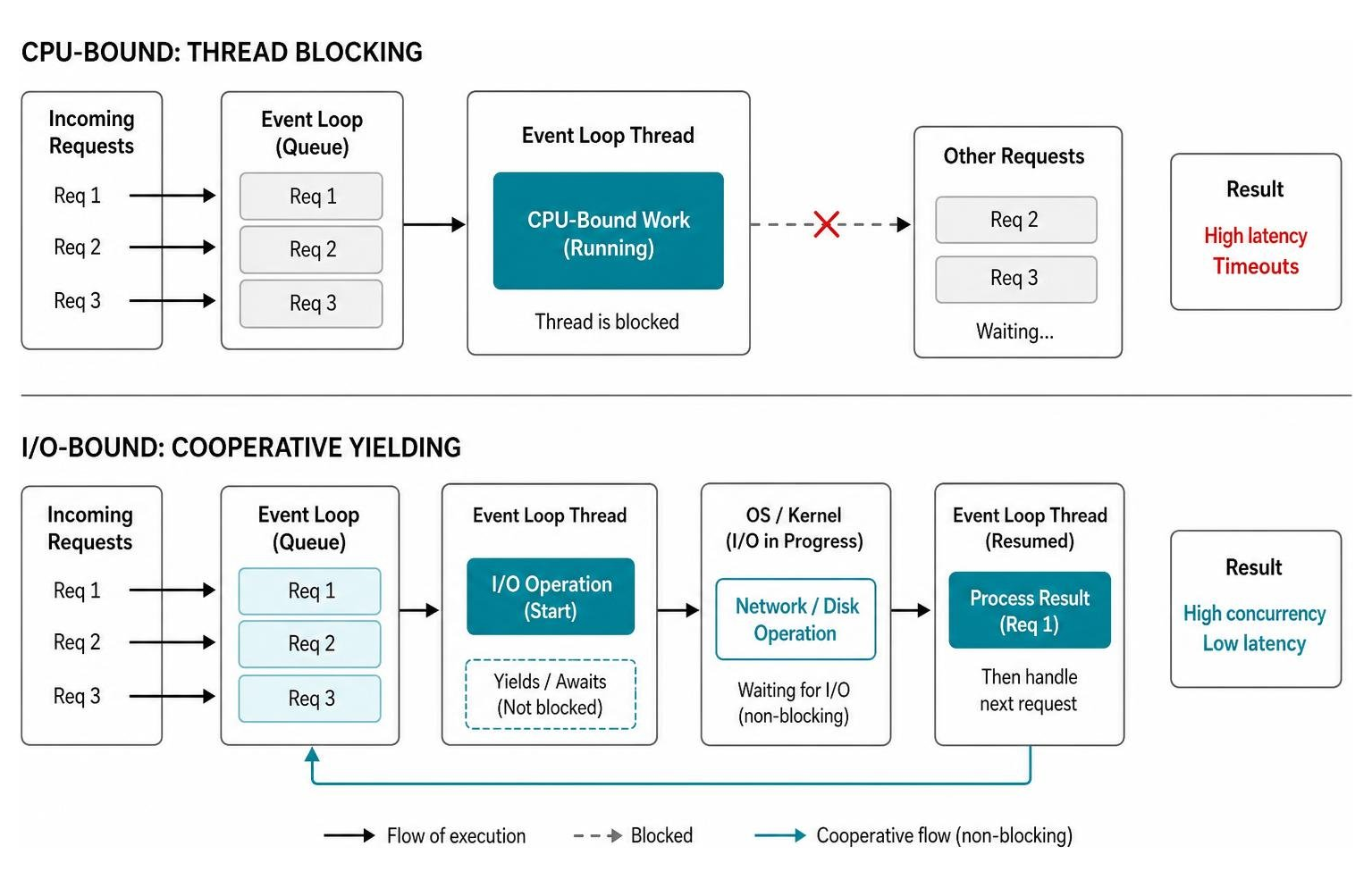
Building a reliable tech stack async devs use requires a clear understanding of non-blocking I/O and event loop mechanics. Modern runtimes like Node.js, Python (FastAPI/uvicorn), and Go handle high concurrency by running an event loop that delegates network and disk calls to the operating system kernel. While the system waits for network packets to return, the event loop picks up the next incoming user request.
However, introducing asynchronous patterns indiscriminately won’t magically double your app’s performance. As noted in guidance on the Best Tech Stack for SaaS in 2026: What Actually Ships, modern frameworks succeed because they pair lightweight non-blocking network handlers with clean, monolithic domain boundaries—avoiding unnecessary distributed complexity until scale demands it.
Core Fundamentals: I/O vs CPU Tasks in a Tech Stack for Async Devs
The single biggest mistake developers make when adopting async patterns is treating all heavy work as if it responds identically to async/await.
- I/O-Bound Tasks: Fetching rows from PostgreSQL, calling an OpenAI embedding endpoint, or reading a file from S3 are I/O-bound operations. The CPU sits idle while waiting for data. Asynchronous code yields thread control during these wait periods, allowing a single CPU thread to manage thousands of active connection state machines.
- CPU-Bound Tasks: Parsing large JSON files, compressing video frames, computing vector math, or calculating password hashes require continuous CPU cycles. Placing heavy CPU tasks inside a single-threaded event loop blocks that loop entirely. No other requests can execute, leading to massive latency spikes and HTTP server timeouts.
When your tech stack calls for CPU-intensive execution, push those jobs to multi-threaded worker pools (such as Node.js worker_threads), background task queues (like ARQ with Redis in Python), or dedicated serverless compute environments.
Concurrency Patterns: Sequential Awaits vs Parallel Promise Aggregation
A classic anti-pattern in frontend and API route handlers is sequential await chaining. If your code fetches user profiles, subscription statuses, and feature flags independently using standard sequential await statements:
Each request blocks execution until it fully completes. If each call takes 300ms, the response time equals 900ms. In high-throughput architectures, fetching non-dependent calls in parallel drastically reduces overall response times to the duration of the single slowest call (e.g., ~300ms total).
To execute promises in parallel, select the aggregation method that matches your failure requirements:
| Execution Strategy | Behavioral Mechanics | Ideal Real-World Use Case |
|---|---|---|
Promise.all() |
Fail-Fast: Rejects immediately as soon as a single promise rejects. | Critical workflows where all data fragments must succeed together (e.g., transactional order checkouts). |
Promise.allSettled() |
Resilient: Waits for every promise to settle (resolve or reject) and returns an array of outcome objects. | Dashboards, batch processing, or aggregating data from independent microservices where partial failures are acceptable. |
Using Promise.allSettled() prevents partial third-party API outages from crashing entire user interfaces. Developers can inspect individual execution statuses, render available content, and gracefully display fallbacks for failed components.
Beware of uncontrolled async spread—often dubbed “viral promise propagation.” Once a function turns async, every upstream function calling it must also become async or explicitly handle returned task objects. While maintaining non-blocking call stacks across all layers is essential, over-engineering basic static methods with unnecessary promises adds mental friction and micro-allocation overhead.
Building Persistent Workflows and Reactive Systems for AI Apps
Generative AI workloads break classical HTTP request-response paradigms. Large Language Model (LLM) responses regularly take anywhere from 10 to 60 seconds to stream, easily exceeding web client timeout windows and cloud proxy connection limits.
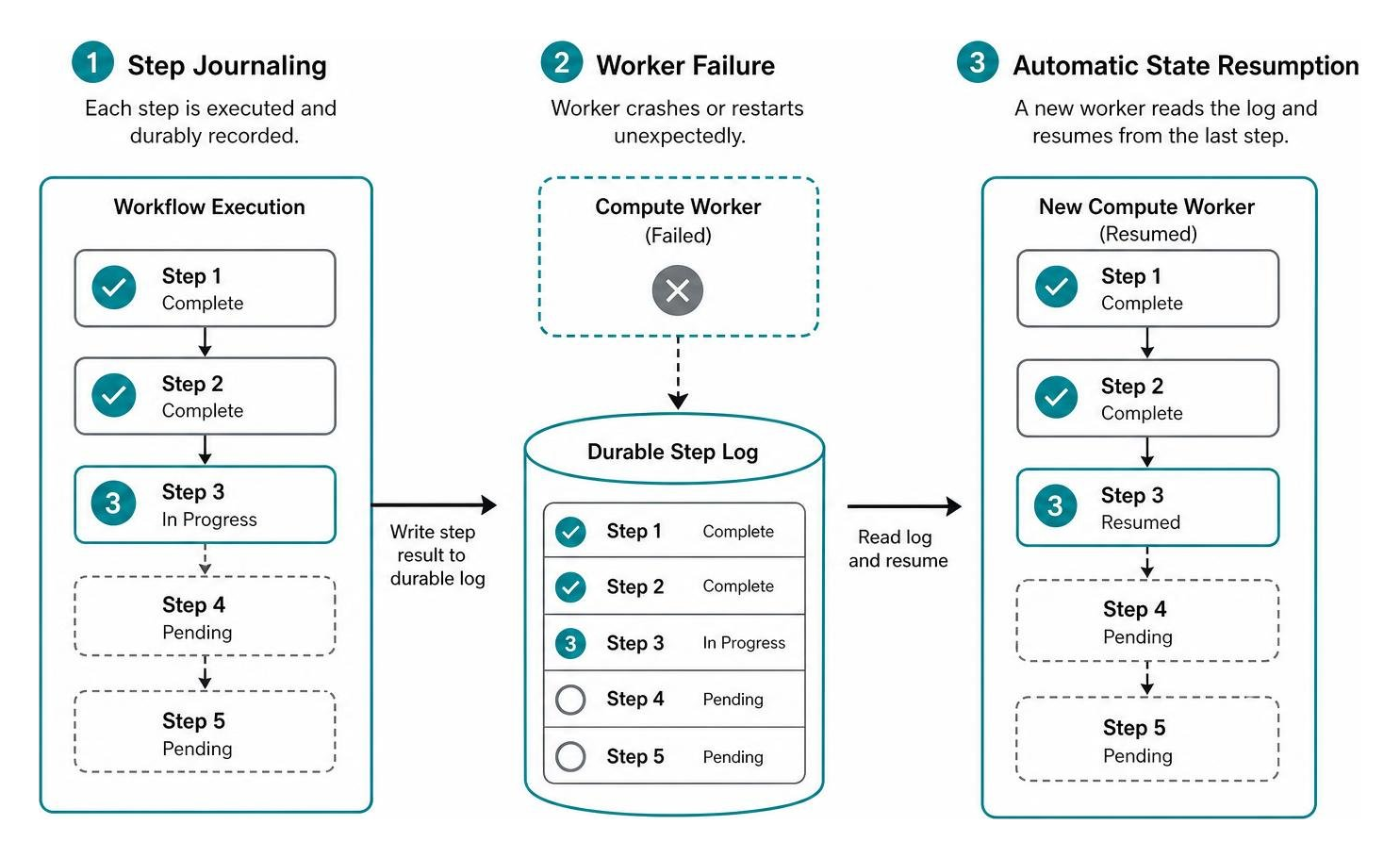
Attempting to manage long-running multi-step AI agent workflows strictly within standard HTTP connections inevitably causes lost state when client devices lose connectivity or backend server containers restart. Modern frameworks solve this by decoupling execution containers from long-term workflow storage, as outlined in detailed guides on How to Build Async AI Apps with Convex and TypeScript.
Long-Running Workflows in a Tech Stack for Async Devs
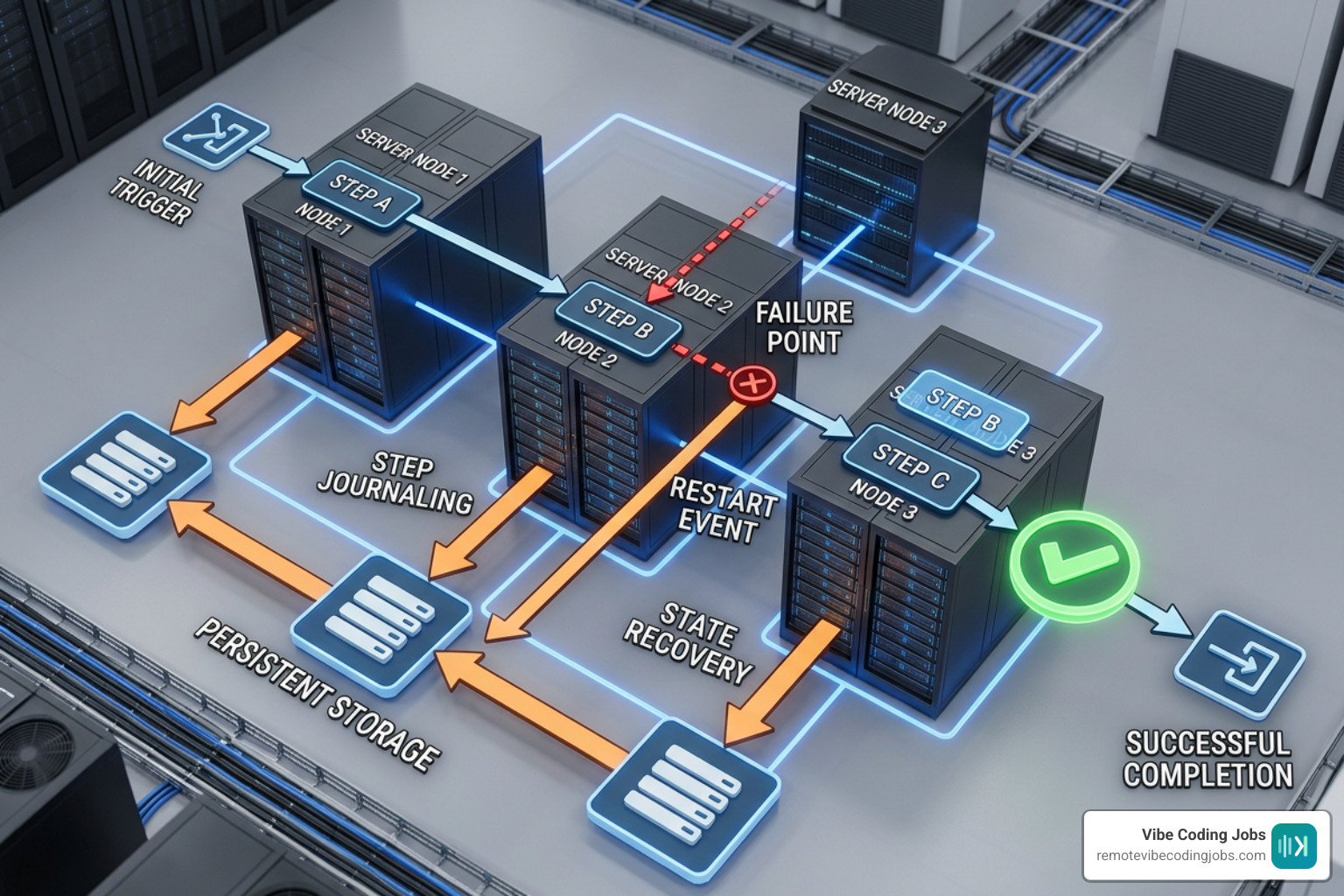
When an AI workflow spans multiple steps—such as extracting web data, running prompts across various models, calling external APIs, and saving embeddings—a single point of failure shouldn’t restart the entire pipeline from scratch.
Durable execution engines (such as Temporal, Inngest, or durable background functions) solve this through step journaling:
- Every completed execution step automatically journals its result into persistent storage.
- If a server worker crashes mid-task, or if a third-party LLM rate-limits your API key, the system catches the failure.
- Upon worker restart, the execution engine replays the workflow. It reads previous step results directly from state storage without re-executing completed external operations, seamlessly picking up exactly where it failed.
Polyglot architectures often split these responsibilities. For example, systems documented in the Technology Stack | theexperiencecompany/gaia | DeepWiki leverage lightweight TypeScript APIs alongside Python FastAPI engines and ARQ Redis background task queues to orchestrate multi-agent workflows safely.
Reactive Databases and Real-Time Cross-Client Synchronization
Historically, keeping user interfaces up to date required either inefficient client polling or fragile custom WebSocket code. Modern AI platforms use reactive databases to stream updates to browsers and mobile apps automatically.
In a reactive database setup:
- The client subscribes to a database query using WebSocket connection hooks.
- An asynchronous background worker executes an AI step and writes progress updates straight to database rows.
- The database engine detects row mutations and pushes the updated query state to all subscribed clients in real time.
This reactive sync approach drastically simplifies features like cross-client cancellation. If a user clicks “Cancel Generation” in a desktop browser, the client updates a status flag column in the database to cancelled. The backend AI task observes this row mutation mid-stream, halts model generation, and broadcasts the cancellation state to every open client tab simultaneously.
For additional context on standardizing web stacks for rapid development, explore The Stack We Use for Every SaaS MVP (and Why).
Production Hardening: Avoiding Silent Failures in Async Systems

Asynchronous code shifts execution away from predictable, thread-bound stacks into loosely coupled event networks. While this design yields impressive throughput, it introduces distinct production failure modes that can silently degrade infrastructure if unmonitored.
Common asynchronous failure modes include:
- Unbounded Fan-Out: A single request triggering dozens of unthrottled downstream API calls simultaneously. Under load, this causes your system to self-inflict a denial-of-service (DoS) attack, exhausting connection pools and causing rate-limit errors.
- Hidden Backpressure: When upstream producers inject tasks into in-memory queues faster than backend event loops can process them, memory usage quietly grows until the process encounters an Out-Of-Memory (OOM) crash.
- Silent Fire-and-Forget: Spawning background task promises without attaching explicit
.catch()handlers or logging trace contexts. Exceptions fail silently, leaving orphaned processes and inconsistent database records behind.
Engineers seeking long-term productivity and system stability should review strategies on How to avoid burnout as a remote developer: a comprehensive guide to cultivate healthier operational habits.
Production Error Mitigation Strategies
To safeguard distributed, non-blocking architectures against silent cascading failures, implement these core production safeguards:
- Strict Queue Rate Limiting: Impose explicit maximum concurrency bounds on all downstream operations using semaphore limits or token-bucket rate limiters.
- Trace Context Propagation: Pass correlation IDs across all asynchronous task boundaries and message queues to ensure end-to-end trace visibility in logging platforms.
- Bounded In-Memory Buffers: Reject incoming work early with HTTP status
429 Too Many Requestsor503 Service Unavailablewhenever buffer limits are reached, preserving system memory.
Async Developer Screening vs Live Technical Interviews

Building systems for asynchronous team environments requires engineers who write clear, self-documenting code and possess strong written communication skills. Traditional live whiteboarding interviews under real-time observation rarely evaluate these practical competencies effectively.
As highlighted in our guide on Async-first remote developer jobs: culture, workflow, communication, distributed engineering organizations increasingly rely on asynchronous developer screening. Candidates complete realistic, non-real-time coding assignments on their own schedules, reflecting how day-to-day deep work actually happens.
Designing Effective Non-Real-Time Technical Evaluations
An effective non-real-time screening pipeline replaces artificial high-stress interviews with objective, work-simulated evaluations:
- Real-World Task Simulations: Provide a functional code repository with a minor bug fix or feature requirement that mimics actual production setups.
- Screen Walkthrough Recordings: Ask applicants to record a brief 5-minute video walkthrough explaining their architectural decisions, trade-offs, and testing approaches.
- Clear Evaluation Rubrics: Grade candidates across standardized dimensions including code maintainability, error handling resilience, domain boundaries, and written documentation clarity.
- Time-Bound Assignments: Limit candidate assignments to 2–3 hours maximum, offering compensation for extended take-home tasks to maintain respect for candidate time.
Adopting non-real-time evaluations reduces synchronous interviewer load by 60–80%, decreases unconscious hiring bias, and accurately identifies candidates equipped to excel in modern remote environments. For further insights on the perks of non-real-time environments, check out Async-first remote developer jobs: benefits and learn how teams foster a culture of focus in Deep work culture developer jobs: finding focus and flow.
Frequently Asked Questions About Tech Stacks for Async Devs
For teams evaluating defaults, open-source resources like CodeAlive-AI/vibe-stack offer opinionated blueprints covering web frameworks, persistent database layers, and background agent tooling.
Why does async/await spread throughout an entire codebase?
Async functions return promises rather than raw values. To consume a promise’s unwrapped value without blocking the main event thread, the calling function must handle the promise using await or .then(). Using await requires wrapping the parent function signature with the async keyword as well. This “contagious” property ensures non-blocking behavior is preserved across all layer boundaries, preventing synchronous code blocks from accidentally freezing application event loops.
How do durable functions recover from server restarts mid-execution?
Durable functions use a technique called step journaling or event sourcing. As a durable workflow runs, the framework records the input and output of every completed step in persistent storage (such as a database or key-value store). When a server crashes or restarts mid-task, the engine re-instantiates the workflow function and replays its execution steps. Rather than re-running external API calls, it reads the saved step results directly from the journal log, allowing execution to resume safely from the exact point of failure.
What is the primary difference between Promise.all and Promise.allSettled?
Promise.all() uses a “fail-fast” policy: if any input promise rejects, the entire aggregate promise immediately rejects with that error, ignoring any remaining pending operations. In contrast, Promise.allSettled() waits for all input promises to settle (either fulfill or reject) before resolving. It returns an array of outcome objects describing the status and value/reason for each individual promise, making it the ideal choice for handling partial failures gracefully.
Conclusion
Building the ultimate tech stack async devs thrive on requires selecting the right tool for each operational scenario. It starts with non-blocking event loops for high-concurrency network I/O, backed by isolated worker pools for heavy CPU tasks, durable engines for multi-step AI workflows, and reactive database subscriptions for real-time user experiences.
Engineering leaders who pair these architectural patterns with asynchronous, remote-first operational cultures give their teams the autonomy and focus needed to ship high-quality software consistently.
At RemoteVibeCodingJobs, we connect talented engineers with forward-thinking remote companies leveraging modern AI tools and non-blocking stacks. If you’re ready to find roles built around deep focus, asynchronous collaboration, and cutting-edge software engineering, explore our curated listings and discover what is vibe coding today!