How to Build a Coding Career in the Age of AI Tools
What AI Tool Coding Careers Actually Look Like in 2026
AI tool coding careers are one of the fastest-moving shifts in tech right now. Here’s a quick summary if you’re short on time:
- What they are: Developer roles where AI agents like Cursor, Claude Code, and GitHub Copilot handle routine code — while you focus on architecture, prompts, and decisions
- Who they’re for: Traditional developers, designers, PMs, and even non-engineers building real software with AI
- What they pay: Entry-level $70K–$100K, mid-level $100K–$150K, senior $150K–$250K+, freelance $100–$300/hr
- Key skills: System design, prompt engineering, API integration, TypeScript/Python
- Top tools: Cursor, Claude Code, OpenAI Codex, GitHub Copilot, Windsurf
- Time to transition: Weeks for experienced devs, 3–6 months for beginners
Something has quietly shifted in software engineering. A few years ago, AI coding tools meant autocomplete. Today, they mean something much bigger — agents that read your entire codebase, plan across dozens of files, run tests, fix failures, and ship committed code while you review the results.
The numbers back this up. MIT CSAIL research found that deploying GitHub Copilot in enterprise teams increased completed tasks by around 25% on average — with even bigger gains for less experienced engineers. At one company, a 50,000-line library migration that would have taken 2–3 months manually was done in roughly 20 hours using Claude Code.
This isn’t just about going faster. It’s about who can build software at all. Non-engineering teams across sales, finance, and operations are now querying data warehouses and building internal tools using plain language. The tools engineers use to build software are now capable of building software themselves — and that changes what it means to have a career in code.
The job market is responding. Right now, over 500 open roles explicitly list tools like Cursor, Claude Code, and Windsurf as required skills. New job titles — AI-First Developer, Product Engineer, AI Systems Architect — are appearing across industries from healthcare to fintech to mechanical engineering.
I’m RVCJ Editorial, the team behind Remote Vibe Coding Jobs, covering AI tool coding careers, remote hiring trends, and async engineering workflows across tools like Cursor, Claude, Copilot, and Windsurf. In this guide, we’ll walk you through exactly how to build — or pivot — your career in this landscape.
The Evolution of AI Tool Coding Careers
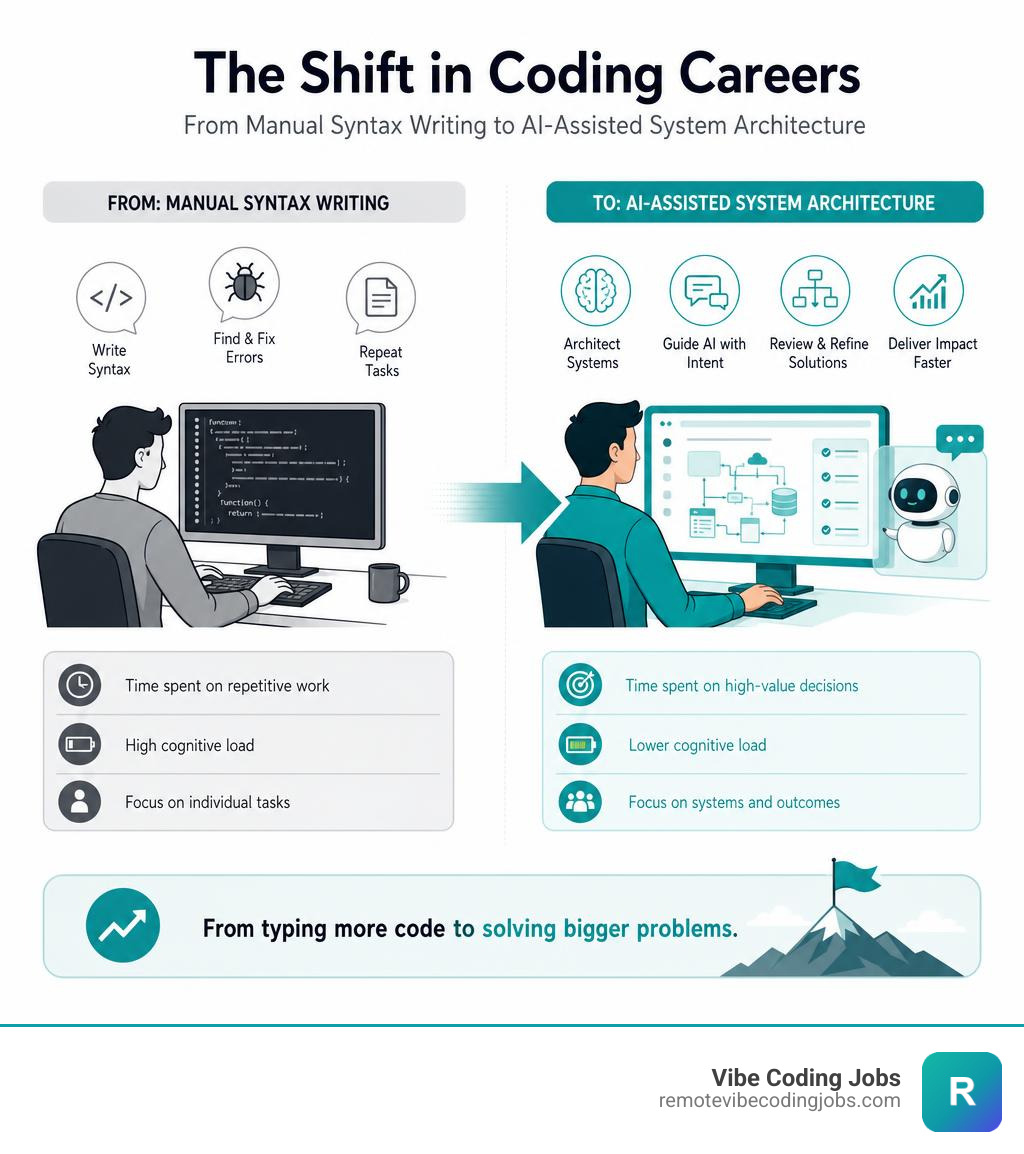
The software development landscape is undergoing a massive structural shift. Previously, a developer’s value was heavily tied to their syntax fluency—how quickly and accurately they could write boilerplate, handle memory management, or debug syntax errors. In 2026, those tasks have largely been automated.
This shift is changing the job market. The United States Bureau of Labor Statistics anticipates a drop in traditional programming jobs from 139,000 to 126,000 over the next decade due to AI automation of routine programming work. However, this is not a death knell for developers. In fact, more than 140,000 openings for software developers are expected over the next 10 years, alongside explosive growth in related fields. The demand for data scientists is projected to grow from 203,000 jobs to 276,000, while the expansion of cloud computing and AI will drive the need for computer network architects from 178,000 to 208,000 over the same period.
What we are seeing is not the elimination of coding, but the rise of ai tool coding careers where developers act as directors, orchestrating systems rather than manually typing out every line of code.
How Agentic Workflows are Redefining Developer Productivity
The evolution of AI in software development has moved from simple inline autocomplete to fully agentic workflows. Instead of suggesting the next line of code, modern agents can autonomously build, test, and debug multi-file features.

With agentic workflows, you can describe a desired outcome in natural language, and the agent will:
- Parse your codebase to understand existing patterns.
- Formulate a multi-step implementation plan.
- Write the necessary code across multiple services.
- Run your local test suite and analyze errors.
- Iterate on failures autonomously until the tests pass.
This level of parallel execution allows developers to run multiple refactoring sessions simultaneously. You can leave an agent running a complex library migration while you focus on system design or take a lunch break. By understanding how these workflows function, developers can unlock massive productivity gains, which is why mastering these tools is essential for securing modern Remote Developer Jobs and AI Tools.
Emerging Roles in AI Tool Coding Careers
As the industry adapts, new specialized roles are emerging that require a deep understanding of AI orchestration:
- AI-First Developer: A software engineer who designs systems specifically to be built and maintained by AI agents, leveraging tools like Cursor and Claude Code to maintain a 2-5x delivery speed.
- Product Engineer: A hybrid role bridging product management and software engineering. Since AI handles the heavy lifting of code generation, these professionals focus on user experience, rapid prototyping, and shipping MVPs in days rather than quarters. Check out the Top Careers That Use AI-Assisted Coding – Campus.edu to see how this role is taking off.
- Creative Technologist: Designers and creatives who use design-to-code AI tools (like Lovable, v0, and Bolt.new) to build interactive, production-ready frontends without waiting on engineering handoffs.
- AI Systems Architect: Engineers who design the infrastructure, context engines, and guardrails that allow AI agents to safely interact with massive enterprise codebases.
To understand where you fit in this new paradigm, exploring AI-Assisted Development Career Opportunities and Growth Trends can give you a clearer roadmap of where the industry is heading.
Handling Legacy Codebases vs Greenfield Projects
While building a new “greenfield” project from scratch with AI is incredibly fast, the real test of an AI coding agent lies in legacy, multi-service architectures.
Historically, AI tools struggled with large codebases because they lacked “context depth.” If an agent only looks at a single file, it cannot understand how a change in a pandas transformation might cascade and break downstream microservices or authentication pipelines.
In 2026, advanced tools use semantic dependency indexing to map how services interconnect. This allows agents to perform deep dependency tracing. For instance, if an engineer who left the company two years ago wrote a complex microservice, a modern agent can trace the codebase, analyze the system, and safely generate unit tests or perform migrations. Understanding how to guide AI through these complex legacy codebases is a crucial skill for long-term AI-Assisted Development Career Growth.
Top AI Coding Agents and Tools in 2026
Choosing the right tool for your workflow is essential. Different agents excel at different tasks, from rapid prototyping to deep codebase refactoring.
Comparing the Leading AI Coding Agents
Below is a comparison of the leading AI coding agents available in 2026:
| Tool | Core Strength | Pricing | Context Depth & Integration |
|---|---|---|---|
| Claude Code | Terminal-based agentic execution, multi-file refactoring, autonomous testing | Included in Claude Pro ($17/mo) or Max ($100/mo); API usage billing | Deep codebase indexing, operates seamlessly across local toolchains |
| Cursor | Best IDE integration, autonomous agents, predictive autocomplete | Free tier; Pro ($20/mo); Business tiers available | Whole-codebase understanding, highly accurate inline edits |
| OpenAI Codex | Multi-agent workflows, background automations, parallel cloud environment execution | Enterprise-focused pricing; credit systems | Excellent for standards-aligned team workflows and background tasks |
| Windsurf | Visual planning, multi-step agent execution, IDE-native Cascade assistant | Free tier; Premium subscription options | Strong contextual awareness, though planning features can require manual steps |
Using these tools in combination is often the best approach. For instance, you might use Cursor: The best coding agent for your daily visual IDE-based prototyping, and switch to Claude Code | Anthropic’s agentic coding system \ Anthropic when you need a terminal-based agent to run test suites and manage complex git operations autonomously. For larger enterprise environments, leveraging Codex | AI Coding Partner from OpenAI | OpenAI can help streamline team-wide background automations. Knowing which tool to deploy for specific scenarios is a hallmark of successful professionals utilizing AI Coding Tools for Vibe Coders.
Enterprise Integration, Security, and Privacy
For organizations deploying AI coding tools at scale, productivity cannot come at the expense of security. Enterprise teams must navigate several critical areas:
- Data Privacy and IP Protection: Many organizations require air-gapped or zero-data-retention models to ensure their proprietary code isn’t used to train public models. Tools like Tabnine and IBM watsonx Code Assistant cater specifically to these regulated environments.
- Compliance Standards: Enterprises frequently look for SOC 2 Type II, ISO 27001, and the newer ISO 42001 (Artificial Intelligence Management System) certifications when evaluating AI vendors.
- Vendor Lock-In: Relying entirely on platform-native tools (like AWS-specific or GCP-specific assistants) can create lock-in risks. Cross-platform tools offer more flexibility as your cloud infrastructure evolves.
Skills and Strategies for AI-Powered Developer Roles
To thrive in ai tool coding careers, you need to shift your mindset from “writing code” to “system orchestration.”
Essential Skills for AI Tool Coding Careers
If you want to command high salaries—ranging up to $250,000+ for senior AI-first developers—you need to build a modern technical skill set:
- System Design and Architecture: You must know how systems should be structured so you can guide the AI to build clean, maintainable, and scalable software.
- Prompt Engineering and Context Management: Learning how to feed the right context to an AI is critical. This includes using tools like
CLAUDE.mdfiles or configuring project-specific system instructions to guide the agent’s behavior. - API and Microservice Integration: Modern software is assembled via APIs. Knowing how to orchestrate connections between third-party services, databases, and frontend frameworks is essential.
To map out your career transition, you can leverage community tools like the ayush488-glitch/ai-career-planner-skill or use open-source frameworks like poferraz/career-ops to optimize your resume and track job applications. Preparing your skill set in this way is the most reliable path to navigating The Future of Remote AI Coding Jobs.
Managing Risks, Code Quality, and Human Oversight
While AI tools are incredibly powerful, relying on them blindly can lead to major issues. AI agents can occasionally generate unstructured “spaghetti code,” duplicate files, or introduce security vulnerabilities.

To maintain high code quality, human oversight is non-negotiable. Best practices include:
- Strict Code Reviews: Treat AI-generated code with the same (or more) skepticism as code written by a junior developer.
- Automated Testing: Always run comprehensive test suites before merging AI-generated pull requests.
- Anti-Slop Gates: Enforce strict quality standards. For example, the
career-opsframework uses an “anti-slop” gate to score outputs on directness, density, and authenticity before they are delivered.
Understanding how to balance rapid AI generation with rigorous quality assurance is what separates amateur “vibe coders” from professional software engineers. Learn more about this balance in our guide on What Are Vibe Coding Jobs? A Guide to the Future of Remote Work.
Frequently Asked Questions
Will AI coding tools replace software engineers?
No, but engineers who use AI will replace those who don’t. While routine syntax writing is being automated, the demand for human oversight, system architecture, security design, and creative problem-solving is higher than ever. The job market is simply shifting toward higher-level engineering tasks, which we discuss extensively in The Future of Remote AI Coding Jobs.
What is vibe coding and how do I get started?
Vibe coding is a modern approach to development where you use natural language prompts to describe what you want to build, and AI agents handle the manual implementation. To get started, choose a project, download Cursor or Claude Code, and practice translating your ideas into structured prompts. For a deep dive into this workflow, check out Vibe Coding Jobs and Remote AI Assistant Careers.
How do employers evaluate AI-fluent developers?
Employers are moving away from traditional LeetCode syntax tests. Instead, they evaluate candidates based on their system design thinking, their ability to orchestrate AI tools to solve complex problems quickly, and portfolios containing real, functional AI-assisted builds.
Conclusion
The rise of AI coding agents is not the end of software development—it is the beginning of a more productive, creative, and accessible era of engineering. Whether you are a seasoned developer looking to multiply your output or a creative professional wanting to build real software, there has never been a better time to pivot into ai tool coding careers.
At RemoteVibeCodingJobs, we curate daily remote listings specifically filtered for companies that embrace AI-assisted workflows. Ready to find your next role? Explore open positions on Vibe Coding Jobs and start building your future today.