
Finding the Best AI Developer Jobs in USA
The AI Programmer Job Market in 2026: What You Need to Know
AI programmer jobs are one of the fastest-growing categories in tech right now — and the numbers back it up.
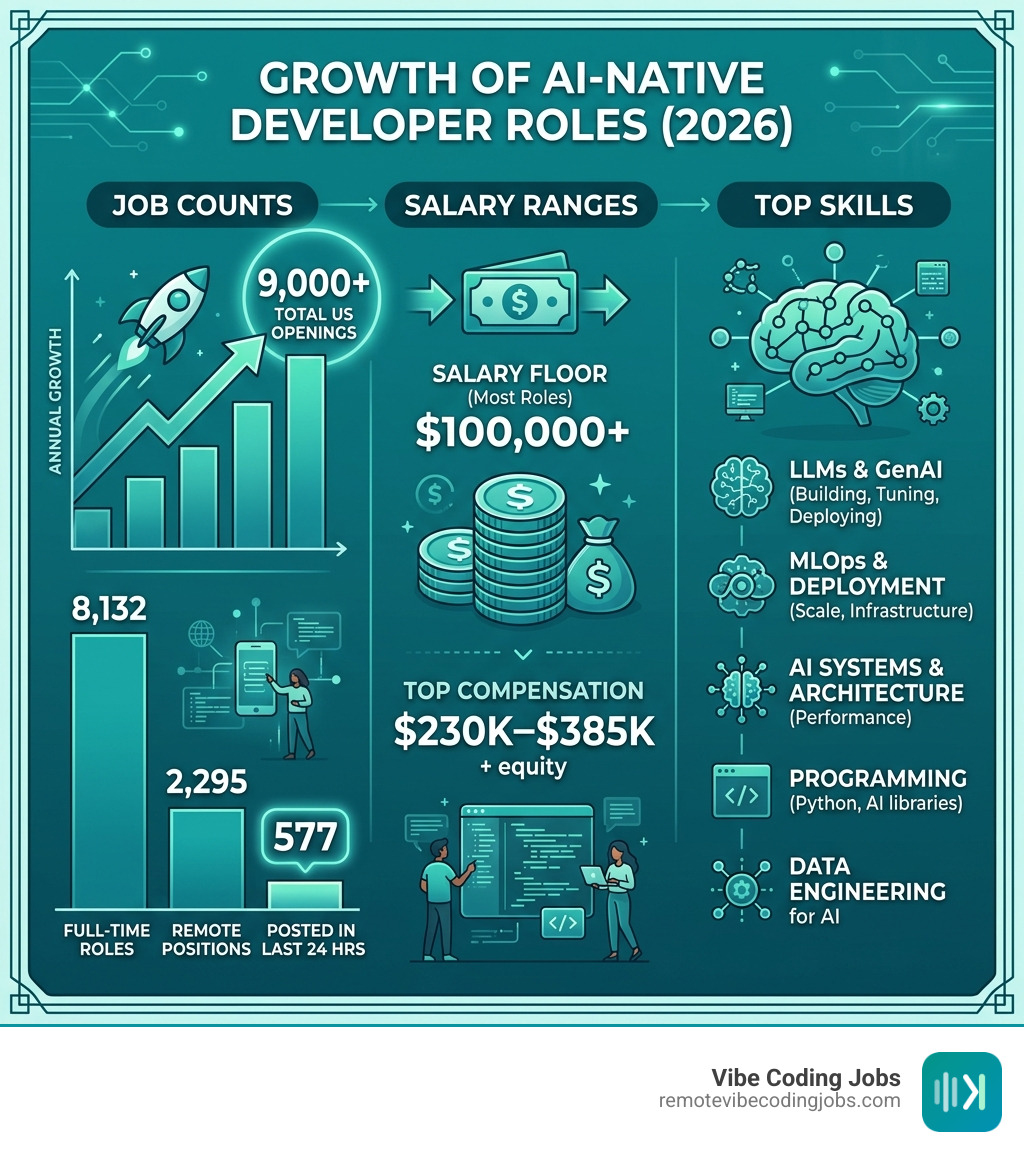
Here’s a quick snapshot of what the market looks like today:
| Category | Data |
|---|---|
| Total US openings | 9,000+ |
| Posted in the last 24 hours | 577 |
| Full-time roles | 8,132 |
| Remote positions | 2,295 |
| Top location | San Francisco, CA (556) |
| Salary floor (most roles) | $100,000+ |
| Top compensation (OpenAI) | $230K–$385K + equity |
The demand is real — but the market has also shifted in ways that matter. Since late 2022, companies have been hiring fewer junior engineers, expecting smaller teams to do more with AI tools. At the same time, roles focused on building, deploying, and improving AI systems have exploded at companies like OpenAI, Microsoft, and hundreds of startups.
If you know where to look — and what skills to bring — there are thousands of open roles waiting.
I’m part of the RVCJ Editorial team at Remote Vibe Coding Jobs, where we track AI programmer jobs and emerging developer roles across async-first companies globally. Our team covers everything from vibe coding trends to compensation benchmarks, so you can cut through the noise and find roles that actually fit your stack and working style.
The Current State of AI Programmer Jobs in 2026
As we move through May 2026, the landscape for ai programmer jobs is both exciting and highly competitive. Currently, there are over 9,000 active job openings in the United States alone. The velocity of the market is staggering; in just the last 24 hours, nearly 600 new positions were posted. This indicates that despite the broader tech industry’s fluctuations since the 2022 slump, AI-centric roles are the primary engine of growth.
The geographic distribution shows a heavy concentration in traditional tech hubs. San Francisco leads the pack with 556 roles, followed closely by New York City with 511. Other significant clusters exist in San Jose (388), Sunnyvale (204), and Boston (138). However, the rise of “async-first” culture has carved out a massive space for remote work, with over 2,200 Remote AI Engineer Jobs currently available.
We are seeing a clear split in the market. On one hand, traditional software engineering roles have faced a tougher recovery since late 2022. On the other hand, specialized AI Engineer Job Listings are surging. According to 1,000+ Ai Programmer jobs in United States – LinkedIn, the demand for professionals who can bridge the gap between Large Language Models (LLMs) and production-ready software is at an all-time high.
Top Companies and Compensation for AI Engineers
When we talk about the “big leagues” of AI, the compensation packages are often eye-watering. The industry has reached a point where an AI programmer’s value isn’t just measured by lines of code, but by their ability to orchestrate complex agentic systems and fine-tune models for enterprise-scale reliability.

Comparing AI Salaries: SF vs. NYC
Location still plays a role in base pay, though the gap is narrowing as remote-first companies standardize their tiers.
| City | Junior/Mid Range | Senior/Principal Range |
|---|---|---|
| San Francisco, CA | $158,400 – $190,000 | $258,000 – $400,000+ |
| New York, NY | $150,000 – $185,000 | $250,000 – $380,000+ |
| Remote (US-Based) | $120,000 – $160,000 | $200,000 – $320,000+ |
For a deeper dive into which organizations are leading the pack in terms of culture and pay, check out our report on the Best Companies Hiring AI Developers. Understanding these AI Coding Jobs Market Trends and Training requirements is essential for anyone looking to break into the six-figure bracket this year.
High-Paying AI Programmer Jobs at OpenAI and Microsoft
OpenAI and Microsoft remain the most aggressive recruiters in the field. At OpenAI, roles like the Applied AI Engineer, Codex Core Agent | OpenAI offer base salaries ranging from $230,000 to $385,000, plus significant equity. These engineers aren’t just using AI; they are building the “kernel” of Codex, making agents that can function autonomously in the real world.
Similarly, Microsoft AI is heavily invested in its Copilot ecosystem. They are currently seeking Senior Software Engineers to build personalization engines that adapt AI behavior based on user telemetry. These roles typically pay between $158,400 and $258,000 in major hubs. OpenAI is also expanding its reach with roles like Software Engineer, Codex for Teams | OpenAI, which focuses on making AI a “proactive teammate” for entire organizations.
The Rise of Vibe Coding and Agentic Engineering
Perhaps the most fascinating trend we’ve observed in 2026 is the emergence of “vibe coding.” While it sounds like a joke, it represents a serious shift in how software is built. Vibe coding refers to an AI-native development workflow where the programmer uses tools like Cursor, Claude Code, and Windsurf to manifest software through natural language descriptions and iterative “vibing” with the model.
This isn’t just about “coding for non-coders.” In fact, elite engineers are using these tools to ship products 3x to 10x faster than traditional methods. We are seeing a new class of Remote Vibe AI Coding Jobs appearing on specialized job boards. These roles often prioritize “logic and prompt skills” over manual syntax mastery.
Beyond just coding, we are seeing the rise of the Agentic Engineer. These professionals don’t just build apps; they build autonomous systems that can observe, reason, and act. Whether it’s a multi-agent system for real-time ad bidding at Microsoft or an AI software engineer that can delegate tasks proactively, the “vibe” is moving toward high-level architectural direction. You can explore these emerging paths in our guide to Vibe Coding Jobs and Remote AI Assistant Careers.
Essential Skills for the AI-Native Era
The job description for an ai programmer jobs candidate in 2026 looks very different than it did in 2022. While Python remains the “lingua franca” of AI, the focus has shifted toward LLM orchestration, vector databases, and “model-facing experimentation.”
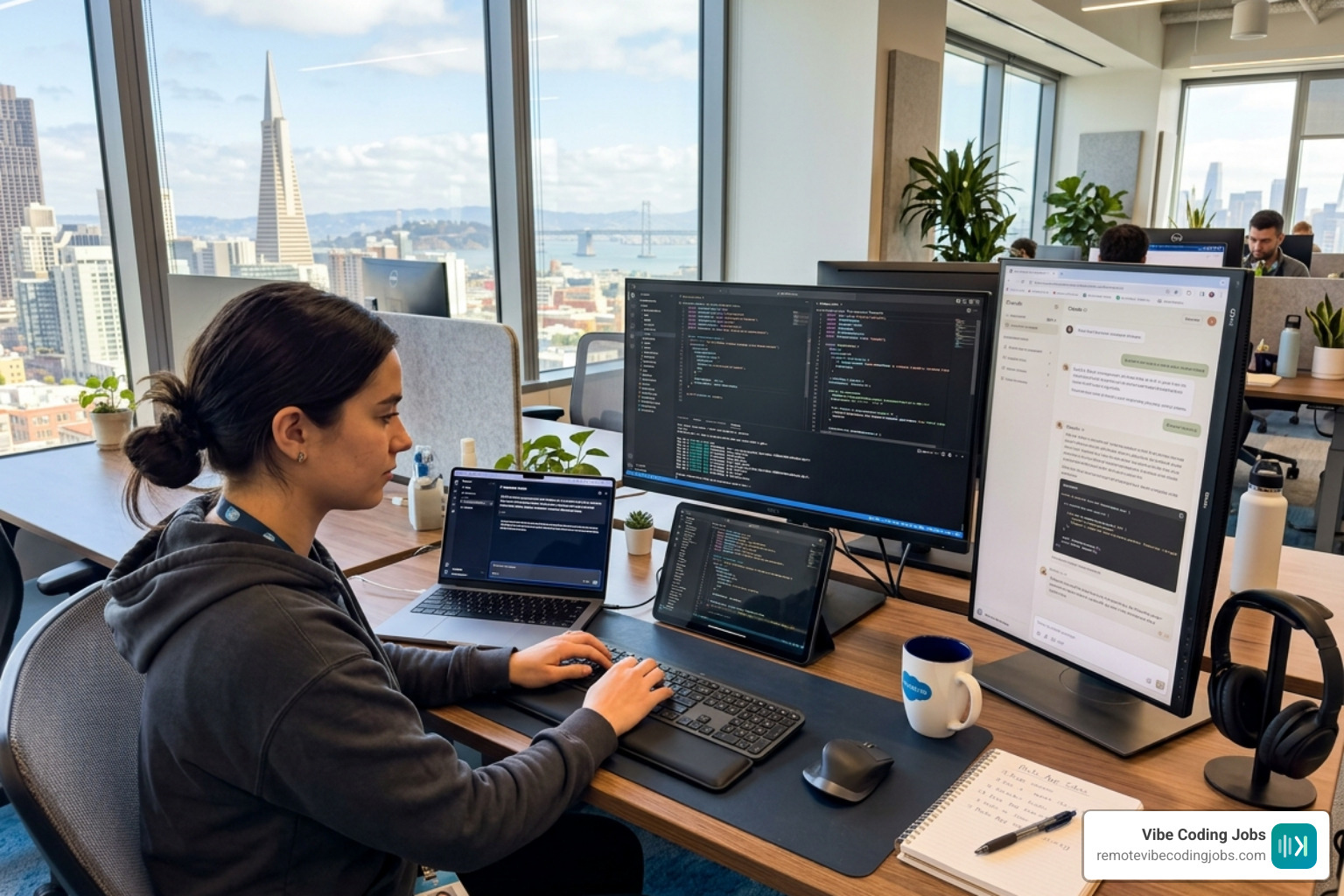
To stay competitive, we recommend mastering the following:
- AI Code Editors: Proficiency in Cursor, Windsurf, or GitHub Copilot is no longer optional; it’s a baseline requirement.
- Prompt Engineering & Iteration: The ability to guide an AI through complex debugging or architectural changes using structured natural language.
- Full-Stack Integration: Knowing how to connect LLMs to real-world APIs, identity systems (SSO/SAML), and secure data layers.
- Evaluation & Observability: Building “evals” to measure model performance and ensure AI agents don’t hallucinate in production.
For a comprehensive roadmap, our AI Assisted Development Career Guide breaks down the transition from a traditional dev to an AI-native builder. You can also monitor the latest requirements through our LLM Engineer Job Listings.
Preparing for Entry-Level AI Programmer Jobs
It is a “brutal time” to be a junior developer who only knows traditional syntax. Evidence suggests that demand for entry-level programmers diverged sharply after the release of ChatGPT, as startups now prefer hiring one AI-augmented “10x” engineer over a team of five juniors.
However, there is a massive “back door” for newcomers: becoming an AI-native builder. If you can show a portfolio of projects built at light-speed using AI tools, you are often more valuable to a modern startup than a CS grad who refuses to use Copilot. We’ve put together an Entry Level AI Coding Jobs Guide to help you navigate this. The key is to demonstrate that you can manage the “vibe” of a project from concept to deployment. Check out more on AI Coding Jobs: Entry Level Growth and Remote Opportunities to see how the junior market is reinventing itself.
Frequently Asked Questions about AI Careers
What is the average salary for an AI programmer in 2026?
While it varies by location, the majority of ai programmer jobs in the US now start at $120,000. Senior roles at top-tier firms like OpenAI or Microsoft frequently exceed $250,000 in base pay, with total compensation (including equity) often reaching $400,000 to $500,000.
Do I need a Computer Science degree for vibe coding jobs?
The industry is becoming more “skill-first.” While a CS degree is still highly valued at companies like Microsoft for core infrastructure roles, many “vibe coding” and “AI-native” startups prioritize a strong portfolio of AI-built products and your ability to direct LLMs effectively. Practical mastery of tools like Cursor and Claude often outweighs a formal degree in rapid-growth environments.
Are there remote opportunities for AI engineers?
Yes, absolutely. Out of the 9,000+ active ai programmer jobs, over 2,200 are explicitly listed as remote. Many AI startups are “async-first,” meaning they care more about your output and your ability to leverage AI tools than your physical presence in an office.
Conclusion
The era of the “code typist” is ending, but the era of the AI-native architect is just beginning. Whether you are aiming for a high-stakes role at OpenAI or looking to join the “vibe coding” revolution at a nimble startup, the opportunities in ai programmer jobs are more abundant—and more lucrative—than ever before.
At Remote Vibe Coding Jobs, we are dedicated to helping you find these roles. We aggregate the best remote, AI-assisted development jobs at companies that value speed, creativity, and the power of AI.
Ready to find your next role? Visit us at https://remotevibecodingjobs.com/ to browse our curated daily listings and join the future of software development.