
6 Essential Skills Every Remote AI Developer Needs in 2026
To become a hired remote AI developer, you must master production Python backend frameworks, scalable vector infrastructure, and agentic orchestration, while validating your technical execution through live-deployed portfolio projects and proactive asynchronous collaboration. Distributed engineering teams prioritize developers who can seamlessly bridge data pipelines with model inference, govern cost and latency constraints, and use AI-assisted tooling to accelerate delivery.
The market for remote engineering has matured rapidly. To stand out among thousands of applicants, you must navigate the baseline Remote AI Developer Jobs Requirements that forward-thinking engineering teams establish for distributed talent.
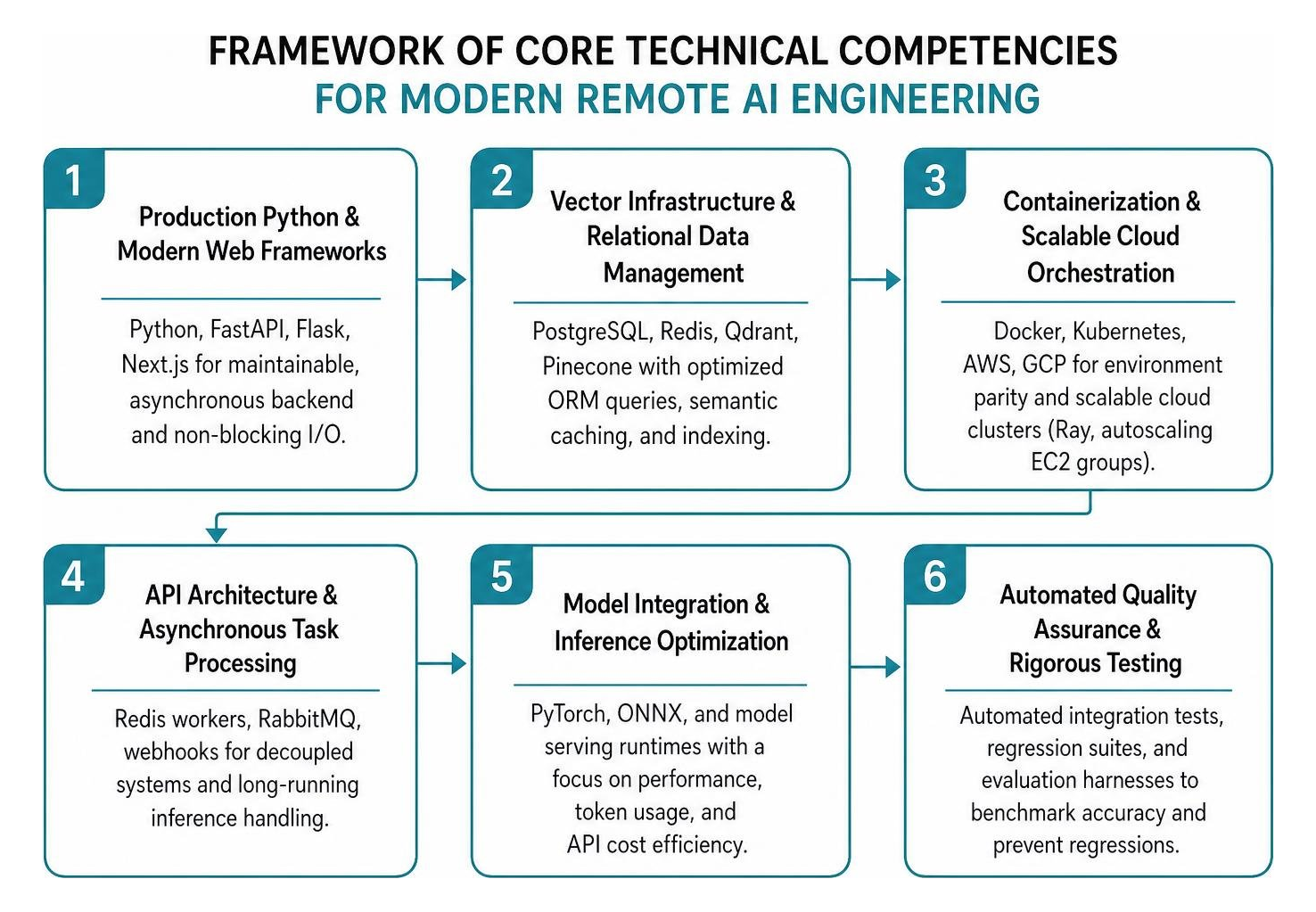
High-performing teams no longer separate raw algorithmic research from day-to-day product engineering. Instead, they expect engineers to bridge backend systems, data pipelines, and AI orchestrations seamlessly. Keeping an eye on the broader Remote Developer Skills in Demand 2026 Future Proof Your Career trends reveals six core competencies you need to succeed:
- Production Python & Modern Web Frameworks: Writing maintainable, asynchronous backend code using Python, FastAPI, Flask, and Next.js is non-negotiable. Real-world systems require managing concurrent model inference and non-blocking I/O.
- Vector Infrastructure & Relational Data Management: Designing high-throughput databases (PostgreSQL, Redis, Qdrant, Pinecone) with optimized ORM queries, semantic caching, and structured indexing to cut API latency by 40% or more.
- Containerization & Scalable Cloud Orchestration: Using Docker, Kubernetes, AWS, and GCP to ensure environment parity between local development and distributed cloud clusters (such as Ray or autoscaling EC2 groups).
- API Architecture & Asynchronous Task Processing: Building decoupled architectures using Redis workers, RabbitMQ, and webhook integrations to handle long-running model inferences without degrading user experience.
- Model Integration & Inference Optimization: Working with PyTorch, ONNX, and model serving runtimes, balancing performance, token consumption, and API expenses.
- Automated Quality Assurance & Rigorous Testing: Crafting automated integration tests, regression suites, and custom evaluation harnesses to benchmark accuracy, prevent regressions, and catch model hallucinations early.
Emerging AI Specializations: Agents, RAG Pipelines, and Vision
The AI developer ecosystem in 2026 is moving toward specialized, applied sub-disciplines:
- Agentic AI & Orchestration: Building multi-agent systems using frameworks like LangGraph and Model Context Protocol (MCP) servers. Engineers in this domain design autonomous workflows with tool-calling features, persistent memory, and human-in-the-loop decision boundaries.
- Advanced Retrieval-Augmented Generation (RAG): Going far beyond basic semantic search. High-value remote roles require building hybrid retrieval pipelines, multi-stage reranking, semantic chunking, and metadata filtering integrated with enterprise vector databases.
- Applied Computer Vision & Edge AI: Deploying custom image segmentation, object detection, and multimodal models across both cloud architectures and on-device environments (using TorchScript, ONNX, and JNI wrappers for mobile applications).
- Fine-Tuning & Small Language Models (SLMs): Curating Supervised Fine-Tuning (SFT) datasets, running Reinforcement Learning from Human Feedback (RLHF) evaluations, and quantizing open-weights models to run on cost-effective infrastructure.
The AI-Native Toolstack: Cursor, Claude Code, and Copilot
The emergence of AI-native workflows has changed engineering expectations. Senior developers at progressive companies are expected to use AI coding tools daily to accelerate prototyping, test generation, and refactoring.
Understanding tool capabilities is essential. In our breakdown of Claude Code vs Copilot for Developers in 2026 A Deep Dive, we highlight how context management separates top performers from average coders. Rather than relying on simple autocomplete, AI-native developers:
- Structure project-level context files (such as
ARCHITECTURE.mdandSKILL.md) so IDE agents understand domain constraints instantly. - Leverage Cursor and Claude Code for multi-file codebase refactoring, architectural auditing, and automated test scaffolding.
- Perform proactive human verification, code audits, and security vulnerability checks on all AI-generated suggestions before submitting pull requests.
4 Strategies to Build an AI Portfolio and Pass Remote Screenings
A collection of static forks or basic tutorial projects will not secure a top-tier remote position. Hiring managers looking for distributed talent want proof of end-to-end execution, system resilience, and product intuition. If you are learning How to Get a Vibe Coding Job The Complete Guide, your portfolio is your primary asset.
Follow these four strategies to build a high-impact portfolio:
- Ship Full-Stack, Live-Deployed MVPs: Build and host production-ready web applications that solve clear business pain points (such as an automated PDF compliance parser or a real-time semantic document assistant). Provide clickable URLs, not just code repositories.
- Highlight Measurable Engineering Metrics: Quantify the impact of your technical choices. Show how your architecture achieved 95%+ classification accuracy, reduced endpoint latency by 40% using Redis caching, or maintained zero downtime across production deployments.
- Document Architecture Trade-Offs Visually: Include clear system architecture diagrams and technical design documents in your public GitHub repositories, demonstrating why you selected specific vector databases, queue workers, or model providers.
- Emphasize Cost and Latency Governance: Document your strategies for handling rate limits, fallback providers, token budgeting, prompt compression, and sliding-window inferences.
How to Stand Out as a Remote AI Developer in Technical Screenings
Remote screening processes have evolved away from pure whiteboard algorithm puzzles toward holistic technical evaluations:
- Detailed Video Walkthroughs: Record 3-to-5-minute high-level Loom walkthroughs explaining the architecture, system constraints, and code organization of your featured portfolio projects.
- Take-Home Architecture Reviews: Treat take-home assignments as live production proposals. Include comprehensive unit tests, clear documentation, Docker setup scripts, and a short retrospective on potential scalability bottlenecks.
- Public Pull Request Histories: Maintain an active, visible GitHub footprint featuring clean commit histories, well-structured pull requests, and contributions to open-source agent tooling or ML libraries.
Mastering Async Collaboration in Distributed AI Engineering
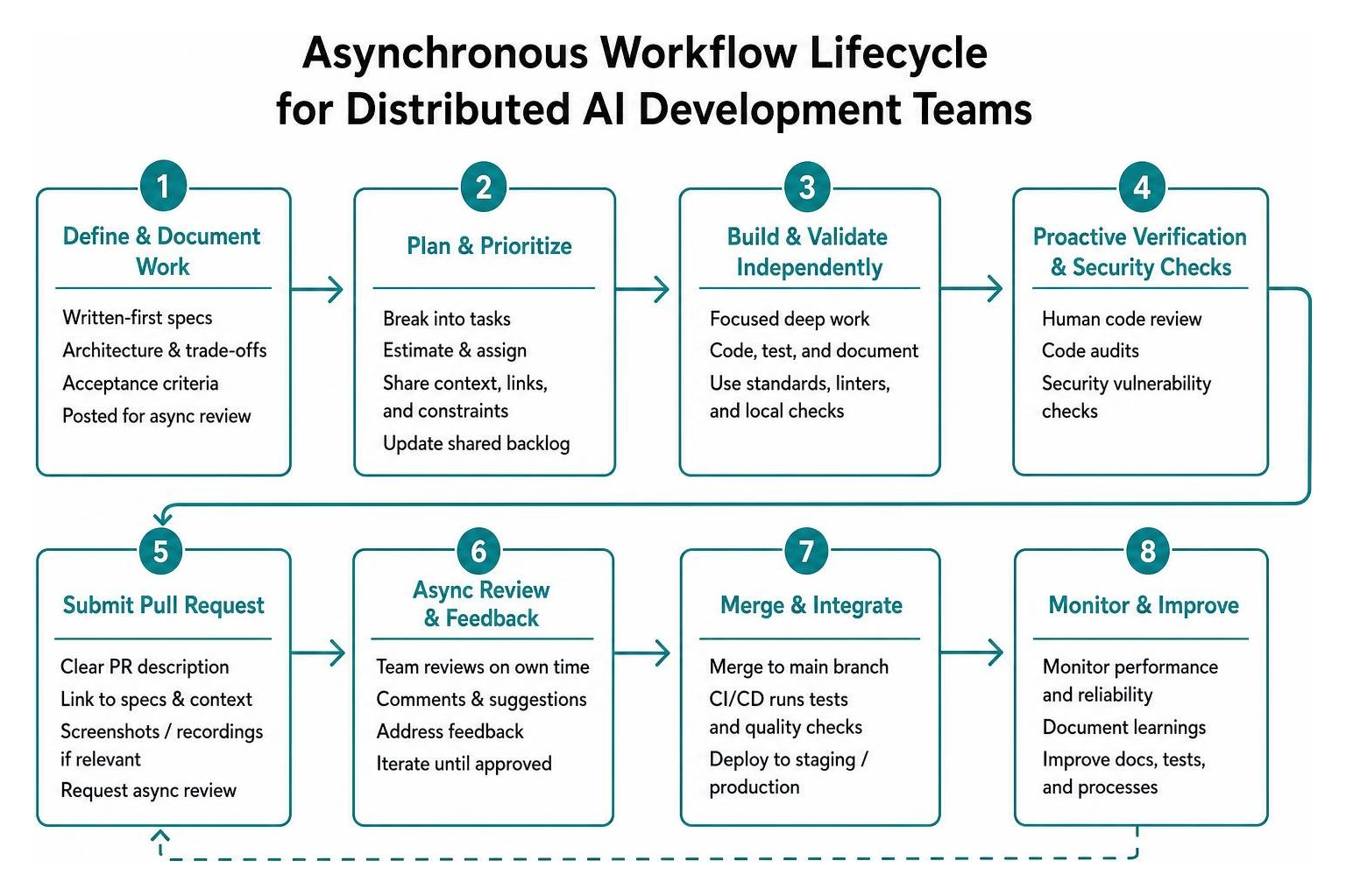
Technical talent alone does not guarantee success in a fully remote environment. Distributed engineering teams rely heavily on autonomous execution and clear, asynchronous communication. Adopting the principles behind Async First Remote Developer Jobs Culture Workflow Communication will set you apart during hiring evaluations:
- Written-First Documentation: Write detailed technical specs, incident post-mortems, and pull request summaries that minimize back-and-forth messaging.
- Structured Timezone Overlap: Maintain 4 to 5 hours of reliable daily overlap with your core team’s working hours (whether US Eastern, GMT, or CET) while working autonomously during uninterrupted deep-work windows.
- Frictionless Global Compliance: Ensure you understand international contractor structures (using platforms like Deel) and can execute standard non-disclosure agreements (NDAs) and IP protection protocols seamlessly.
Compensation Benchmarks and Global Market Insights for 2026
Compensation for AI engineers reflects both specialized technical skills and geographical location. Venture-backed startups and scaling enterprises offer strong base salaries often paired with meaningful startup equity.
Reviewing Vibe Coding Salary Remote Roles Data Insights illustrates how compensation scales across experience levels and global talent hubs:
| Role Seniority | Primary Location Benchmark | Typical Base Salary Range (USD) | Standard Equity Package | Primary Tech Focus |
|---|---|---|---|---|
| Junior / Entry-Level AI Developer | US Remote / Global Hubs | $60,000 – $100,000 | 0.05% – 0.25% | Prompt chaining, UI/UX prototyping, basic API integrations, Next.js |
| Mid-Level Applied AI Engineer | US / European Remote | $120,000 – $175,000 | 0.20% – 0.75% | Production FastAPI backends, vector search, RAG pipelines, Docker |
| Senior AI / Backend Architect | US Remote (Tier 1/2) | $180,000 – $260,000+ | 0.50% – 1.50% | Agentic workflows, distributed Ray clusters, MLOps, inference optimization |
| Founding AI Engineer | Early-Stage Seed / Series A | $140,000 – $220,000 | 1.00% – 4.00% | End-to-end product architecture, rapid iteration, foundational infra |
| International AI Specialist (APAC / LatAm) | Global Remote / B2B | $45,000 – $95,000 | Discretionary / Bonus | Data extraction pipelines, computer vision, full-stack web platforms |
Salary Benchmarks for a Remote AI Developer Across Regions
In the United States, senior remote roles at growth-stage companies typically offer base salaries ranging from $150,000 to $250,000+, with staff-level and founding engineer packages reaching up to $300,000+.
Globally, compensation models vary based on contract type and regional cost benchmarks. Experienced senior developers based in Latin America, Eastern Europe, or the APAC region frequently command competitive hourly contractor rates from $25/hr to $65+/hr (translating to $50,000–$130,000+ annually). These arrangements give international engineers high purchasing power locally while providing global organizations with round-the-clock development coverage.
Frequently Asked Questions About Remote AI Engineering
What is the difference between a traditional software engineer and an AI developer?
While traditional software engineers focus on deterministic business logic, database schemas, and microservice communication, modern AI developers design systems around non-deterministic model outputs. This requires mastering vector search, semantic chunking, prompt orchestration, token context limits, and building automated evaluation loops to catch hallucinations.
How do companies evaluate remote AI engineers without LeetCode?
Modern remote teams evaluate candidates through practical take-home projects, live architecture reviews, and AI code verification sessions. Interviewers want to see how you orchestrate external APIs, design asynchronous queue workers, structure data models, and use modern AI IDEs like Cursor or Claude Code to ship bug-free code quickly.
Which programming languages are most valuable for AI development in 2026?
Python remains the primary language for AI backend services, data modeling, PyTorch workflows, and agentic orchestration. TypeScript (paired with React and Next.js) is equally essential for building user interfaces and responsive web applications, while SQL, Go, and Rust are increasingly used for high-performance data processing and low-latency infrastructure.
Conclusion

The demand for talented developers who understand how to build, deploy, and scale AI-native software continues to accelerate. By mastering modern backend foundations, building deep specialization in RAG and agentic workflows, and proving your ability to collaborate asynchronously, you position yourself at the front of the global remote hiring market.
Explore active Cursor AI developer roles to find forward-thinking companies hiring engineers ready to build the future of software.