
Everything You Need to Know About Remote Vibe Coding Jobs
What is Vibe Coding and How Does it Differ from Traditional Development?
Vibe coding represents a fundamental shift in how we approach software development. At its core, vibe coding is an AI-assisted development methodology where developers leverage sophisticated AI tools to accelerate the entire software creation process. Instead of meticulously writing every line of code from scratch, vibe coders use natural language prompts to guide AI assistants in generating, refactoring, and optimizing code. This transforms the developer’s role from a syntax typist to a high-level architect, focusing on designing solutions, structuring systems, and ensuring overall quality.
This modern approach is often referred to as agentic engineering, signifying a more mature practice beyond basic AI code completion. It’s about orchestrating AI agents to perform complex tasks, allowing human developers to concentrate on the “what” and “why” of a project rather than the “how” of its implementation. For a deeper dive into this concept, you can explore What is Vibe Coding and understand why Is Vibe Coding a Real Job is no longer a question but a statement of fact in May 2026.
The distinction from traditional software development is clear:
- Traditional Coding: Primarily involves manual, line-by-line code writing, where developers are responsible for syntax, boilerplate, and intricate implementation details. The focus is often on mastering specific programming languages and frameworks.
- Vibe Coding: Shifts the emphasis to prompt engineering and architectural thinking. Developers describe the desired “vibe” or outcome, and AI tools translate that into functional code. This allows for rapid prototyping, quicker iterations, and a focus on the larger system design. We’re not replacing developers; we’re evolving the role to be more strategic and impactful.
The Core Philosophy of Vibe Coding
The underlying philosophy of vibe coding prioritizes output and high-level logic over the minutiae of syntax and boilerplate code. It operates on the principle that it’s not humans versus AI, but rather humans with AI versus humans without AI. Our experience shows that the more you understand traditional coding fundamentals, the better equipped you are to be an effective vibe coder. Deep technical expertise allows you to craft superior prompts, critically evaluate AI-generated code, and architect robust solutions.
Companies embracing vibe coding often report significant gains, with AI tools enabling 10x productivity increases and faster time-to-market. This efficiency allows teams to build more ambitious projects and deliver value at an unprecedented pace.
What AI Tools and Skills Do Vibe Coders Use Today?
The landscape of AI coding tools is rapidly evolving, and vibe coders are at the forefront of adopting these innovations to enhance their workflow. In May 2026, a suite of powerful tools forms the core toolkit for any aspiring or experienced vibe coder.
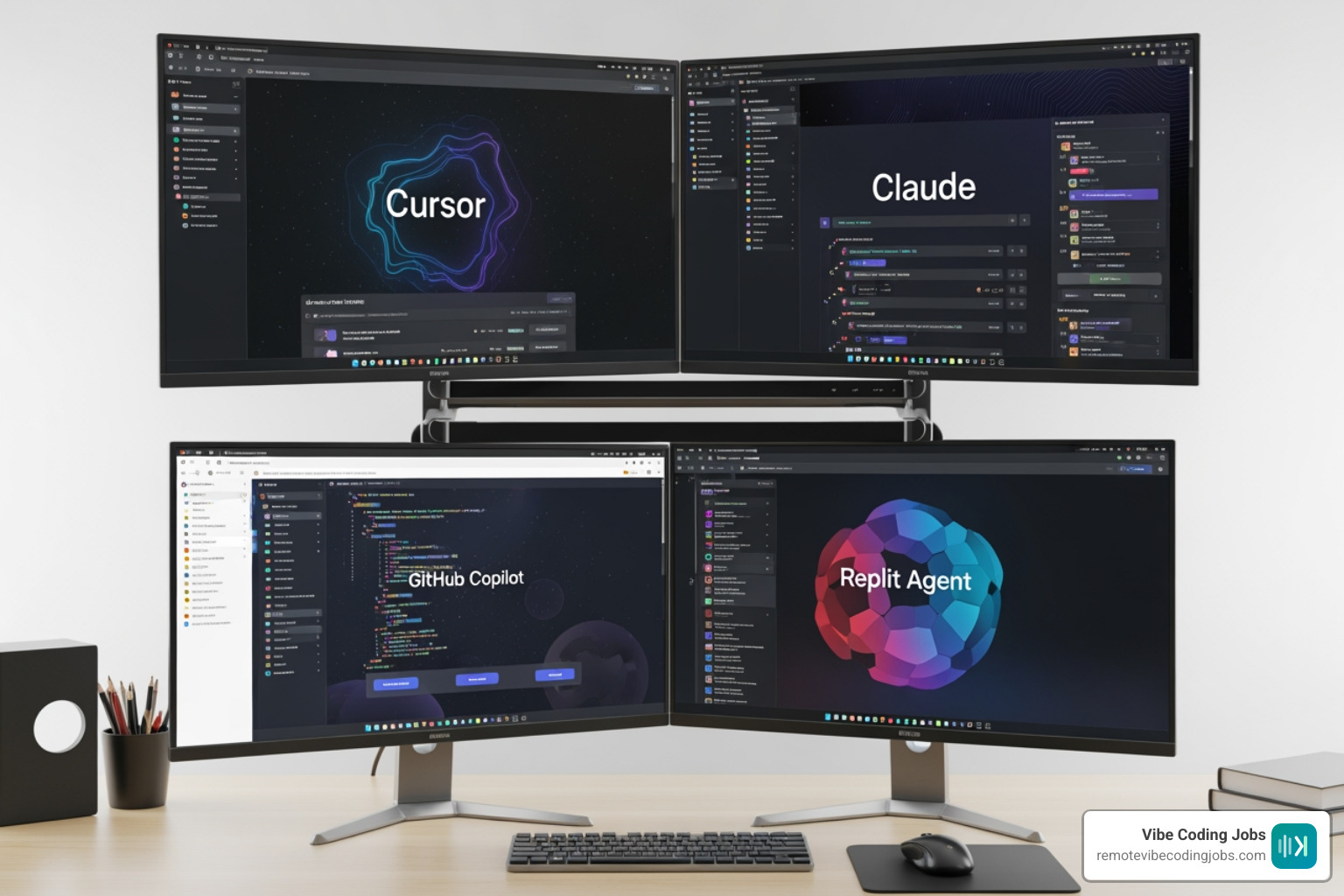
Some of the most popular AI tools and platforms used by vibe coders today include:
- Cursor: An AI-powered code editor offering context-aware suggestions, code generation, and refactoring capabilities directly within the development environment.
- Claude Code: Often used as a terminal agent, it assists with complex coding tasks, debugging, and understanding large codebases through natural language interaction.
- GitHub Copilot: A widely adopted AI pair programmer that provides real-time code suggestions and completions, significantly speeding up development.
- Windsurf: A collaborative AI development environment designed for teams to build and iterate together with AI assistance.
- Bolt.new: A prompt-to-app platform enabling rapid prototyping and application generation from natural language descriptions.
- Lovable: A visual app builder that leverages AI to transform design ideas into functional code.
- v0: A generative UI tool that creates React components from text prompts, accelerating frontend development.
- Replit Agent: An AI agent integrated into the Replit environment, facilitating coding, debugging, and project management.
- Lazy AI: An automated workflow builder that helps streamline repetitive tasks and integrate various AI services.
The proficiency with these tools is paramount, but equally important is the skill of prompt engineering. This involves crafting precise and effective natural language instructions to elicit the best possible code and solutions from AI models. Furthermore, a strong foundation in essential programming languages remains crucial. We typically see a focus on TypeScript/JavaScript for web development, especially with modern frameworks like React, Next.js, and Node.js, alongside Python for AI/ML integration and backend services. The ability to think in terms of system design and architecture becomes even more valuable, as AI handles the implementation details, freeing developers to focus on the overall structure and scalability. For more insights into these essential tools, explore our articles on AI Coding Tools for Vibe Coding and Remote Developer Jobs AI Tools.
Key Skills for Success in Vibe Coding
Beyond tool proficiency, successful vibe coders cultivate a specific set of skills:
- Prompt Engineering and Clear Communication with AI: The ability to articulate complex requirements in natural language that AI models can understand and act upon is fundamental. This includes iterative prompting and understanding how to guide the AI effectively.
- Full-Stack Development Capabilities: While AI assists, a comprehensive understanding of both frontend and backend development is crucial. This includes familiarity with databases like PostgreSQL and Supabase, enabling vibe coders to build complete, end-to-end solutions.
- Understanding of Large Language Models (LLMs) and Their Integration: Knowing how LLMs work, their capabilities, and how to integrate them into applications is a significant advantage.
- Product Mindset: Vibe coders are often expected to own product features from concept to shipped code. This involves thinking beyond just coding, understanding user needs, and making product-centric decisions.
- Curiosity, Rapid Learning, and Experimentation: The AI landscape changes daily. A successful vibe coder is inherently curious, eager to learn new tools and techniques, and comfortable experimenting to find the most efficient solutions.
Here’s a list of the top AI coding tools in 2026 that we frequently see mentioned in remote vibe coding roles:
- Cursor
- Claude Code
- GitHub Copilot
- Windsurf
- Bolt.new
- Lovable
- v0
- Replit Agent
- Lazy AI
What Salary Can Remote Vibe Coders Expect and Which Companies Are Hiring?
The demand for skilled remote vibe coders is booming, leading to competitive and attractive salary ranges across various experience levels. As of May 2026, we observe the following compensation trends:
- Internships: Typically range from $40-$50 per hour.
- Entry-Level (1-2 years experience): Vibe coders with foundational experience can expect to earn between $70,000-$100,000 annually.
- Mid-Level (with AI proficiency): Developers who have integrated AI tools into their workflow effectively command salaries from $90,000-$150,000.
- Senior (AI-first developers, product engineers): Highly experienced professionals leveraging AI for strategic product development can earn anywhere from $150,000 to over $400,000 annually, especially at leading tech companies.
- Freelance Vibe Coders: These independent professionals typically charge between $75-$300 per hour, depending on their expertise and the complexity of the project.
For more detailed information on compensation, refer to our insights on Vibe Coding Salary Remote Work Location Growth.
The range of companies actively hiring for remote vibe coding roles is broad, spanning from innovative startups to established Fortune 500 enterprises. We see companies like Adaptify SEO, Moonvalley AI, Genesis Computing, Agencyhires, and Zencoder leading the charge in seeking AI-fluent developers. These organizations recognize the transformative power of AI-assisted development and are eager to integrate it into their core engineering practices. You can often find specific opportunities, such as the Vibe Coder – Adaptify SEO Careers role, which highlights the blend of AI, SEO, and full-stack development.
Understanding Vibe Coder Compensation
Several factors influence a vibe coder’s salary. Experience level is paramount, but so are the specific AI tools you’ve mastered, the size and funding of the hiring company, and even your ability to demonstrate the “10x productivity gains” that AI tools enable. Companies are willing to pay a premium for developers who can significantly accelerate their product development cycles and deliver high-quality solutions faster.
Companies Embracing AI-First Development
Many of the companies at the forefront of vibe coding prioritize an async-first, no-BS culture. This means they value deep work, minimal mandatory meetings, and empower their employees with significant autonomy. These environments are ideal for vibe coders who thrive on focused, uninterrupted work and direct impact.
Common role titles we see emerging in this space include:
- AI-First Developer
- Product Engineer
- Full Stack AI Developer
- Creative Technologist
- AI Systems Architect
- Agentic Engineer
To discover more about companies with great remote cultures, check out Best Companies Hiring AI Developers Remote Culture Ratings.
Vibe Coder Salary Ranges by Experience Level
To provide a clearer picture, here’s a consolidated look at the salary ranges we observe for remote vibe coders in May 2026:
| Experience Level | Annual Salary Range (USD) | Hourly Rate (Freelance) |
|---|---|---|
| Intern | N/A | $40 – $50 |
| Entry-Level | $70,000 – $100,000 | N/A |
| Mid-Level | $90,000 – $150,000 | N/A |
| Senior | $150,000 – $400,000+ | N/A |
| Freelance | N/A | $75 – $300 |
How Can Developers Transition to Vibe Coding and What Do Interviews Involve?
Transitioning into vibe coding is an achievable goal for developers at all stages of their careers. For experienced developers, the shift can be relatively quick, often taking just a few weeks to adapt to new tools and integrate AI into existing workflows. Beginners with a foundational understanding of coding might take a bit longer, typically 3-6 months, to become proficient in AI-assisted development.
Here are actionable steps we recommend for a successful transition:
- Learn Prompt Engineering: This is arguably the most critical skill. Dedicate time to understanding how to craft effective prompts, iterate on them, and guide AI models to generate desired outcomes.
- Build Portfolio Projects Demonstrating AI-Assisted Development: Don’t just show the final code; showcase your process. Highlight how you used AI tools to rapidly prototype, solve problems, and achieve results faster.
- Master Key AI Tools: Become highly proficient with tools like Cursor, Claude Code, and GitHub Copilot. Experiment with different combinations to find what works best for your workflow.
- Focus on System Design and Architecture: As AI handles more of the low-level coding, your ability to design scalable, robust, and well-architected systems becomes even more valuable.
- Embrace Continuous Learning: The AI landscape is dynamic. Stay updated with the latest tools, models, and best practices.
Building Your Vibe Coding Portfolio
Your portfolio is your most powerful asset when applying for vibe coding roles. It should tell a story of how you leverage AI to build efficiently and effectively. We encourage you to:
- Showcase Projects Built with AI Tools: Include examples where AI assisted in code generation, refactoring, or even brainstorming.
- Demonstrate Ability to Turn Ideas into Working Prototypes Quickly: Highlight projects where you went from a rough concept to a functional prototype in hours or days, emphasizing the speed AI enables.
- Highlight Prompt Engineering Skills and Problem-Solving: Explain the prompts you used, the challenges you faced, and how you iterated with the AI to arrive at a solution.

Navigating the Vibe Coding Interview Process
Vibe coding interviews often differ significantly from traditional technical interviews. You’ll likely encounter less emphasis on rote memorization or LeetCode-style algorithms and more on practical application, problem-solving with AI tools, and demonstrating a strong product sense.
Prepare for “agentic interviews” by:
- Focusing on Real-World Problem-Solving: Be ready to tackle open-ended problems and demonstrate how you would use AI tools to approach them.
- Discussing Your Workflow with AI Tools: Interviewers will want to understand your process, how you integrate AI, and how you ensure the quality and security of AI-generated code.
- Emphasizing Rapid Prototyping and Architectural Thinking: Showcase your ability to quickly build functional components and think about the scalability and design of the overall system.
- Consider Loom Video Submissions: Some companies appreciate Loom videos where you walk through a project or answer questions, as they can significantly increase your callback rates by showcasing your communication and technical skills simultaneously.
Companies that prioritize an async-first culture often have unique interview processes. Learn more about this in Async First Remote Developer Jobs Culture Tools Salary.
What Are the Pros and Cons of Remote Vibe Coding and Where Can You Find Positions?
Working as a remote vibe coder offers a unique blend of advantages and challenges. Understanding both sides is crucial for a fulfilling career in this evolving field.
Advantages of the Remote Vibe Coder Lifestyle
- Increased Productivity: Developers often report being 2-5x faster, thanks to AI handling repetitive tasks, allowing for rapid iteration and delivery.
- Focus on High-Level Architecture and Creative Problem-Solving: AI frees you from boilerplate, enabling you to dedicate more mental energy to complex design challenges and innovative solutions.
- Flexibility of Remote Work and Async-First Culture: Many vibe coding roles are fully remote, offering location independence and the ability to work asynchronously, fitting into various lifestyles and time zones.
- High Demand and Competitive Salaries: The need for AI-fluent developers is exploding, leading to excellent compensation packages.
- Lower Barrier to Entry: While coding fundamentals are important, less emphasis is often placed on traditional computer science degrees, with practical skills and a strong portfolio being highly valued.
- Global-Friendly: Remote roles open up opportunities regardless of your geographical location, fostering diverse teams.
- Deep Work Focus, Minimal Meetings: Async-first cultures are designed to protect engineers’ focus time, leading to more productive work.
- Ownership and Autonomy Over Projects: Vibe coders are often empowered to take full ownership of features, from concept to deployment.
Challenges and Considerations
- Potential Over-Reliance on AI Leading to Skill Degradation: Without careful practice, there’s a risk of developers losing touch with core coding fundamentals.
- Need for Continuous Learning: The AI tool landscape changes rapidly, requiring constant effort to stay updated and proficient.
- Bias in AI-Generated Code: AI models can inherit biases from their training data, necessitating vigilant review and ethical considerations from the developer.
- Emphasis on Speed Can Lead to Less Robust Solutions: The drive for rapid delivery must be balanced with ensuring code quality, security, and maintainability.
- Occasional Late Nights/Weekends in Startup Environments: While many roles are async, the nature of startups, especially those building cutting-edge AI, can sometimes demand extra effort.
- Maintaining Code Quality and Security with AI Assistance: Developers must implement rigorous testing and review processes to ensure AI-generated code meets high standards.
- The “Anti-Scrum” Mindset Might Not Suit Everyone: Some developers prefer structured processes and ceremonies, which are often eschewed in agile, AI-first environments.
- Need for Strong Self-Direction and Communication Skills: Working remotely with AI tools requires excellent self-management and clear, concise communication, especially in async teams.
Where to Find Remote Vibe Coding Positions
Finding the right remote vibe coding job requires knowing where to look. While general remote job boards can be a starting point, we highly recommend focusing on platforms and resources specifically tailored to AI-assisted development roles.
- Specialized Niche Platforms: These platforms curate roles that explicitly mention AI tools like Cursor, Claude, and GitHub Copilot, and often filter by company culture (e.g., async-first).
- Company Career Pages: Many innovative startups and tech companies directly post their AI-first developer roles on their own websites. Keep an eye on companies that are vocal about their AI adoption.
- Our Platform, RemoteVibeCodingJobs.com: We pride ourselves on offering curated daily listings filtered by culture, tech stack, and the specific AI tools used. We also provide a free playbook and facilitate fast applications to streamline your job search.
For those interested in specific tech stacks, our guide on Remote Next.js Developer Jobs Your Ultimate 2024 Guide can also be a valuable resource, as Next.js is a popular framework in AI-assisted web development.
What Does the Future Hold for Vibe Coding Careers?
The trajectory for vibe coding careers in May 2026 is one of continuous growth and evolution. We view vibe coding not as a temporary trend but as the definitive future of software development. As AI capabilities advance, so too will the methodologies and roles within the development ecosystem.
We anticipate a continued evolution of AI tools and agentic engineering, moving beyond simple code generation to more sophisticated multi-agent orchestration. This means AI systems will increasingly be able to coordinate complex workflows, with AI creating AI to solve intricate problems. This shift will further increase the demand for AI-native product builders – individuals who can conceptualize, design, and implement solutions where AI is a core component from the outset.
New and specialized roles are already emerging and will become more prevalent:
- AI Systems Architect: Designing the overarching structure and interaction of AI agents and human developers.
- AI Product Prototyper: Rapidly bringing AI-driven product concepts to life with minimal overhead.
- AI Automation Builder: Focusing on leveraging AI to automate business processes and workflows.
The Evolution of AI-Assisted Development
The journey of AI-assisted development is progressing rapidly. We’re moving from basic code completion and generation to complex agentic workflows where AI can manage entire development cycles for specific tasks. This evolution means AI will handle an even greater share of repetitive, predictable tasks, truly freeing developers to focus on innovation, strategic thinking, and tackling problems that require uniquely human creativity and judgment.
Long-Term Career Progression
For vibe coders, long-term career progression will involve opportunities in leadership, architecture, and specialized AI domains. The ability to understand and direct AI will be a highly valued skill. Continuous learning will not just be an advantage but a core requirement, as the tools, models, and best practices will continue to evolve at a breakneck pace. Those who embrace this dynamic environment will find themselves at the forefront of technological innovation.
Frequently Asked Questions about Remote Vibe Coding Jobs
Q1: Do I need a CS degree to become a Vibe Coder?
A: Not necessarily. While a computer science degree can provide a strong theoretical foundation, many vibe coding positions value practical skills, a robust portfolio showcasing AI-assisted projects, and strong prompt engineering abilities more than formal education. Your ability to build and innovate with AI tools often outweighs traditional academic credentials.
Q2: How quickly can I become proficient in Vibe Coding?
A: The timeline varies based on your existing experience. For experienced developers, adapting to vibe coding tools and workflows can happen in a matter of weeks. If you’re a beginner with basic coding knowledge, we typically see individuals become proficient within 3-6 months of dedicated learning and practice.
Q3: Is Vibe Coding a real job, or just a buzzword?
A: Vibe coding is definitely a real and rapidly growing field. It represents the future of software development, with companies actively hiring for these roles across various industries. The demand for AI-powered developers is exploding, and these positions offer competitive salaries and significant career opportunities.
Conclusion
Remote vibe coding jobs are not just a passing trend but the undeniable frontier of software development in May 2026. This transformative shift empowers developers to elevate their focus to high-level architecture, strategic problem-solving, and creative innovation, all while leveraging powerful AI tools to achieve unprecedented productivity. With competitive salaries, the flexibility of remote work, and a continuous, escalating demand for skilled professionals, the future for vibe coders is exceptionally bright. We encourage you to embrace these cutting-edge tools, hone your prompt engineering skills, and prepare for a career that prioritizes impact, efficiency, and continuous innovation.