
Why Is Speed Crucial When Applying for Async Remote Tech Jobs?
In the fast-evolving landscape of 2026, the shift toward asynchronous work cultures has reached a tipping point. Top-tier developers are no longer willing to chain themselves to a rigid 9-to-5 schedule or endure endless, unproductive meetings. Instead, we are seeing a massive migration toward async-first companies—organizations that prioritize documentation, deep work, and autonomy over real-time presence.
However, because these roles are highly coveted, the competition is fierce. In this environment, application speed is not just a convenience; it is a critical competitive advantage.
Traditional hiring pipelines are fundamentally incompatible with async-first companies. Standard corporate hiring often relies on meeting-heavy processes: multiple rounds of synchronous HR screenings, real-time whiteboard tests, and scheduling back-and-forths that stretch across weeks or even months. For a company operating across multiple time zones, this synchronous overhead is a massive bottleneck.
To bypass this friction, modern remote-first companies have rebuilt their hiring pipelines from the ground up. By utilizing streamlined digital hiring processes, async-first employers report a 40% shorter time-to-hire compared to traditional synchronous interview processes. Furthermore, remote job applications on optimized platforms receive responses 30% to 50% faster than traditional in-office applications.
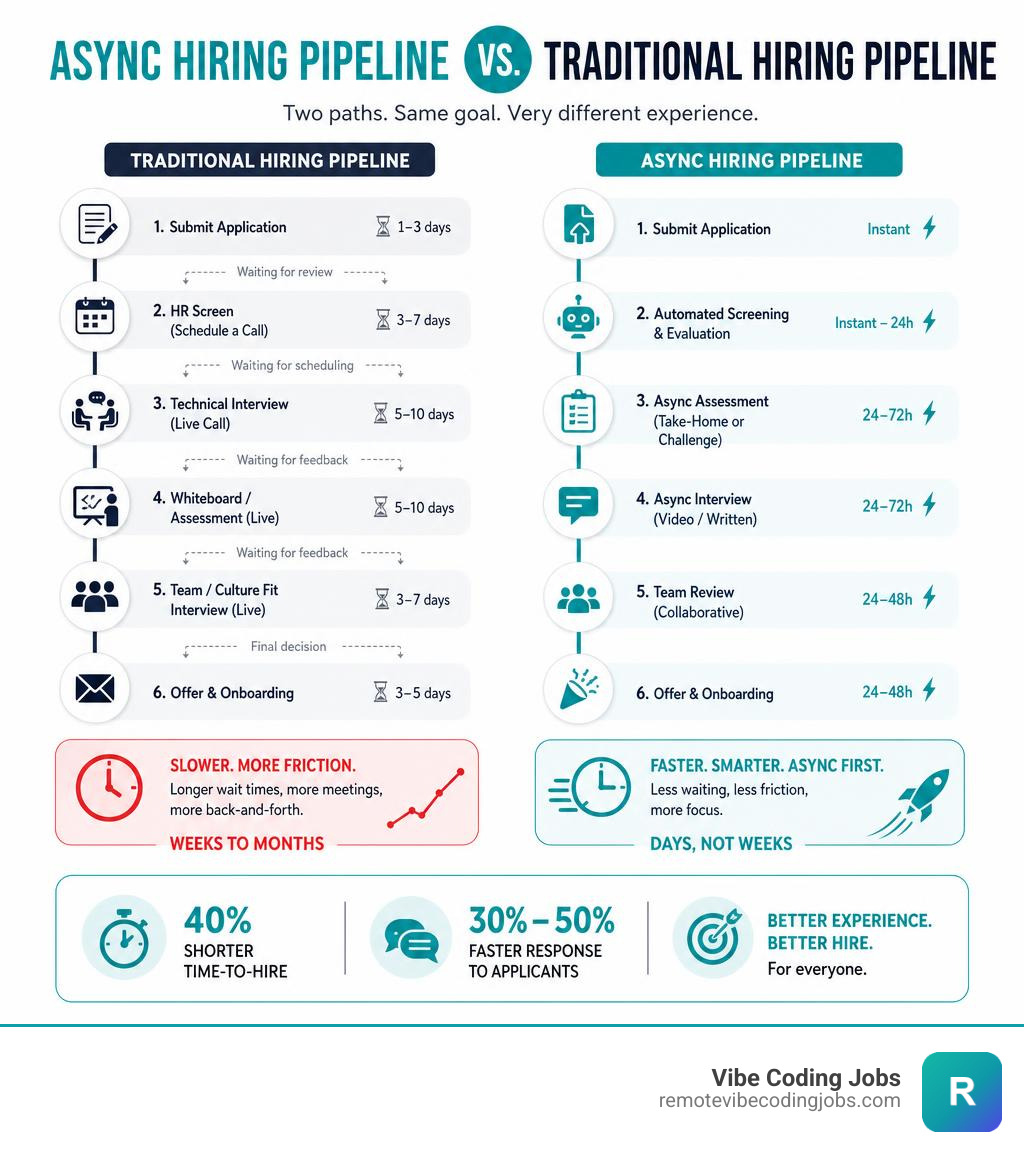
When you apply early to a fast-moving startup, you position yourself at the front of a highly automated queue. Many of these companies use automated screening tools that evaluate candidates as they submit. If you delay your application by even a few days, the hiring team may have already filled their interview slots or initiated a paid trial project with an early applicant.
By leveraging platforms built for speed, you ensure your profile lands in front of decision-makers before application fatigue sets in on the hiring side.
Which Platforms Offer the Fastest Application Process for Remote Tech Jobs at Async Companies?
To accelerate your job search, you must target platforms specifically engineered to eliminate application friction. Traditional job boards require you to upload a resume, manually re-enter your entire work history into clunky applicant tracking systems (ATS), and write repetitive cover letters. Modern, async-optimized platforms eliminate these hurdles through features like one-click apply, direct developer-to-team matching, and pre-vetted profile databases.
By using specialized networks, you bypass the traditional resume screening layer entirely. Instead of your application sitting in a generic HR inbox, your verified technical portfolio is presented directly to engineering managers who understand your stack.
If you are looking to compare the top options on the market, our Remote Job Boards Comparison provides a detailed breakdown of how different platforms stack up. For those targeting roles that specifically embrace asynchronous communication, exploring curated lists of Async Remote Developer Jobs is the fastest way to find employers who value output over hours logged.
To understand the broader ecosystem of remote work platforms, you can also consult resources like the Best Platforms to Get Remote Tech Jobs in 2026 – Fueler .
At Remote Vibe Coding Jobs, we have built the premier destination specifically for AI-assisted developers (or “vibe coders”) who want to find fast-track async roles. We aggregate daily listings that are highly filtered by culture, tech stack, and compatibility with modern AI tools like Cursor and Claude, ensuring you do not waste time on roles that do not fit your workflow.
The Power of Curated Async Job Feeds
Curated developer platforms do not just display job listings; they actively match candidates with employers, often cutting the time-to-interview down to under 72 hours. Because these platforms pre-vet both the talent and the employers, the initial trust barrier is already broken.
Another massive accelerant is the integration of automated compliance and payroll. When a company hires globally, legal compliance, contract handling, and cross-border payments can delay onboarding by weeks. Platforms that handle these administrative hurdles automatically allow startups to hire and onboard international developers almost instantly, giving global candidates an equal footing.
Direct-to-Team Matching
The traditional HR gatekeeper is often the biggest bottleneck in tech hiring. Non-technical recruiters may filter out highly qualified developers simply because a resume lacks a specific keyword.
Direct-to-team matching platforms solve this by delivering your technical portfolio directly to engineering leads. When hiring managers can immediately view your public repositories, proof-of-work, or “vibe coding” projects, they can make instant technical evaluations.
Additionally, platforms that mandate transparent salary ranges and timezone disclosures prevent the back-and-forth negotiations that typically slow down traditional hiring pipelines.
How Do AI-Powered Tools and Automation Accelerate Your Job Search?
In 2026, manual job hunting is rapidly becoming obsolete. The integration of AI-powered tools and browser extensions has transformed how developers find and apply for roles. By automating the repetitive aspects of the application process, you can scale your outreach without sacrificing the quality of your submissions.
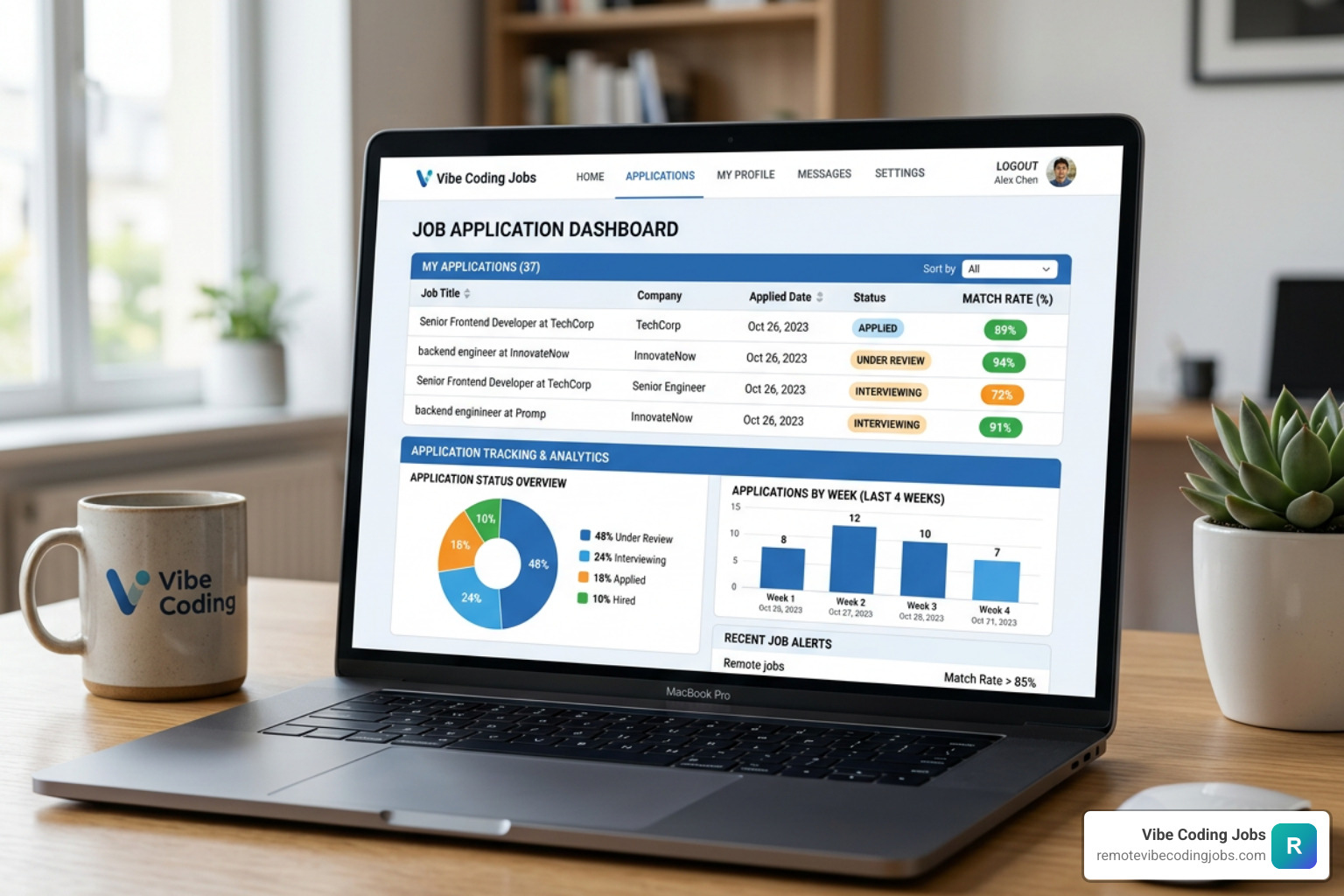
AI auto-apply extensions and resume-tailoring bots allow you to apply to dozens of relevant roles in a fraction of the time. These tools work by scanning job descriptions, identifying core technical requirements, and automatically adapting your resume and cover letter to match those specific keywords. This ensures your application passes through automated ATS filters with high compatibility scores, all while reducing your average application time to under two minutes.
However, the key to success in 2026 is balancing automated speed with personalized outreach. Simply spamming hundreds of generic applications will lead to high rejection rates. Instead, the most effective strategy is to use AI to handle the heavy lifting of tailoring and formatting, while you maintain human oversight to inject genuine personality and project context.
If you want to master this balance, check out our comprehensive guide on How to Get a Remote Developer Job.
At Remote Vibe Coding Jobs, we optimize this process by curating listings specifically for developers who utilize AI tools like Cursor and Claude in their daily development. Because the employers on our platform actively seek “vibe coders” who know how to build rapidly with AI assistance, your familiarity with these tools becomes your primary selling point, dramatically accelerating the hiring conversation.
AI Resume Tailoring vs. Generic Spamming
There is a massive difference between mass-spamming job boards and using hyper-personalized AI tools. When you use an AI tool to tailor your resume, it analyzes the specific nuances of an async-first job description—such as a preference for strong written communication, self-management, and documentation-driven workflows.
By automatically highlighting your experience with tools like Notion, Slack, and Git-based project management, the AI positions you as an ideal async candidate. This targeted approach is why hyper-personalized AI applications yield up to a 3x higher response rate compared to generic submissions.
Co-Pilot Modes in Job Hunting
Many modern job search tools feature a “Co-Pilot” mode. Instead of fully automating the submission, the AI drafts highly personalized cover letters, tailored resumes, and direct outreach messages for LinkedIn or email, then presents them to you for review.
This allows you to make quick, manual adjustments—such as adding a link to a specific repository or mentioning a shared connection—before hitting submit. This hybrid approach combines the blistering speed of AI automation with the high-converting touch of personal networking.
What Are the Trade-offs Between Speed and Quality in Async Job Applications?
While speed is incredibly valuable, a pure high-volume, low-quality application strategy carries significant risks. Relying solely on automated bots to blast your resume to hundreds of open boards can lead to severe application fatigue, recruiter blacklists, and a high volume of rejection emails that can damage your morale.
Furthermore, massive, uncurated job boards are often filled with “ghost jobs” (listings that are no longer active but left up to build a resume database) or companies that use “async” as a trendy buzzword without actually practicing it.
To help you navigate these choices, we have compiled a comparison of the two primary application strategies:
| Feature / Metric | Curated Job Boards (e.g., Remote Vibe Coding Jobs) | Automated Mass-Apply Platforms |
|---|---|---|
| Application Speed | Moderate (requires quick profile setup or tailored submission) | Extremely Fast (one-click or fully automated bot submissions) |
| Response Rates | High (often 20% to 40% due to pre-vetted matching) | Low (typically under 5% due to high volume and generic templates) |
| Culture Alignment | Verified (employers are vetted for true async workflows) | Unverified (high risk of meeting-heavy “fake async” cultures) |
| Job Quality | High (filtered for modern tech stacks and competitive pay) | Mixed (includes outdated tech stacks, low pay, and ghost listings) |
| Risk of Ghosting | Low (platforms often enforce feedback loops or quick response times) | High (applications frequently disappear into deep ATS black holes) |
To avoid falling into the trap of “fake async” companies, it is vital to research how target organizations actually operate. Reading public company handbooks, reviewing employee blogs, and checking platforms like Glassdoor can reveal whether a company truly supports distributed, asynchronous work.
For a deeper look into identifying genuine async employers, read our guide on Async-First Remote Developer Jobs: Roles, Teams, and Companies. You can also review real-world examples of highly successful distributed teams in Zapier’s list of 50+ fully remote companies that let you work from anywhere – Zapier .
The Risk of Application Fatigue
Applying to 10 highly targeted, deeply researched async roles is infinitely more effective than submitting 100 automated applications to generic listings. When you focus on quality, you can spot red flags in job descriptions that automated bots miss.
For example, if a job description claims to be “fully remote and async-first” but simultaneously lists “must be online and available for daily standups from 9 AM to 5 PM EST,” you are looking at a synchronous company in disguise. Applying to these roles only leads to frustration and alignment issues down the road.
Vetted Platforms vs. Open Job Boards
Vetted platforms protect your time by ensuring that every listed role is legitimate, active, and aligned with modern remote standards. Many curated boards require employers to meet specific criteria—such as a minimum Glassdoor rating, transparent salary disclosures, or verified remote-first infrastructure—before they can post. This drastically reduces the likelihood of being ghosted and ensures that your application efforts are spent on companies that actually value your skills and respect your time.
How Can You Optimize Your Profile for Instant Async Matching?
If you want recruiters on fast-track platforms to reach out to you directly, you must optimize your profile for instant matching. In an asynchronous environment, hiring managers cannot rely on real-time conversations to gauge your capability. Instead, they look for signals of high-agency behavior, exceptional written communication, and a strong “proof-of-work” portfolio.
To stand out, your profile must immediately demonstrate that you can thrive without constant supervision. This means highlighting your self-management skills, your ability to document processes clearly, and your experience collaborating across diverse time zones.
For practical tips on positioning your profile for global employers, see our guide on how to Land Your Dream Job: Global-Friendly Remote Developer Jobs.
Essential Skills to Highlight on an Async Developer Resume:
- Proactive Documentation: Experience writing clean, comprehensive technical specifications, READMEs, and post-mortems.
- Asynchronous Tooling: Mastery of tools like Notion, Linear, Slack, Loom, and Git-based project workflows.
- Vibe Coding & AI Orchestration: Demonstrated ability to build rapidly using AI assistants like Cursor, Claude, and GitHub Copilot.
- Time Zone Autonomy: Proven track record of managing your own schedule, unblocking yourself, and delivering results without real-time oversight.
- Clear Written Communication: The ability to explain complex technical concepts simply and concisely in writing.
Documenting Your Work Publicly
In 2026, a polished resume is secondary to a verified public footprint. Async-first companies love candidates who document their work publicly.
By maintaining active GitHub repositories with well-structured README files, writing technical blog posts, or sharing video walkthroughs of your projects using tools like Loom, you provide immediate, undeniable proof of your technical capability. This allows hiring managers to skip basic technical screenings and move you straight to the final stages of the hiring process.
Preparing for Paid Trial Projects
True async-first companies (such as Automattic, GitLab, and Buffer) rarely use synchronous, high-pressure whiteboard interviews. Instead, they evaluate candidates through paid trial projects or short-term contract tasks.
These trials are designed to mimic actual working conditions: you are given a real-world task, access to the necessary documentation, and a set deadline to complete it asynchronously. To excel in these trials, focus heavily on your communication. Document your progress, explain your architectural decisions clearly in your pull requests, and ask thoughtful, asynchronous questions when necessary.
Frequently Asked Questions About Async Hiring Platforms?
How do I know if a company is truly async-first?
A truly async-first company will have a documented public handbook (like GitLab or Buffer) detailing their communication policies. In their job descriptions, look for phrases like “results-oriented,” “flexible hours,” “written communication preferred,” or “no daily standups.”
If a company emphasizes documentation over meetings and does not require you to overlap significant hours with a specific time zone, they are likely operating with a genuine async culture.
Do async companies require real-time coding interviews?
Generally, no. True async-first organizations replace stressful, real-time whiteboard coding sessions with paid, take-home trial projects or asynchronous code reviews.
They want to see how you solve problems, write code, and document your decisions in a natural, real-world setting rather than testing your ability to memorize algorithms under live pressure.
How fast can I expect a response from an async job application?
While traditional corporate hiring can take several weeks or months, async-first startups using modern hiring platforms move incredibly fast. You can typically expect a status update or initial response within 7 days.
On highly curated matching networks, candidates are often matched with active hiring managers and scheduled for interviews in as little as 72 hours.
How Can Vibe Coding Jobs Help You Land Your Next Async Role?

Securing a high-paying remote tech job at an async-first company in 2026 requires a blend of speed, smart automation, and precise targeting. By focusing your efforts on specialized platforms, leveraging AI co-pilots responsibly, and optimizing your profile for asynchronous trust, you can bypass traditional hiring bottlenecks entirely.
At Remote Vibe Coding Jobs, we make this process seamless. We are the only platform dedicated entirely to aggregating daily-curated remote listings specifically filtered for “vibe coders”—developers who utilize AI tools like Cursor and Claude to build software at lightning speed. We partner with forward-thinking, async-first companies that actively seek developers who know how to maximize their productivity with AI-assisted workflows.
By joining our network, you gain access to:
- Daily-updated, highly curated listings filtered by culture, tech stack, and AI tool compatibility.
- A streamlined application process that connects you directly with modern engineering teams.
- Our free playbook designed to help you optimize your profile, ace paid trial projects, and stand out to top remote employers.
Stop wasting time scrolling through outdated, meeting-heavy job boards. Explore Async-First Remote Developer Jobs and Benefits on Remote Vibe Coding Jobs today, and find a role that truly fits your lifestyle and development workflow.